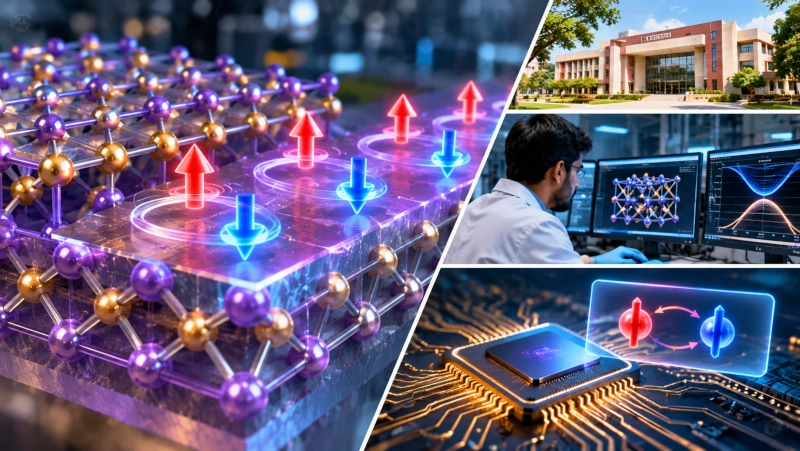
Researchers at the Indian Institute of Technology (IIT) Bhubaneswar have identified a promising semiconductor surface that could contribute to the development of next-generation electronic devices using electron spin for information processing and storage. The research provides new insights into the behaviour of electrons in quantum materials and offers potential pathways towards more energy-efficient computing technologies.
The study, led by Dr Manish Kumar Mohanta, Ramanujan Faculty in the Department of Physics at IIT Bhubaneswar, identifies the (110) surface of cubic zinc-blende silver iodide (AgI) as a promising platform for a quantum phenomenon known as Persistent Spin Texture (PST). The findings were published on 20 October 2026 in Physical Review B, an international peer-reviewed journal of the American Physical Society, and were reported on 10 November.
Using first-principles quantum mechanical calculations and mathematical modelling, the researcher investigated how the arrangement of electron spins within certain semiconductor structures could enable spin information to remain stable for longer periods. The findings contribute to the emerging field of spintronics, which seeks to exploit the intrinsic spin of electrons alongside their electrical charge.
Understanding Spintronics and Its Significance
Conventional electronic devices primarily process and store information by controlling the movement and distribution of electrical charge. Transistors, memory devices and processors operate through complex arrangements of semiconductor components that regulate electrical signals.
Spintronics introduces an additional dimension by utilising electron spin, an intrinsic quantum mechanical property associated with the electron’s magnetic behaviour. By manipulating spin states, researchers are investigating new approaches to information storage, signal processing and electronic device design.
One of the principal challenges in developing spintronic devices is maintaining the orientation of electron spins over sufficiently long periods. Interactions within materials can cause spins to lose their initial orientation through a process known as spin relaxation, limiting the stability of spin-based information.
Materials capable of suppressing unwanted spin relaxation are therefore of considerable scientific interest. Such materials could potentially enable future devices to preserve spin information more effectively while reducing some of the limitations associated with conventional charge-based electronics.
Discovery of Persistent Spin Texture in Silver Iodide
The IIT Bhubaneswar research focuses on Persistent Spin Texture, a quantum phenomenon in which electron spins exhibit a stable, unidirectional orientation across particular regions of a material’s electronic structure.
Persistent Spin Texture is significant because specific arrangements of electron spins can suppress certain spin-relaxation mechanisms. This property makes materials exhibiting PST promising candidates for investigating long-lived spin states and future spin-based technologies.
Dr Mohanta’s calculations identified the (110) surface of silver iodide, particularly in a few-layer configuration, as a potential host for this phenomenon.
Silver iodide is a compound containing silver and iodine. In its cubic zinc-blende crystal structure, the arrangement of atoms produces electronic properties that can be examined for their suitability in advanced semiconductor applications.
The research demonstrates theoretically that the structural symmetry and spin-orbit interactions of the AgI (110) system can support a persistent spin texture.
This finding expands the range of semiconductor materials that researchers can investigate for spintronic applications, particularly among low-dimensional halide compounds.
Stability Under Mechanical Strain
An important finding concerns the predicted stability of the electron spin arrangement when the silver iodide structure experiences mechanical strain.
In practical electronic systems, semiconductor materials can experience strain arising from fabrication processes, interactions with supporting substrates or changes in their physical environment. Understanding whether desired electronic properties remain stable under such conditions is an important consideration in materials research.
The IIT Bhubaneswar study indicates that the predicted persistent spin texture can remain robust under moderate mechanical strain.
This suggests that the spin arrangement may not be easily disrupted by certain structural changes, making the material an interesting candidate for further investigation.
However, the finding is based on theoretical calculations and computational modelling. Experimental studies would be required to establish how the predicted properties behave in fabricated material samples and under operating conditions.
Electrical Control of Electron Spin
The study also investigates how external electric fields influence the predicted spin arrangement.
The researcher found that applying an electric field perpendicular to the silver iodide surface can destabilise the persistent spin texture by changing the symmetry conditions that support it.
Although this disrupts the original spin configuration, it also reveals a potentially useful property: the spin texture can respond to externally applied electrical signals.
Such responsiveness is important for spintronics because future devices would need methods for manipulating spin states in a controlled and reproducible manner.
Electrical control offers a possible route towards integrating spin-dependent functions with semiconductor technologies.
The findings therefore provide a theoretical foundation for examining how spin configurations might be modified through external electric fields.
Further research will be necessary to determine whether this behaviour can be translated into reliable device architectures.
New Mathematical Models for Quantum Materials
Beyond the findings involving silver iodide, the research introduces two mathematical models designed to explain unusual electron spin arrangements in quantum materials.
The models incorporate different forms of spin-orbit coupling, a quantum mechanical interaction connecting an electron’s spin with its motion through the electronic environment of a material.
The study examines how these interactions can produce persistent spin textures under particular conditions and explains the emergence of partial persistent spin textures when those conditions are modified.
The models are also used to investigate spin behaviour in OsSi, a bulk crystal that has attracted scientific attention because of its unusual electronic properties.
By comparing theoretical predictions with first-principles calculations across different materials, the research develops a broader framework for understanding persistent spin textures in both two-dimensional and three-dimensional systems.
This contribution is important because identifying suitable spintronic materials requires more than examining individual compounds. Researchers also need theoretical tools capable of predicting which crystal structures and electronic interactions are likely to produce desirable spin characteristics.
The models developed in the study could therefore support future investigations into other semiconductors and quantum materials.
Potential Applications in Future Electronics
Spintronics is an expanding area of research with potential applications in non-volatile memory, information processing and advanced semiconductor devices.
Conventional computing systems face continuing challenges associated with power consumption, heat generation and the physical limitations of miniaturisation. Researchers are investigating alternative approaches that could complement established semiconductor technologies.
Materials capable of supporting long-lived electron spin states could contribute to the development of devices that preserve or manipulate information through spin-dependent mechanisms.
The IIT Bhubaneswar findings are relevant to these efforts because they identify a semiconductor structure with theoretically favourable spin characteristics and examine how those characteristics respond to mechanical and electrical influences.
However, the research does not demonstrate a functioning spintronic memory device or establish measured improvements in computing speed, power efficiency or information-retention time.
Its contribution lies in identifying promising material properties and developing the theoretical understanding needed for subsequent experimental investigations.
Strengthening India’s Advanced Semiconductor Research
The research highlights the growing importance of computational materials science in India’s broader semiconductor and quantum technology ecosystem.
Advanced electronics depend not only on semiconductor manufacturing capabilities but also on fundamental research into materials, electronic structures and the physical mechanisms governing their behaviour.
First-principles quantum mechanical simulations enable researchers to investigate these properties at the atomic and electronic levels before undertaking complex experimental fabrication.
Such methods can help identify promising materials, understand their limitations and guide future laboratory studies.
Dr Mohanta’s work adds to IIT Bhubaneswar’s research contributions in condensed-matter physics, computational materials science and low-dimensional electronic systems.
The findings also demonstrate the role of fundamental scientific research in exploring technologies that may eventually contribute to more capable and energy-efficient electronic systems.
As India expands its semiconductor and quantum technology capabilities, continued research into advanced materials will remain important for developing scientific expertise and identifying future technological opportunities.
Conclusion
The identification of persistent spin texture in the AgI (110) semiconductor system represents a promising development in theoretical spintronics research.
By demonstrating the possibility of stable, unidirectional electron spin arrangements and examining their response to mechanical strain and external electric fields, the IIT Bhubaneswar study provides valuable insights into the physical properties required for future spin-based electronic technologies.
The introduction of additional mathematical models further expands the research contribution by offering new approaches to understanding spin behaviour across different classes of quantum materials.
Although practical applications will require experimental verification and subsequent device development, the findings provide a scientific foundation for investigating semiconductor systems capable of supporting long-lived spin states.
The research underscores the importance of fundamental materials science in advancing future electronics, where understanding and controlling the quantum properties of electrons could open new possibilities for information processing and storage.
Research Reference
Research paper: Constraints on Persistent Spin Texture in Quantum Materials
Researcher: Manish Kumar Mohanta
Institution: Department of Physics, Indian Institute of Technology Bhubaneswar, Odisha, India
Journal: Physical Review B, Volume 114, Article 225415
Publication date: 20 October 2026
DOI: 10.1103/6dcb-r2xb
Publisher: American Physical Society
You may also like
-
DRDO Awards Blockchain Security Development Project to Indian Startup Zupple Labs
-
Data Patterns Completes Indigenous Su-30MKI Self-Protection Jammer Design, Prepares for Flight Trials
-
DRDO Invites Indian Industry to Develop AI-Powered Acoustic Drone Detection System
-
India Records Highest-Ever 15.62 Crore E-Way Bills in October 2026, Registering 23.14% Annual Growth
-
India’s Worker Population Ratio Rises to 52.7% as Latest Labour Survey Shows Employment Gains
