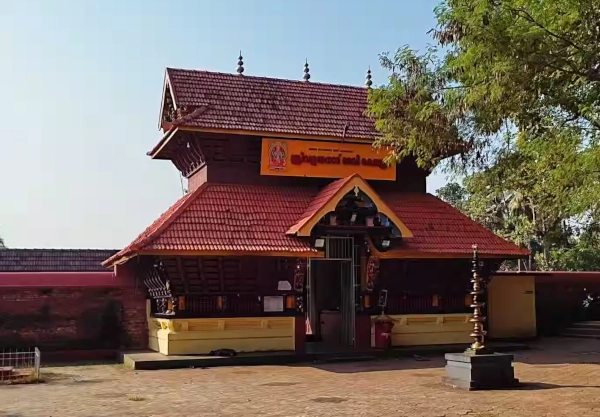
The Sree Valayanad Devi Temple is one of Kozhikode’s most historically significant Bhagavathy shrines. Standing near Govindapuram on the Mankavu–Govindapuram route, the temple represents a distinctive meeting point of Kerala’s Shakta traditions, the political heritage of the Zamorins and the ritual culture of northern Malabar. Valayanad Bhagavathy has long been revered as the principal family deity, or bharadevatha, of the Zamorin royal house, whose rulers transformed Kozhikode into one of medieval India’s greatest maritime and commercial centres.
More than a local place of worship, Valayanad Devi Temple preserves memories of the long rivalry between the Zamorin of Kozhikode and the Valluvakonathiri, the ruler of Valluvanad. Its origin legend connects the shrine with Thirumandhamkunnu Bhagavathy, the tutelary goddess of the Valluvanad rulers, and with the centuries-long contest for political authority over central and northern Kerala.
The Legend of the Zamorin and the Goddess
According to temple tradition, the Zamorin repeatedly attempted to defeat the Valluvakonathiri but failed despite possessing greater military resources. He eventually concluded that his rival’s strength arose from the divine protection of Thirumandhamkunnu Bhagavathy.
The Zamorin then travelled in disguise to Thirumandhamkunnu and performed intense penance before the Goddess. Pleased by his devotion, Bhagavathy appeared before him. The Zamorin requested her to accompany him to Kozhikode and become the guardian deity of his kingdom.
The Goddess agreed, placing one condition before him: he had to walk forward without turning back. She would follow him, and the sound of her anklets would assure him of her presence. During the journey, the anklet sound suddenly ceased. Overcome by uncertainty, the Zamorin turned around. Bhagavathy immediately stopped and declared that she would proceed no further.
The Goddess then threw one of her bangles towards Kozhikode, promising that her divine presence would become established wherever it landed. Temple tradition says that the bangle revolved for seven days at a place later called Azhchavattom and finally came to rest at Valayanad. The Zamorin consequently established the temple at the site where the bangle fell. This sacred bangle is also associated in popular explanation with the name Valayanad, combining vala, meaning bangle, with the idea of the place where it came to rest.
A small sacred grove known as Tharakkal Kavu at Azhchavattom remains connected with this tradition. During the concluding ceremonies of the annual festival, the Goddess proceeds ceremonially towards this associated sacred landscape, and the Arattu, or ritual bath, is performed at the Trishala pond near Mankavu.
The Zamorin’s Family Goddess
Valayanad Bhagavathy occupied an important position within the sacred world of the Zamorin kingdom. The Goddess was regarded as the ruler’s principal family deity, alongside other royal divinities such as Tali Mahadeva and Vettakkorumakan of Balathikkulangara.
Before undertaking important political or military ventures, members of the Zamorin family sought the blessings of Valayanad Bhagavathy. The temple’s association with the royal house also linked it with the Mamankam festival at Thirunavaya, where the Zamorin claimed the ceremonial position of Rakshapurusha, or Great Protector.
The temple also possessed a judicial and political role in the traditional kingdom. Historical accounts preserved in later studies indicate that solemn oaths were taken before Valayanad Bhagavathy. Appearing before the Goddess and swearing to the truth carried great moral and religious authority. The shrine therefore functioned as a sacred institution through which kingship, justice and divine sanction were brought together.
The temple’s historical associations are commonly traced to the medieval period, particularly the expansion of Zamorin power from the fourteenth century onward. The surviving traditions surrounding the shrine reveal how temple worship became intertwined with the contests between Kozhikode and Valluvanad for control over trade routes, territory and the Mamankam.
Valayanad Bhagavathy as Chandika
The presiding deity is worshipped as a powerful manifestation of the Divine Mother. Temple traditions identify her with Chandika and Bhadrakali and also use names such as Mahartham and Kalasarppini. She embodies the fierce, protective and sovereign dimensions of Shakti—the cosmic power through which creation is sustained and destructive forces are subdued.
The deity is represented in a majestic seated form. Descriptions of the principal image portray the Goddess seated upon a sacred pedestal, with one leg folded and the other hanging downward. She bears weapons and divine emblems, including a sword, axe, noose and vessel. The image is traditionally described as a large wooden icon adorned with a crown, ornaments, bangles and a crescent-moon emblem.
The Goddess is accompanied by the Saptamatrikas, the Seven Divine Mothers. Images associated with Veerabhadra and Ganesha are also found close to the sanctum. The presence of these deities places Valayanad within the wider Shakta theological world in which the Goddess appears as supreme power surrounded by attendant divinities.
A Rare Centre of Shakta Worship
One of the most remarkable features of Valayanad Devi Temple is its ritual tradition. The shrine is counted among Kerala’s rare Shakta temples where worship follows the Rurujit or Ruruji system. Temple authorities and Kerala Tourism describe the ritual system as preserving elements associated with the Kashmiri tradition of Shakti worship.
The hereditary priests traditionally associated with the regular Shakta worship are known as Moosads. Their ritual lineage gives Valayanad a distinctive identity among the Bhagavathy temples of Kerala, many of which follow different Tantric systems.
A Sreechakra, regarded in Shakta worship as a geometric embodiment of the Divine Mother and the structure of cosmic power, is installed within the sanctum. Temple tradition attributes its design to the yogi Thayyavur Sivasankar. The Sreechakra forms an important focus of the spiritual presence believed to reside permanently within the shrine.
The ritual identity of Valayanad illustrates the remarkable diversity of Kerala’s temple traditions. Its worship combines local Bhagavathy devotion, Tantric philosophy, royal patronage and ritual elements remembered as having connections with northern Indian Shakta systems.
Architecture of the Temple
The Valayanad Devi Temple occupies a slightly elevated site surrounded by the urban landscape of Kozhikode. Wide steps lead towards the compound, creating a gradual transition from the outer world into the sacred precinct.
The temple faces north, an orientation that gives approaching devotees a direct view towards the principal shrine from the northern entrance. Kerala Tourism records that the complex possesses four gateways or gopurams. Within the enclosure are the sanctum, sub-shrines, chuttambalam, principal sacrificial stone, flagstaff, temple well and pond.
The rectangular sanctum follows the traditional Kerala temple idiom. Its granite base supports laterite walls and a sloping roof historically protected with copper sheets. Carved pillars, ornamental motifs and sculpted architectural details give the shrine an appearance combining strength with elegance.
A granite-paved circumambulatory path allows devotees to walk around the central structure. The spacious chuttambalam accommodates worshippers, ritual offerings and the distribution of prasadam. The layout reflects the enclosed, inward-looking character of Kerala’s traditional sacred architecture, in which the sanctum forms the spiritual centre of a sequence of walls, halls, gateways and ritual spaces.
Other deities worshipped within the complex include Shiva, Thevara Bhagavathy, Ayyappa, Vigneswara and Kshetrapala. These associated shrines create a complete sacred environment around the principal manifestation of Bhagavathy.
The Annual Makaram Festival
The principal annual festival begins under the Karthika star in the Malayalam month of Makaram, corresponding approximately to January or February. The main observances traditionally continue for seven days, with associated preparations and programmes extending across a longer festival period.
A major ceremonial connection exists between Valayanad Devi Temple and the historic Tali Mahadeva Temple of Kozhikode. Before the festival, the Goddess’s ceremonial sword, known as Naandakam or Udaval, is brought from Tali Temple to Valayanad in a formal procession. The movement of the sword symbolically renews the relationship between Bhagavathy, Tali Mahadeva and the former Zamorin kingdom.
The festival formally commences with Kodiyettam, the hoisting of the sacred flag. Each day includes elaborate temple observances such as Usha Puja, Kazhcha Seeveli, Pantheeradi Puja, Sree Bhoothabali, Navakam, Ucha Puja, Deeparadhana, Athazha Puja and ceremonial processions.
Traditional percussion, illuminated processions and ritual arts contribute to the festival atmosphere. Cultural programmes may include Kerala art forms such as Ottanthullal, Chakyarkoothu, Thayambaka and Kalamezhuthu Pattu. Annadanam, the devotional distribution of food, is another important part of the celebration.
The festival culminates in the Arattu procession. The ceremonial representation of the Goddess travels towards the associated Tharakkal shrine and the Trishala pond at Mankavu, where the ritual bath is performed. The return procession to Valayanad is followed by Kodiyirakkam, the lowering of the festival flag, marking the completion of the annual observances.
Kalamezhuthu Pattu
Valayanad Devi Temple is particularly renowned for its forty-one-day Kalamezhuthu Pattu observance during the Mandala season. It begins on the first day of the Malayalam month of Vrischikam.
Kalamezhuthu is a sacred visual art in which an elaborate image of the Goddess is drawn upon the floor using naturally prepared coloured powders. Rice flour creates white, charcoal produces black, turmeric provides yellow, powdered leaves create green, and a combination of turmeric and lime produces red.
Once the image has been completed, devotional songs narrating the deeds of Bhagavathy are performed with musical accompaniment. The songs frequently recount the Goddess’s battle with Darika, representing the victory of divine power over destructive forces. Ritual circumambulation and expressive movements accompany the singing, after which the sacred drawing is ceremonially erased.
The temporary nature of the image carries deep spiritual meaning. The Goddess is invoked through colour, sound, rhythm and devotion, remains present throughout the ritual and then returns to her formless state when the kalam is erased.
Guruthi and Muttarukkal
Guruthi is one of the temple’s best-known Shakta offerings. In its contemporary ritual form, a red liquid prepared with turmeric and lime symbolically represents the life-force offered before the Goddess. Guruthi ceremonies are traditionally conducted on selected days following the evening worship and attract devotees seeking protection, fulfilment of vows and relief from adversity.
Another important offering is Muttarukkal. The expression combines muttu, meaning an obstruction, with arukkal, meaning cutting or removing. During the ritual, a coconut is broken before the deity, symbolising the removal of obstacles affecting health, livelihood, family life or personal progress. Devotees approach the Goddess with the belief that her power will clear difficulties and open the path towards success.
Other offerings associated with the temple include abhishekam, garlands, payasam, Ganapathi Homam, Vidyarambham and different forms of Guruthi worship. The continued performance of these offerings shows how Valayanad Bhagavathy remains closely connected with the everyday concerns of devotees.
A Living Monument of Kozhikode’s Heritage
Valayanad Devi Temple occupies a special position in Kozhikode because its identity extends across religion, history, art and kingship. Its legends preserve memories of the Zamorin–Valluvanad rivalry. Its processions connect it with Tali Temple, Azhchavattom and Mankavu. Its Kalamezhuthu observances sustain one of Kerala’s most expressive ritual-art traditions, while its distinctive Shakta worship reflects the wide philosophical and ceremonial diversity of Hindu practice.
The temple also reveals the central role once played by sacred institutions in Kerala’s political life. Valayanad Bhagavathy served simultaneously as royal guardian, witness to solemn oaths, protector of the kingdom and compassionate mother of ordinary devotees.
Today, the temple stands within the expanding city of Kozhikode, yet its tiled roofs, enclosed courtyards, oil lamps, sacred processions and ancient ritual rhythms continue to evoke the world of historic Malabar. For devotees, Valayanad Bhagavathy remains an immediate source of courage, protection and grace. For students of Kerala’s heritage, the temple is an enduring monument to the spiritual foundations upon which the Zamorins built their kingdom.
How to Reach Valayanad Devi Temple
Valayanad Devi Temple is situated at Kommeri on the Mankavu–Govindapuram road within Kozhikode city. The shrine lies approximately four kilometres east of Kozhikode Railway Station, from where devotees can reach it conveniently by taxi, autorickshaw or local bus through Mankavu and Govindapuram. Kozhikode is well connected by road with major destinations across Kerala, and visitors arriving by car can approach the temple through the city’s Mankavu–Govindapuram route. The nearest airport is Calicut International Airport at Karipur, situated around 23 kilometres from central Kozhikode. Taxis are available from the airport for the onward journey to Valayanad.
Reference
Sree Valayanad Devi Temple. “Official Website of Valayanad Devi Temple, Kozhikode.”
https://www.valayanaddevi.in/
Sree Valayanad Devi Temple. “History, Deity, Rituals and Festival Traditions.”
https://www.tiruvalayanadkavu.in/
Kerala Tourism. “Utsavam — Sree Valayanad Bhagavathy Temple, Kozhikode.” Festival Information System, Department of Tourism, Government of Kerala.
https://www.keralatourism.org/1000festivals/assets/uploads/pdf/1510142272-0.pdf
Christ College, Irinjalakuda Digital Repository. “Sree Valayanad Devi Temple, Kommeri: Historical and Cultural Study.”
https://dspace.christcollegeijk.edu.in/bitstream/123456789/1422/3/CCASADER15.pdf
Kerala Tourism. “Tali Temple, Kozhikode.”
https://www.keralatourism.org/destination/tali-temple-kozhikode/281/
Kozhikode District Administration. “How to Reach Kozhikode.”
https://kozhikode.nic.in/en/tourism/how-to-reach/
You may also like
-
Yavana in the Mahabharata: Greek Connections, Pandava Campaigns and the Warriors of Kurukshetra
-
India and Sri Lanka Launch SAMHiTA Manuscript Digitisation Project to Preserve Ancient Buddhist Heritage
-
ASI Uses Ground-Penetrating Radar to Investigate Ancient Buddhist Stupa at Ujjain After Nearly 90 Years
-
Pahlava: The Parthian World Beyond India’s Northwestern Frontiers in the Mahabharata
-
Namami Gange in 2026: 368 Projects Completed, 4,339 MLD Sewage Treatment Capacity Created as Ganga Rejuvenation Advances
