Ancient Indian Warcraft Series | Śiva Purāṇa — Rudra Saṃhitā, Kumāra Khaṇḍa | Skanda Purāṇa — Māheśvara Khaṇḍa
The Purāṇic accounts of Kārttikeya’s war against Tārakāsura present one of the most significant military narratives in Hindu sacred literature. Born for the specific purpose of defeating an Asura whose extraordinary powers had overwhelmed the celestial armies, Kārttikeya emerges as the supreme commander of the Devas, bringing renewed strength and leadership to their prolonged struggle against Tāraka. His appointment marks a decisive change in a conflict in which the established celestial powers had repeatedly failed to overcome their adversary.
Known by several names, including Skanda, Kumāra, Ṣaṇmukha, Guha and Mahāsena, the son of Śiva and Pārvatī embodies extraordinary martial strength, courage and divine authority. His emergence changes the balance of power between the Devas and Asuras, while his eventual victory over Tāraka establishes him as one of the foremost military commanders in Purāṇic tradition. The central military significance of the narrative lies in the transformation of a repeatedly defeated alliance into a force capable of achieving victory through unified leadership, the identification of the enemy’s vulnerability and the decisive employment of a specialised weapon.
The Śiva Purāṇa and Skanda Purāṇa describe Kārttikeya’s appointment, the mobilisation of celestial armies, the confrontation with Tāraka’s forces and the destruction of the Asura through the divine Śakti spear. The accounts also extend beyond the principal battle, describing subsequent engagements against surviving Asura leaders. Together, these episodes provide a detailed portrayal of military command, battlefield resilience, the concentration of combat power and the responsibilities that follow a major victory.
Tārakāsura’s Rise and the Strategic Crisis of the Devas
The origins of the conflict lie in Tārakāsura’s acquisition of extraordinary powers through severe austerities. The Purāṇic traditions differ in their descriptions of the boon he receives, but they agree that the protection associated with it renders the established celestial powers incapable of defeating him through ordinary means. In the Śiva Purāṇa, the conditions attached to Brahmā’s boon make the son of Śiva the destined destroyer of Tāraka, while the Skanda Purāṇa preserves related traditions concerning the Asura’s protection and the necessity of Kārttikeya’s birth.
Having obtained these powers, Tāraka expands his authority and repeatedly defeats the Devas. His military successes enable him to challenge their position across the celestial regions, while Indra and other divine warriors prove unable to destroy him. The resulting conflict becomes a prolonged struggle in which the Devas possess considerable military strength but cannot achieve their principal objective. Tāraka’s advantage demonstrates a fundamental strategic problem: an army may possess numerous powerful commanders and formidable weapons yet remain incapable of victory when its capabilities are insufficient against the particular strengths of its adversary.
The situation also creates a crisis of leadership and morale. The Devas have experienced repeated reverses, and their inability to defeat Tāraka weakens confidence in their established methods of warfare. Their subsequent appeal to the higher divine powers reflects their recognition that merely repeating earlier campaigns will not resolve the conflict. The military lesson is that repeated battlefield failure requires a reassessment of the enemy’s capabilities and the means available to defeat him, rather than the continued employment of unsuccessful methods.
The Birth of Kārttikeya and the Emergence of a Decisive Warrior
Recognising that Tāraka can be defeated only through the emergence of Śiva’s son, the Devas seek the circumstances necessary for his birth. The Purāṇas describe Kārttikeya’s extraordinary origins through divine events involving Śiva, Pārvatī, Agni, Gaṅgā and the Kṛttikās. These traditions explain several of his names and establish his divine connection with the purpose for which he enters the world.
Although represented as a youthful warrior, Kārttikeya possesses extraordinary strength, intelligence and martial ability. His youth stands in striking contrast to the enormous responsibility entrusted to him, especially when compared with the experience and power of the celestial commanders who have already confronted Tāraka. The narrative emphasises that his significance arises not merely from physical strength but from his unique ability to overcome an enemy whom the other Devas cannot destroy.
Kārttikeya’s arrival represents a fundamental change in the strategic circumstances of the Devas. Until this point, they have lacked the means to achieve a decisive result, regardless of the number of warriors they deploy. His emergence provides the capability required to overcome the protection enjoyed by Tāraka. From a military perspective, Kārttikeya represents the introduction of a decisive capability into an otherwise unsuccessful campaign, demonstrating that victory depends upon matching the means of warfare to the specific nature of the enemy.
The Appointment of Kārttikeya as Commander of the Celestial Armies
The Śiva Purāṇa, Rudra Saṃhitā, Kumāra Khaṇḍa, Chapter 5, describes the recognition of Kārttikeya by Śiva, Pārvatī and the assembled celestial beings. His emergence is followed by his elevation to a position of military authority, preparing him to lead the Devas against Tāraka. The Skanda Purāṇa also describes his appointment as commander of the celestial armies, associating his leadership with the restoration of the Devas’ military strength.
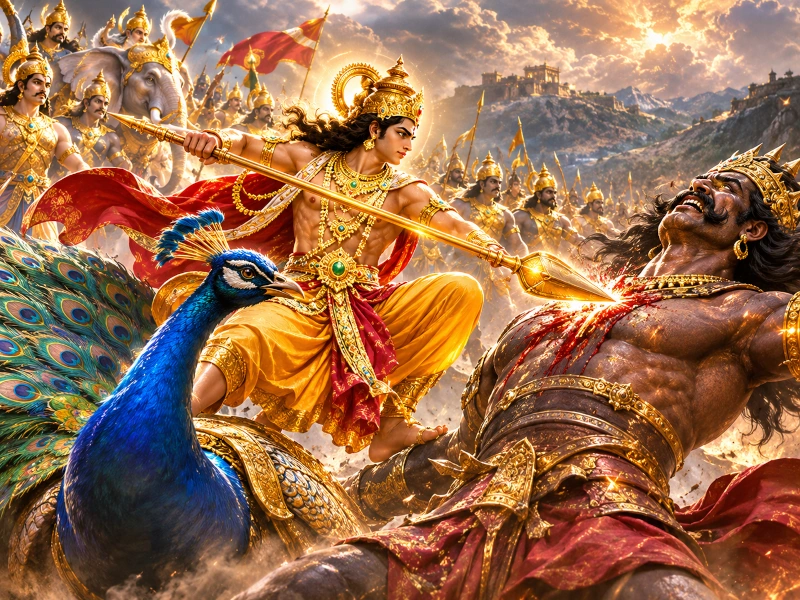
Kārttikeya receives divine weapons and the support of the principal celestial powers. His peacock becomes his celebrated vehicle, while the Śakti emerges as the weapon most closely associated with his martial identity. The Skanda Purāṇa, Nāgara Khaṇḍa, Chapter 71, describes the presentation of divine weapons to Kārttikeya, including a powerful Śakti, and the preparations for his military responsibilities.
The appointment has considerable significance because the Devas already possess numerous powerful warriors, each commanding extraordinary abilities and weapons. Nevertheless, their previous campaigns have failed to defeat Tāraka. By placing Kārttikeya at the head of their forces, the celestial powers establish a central figure around whom their renewed campaign can be organised. The appointment illustrates the importance of unity of command, in which the efforts of several powerful formations are directed towards a common objective under a recognised military leader.
Kārttikeya’s titles, particularly Senāpati and Mahāsena, reflect his association with military command and the leadership of the celestial hosts. His role is therefore distinguished from that of an individual warrior acting independently upon the battlefield. He becomes the commander responsible for bringing the combined strength of the Devas into a confrontation intended to achieve a specific and decisive result.
The Mobilisation of the Deva Army Against Tāraka
Following Kārttikeya’s appointment, the Devas begin preparations for a renewed military campaign. The Śiva Purāṇa, Kumāra Khaṇḍa, Chapter 7, describes the mobilisation of their forces and the commencement of hostilities against Tāraka. When the Asura learns of these preparations, he assembles his own warriors and advances to meet the celestial army.
The opposing forces prepare for a major confrontation. The Purāṇic descriptions emphasise the presence of powerful warriors, numerous weapons and the sounds of drums, conches and other instruments announcing the movement of armies. The Devas advance with renewed confidence because Kārttikeya is now leading them, while Tāraka’s forces enter the conflict with the assurance derived from their earlier victories.
The arrival of Kārttikeya at the head of the Deva army has an immediate psychological significance. The celestial warriors, who have previously suffered defeats against Tāraka, now possess a commander whose birth is directly associated with the destruction of their adversary. His leadership provides them with a renewed belief that the conflict can be brought to a successful conclusion. The episode demonstrates that effective military leadership must restore the confidence of defeated forces, because an army’s willingness to engage a powerful enemy is influenced by its belief in the competence and capability of its commander.
The mobilisation also reflects the importance of preparing for a decisive campaign rather than continuing a series of unsuccessful confrontations. The Devas assemble their available strength with the intention of confronting Tāraka under changed circumstances. Their objective is no longer simply to resist the expansion of Asura power but to eliminate the principal adversary responsible for their military difficulties.
The Opening Battles and the Devas’ Initial Reverses
The Śiva Purāṇa, Kumāra Khaṇḍa, Chapter 8, describes the opening engagements between the Devas and Asuras. Despite the emergence of Kārttikeya, the celestial forces encounter severe resistance, and several of their leading warriors suffer setbacks. Tāraka’s army demonstrates considerable fighting strength, while the Asura leader himself continues to dominate important confrontations.
Indra and other celestial warriors are challenged by the intensity of the fighting, and the initial engagements do not immediately produce the victory anticipated by the Devas. Powerful weapons are exchanged, individual commanders enter combat and the struggle develops into a fierce confrontation between opposing forces. The Asuras draw confidence from their ability to withstand the renewed celestial offensive.
The participation of Śiva’s Gaṇas under Vīrabhadra introduces additional strength into the battle. Vīrabhadra and his warriors engage the Asura forces, creating further confrontations involving some of the most formidable combatants described in the Purāṇic narrative. Nevertheless, the presence of these powerful allies does not immediately eliminate Tāraka.
The reverses suffered by the Devas demonstrate that the appointment of a new commander does not automatically guarantee victory at every stage of a campaign. Kārttikeya’s leadership changes the strategic possibilities available to the celestial forces, but the enemy remains powerful and capable of inflicting serious damage. The military significance lies in the distinction between gaining a strategic advantage and converting that advantage into battlefield victory, a process that may require sustained fighting, resilience and the eventual concentration of decisive force against the principal target.
Tāraka’s Confrontations with Indra, Viṣṇu and Vīrabhadra
The Śiva Purāṇa, Kumāra Khaṇḍa, Chapter 9, describes a succession of major confrontations involving Tāraka and the leading celestial warriors. Indra attacks the Asura with his thunderbolt, temporarily bringing him down. However, Tāraka recovers and retaliates with his spear, striking Indra and causing him to fall during the engagement.
Viṣṇu subsequently enters the confrontation and attacks Tāraka with his discus. The weapon strikes the Asura, but he again recovers and launches a counterattack. Vīrabhadra also confronts Tāraka with his trident, demonstrating the formidable strength of Śiva’s forces. His attack temporarily overcomes the Asura, yet Tāraka once again rises and continues fighting.
These repeated engagements establish the extraordinary resilience of Tāraka and the limitations faced by his opponents. Each celestial warrior possesses tremendous strength and powerful weapons, but none is able to bring about the Asura’s final destruction. The confrontation therefore becomes a demonstration of the difference between inflicting damage upon an enemy and achieving the military objective for which the campaign has been undertaken.
The participation of Indra, Viṣṇu and Vīrabhadra also emphasises the exceptional nature of Tāraka’s protection. Their inability to destroy him does not diminish their divine strength within the narrative; rather, it establishes that his defeat depends upon the fulfilment of the conditions associated with his boon. The strategic lesson is that repeated successful strikes against an adversary do not necessarily constitute victory if the enemy retains the ability to recover, continue fighting and preserve the capability that makes him dangerous.
Brahmā’s Intervention and the Identification of the Decisive Combatant
As the fighting continues, Brahmā intervenes to explain the necessity of Kārttikeya’s direct participation. The Śiva Purāṇa, Kumāra Khaṇḍa, Chapter 9, describes Brahmā informing the young commander that the destruction of Tāraka cannot be accomplished by Viṣṇu or the other celestial warriors because of the special protection granted to the Asura.
Brahmā reminds Kārttikeya that his emergence is connected with the specific purpose of defeating Tāraka. The intervention clarifies the central objective of the campaign and identifies the warrior capable of bringing it to a conclusion. The responsibility for the decisive confrontation consequently passes to Kārttikeya.
This moment represents a significant development in the military narrative. The Devas have already employed powerful commanders and extraordinary weapons against the enemy, but their efforts have not produced the required result. Brahmā’s intervention identifies the specific capability that must now be employed. The military significance is the recognition that a decisive objective must be assigned to the force capable of achieving it, rather than continuing to commit powerful but ineffective resources to the same task.
Kārttikeya’s subsequent advance marks the transition from a prolonged series of engagements to the decisive confrontation. The campaign has reached a stage where the outcome depends upon the direct encounter between Tāraka and the warrior destined to defeat him.
Kārttikeya’s Final Confrontation with Tārakāsura
The Śiva Purāṇa, Kumāra Khaṇḍa, Chapter 10, describes the final duel between Kārttikeya and Tāraka as an extraordinary contest involving powerful weapons and exceptional martial ability. Kārttikeya advances against the Asura with his spear, while Tāraka prepares to confront the young commander with his own weapon.
The two warriors engage in fierce combat, exchanging powerful attacks and demonstrating considerable skill. Tāraka’s experience and extraordinary strength allow him to withstand Kārttikeya’s initial assaults, while the young commander displays the courage and determination necessary to confront a formidable adversary. The battle does not immediately produce a decisive result, and both warriors continue fighting despite the intensity of the confrontation.
At one stage, Tāraka strikes Kārttikeya with his spear, temporarily rendering him unconscious. The Asura’s attack demonstrates that even the destined commander is not beyond the danger of battlefield injury. Kārttikeya subsequently recovers and resumes the confrontation, refusing to abandon the objective for which he has entered the battle.
The Purāṇic narrative describes the anxiety of the assembled Devas as the duel continues. Extraordinary disturbances occur in the natural world, reflecting the cosmic importance attributed to the confrontation. The celestial beings fear the consequences of another defeat, but a divine assurance declares that Kārttikeya will ultimately overcome Tāraka.
The duel establishes Kārttikeya’s resilience as an essential component of his martial character. Although his special destiny makes him capable of defeating the Asura, he must still endure the dangers of the encounter and continue fighting after suffering a serious blow. The military lesson is that the possession of decisive capability must be accompanied by personal courage, combat endurance and the ability to recover from setbacks during the execution of a critical mission.
The Śakti Spear and the Destruction of Tārakāsura
The decisive moment of the campaign arrives when Kārttikeya prepares to employ the divine Śakti against Tāraka. The Śiva Purāṇa, Kumāra Khaṇḍa, Chapter 10, describes the young commander bowing to Śiva and Pārvatī before taking up his brilliant spear for the final attack.
The Śakti is not presented as an ordinary battlefield weapon. Within the Purāṇic narrative, it possesses extraordinary divine power and is closely associated with Kārttikeya’s ability to overcome enemies whose strength exceeds that of conventional warriors. Its employment against Tāraka represents the culmination of the campaign and the fulfilment of the purpose for which Kārttikeya was born.
Kārttikeya launches the decisive attack, striking Tāraka with the Śakti and destroying him. The Asura falls upon the battlefield, bringing an end to the confrontation that had defeated so many celestial warriors. The Śiva Purāṇa describes the rejoicing of the Devas and other celestial beings following the destruction of their powerful adversary.
The Skanda Purāṇa also associates Tāraka’s death with the Śakti, although its different sections preserve variations in the sequence of combat and the circumstances surrounding the final strike. The central outcome remains consistent: Kārttikeya defeats the Asura through the divine weapon associated with his martial authority.
The military significance of the final strike lies in the concentration of decisive combat power against the principal enemy at the critical moment. Earlier engagements had demonstrated that numerous powerful attacks could weaken or temporarily overcome Tāraka without destroying him. Kārttikeya’s employment of the Śakti achieves the objective that the combined efforts of the other celestial warriors had failed to accomplish.
The destruction of Tāraka also demonstrates the importance of distinguishing between the broader conduct of battle and the specific action required to secure victory. The Devas’ mobilisation, their initial engagements and the participation of powerful commanders create the circumstances for the decisive confrontation, but the final result is achieved through Kārttikeya’s direct intervention.
The Collapse of Tāraka’s Power and the Restoration of Celestial Confidence
Tāraka’s death changes the strategic circumstances of the conflict. The Asura whose extraordinary protection had enabled him to dominate the Devas is no longer present, and the principal obstacle to the restoration of celestial authority has been eliminated. The Śiva Purāṇa describes widespread rejoicing among the Devas, sages and other celestial beings following Kārttikeya’s victory.
The outcome establishes the success of the campaign for which Kārttikeya was appointed commander. His leadership has enabled the celestial forces to overcome an adversary whom their earlier methods could not defeat. The victory also restores confidence among warriors who had previously suffered repeated reverses.
Although the narrative celebrates Tāraka’s destruction, it does not establish that every surviving Asura immediately abandons hostile activity. Other warriors associated with Tāraka continue to threaten different regions and beings, requiring additional interventions by Kārttikeya. The strategic significance is that the destruction of an enemy’s principal leader can transform the balance of power without necessarily eliminating every remaining source of armed resistance.
The events following Tāraka’s death consequently extend Kārttikeya’s responsibilities beyond the original battle. He continues to act as a powerful protector, confronting surviving adversaries and removing threats that remain after the principal campaign has ended.
Kārttikeya’s Campaign Against Bāṇa at Mount Krauñca
The Śiva Purāṇa, Kumāra Khaṇḍa, Chapter 11, describes Kārttikeya’s confrontation with Bāṇa, an Asura who escapes from the earlier fighting. Following Tāraka’s destruction, Bāṇa continues his hostile activities and attacks Mount Krauñca, causing devastation and suffering.
Unable to withstand the Asura’s attacks, Krauñca approaches Kārttikeya and seeks his protection. The commander responds to the appeal and prepares to confront the surviving enemy. Remembering Śiva, he takes up his powerful Śakti and directs it against Bāṇa.
The weapon strikes the Asura and destroys him along with his forces. Having accomplished its purpose, the Śakti returns to Kārttikeya, who assures Krauñca that the danger has been removed.
This episode demonstrates the continuation of military responsibilities after the destruction of the principal adversary. Tāraka’s death has achieved the central objective of the earlier campaign, but Bāṇa’s activities show that other hostile forces remain capable of causing destruction. The military significance lies in the need to address surviving threats after a major victory, because the defeat of the principal enemy does not automatically guarantee security across the wider theatre of conflict.
Kārttikeya’s response also reflects the protective responsibilities associated with his command. He does not undertake the engagement merely to demonstrate personal strength but intervenes in response to an appeal from one threatened by an aggressive adversary.
The Destruction of Pralamba and the Elimination of Another Surviving Threat
The same chapter of the Śiva Purāṇa describes a subsequent confrontation with Pralamba, another Asura associated with Tāraka’s forces. Having survived the earlier conflict, Pralamba continues his destructive activities and threatens Kumuda, the son of the serpent chief Śeṣa.
Unable to resist the Asura, Kumuda approaches Kārttikeya and requests protection. The divine commander responds by taking up his Śakti and directing it against Pralamba. The weapon destroys the Asura and returns to Kārttikeya, bringing the immediate threat to an end.
The destruction of Pralamba completes another episode in the sequence of military victories associated with Kārttikeya. Like the confrontation with Bāṇa, it demonstrates that the commander continues to employ his strength against enemies who remain dangerous after the defeat of Tāraka.
The two engagements reveal an important distinction between achieving the primary military objective and addressing the consequences of victory. Kārttikeya’s destruction of Tāraka ends the central confrontation, while his subsequent actions remove additional threats that continue to affect the wider order. From a strategic perspective, these episodes illustrate the importance of follow-on operations against surviving hostile forces, particularly when their continued activities threaten the security gained through the principal victory.
The Purāṇic narrative therefore presents Kārttikeya not only as the destroyer of one powerful Asura but also as a continuing protector whose military responsibilities extend beyond a single campaign.
Kārttikeya’s Participation in Later Divine Wars
Kārttikeya’s martial activities are not confined to the Tārakāsura conflict. The Śiva Purāṇa, Rudra Saṃhitā, Yuddha Khaṇḍa, describes his participation in other confrontations involving powerful Asuras, including the wars against Jalandhara and Śaṅkhacūḍa.
During the conflict against Jalandhara, Kārttikeya fights alongside prominent warriors associated with Śiva, including Vīrabhadra, Nandin and Gaṇeśa. The narrative describes a series of engagements in which different commanders confront the powerful Asura forces. Kārttikeya participates as a formidable combatant within the broader celestial coalition.
In the Yuddha Khaṇḍa, Chapter 21, Kārttikeya confronts Niśumbha and subsequently attacks Jalandhara with his spear. Although his attack strikes the Asura, Jalandhara recovers and retaliates, temporarily overcoming Kārttikeya. The episode demonstrates that the divine commander remains exposed to serious battlefield resistance even after his celebrated victory over Tāraka.
The Śiva Purāṇa also describes Kārttikeya’s participation in the conflict involving Śaṅkhacūḍa. During this confrontation, he employs powerful weapons against the Asura before suffering a counterattack. These accounts expand his military identity beyond the single role of Tāraka’s destined destroyer.
The military significance of these later engagements is that even a celebrated commander cannot be assumed to possess overwhelming superiority in every battle. The nature of the adversary, the circumstances of the confrontation and the capabilities employed continue to influence the outcome.
These narratives also establish Kārttikeya as a recurring participant in the defence of the celestial order. His command and martial responsibilities are not exhausted by one decisive victory but remain relevant to subsequent conflicts.
Military Significance: Unity of Command and the Reorganisation of Defeated Forces
One of the most important military themes in Kārttikeya’s campaign is the need for unified leadership when an alliance confronts a superior adversary. Before his emergence, the Devas possess numerous powerful commanders and extraordinary weapons, but their individual capabilities fail to overcome Tāraka.
The appointment of Kārttikeya establishes a recognised leader whose purpose is directly connected with the campaign’s central objective. His presence creates renewed confidence and provides a focal point for the Devas’ collective military effort.
The narrative does not describe modern command structures or formal operational planning systems. Nevertheless, the appointment of a supreme commander offers a clear strategic lesson concerning the coordination of military strength. The effectiveness of an alliance depends not merely upon the combined power of its members but upon the ability to direct that power towards a common objective under effective leadership.
Kārttikeya’s role further demonstrates that command authority must be supported by the capability to achieve the mission. His appointment succeeds because he possesses the ability required to defeat the particular enemy confronting the Devas.
Military Significance: Morale, Resilience and the Recovery of Battlefield Confidence
The Devas’ repeated defeats against Tāraka create a situation in which military weakness is accompanied by psychological uncertainty. Their established commanders have suffered reverses, and the Asura’s extraordinary strength has created the expectation that he cannot be defeated.
Kārttikeya’s emergence changes this psychological environment. The Devas regain confidence because they believe their new commander possesses the power necessary to destroy Tāraka. His presence encourages them to renew a campaign that had previously appeared unsuccessful.
The final duel reinforces the importance of personal resilience. Kārttikeya suffers a powerful strike from Tāraka and temporarily loses consciousness, but he recovers and continues fighting. His determination becomes an essential part of the narrative’s portrayal of his military character.
The principal military lesson is that effective commanders must combine capability with resilience, because battlefield reverses can occur even during a strategically favourable campaign. The ability to recover from such setbacks and maintain commitment to the objective is essential to sustaining military effectiveness.
The episode also demonstrates the relationship between leadership and collective morale. The Devas’ confidence is strengthened not by Kārttikeya’s title alone but by his willingness to confront the enemy directly and endure the dangers of the battlefield.
Military Significance: Selecting the Right Capability Against the Enemy
The repeated confrontations involving Indra, Viṣṇu and Vīrabhadra demonstrate that overwhelming divine strength does not necessarily produce a decisive military result. Each warrior employs powerful weapons against Tāraka, but the Asura repeatedly recovers and continues fighting.
Brahmā’s intervention clarifies why these efforts fail. The conditions protecting Tāraka require the participation of Śiva’s son, making Kārttikeya the warrior capable of achieving the campaign’s objective.
This distinction provides one of the narrative’s strongest military lessons. The Devas’ failure does not arise simply from a lack of strength or courage. It arises from the inability of their available capabilities to overcome the specific protection possessed by the enemy. The strategic principle is that the selection of military capabilities must be governed by the nature of the adversary and the objective to be achieved, rather than by the general strength or reputation of the forces available.
Kārttikeya’s eventual victory illustrates the consequences of correctly identifying the decisive capability. Once the appropriate warrior directly confronts Tāraka, the possibility of achieving a final result becomes a reality.
Military Significance: The Decisive Employment of the Śakti
The Śakti spear is the most recognisable weapon associated with Kārttikeya’s victory over Tārakāsura. Within the Purāṇic narrative, it possesses extraordinary divine power and becomes the instrument through which the destined warrior destroys the powerful Asura.
Its significance extends beyond the physical act of striking the enemy. The weapon represents the capability required to accomplish a military objective that other powerful weapons have failed to achieve. The thunderbolt of Indra, the discus of Viṣṇu and the trident employed by Vīrabhadra all demonstrate considerable destructive power, yet they do not bring about Tāraka’s final defeat.
Kārttikeya’s employment of the Śakti achieves the decisive result. The military significance lies in the difference between the repeated application of force and the effective use of a capability capable of neutralising the principal enemy. The successful employment of the decisive weapon at the critical moment determines the outcome of the campaign.
The subsequent destruction of Bāṇa and Pralamba through the same weapon reinforces its association with Kārttikeya’s martial authority. In these later confrontations, the Śakti continues to serve as the instrument through which he eliminates dangerous adversaries and restores security to those seeking his protection.
Military Significance: Decisive Victory and the Management of Surviving Threats
The destruction of Tāraka achieves the principal objective of the Devas’ campaign, but the later confrontations with Bāṇa and Pralamba demonstrate that the consequences of victory extend beyond the elimination of the enemy leader.
The surviving Asuras continue hostile activities in different locations, threatening beings who had not necessarily participated in the principal battle. Kārttikeya responds to these developments by undertaking further action against the remaining adversaries.
The Purāṇic narrative does not describe a formal campaign of territorial occupation or administrative consolidation. Its emphasis is upon the divine commander’s continuing responsibility to protect the wider order. Nevertheless, the sequence offers an important military parallel concerning the distinction between defeating the central adversary and addressing the threats that survive him.
The strategic lesson is that a decisive battlefield victory can remove the principal source of enemy power while leaving residual forces capable of renewed aggression. Lasting security therefore requires attention to the threats that remain after the central confrontation has concluded.
Kārttikeya’s campaigns against Bāṇa and Pralamba demonstrate this continuing responsibility and reinforce his position as a military protector rather than merely the victor of a single celebrated duel.
The Symbolism of Kārttikeya as the Supreme Celestial Commander
Kārttikeya occupies a distinctive position in Hindu tradition because his identity combines divine knowledge, youthful energy, extraordinary martial strength and the responsibility to protect the celestial order. His six-faced form, traditionally associated with the name Ṣaṇmukha, is among his most recognisable iconographic features, while his peacock and Śakti spear remain closely connected with his representation as a divine warrior.
His title Senāpati identifies him with the command of armies, while Mahāsena reflects his association with the great celestial hosts. These names reinforce his role as a commander whose authority extends beyond individual combat and includes leadership in major conflicts involving the Devas and Asuras.
The destruction of Tāraka represents the defining achievement of this military identity. Kārttikeya succeeds where other powerful celestial warriors have failed, not because their strength is insignificant but because the nature of the threat requires a particular warrior and capability.
His subsequent campaigns demonstrate that martial authority carries continuing responsibilities. Strength must be employed against threats that endanger the wider order, while victory in one confrontation does not eliminate the obligation to protect those who remain vulnerable.
The enduring military symbolism of Kārttikeya is the union of decisive power and disciplined purpose. His authority is defined not merely by his ability to defeat enemies but by his responsibility to employ that strength in the protection of the celestial order.
Conclusion: The Divine Commander Who Changed the Course of War
Kārttikeya’s campaign against Tārakāsura represents one of the most elaborate accounts of military leadership and decisive warfare in the Purāṇic tradition. The conflict begins with a strategic imbalance in which the Devas possess formidable warriors and weapons but remain unable to defeat an adversary protected by extraordinary powers.
The emergence of Kārttikeya changes these circumstances. His appointment provides the Devas with a commander capable of achieving their central objective, while his presence restores confidence among forces that have suffered repeated defeats. The ensuing campaign demonstrates that the enemy remains powerful and capable of inflicting serious setbacks even after the balance of power has begun to change.
The decisive confrontation occurs when Kārttikeya directly engages Tāraka and destroys him with the Śakti spear. This victory ends the principal conflict and establishes the young commander as one of the supreme martial figures of Hindu sacred literature. His subsequent victories over Bāṇa and Pralamba extend the narrative beyond the main battle and demonstrate his continuing responsibility to eliminate surviving threats.
The principal military lesson of Kārttikeya’s campaign is that victory requires more than numerical strength, celebrated commanders or powerful weapons. It depends upon understanding the enemy, establishing effective leadership, identifying the decisive capability and employing it against the principal objective at the critical moment.
The narrative also demonstrates that battlefield resilience and the responsibilities following victory are inseparable from successful military command. Kārttikeya must overcome the dangers of direct combat before achieving his destined victory, and his later campaigns show that the restoration of security requires continuing vigilance.
Through his appointment, leadership, decisive confrontation and subsequent military actions, Kārttikeya emerges as the embodiment of purposeful martial strength. His victory over Tārakāsura establishes a lasting Purāṇic ideal of military command in which courage, knowledge, determination and the appropriate employment of power combine to overcome an adversary who had previously appeared invincible.
Primary Scriptural References
The principal account of Kārttikeya’s appointment and the war against Tārakāsura appears in the Śiva Purāṇa, Rudra Saṃhitā, Kumāra Khaṇḍa, Chapters 5–11. Chapter 5 describes Kārttikeya’s recognition and elevation to military authority, Chapter 7 introduces the mobilisation and commencement of hostilities, Chapter 8 describes the initial battles between the Devas and Asuras, and Chapter 9 records the confrontations involving Indra, Viṣṇu and Vīrabhadra. Chapter 10 contains the decisive duel and Tāraka’s destruction by the Śakti, while Chapter 11 describes Kārttikeya’s subsequent victories over Bāṇa and Pralamba.
The Skanda Purāṇa, Māheśvara Khaṇḍa, Kaumārikā Khaṇḍa, Chapters 29–32, preserves another major account of the conflict between the Devas and Tārakāsura. These chapters describe the celestial confrontation and the eventual destruction of Tāraka, including variations in the circumstances surrounding the final battle. The Skanda Purāṇa, Nāgara Khaṇḍa, Chapters 70–71, provides additional traditions concerning Kārttikeya’s birth, divine weapons and appointment to military leadership.
Kārttikeya’s participation in later conflicts is described in the Śiva Purāṇa, Rudra Saṃhitā, Yuddha Khaṇḍa, particularly Chapter 21, concerning the war against Jalandhara, and Chapter 37, concerning the conflict involving Śaṅkhacūḍa. These accounts establish his continued martial role beyond the destruction of Tārakāsura.
The interpretations concerning unity of command, battlefield morale, decisive capabilities, the concentration of force and follow-on operations are analytical observations drawn from the Purāṇic narratives. They are not presented as formal military doctrines explicitly formulated by the ancient texts.
You may also like
-
Two Envoys, Two Missions: Comparing Hanumān’s and Aṅgada’s Diplomatic Strategies
-
Aṅgada and Rāvaṇa: The Art of Diplomatic Communication and the Weight of Words
-
Shiva versus Jalandhara: Siege Warfare, Strategic Deception and the Destruction of an Invincible Asura
-
Vīrabhadra Confronts the Gods: The Celestial Battle That Overwhelmed Dakṣa’s Defenders
-
Aṅgada and Rāvaṇa: Why Diplomatic Negotiations Fail When Leaders Reject Reality
