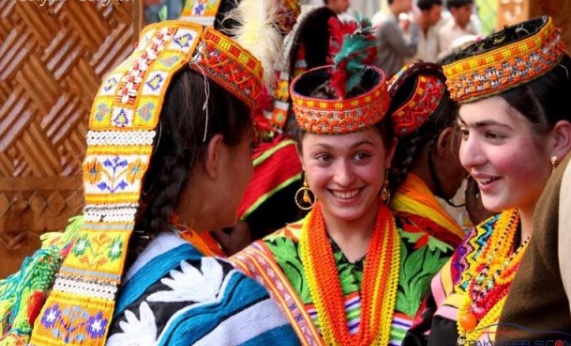
The United Nations Educational, Scientific and Cultural Organization (UNESCO) has listed a tradition of the minority Kalash community in Pakistan on the list of intangible cultural heritage in need of urgent safeguarding.
The Kalash, a tiny pagan tribe, is a distinct religious and ethnic group based in the remote mountains of northwestern Pakistan along the border with Afghanistan.
In a statementon November 29, UNESCO recognized the Kalash tradition of Suri Jagek, translated as “observing the sun,” as a living heritage whose viability was under threat.
UNESCO said Suri Jagek was a “traditional Kalash meteorological and astronomical knowledge system and practice — enacted predominantly in the Hindu Kush mountain range — based on the observation of the sun, moon, stars, and shadows with respect to the local topography.”
The method is used to measure appropriate times for sowing seeds and predict natural disasters, besides being the basis of the Kalash calendar, UNESCO said.
The Kalash, which number around 4,000 people, consider themselves descendants of Alexander the Great’s soldiers, and have lived mostly in isolation since the Macedonian warrior king invaded the region more than 2,300 years ago.
Source: Gandhara
Image Courtesy:OCNAL
You may also like
-
Philippine Marine Wargames Reportedly Show BrahMos Can Penetrate Chinese Destroyer Air Defences
-
Adani Power and Druk Green Power to Develop 770 MW Chamkharchhu-I Hydropower Project in Bhutan
-
Russia’s Irkutsk Pneumonia Scare: No Confirmed Plague Epidemic, No Immediate Threat to India
-
Flydubai FZ1073 Attack: Captain Smit Machchhar’s Calls With Modi and Netanyahu as UAE Probe Names Terror Plot
-
Ukraine Says India’s Ceasefire Proposal Is Broadest Among Four International Initiatives
