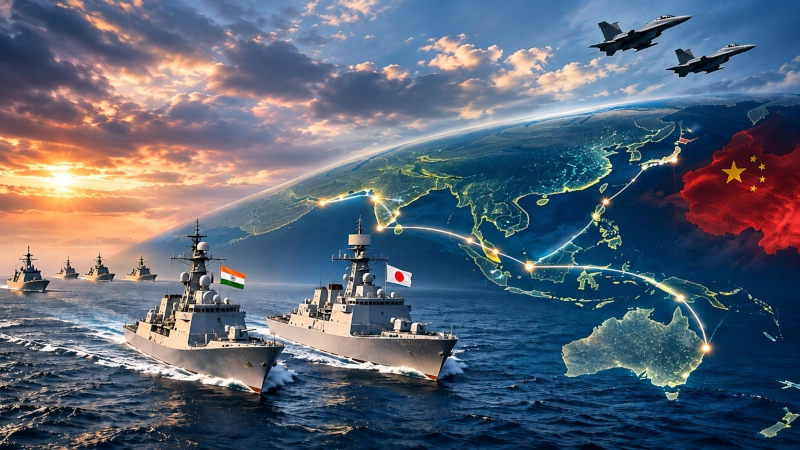
Japan is accelerating the development of a network of defence and security partnerships stretching from the western Pacific and the Taiwan Strait through Southeast Asia to the Indian Ocean, reflecting a significant transformation in the strategic architecture of the Indo-Pacific. As China’s military capabilities expand and regional governments reassess their security requirements, Tokyo is strengthening cooperation with India, Australia, the Philippines and other regional partners through maritime security agreements, joint military exercises, defence-industrial collaboration and technology partnerships.
India is emerging as an increasingly important participant in this evolving security framework, offering capabilities that extend beyond conventional military cooperation. Its geographical position across the Indian Ocean, expanding naval power, indigenous defence manufacturing capabilities and commitment to independent strategic decision-making provide Japan with opportunities to strengthen regional security through a partnership with one of Asia’s major maritime powers. The relationship has gained substantial momentum during 2026, with new agreements covering maritime security, naval shipbuilding, military logistics and technological cooperation.
The development does not represent the establishment of a formal military alliance directed against China. Instead, Japan is building a network of overlapping security partnerships intended to strengthen deterrence, improve military interoperability, secure international maritime routes and reduce the vulnerability of regional countries to coercion. India’s participation adds an important Indian Ocean dimension to this emerging strategic structure while allowing New Delhi to preserve its established policy of strategic autonomy.
China’s Expanding Military Capabilities Reshape Japan’s Security Strategy
Japan’s evolving defence posture is closely connected to changes in the regional military environment, particularly China’s growing naval and air capabilities in the East China Sea, South China Sea and western Pacific. The expansion of the People’s Liberation Army Navy, deployment of advanced missile systems and increasing military activity around Taiwan have become significant considerations in Japanese defence planning.
Tokyo is particularly concerned about the security of its southwestern island chain, which extends towards Taiwan and includes territories situated close to areas of growing Chinese military activity. The geographical proximity of these islands to the Taiwan Strait means that a major regional confrontation could directly affect Japan’s national security, maritime trade and access to essential supplies.
Japan’s dependence on international maritime commerce further reinforces the importance of maintaining secure sea routes. Energy supplies and manufactured goods reach Japanese ports through maritime passages connecting the Indian Ocean, Southeast Asia and the western Pacific. Disruption of these routes could have substantial consequences for Japan’s economy and industrial production.
The Japanese government has responded by increasing defence expenditure, strengthening military capabilities and expanding cooperation with countries sharing concerns about regional security. Its 2026 Defence White Paper identifies China’s military modernisation and increasingly extensive operations as major challenges, while reaffirming the importance of the Japan–United States alliance and stronger cooperation with regional partners.
Rather than relying exclusively on bilateral military arrangements with Washington, Tokyo is increasingly seeking complementary relationships that improve the combined capabilities of countries operating across different parts of the Indo-Pacific.
Japan Develops a Network of Maritime and Military Partnerships
The emerging Japanese security architecture consists of several interconnected relationships, each serving different geographical and operational requirements. Japan’s cooperation with the United States remains the foundation of its national defence, while Australia, the Philippines and India contribute complementary capabilities across the wider Indo-Pacific.
Australia has become one of Japan’s closest defence partners, with cooperation extending into naval procurement, military logistics, exercises and advanced technology development. The two countries have strengthened their relationship through a Reciprocal Access Agreement and subsequent defence-industrial arrangements designed to improve interoperability and long-term military cooperation.
A significant development occurred in April 2026 when Australia and Japan finalised agreements covering the first three frigates in Australia’s new general-purpose frigate programme. The vessels will be based on Japan’s upgraded Mogami-class design, creating a substantial industrial partnership involving shipbuilding technology, equipment integration and future maintenance requirements.
The Philippines occupies another important position within Japan’s expanding security network. Its geographical location near Taiwan and the South China Sea makes it strategically relevant to maritime security in the western Pacific. Japan and the Philippines have implemented agreements facilitating reciprocal military access and logistical cooperation, enabling their armed forces to conduct joint activities more effectively.
Japan has also expanded security assistance to Southeast Asian countries through programmes supporting maritime surveillance, patrol capabilities and defence infrastructure. These initiatives strengthen the capacity of regional governments to monitor their maritime territories while providing additional opportunities for military and technical cooperation.
The relationships collectively create a geographically extensive security network, although participating countries retain different defence commitments and independent foreign policies. Their cooperation is therefore better understood as a developing system of partnerships rather than a unified military command or collective-defence alliance.
India Becomes a Major Partner in Japan’s Indo-Pacific Strategy
India occupies a distinctive position within Japan’s strategic calculations because its military capabilities and geographical influence are concentrated in an area of considerable importance to international trade and maritime security. Unlike Japan, Australia and the Philippines, which maintain formal security alliances with the United States, India pursues defence cooperation through strategic partnerships without accepting corresponding mutual-defence obligations.
This independent position provides New Delhi with flexibility while allowing it to participate in initiatives that strengthen regional stability and protect shared maritime interests.
India’s central location in the Indian Ocean gives it access to major maritime routes connecting the Middle East, Africa, Southeast Asia and East Asia. The Indian Navy maintains operational capabilities across the Arabian Sea, Bay of Bengal and wider Indian Ocean, supported by coastal facilities and island territories.
The Andaman and Nicobar Islands are particularly important because of their proximity to maritime routes connecting the Indian Ocean with the Strait of Malacca. These geographical advantages strengthen India’s ability to monitor regional maritime developments and cooperate with international partners in maintaining secure shipping routes.
For Japan, closer cooperation with India offers opportunities to improve maritime awareness beyond the western Pacific while strengthening relationships with an established Indian Ocean naval power. For India, the partnership provides access to Japanese technological expertise, specialised manufacturing capabilities and additional avenues for defence-industrial cooperation.
The relationship is therefore based on complementary strategic interests rather than identical security commitments.
India and Japan Establish New Framework for Defence Cooperation
A major foundation for the expanding partnership was established on August 29, 2025, when India and Japan adopted a Joint Declaration on Security Cooperation. The declaration outlined a comprehensive framework involving military interoperability, maritime security, defence technology, industrial collaboration, space cooperation and exchanges concerning regional security developments.
The agreement identified opportunities to strengthen bilateral military exercises, enhance logistical cooperation and improve the use of maintenance and repair facilities. It also called for greater maritime information sharing through India’s Information Fusion Centre–Indian Ocean Region and cooperation under the Indo-Pacific Partnership for Maritime Domain Awareness.
Defence technology emerged as another important component of the declaration. Both governments agreed to explore joint development and production of military equipment while strengthening engagement between India’s Defence Research and Development Organisation and Japan’s Acquisition, Technology and Logistics Agency.
The framework also recognised the importance of cooperation involving space systems, satellite-based navigation, Earth observation, cybersecurity and resilient supply chains.
These commitments established a foundation for expanding the relationship beyond traditional military exercises into areas involving research, manufacturing and advanced technology.
August 2026 Agreement Advances Naval and Maritime Cooperation
The partnership gained further momentum during the August 20, 2026, meeting between Indian Defence Minister Rajnath Singh and Japanese Defence Minister Shinjiro Koizumi in New Delhi.
The two ministers signed a Memorandum of Arrangement on Maritime Security Cooperation, establishing a framework for strengthening practical cooperation between the Indian Navy and the Japan Maritime Self-Defense Force.
The agreement addresses maritime domain awareness, information sharing, search-and-rescue operations, humanitarian assistance and disaster relief. It also provides for increased naval exchanges, joint exercises and logistical cooperation involving ports, maintenance facilities and repair infrastructure.
The discussions identified naval shipbuilding and mine countermeasures as areas of particular interest. Both countries agreed to explore opportunities for combining Japan’s technological expertise with India’s manufacturing capabilities, including possible cooperation in ship design and construction.
This represents an important development for India’s indigenous defence industry. Japanese expertise in advanced shipbuilding, maritime electronics and specialised engineering could complement the capabilities of Indian shipyards and defence manufacturers.
The two governments also agreed to establish a working group to coordinate cooperation across operational, intelligence, equipment, technological and industrial areas. The arrangement provides an institutional mechanism for translating ministerial commitments into specific programmes.
October Defence Talks Highlight Growing Industrial Integration
The latest evidence of the partnership’s development emerged during the October 28, 2026, meeting between the Indian and Japanese defence ministers in the Philippines.
The ministers reviewed progress made since their August discussions and welcomed continuing work on maritime security cooperation, mine countermeasure capabilities and potential joint development in naval shipbuilding and design.
They also highlighted growing cooperation between the Indian Air Force and Japan Air Self-Defense Force. Exercise Veer Guardian 2026 included the first visit to India by Japanese fighter aircraft for the bilateral air exercise, representing another development in operational engagement between the two air forces.
Defence-industrial cooperation also received attention following the successful organisation of an India–Japan Defence Industry Forum in Tokyo. Approximately 40 companies from both countries participated, creating opportunities for direct engagement among manufacturers, technology developers and industry representatives.
The ministers further agreed to accelerate preparations for the fourth India–Japan Foreign and Defence Ministers’ 2+2 meeting and subsequent defence consultations.
These developments demonstrate the increasingly comprehensive nature of the partnership, with cooperation advancing simultaneously across naval operations, military aviation, defence manufacturing and institutional coordination.
The Quad Provides an Additional Framework for Maritime Cooperation
The Quadrilateral Security Dialogue, involving India, Japan, Australia and the United States, provides another important platform connecting the four countries’ strategic interests.
Although the Quad is not a military alliance, its activities support cooperation in maritime security, critical technologies, infrastructure, supply-chain resilience and regional stability. The grouping also creates opportunities for coordination among countries possessing substantial maritime capabilities across the Indo-Pacific.
Exercise MALABAR represents a prominent example of practical naval cooperation among the four countries. The exercise enables their navies to develop interoperability, conduct coordinated maritime activities and improve their understanding of each other’s operational procedures.
The 2026 edition brings the four navies together in Japan, with India’s indigenously built stealth frigate INS Sahyadri participating following its arrival at Yokosuka Naval Base on November 4.
The participation of Indian-built warships in multinational exercises demonstrates the country’s growing naval manufacturing capabilities while contributing to professional exchanges and operational cooperation.
The Quad’s strategic importance lies partly in its ability to connect different regional security interests without requiring participating countries to accept identical defence commitments.
For India, this flexibility is particularly valuable because it enables cooperation on shared maritime challenges while preserving independent decision-making.
Defence Manufacturing Could Become a Major Pillar of India–Japan Relations
Beyond maritime geography, India’s expanding defence-industrial ecosystem provides an additional foundation for closer cooperation with Japan.
India has developed substantial capabilities in naval shipbuilding, aerospace manufacturing, missile systems, defence electronics and advanced engineering. Public sector enterprises, private manufacturers, research institutions and specialised startups are increasingly participating in the development of sophisticated military equipment.
Japan possesses complementary strengths in precision manufacturing, materials engineering, maritime systems, electronics and specialised industrial technologies. Combining these capabilities could support joint research, component development, manufacturing partnerships and cooperation involving advanced defence platforms.
The naval shipbuilding discussions initiated in August 2026 are particularly relevant because both countries possess established industrial capabilities in this sector. India’s shipyards have experience constructing major surface combatants, submarines and specialised naval vessels, while Japanese manufacturers bring expertise in sophisticated ship systems and production technologies.
Opportunities may also emerge in mine countermeasures, maritime sensors, unmanned systems and defence equipment maintenance. The expanding dialogue between DRDO and Japan’s ATLA provides an institutional foundation for exploring technological cooperation.
Such partnerships could contribute to India’s objective of strengthening indigenous defence manufacturing while helping Japan diversify industrial relationships and develop resilient defence supply chains.
The Taiwan Strait and China’s Military Expansion Shape Regional Calculations
The Taiwan Strait remains one of the most sensitive strategic areas in the Indo-Pacific. Japan’s proximity to Taiwan means that instability in the region could have direct implications for Japanese security, maritime trade and military readiness.
China considers Taiwan part of its territory and opposes international arrangements that it regards as interference in the Taiwan question. Japan and several regional partners have expressed concern about increasing military activity around Taiwan and emphasised the importance of maintaining peace and stability in the strait.
China has also criticised expanding military cooperation among Japan, the Philippines and the United States, arguing that security arrangements directed against particular countries could intensify regional confrontation.
For Japan and its partners, stronger defence cooperation is intended to improve deterrence and discourage attempts to change established arrangements through force or coercion.
These competing interpretations illustrate the strategic tensions surrounding the emerging security network. Measures intended by one group of countries to strengthen defensive capabilities may be viewed by another as attempts to constrain its regional influence.
The network could consequently alter military calculations across the Indo-Pacific, even without developing into a formal alliance.
India’s position remains distinct. New Delhi maintains an interest in peace and stability in the Taiwan Strait but has not undertaken any treaty obligation to participate in a military conflict involving Taiwan. Its cooperation with Japan is guided by broader national security objectives and its independent assessment of regional developments.
American Military Commitments Add Another Dimension
Japan’s expanding partnerships also reflect the wider challenge of maintaining regional security while the United States faces military and diplomatic commitments across several parts of the world.
American involvement in the ongoing conflict involving Iran has renewed discussion about the availability of military resources during simultaneous international crises. Naval vessels, air-defence systems, surveillance platforms and other specialised capabilities are required for operations in both the Middle East and Indo-Pacific.
For American partners, the possibility of competing demands reinforces the value of strengthening their own capabilities and improving cooperation with other regional countries.
However, Japan’s efforts to develop these partnerships began well before the present Middle Eastern conflict. Its National Security Strategy adopted in 2022, defence agreements with Australia and the Philippines, and expanding cooperation with India demonstrate a longer-term restructuring of Japanese security policy.
Japan continues to regard its alliance with the United States as the foundation of its national defence. Its growing relationships with other regional partners are therefore intended to complement that alliance rather than replace it.
The broader objective is to create a more resilient regional security environment in which participating countries can contribute greater capabilities while maintaining their existing strategic relationships.
India’s Strategic Autonomy Remains Central to Its Regional Role
India’s expanding defence cooperation with Japan does not imply participation in a formal military bloc or acceptance of obligations extending beyond its established agreements.
New Delhi has consistently pursued strategic autonomy, maintaining relationships with multiple countries while retaining independent control over its defence and foreign policy decisions.
This approach allows India to cooperate with Japan, Australia and the United States on maritime security, technology and regional stability while continuing to manage its relationships with other major powers according to its national interests.
The distinction is important because India’s strategic geography, military resources and economic capabilities give it an influential role in the Indian Ocean independent of any particular security grouping.
The benefits of cooperation with Japan are therefore substantial even without a formal collective-defence agreement. Improved maritime surveillance, greater technological cooperation, defence-industrial partnerships and coordinated naval activities can strengthen India’s capabilities while preserving its policy flexibility.
Japan similarly benefits from closer engagement with a major maritime power whose strategic influence extends across an area of increasing importance to global trade and regional security.
India’s participation consequently strengthens the geographical and operational reach of Japan’s wider partnership network without transforming the relationship into a military alliance.
A Changing Balance of Power Across the Indo-Pacific
Japan’s expanding security partnerships represent an important development in the evolving strategic balance of the Indo-Pacific. The combination of stronger Japanese military capabilities, deeper cooperation with Australia and the Philippines, and an increasingly comprehensive partnership with India creates new opportunities for maritime coordination and defence-industrial collaboration.
The emerging structure remains a network of independent countries rather than a unified military alliance. Its members have different security obligations, geographical priorities and economic relationships with China. Nevertheless, greater cooperation among these countries can strengthen maritime awareness, military readiness and their collective ability to address regional security challenges.
For India, the most significant opportunities lie in expanding naval cooperation, strengthening indigenous defence manufacturing and accessing specialised technologies through partnerships that respect its independent strategic position.
The agreements concluded during 2025 and 2026 demonstrate that India–Japan relations are moving beyond conventional diplomatic engagement towards deeper operational and industrial cooperation. Maritime security, naval shipbuilding, military aviation and advanced defence technology are increasingly becoming central elements of the partnership.
As Asia’s strategic environment evolves, India’s combination of geographical advantages, military capabilities, industrial capacity and independent foreign policy gives it an important position in the emerging Indo-Pacific security architecture. Japan’s growing engagement with New Delhi reflects recognition of these capabilities and establishes a foundation for strengthening regional cooperation across the Indian and Pacific Oceans.
You may also like
-
Philippine Marine Wargames Reportedly Show BrahMos Can Penetrate Chinese Destroyer Air Defences
-
Adani Power and Druk Green Power to Develop 770 MW Chamkharchhu-I Hydropower Project in Bhutan
-
Russia’s Irkutsk Pneumonia Scare: No Confirmed Plague Epidemic, No Immediate Threat to India
-
Flydubai FZ1073 Attack: Captain Smit Machchhar’s Calls With Modi and Netanyahu as UAE Probe Names Terror Plot
-
Ukraine Says India’s Ceasefire Proposal Is Broadest Among Four International Initiatives
