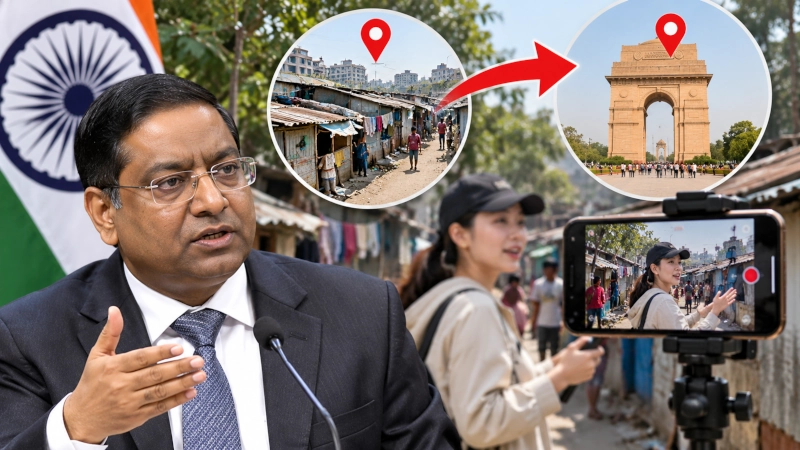
India has strongly criticised reports of Chinese social media influencers filming economically disadvantaged neighbourhoods in Bangladesh and falsely presenting the locations as parts of New Delhi. The Ministry of External Affairs described such attempts to misrepresent another country’s geographical locations and living conditions as unfortunate, warning that the dissemination of misleading narratives undermines the credibility of those involved.
Responding to questions during a media briefing in New Delhi on 10 November 2026, Ministry of External Affairs spokesperson Randhir Jaiswal said the Government had taken note of reports concerning foreign content creators operating in Bangladesh’s capital, Dhaka. He urged the authorities concerned to take appropriate action against individuals involved in spreading misleading information about India.
The controversy follows investigative reporting in Bangladesh alleging that Chinese nationals have been recording and livestreaming footage from neighbourhoods in Dhaka while identifying the locations to online audiences as New Delhi.
Ministry of External Affairs Calls for Action Against False Narratives
Addressing the controversy, Randhir Jaiswal confirmed that the Ministry of External Affairs had seen media reports concerning the activities of Chinese content creators in Bangladesh.
He described attempts to present a distorted image of another country as unfortunate and emphasised that spreading false narratives damages the credibility of those responsible for producing and disseminating such material.
The spokesperson specifically referred to reports concerning foreign individuals portraying parts of Dhaka as Delhi and called upon the relevant authorities to take appropriate action.
India’s response reflects concern over the deliberate misidentification of geographical locations in digital content, particularly when such material is accompanied by commentary that could create misleading impressions of another country’s social and economic conditions.
The Ministry’s remarks also underline the importance of accountability in cross-border digital communication, where inaccurate representations can rapidly circulate among international audiences.
Chinese Influencers Filming in Dhaka’s Uttara and Tekpara Areas
The controversy emerged following investigative reporting by Bangladeshi newspaper Prothom Alo, which documented the activities of Chinese vloggers and livestreamers operating in the Uttara and Tekpara neighbourhoods of Dhaka.
According to the investigation, approximately 150 Chinese nationals were reportedly involved in filming and broadcasting content from these areas, although the precise number has not been independently established.
The content creators allegedly recorded streets, residential buildings, small businesses and densely populated neighbourhoods while presenting the footage to viewers as scenes from India’s national capital.
Reports indicated that the videos were circulated through Chinese digital platforms, including Douyin and WeChat, with some broadcasts containing disparaging commentary about housing, sanitation, infrastructure and living conditions.
The central concern raised by the reporting was not the documentation of economically disadvantaged communities, but the alleged misrepresentation of locations in Bangladesh as being situated in India.
Such geographical misidentification can mislead viewers about the conditions prevailing in the country being portrayed, particularly when audiences are unfamiliar with the locations shown in the recordings.
November 1 Livestream Raises Questions About Misleading Content
One incident highlighted in the Bangladeshi investigation involved a Chinese woman reportedly livestreaming from Uttara’s Sector 12 on 1 November 2026.
During the broadcast, the individual allegedly identified the location as New Delhi while making negative observations about housing conditions, sanitation and infrastructure.
The investigation also described other Chinese content creators filming neighbourhood streets, roadside businesses and residential areas while making comments that appeared to attribute local conditions to India.
Bangladeshi media reports further indicated that some foreign content creators had engaged local residents as guides and facilitators to assist with filming activities.
The reported incidents have raised questions about how digital audiences can distinguish authentic geographical reporting from material that misrepresents where footage was recorded.
While the available reports document allegations of misleading broadcasts, the identities of those who may have organised or financed the activities and whether the individual livestreamers were operating as part of a coordinated campaign have not been conclusively established.
India Highlights the Credibility of Digital Information
The Ministry of External Affairs’ response draws attention to the wider challenge of misleading information circulating through international social media networks.
Digital platforms allow individuals to broadcast live video to large audiences, often without independent verification of the geographical locations or circumstances being depicted.
When footage from one country is deliberately attributed to another, viewers can be presented with an inaccurate understanding of the society, infrastructure or living conditions being discussed.
Such practices become particularly concerning when misleading location descriptions are accompanied by commentary intended to create negative perceptions of the country being represented.
India’s official response emphasises that the credibility of digital content depends on accurate geographical identification and truthful representation.
The controversy also highlights the importance of verifying the origin of online material before treating it as reliable evidence of conditions in another country.
Development Comes Amid India-China Diplomatic Engagement
The controversy has emerged during a period in which India and China have been working to stabilise bilateral relations following several years of tensions along the Line of Actual Control.
The two countries reached an understanding in October 2024 concerning patrolling arrangements in certain areas along their disputed boundary, creating conditions for further diplomatic engagement.
Since then, bilateral discussions have addressed border management, diplomatic relations and the gradual restoration of engagement across various sectors.
Against this backdrop, the controversy surrounding the alleged misrepresentation of Dhaka neighbourhoods demonstrates how digital information can become a sensitive issue in the wider environment of international relations.
However, the Ministry of External Affairs’ statement did not publicly establish that the reported activities were directed or financed by the Chinese Government. The official response focused on the misleading nature of the reported content and the need for action against those responsible.
India Calls for Accountability in Cross-Border Digital Content
India’s response to the reported activities of Chinese influencers in Bangladesh reinforces the importance of accuracy and accountability in international digital communication.
By publicly challenging attempts to portray Dhaka neighbourhoods as New Delhi, the Ministry of External Affairs has drawn attention to the potential consequences of geographical misrepresentation and misleading narratives.
The controversy also demonstrates the growing importance of credible information in shaping perceptions of countries among international audiences, particularly as social media platforms become increasingly influential sources of news and commentary.
The Government’s call for appropriate action places responsibility on the relevant authorities to examine the reported activities and address instances of deliberate misinformation.
At a time when digital content can circulate across national boundaries almost instantaneously, ensuring that geographical locations and associated claims are accurately represented remains essential to maintaining public trust and credibility in international communication.
You may also like
-
India Amends Immigration Rules, Eases Passport and Visa Requirements for Specified Foreign Nationals
-
India Reduces Prices of 120 Cancer Medicines as 70 Pharma Companies Submit Revised Rates
-
India Crosses 65 Lakh Rooftop Solar Installations Under PM Surya Ghar Yojana
-
Japan’s Emerging Indo-Pacific Security Network: Why India Is Becoming a Strategic Partner in Asia’s Balance of Power
-
India Notifies Bharatiya Vayuyan Niyam 2026, Replacing 89-Year-Old Aviation Rules
