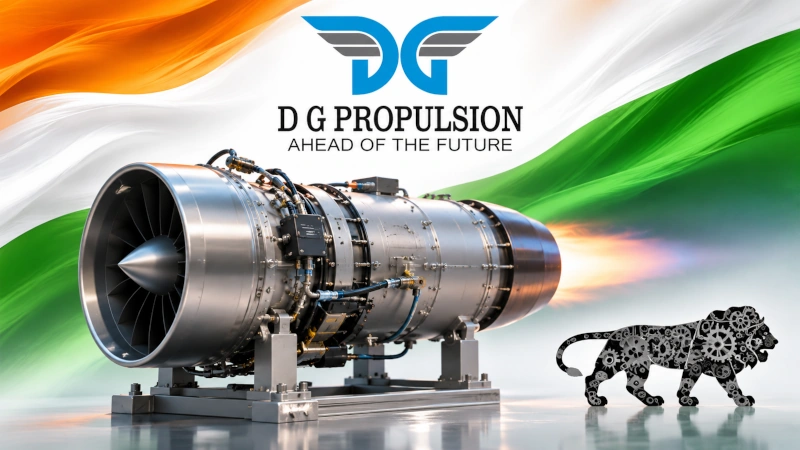
Indian aerospace startup DG Propulsion has successfully conducted repeated automatic relight tests on its indigenously developed J100 turbojet engine, demonstrating the ability to restart the engine following a deliberate interruption of fuel supply. The tests represent an important development in the company’s efforts to improve the reliability and operational characteristics of its indigenous propulsion systems for unmanned aerial vehicles.
Announcing the achievement on November 12, 2026, DG Propulsion founder Prateek Dhawan confirmed that the company’s engineers had tested the engine’s relight control firmware by deliberately interrupting the fuel supply to its pump, causing the engine to shut down. The procedure was repeated multiple times to assess the system’s ability to restore combustion after a fuel interruption.
According to Dhawan, the J100 engine successfully restarted during every reported test, including instances when its rotational speed had declined to approximately 2,000–3,000 revolutions per minute (RPM). The results demonstrate the functionality of the company’s relight system under the conditions reproduced during testing.
Automatic Relight Demonstrated Following Fuel Interruption
The testing programme focused on evaluating the J100 turbojet engine’s ability to recover after combustion had been interrupted.
During normal turbojet operation, a continuous supply of fuel is required to sustain combustion and produce thrust. Interruptions in fuel delivery can cause combustion to cease, resulting in a loss of engine power.
DG Propulsion’s engineers deliberately interrupted fuel delivery to simulate conditions that could arise from air bubbles in the fuel system or other temporary disruptions.
The engine was then allowed to lose rotational speed before the relight control system initiated the restart process.
Prateek Dhawan confirmed that the engine successfully relit even after its rotational speed had fallen to approximately 2,000–3,000 RPM.
The ability to restore combustion at such low rotational speeds is a significant result of the company’s reported testing, particularly because the J100 is designed to operate at rotational speeds reaching 65,000 RPM.
The repeated tests provided the company with an opportunity to examine the engine’s restart behaviour under deliberately induced fuel-interruption conditions.
Indigenous Relight Firmware and Engine Control
The automatic relight capability is associated with the engine control firmware developed by DG Propulsion.
Modern turbojet engines depend on coordinated control of fuel delivery, ignition and engine operating parameters to maintain stable combustion and respond to changes in operating conditions.
An engine relight function is intended to restore combustion after an interruption, provided the conditions required for a successful restart are available.
The J100 testing demonstrated the operation of this functionality following repeated simulated fuel-supply interruptions.
DG Propulsion identifies proprietary electronic engine control systems, digital engine monitoring and telemetry among its technological capabilities.
These systems form part of the company’s approach to developing integrated propulsion solutions for unmanned aerial platforms.
The latest demonstration provides a specific test result associated with the J100’s engine control software and restart functionality.
J100 Turbojet Designed for 100 kgf Thrust Class
The DG J100 is an indigenous turbojet engine developed for unmanned aerial vehicles and defence applications requiring relatively high thrust from a compact propulsion system.
According to the company’s official technical specifications, the J100 belongs to the 100 kilogram-force thrust class and has a dry weight of approximately 9 kilograms.
The engine measures 496 millimetres in length and has an outer diameter of 203 millimetres, providing a compact configuration for integration into unmanned aircraft.
Its maximum rotational speed is listed as 65,000 RPM, while the nominal idle speed is approximately 20,000 RPM, which the company describes as adjustable.
The engine has a specified pressure ratio of 3.8 and is designed to operate using aviation turbine fuel and other compatible fuels identified by the manufacturer.
The J100’s combination of compact dimensions and high rotational speed reflects the engineering requirements associated with small turbojet propulsion systems.
The engine is intended for applications involving higher-payload unmanned aerial vehicles and other platforms requiring compact jet propulsion.
Importance of Relight Capability in Unmanned Aircraft
Engine reliability is an important requirement for unmanned aerial vehicles, particularly those intended for missions involving extended flight durations or operation without continuous human intervention.
A temporary interruption in fuel delivery can affect engine combustion and thrust generation. Without a functioning relight capability, such an interruption may result in an engine shutdown that cannot be recovered during operation.
An automatic relight system is designed to restore combustion without requiring manual intervention, subject to the aircraft’s operating conditions and the limitations of the propulsion system.
For unmanned aircraft, the ability to recover from temporary combustion interruptions is relevant to propulsion reliability and the continuity of flight operations.
The J100 tests demonstrate that DG Propulsion’s relight system successfully restored combustion under the simulated interruption conditions described by the company.
However, the announcement concerns the reported test procedure and does not establish that the same capability has undergone in-flight qualification across the engine’s operating envelope.
Indigenous Jet Engine Development and Testing Infrastructure
DG Propulsion is developing a range of compact turbojet engines for unmanned aircraft and related aerospace applications.
The company’s product portfolio includes the J40 and J100 turbojet platforms, which address different thrust requirements.
The J40 is designed for smaller unmanned aircraft applications, while the J100 provides a higher-thrust option for platforms with greater propulsion requirements.
DG Propulsion’s development activities encompass engine design, manufacturing, assembly, testing and integration support.
The company also operates dedicated engine testing facilities equipped to evaluate thrust, exhaust gas temperature, rotational stability and repeated engine-start behaviour.
In September 2026, Prateek Dhawan announced that the company’s upgraded test infrastructure had become operational, providing additional facilities for repeatable engine testing and validation.
Such infrastructure is important for evaluating propulsion systems under controlled conditions and collecting technical data during successive development and testing cycles.
The November relight demonstration forms part of this continuing engine development and validation activity.
Development of Indigenous Propulsion Capabilities
India’s expanding unmanned aviation sector requires propulsion systems suited to different aircraft configurations, payload capacities and operational requirements.
Small turbojet engines represent a specialised segment of aerospace engineering, requiring expertise in compressor design, combustion systems, turbine components, high-speed rotating machinery and electronic engine controls.
DG Propulsion is developing these technologies domestically, with an emphasis on manufacturing compact jet engines and supporting their integration into unmanned platforms.
The company’s J100 programme combines mechanical propulsion engineering with electronically controlled operating functions, including the relight system demonstrated during the latest tests.
The reported results add to the company’s ongoing work on engine performance, control software and repeatable testing.
The successful repeated relight tests establish a demonstrated capability of the J100’s control system under simulated fuel-interruption conditions, adding an important technical result to DG Propulsion’s indigenous turbojet development programme.
You may also like
-
IISc-Incubated Thinking Balloon Successfully Tests Autonomous Tethered Aerostat Near Bengaluru
-
CUMI’s Indigenous Ceramic Vehicle Armour Achieves NATO STANAG Level 4 Qualification
-
Hathor Rockets Plans ₹250 Crore Rocket Engine Manufacturing and Testing Facility in Andhra Pradesh
-
Alembic Pharmaceuticals Secures USFDA Approval for Generic Cancer Drug, Eligible for 180-Day Exclusivity
-
Escorts Kubota Plans New Tractor Manufacturing Plant in Uttar Pradesh with Initial Capacity of 60,000 Units
