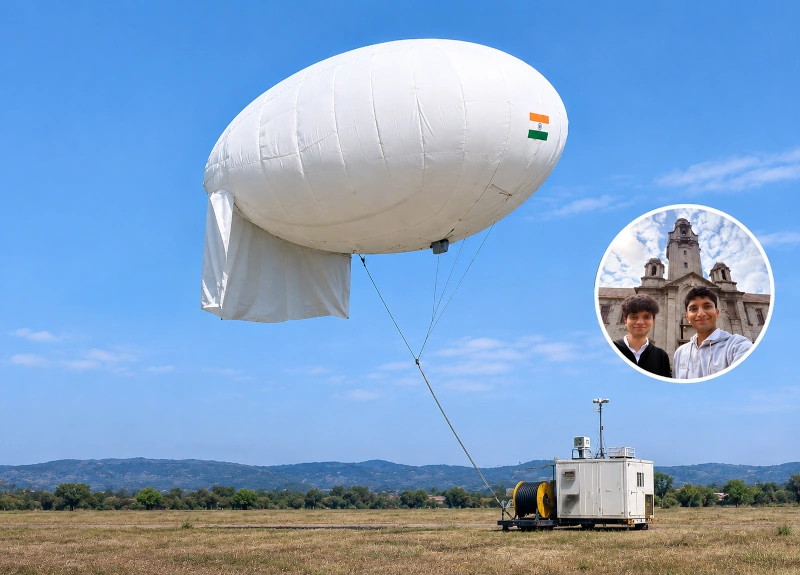
Bengaluru-based aerospace and defence technology startup Thinking Balloon has successfully conducted a three-day field trial of its indigenously developed autonomous tethered aerostat system near Nelamangala, on the outskirts of Bengaluru. The trials, conducted from 28 to 30 October 2026, demonstrated an automated aerial platform designed to support persistent surveillance, communications and monitoring operations with reduced dependence on ground personnel.
The development was confirmed by the Foundation for Science, Innovation and Development (FSID), the startup incubation organisation associated with the Indian Institute of Science (IISc), Bengaluru. Thinking Balloon has developed an integrated system capable of launching an aerostat, maintaining its designated altitude, recovering it, docking it at a ground station and conducting servicing operations through automated mechanisms.
The startup also conducted a public demonstration on 30 October 2026, attended by representatives from industry, the media and the startup ecosystem. According to the company’s founders, the technology has been designed and developed in Bengaluru.
Three-Day Trial Demonstrates Autonomous Aerostat Operations
Thinking Balloon’s field trials demonstrated the operation of an automated aerostat platform integrated with a ground-based control and servicing station.
Unlike conventional unmanned aerial vehicles that depend on propulsion systems to remain airborne, tethered aerostats use lifting gas to maintain altitude. The balloon remains connected to a ground station through a tether, allowing it to carry surveillance cameras, communications equipment and other mission-specific payloads at an elevated position.
The company’s autonomous system is designed to manage the aerostat’s operational cycle, including launch, altitude maintenance, recovery, docking and servicing.
According to Rushabh Chalke, co-founder and Chief Executive Officer of Thinking Balloon, the ground station has been developed to launch and operate the balloon, maintain it at a selected altitude and recover it for lifting-gas replenishment without requiring manual handling throughout the process.
The three-day demonstration provided an opportunity to test the integrated system under field conditions and demonstrate its capabilities to potential users and industry representatives.
The company’s testing programme has also achieved more than 100 autonomous launch-and-recovery cycles, according to an update published on its official website on 9 November 2026.
Indigenous Development of Aerostat and Ground Station
Thinking Balloon operates through Thinking Near Space Private Limited and was established by brothers Rushabh Chalke and Saurabh Chalke.
Rushabh Chalke serves as co-founder and Chief Executive Officer, while Saurabh Chalke is co-founder and Chief Technology Officer.
The startup is incubated at the Foundation for Science, Innovation and Development at IISc Bengaluru, which supports the development and commercialisation of advanced technologies.
Thinking Balloon specialises in autonomous aerial infrastructure designed for defence, security, industrial monitoring and communications applications.
The company’s technology consists of three principal components: a tethered aerostat platform, an autonomous ground station and software designed to manage aerostat operations.
The aerostat carries mission-specific payloads while the tether connects it to the ground station. A stabilising sail helps maintain its orientation relative to the wind.
The ground station manages the mechanical processes associated with launch and recovery, while the software coordinates the platform’s operating cycle.
According to the company, the complete system has been designed and developed in Bengaluru.
Autonomous Launch, Recovery and Gas Replenishment
The principal technological significance of Thinking Balloon’s system lies in automating the ground-handling operations that traditionally require dedicated personnel and specialised equipment.
The operating sequence begins with the ground station releasing the aerostat and progressively extending the tether as the balloon gains altitude.
Once the aerostat reaches its designated operating height, the control system maintains its position and orientation, allowing the onboard payload to perform its assigned functions.
When recovery is required, the ground station uses a controlled winch mechanism to bring the balloon back towards the launch platform.
The aerostat then docks with the station, where servicing operations include system checks and lifting-gas replenishment.
The system is designed to repeat this operating sequence, reducing the requirement for personnel to manually launch, recover and secure the balloon.
Thinking Balloon has also incorporated protective mechanisms intended to secure the aerostat during power interruptions or control-system failures. According to the company, the ground station is designed to hold the tether securely if power is lost, while its safety systems prevent automatic restarting following certain fault conditions.
These features form part of the company’s approach to developing autonomous aerial infrastructure suitable for prolonged operations.
Applications in Border Surveillance and Coastal Security
Thinking Balloon is developing its aerostat technology for persistent surveillance and communications applications relevant to India’s defence and security requirements.
Tethered aerostats offer an operational advantage by positioning sensors above ground-level obstacles, thereby extending their observation and communication horizons without requiring continuous powered flight.
The company identifies border surveillance, coastal monitoring, military installations and temporary operational sites among the potential applications of its technology.
An elevated surveillance platform can provide an observation point for monitoring terrain, approaches to sensitive installations and other areas requiring persistent coverage.
The aerostat can also support communications equipment, enabling radio links to operate over terrain and obstacles that may restrict ground-based systems.
Thinking Balloon’s development programme includes concepts for integrating surveillance cameras, communication relays and other specialised payloads onto a common airborne platform.
The company is also exploring early-warning applications involving low-flying aerial objects, although these capabilities remain part of its broader development programme rather than demonstrated operational deployments.
Industrial Monitoring and Aerospace Testing Applications
Beyond defence and security, Thinking Balloon is developing its autonomous aerostat platform for industrial infrastructure monitoring and aerospace testing.
The company has identified ports, industrial plants and aerospace test ranges as its initial application areas.
At ports and industrial installations, tethered aerostats can provide elevated observation positions above buildings, storage areas, cranes and other structures.
The company plans to integrate day-and-night camera systems capable of supporting monitoring activities across such facilities.
Another proposed application involves aerospace testing, where an aerostat can serve as an elevated platform for telemetry relay, counter-drone evaluations and controlled drop-testing activities.
Thinking Balloon has designed its system around a common payload interface that can accommodate different equipment without requiring fundamental changes to the aerostat platform.
According to the company’s 9 November 2026 update, initial pilot activities involving ports and industrial facilities are beginning.
The company has also emphasised the importance of defining operational boundaries for surveillance activities, including agreements governing camera coverage and data retention before deployment at industrial sites.
Development of Next-Generation Aerostat Platforms
Following the successful field trials, Thinking Balloon is developing a subsequent version of its autonomous aerostat system.
According to Chief Technology Officer Saurabh Chalke, the next platform is being designed to operate across a wider range of weather conditions while increasing the level of automation throughout its flight cycle.
The company is working towards improving the system’s ability to operate in varying wind and atmospheric conditions.
Thinking Balloon has stated that its operating limits will be published after the relevant testing and measurements have been completed.
The company’s broader technology roadmap includes fixed-site aerostat installations and smaller road-mobile systems that can be deployed at temporary locations.
The fixed-site concept is intended for applications requiring elevated surveillance and communications platforms, while mobile variants are being developed for operations at temporary installations, events and disaster-affected areas.
These systems remain part of the company’s development programme, with future capabilities subject to engineering validation and field testing.
IISc Incubation Supports Indigenous Aerospace Innovation
Thinking Balloon’s development reflects the role of academic incubation programmes in supporting Indian startups working on specialised aerospace and defence technologies.
The Foundation for Science, Innovation and Development at IISc Bengaluru has supported the startup as part of its efforts to translate scientific and engineering expertise into practical industrial technologies.
FSID congratulated the company’s founders following the three-day trial and highlighted the relevance of indigenous aerial infrastructure to India’s border and coastal security requirements.
The organisation also expressed its continued support for the startup’s development of autonomous aerostat technologies.
Thinking Balloon’s progress illustrates the increasing participation of Indian deep technology startups in advanced aerospace systems, particularly technologies involving autonomous control, integrated mechanical systems and aerial sensor platforms.
Strengthening India’s Indigenous Autonomous Aerial Infrastructure
The successful three-day field trial near Bengaluru represents an important milestone in Thinking Balloon’s development of autonomous tethered aerostat technology.
The achievement demonstrates the integration of an indigenous aerostat platform with automated launch, altitude control, recovery and servicing infrastructure, addressing several operational challenges associated with conventional tethered balloon systems.
With more than 100 autonomous launch-and-recovery cycles completed during field testing, the company has established an initial technical foundation for further development.
Its ongoing work on improved weather tolerance, automated ground operations and mission-specific payload integration reflects the expanding capabilities of India’s private aerospace technology sector.
As Thinking Balloon advances its planned industrial pilots and next-generation platforms, the project adds to India’s indigenous engineering capabilities in persistent aerial observation, communications and autonomous aerospace systems.
You may also like
-
CUMI’s Indigenous Ceramic Vehicle Armour Achieves NATO STANAG Level 4 Qualification
-
Hathor Rockets Plans ₹250 Crore Rocket Engine Manufacturing and Testing Facility in Andhra Pradesh
-
Alembic Pharmaceuticals Secures USFDA Approval for Generic Cancer Drug, Eligible for 180-Day Exclusivity
-
Escorts Kubota Plans New Tractor Manufacturing Plant in Uttar Pradesh with Initial Capacity of 60,000 Units
-
DISA India Inaugurates New Manufacturing Facility in Karnataka, Expands Industrial Equipment Production
