Warcraft Strategies from the Purāṇas | Śrīmad Bhāgavata Purāṇa, Sixth Skandha, Chapters 9–12
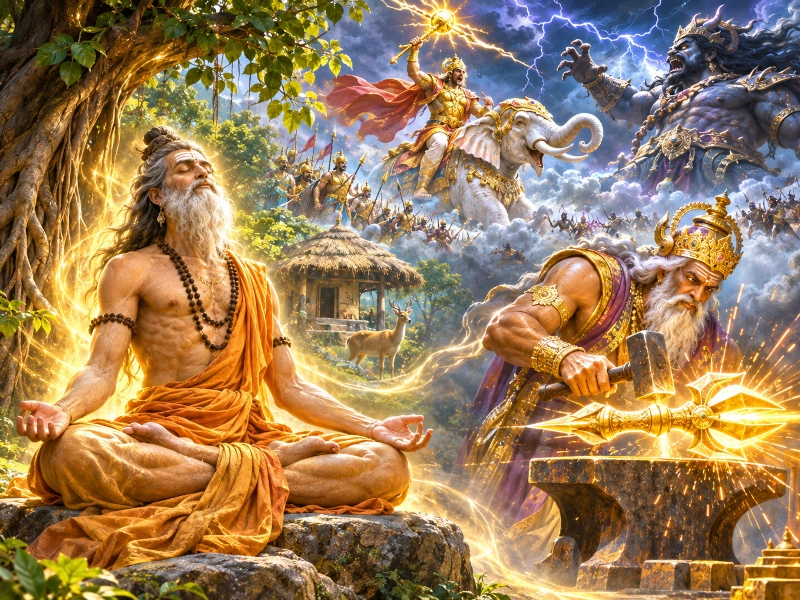
The conflict between the Devas and Vṛtrāsura represents one of the most significant military confrontations described in the Śrīmad Bhāgavata Purāṇa. At the centre of this narrative stands an extraordinary act of sacrifice by the sage Dadhīci, whose bones were used to create the Vajra, the divine thunderbolt wielded by Indra. The episode combines the themes of spiritual power, weapons development, military leadership and the willingness of an individual to surrender his life for the welfare of others.
The origins of the confrontation lay in the circumstances surrounding the death of Viśvarūpa, the son of Tvaṣṭā. Indra had appointed Viśvarūpa as the priest of the Devas after losing the guidance of Bṛhaspati. However, Viśvarūpa secretly offered portions of sacrificial offerings to the Asuras because of his maternal relationship with them. Upon discovering this, Indra killed Viśvarūpa, provoking Tvaṣṭā to perform a powerful sacrifice intended to destroy the ruler of the Devas.
From this sacrificial rite emerged Vṛtrāsura, a formidable being whose strength threatened the celestial armies. The Devas confronted him with their weapons, but their attacks proved ineffective. Vṛtrāsura overwhelmed their resistance, leaving Indra and his forces unable to defeat the enemy through their existing military capabilities.
The military significance of this crisis lies in the failure of conventional weapons against an adversary possessing overwhelming defensive and offensive capabilities. The Devas faced a situation in which numerical strength and established battlefield methods could no longer guarantee victory.
The Search for a Weapon Capable of Defeating Vṛtrāsura
Unable to overcome Vṛtrāsura, the Devas sought the protection of Lord Viṣṇu. Their appeal reflected the severity of the military situation, as the survival of their celestial order depended upon finding a means of neutralising an enemy whom their available weapons could not defeat.
Viṣṇu instructed the Devas to approach the sage Dadhīci, the son of Atharvan. The sage had acquired extraordinary spiritual strength through his knowledge, austerities and disciplined observances. According to the divine instruction, his body possessed qualities that would make his bones suitable for creating a powerful weapon.
Viṣṇu explained that Viśvakarmā, the celestial architect, could fashion the Vajra from Dadhīci’s bones. Empowered by the sage’s spiritual strength and divine power, this weapon would become capable of destroying Vṛtrāsura.
This episode introduces a fundamental principle of military innovation: when existing weapons cannot overcome a particular threat, the solution may require the development of a specialised capability rather than the continued use of ineffective systems.
The proposed Vajra was not presented merely as another addition to Indra’s armoury. It was intended to overcome the particular enemy against whom the Devas had repeatedly failed.
Dadhīci’s Decision: Sacrifice for the Collective Good
Following Viṣṇu’s instructions, the Devas approached Dadhīci and requested his body so that its bones could be used to manufacture the Vajra. Their request was extraordinary, for it demanded the voluntary surrender of the sage’s physical existence.
Dadhīci initially questioned the Devas about the pain associated with death and the natural attachment of living beings to their bodies. His questions prompted a discussion of duty, sacrifice and the responsibilities of those who seek the welfare of others.
The Devas acknowledged the greatness of the sacrifice they were requesting. They explained that individuals possessing compassion and an understanding of Dharma could willingly undertake extraordinary acts for the benefit of others.
Dadhīci ultimately agreed. He recognised that the physical body was temporary and that its highest purpose could be fulfilled through service to a greater cause. Having resolved to make the sacrifice, he withdrew his senses, controlled his life force and entered profound spiritual absorption.
Through his yogic discipline, Dadhīci relinquished his physical body, making his bones available for the creation of the Vajra.
From a military perspective, Dadhīci’s sacrifice illustrates the relationship between individual commitment and collective security. The survival of an entire fighting force depended upon the willingness of one individual to provide what no other source could supply.
The episode also distinguishes personal sacrifice from the pursuit of military glory. Dadhīci did not enter the battlefield seeking victory or recognition. His contribution lay in providing the means through which others could confront the danger.
Viśvakarmā Forges the Vajra
Following Dadhīci’s sacrifice, Viśvakarmā fashioned the Vajra from the sage’s bones. The Śrīmad Bhāgavata Purāṇa describes the weapon as possessing the spiritual potency of Dadhīci and the power bestowed by the Supreme Lord.
Indra received the completed Vajra and prepared to confront Vṛtrāsura. Mounted upon Airāvata, his celestial elephant, and accompanied by the Devas, he advanced towards the battlefield.
The creation of the Vajra transformed the military situation. Previously, the Devas had been unable to inflict decisive damage upon their adversary. They now possessed a weapon specifically identified as capable of overcoming Vṛtrāsura.
The military importance of Viśvakarmā’s contribution lies in the conversion of an exceptional source of strength into an operational weapon. The narrative links specialised knowledge, weapon construction and battlefield requirements through a single strategic objective.
Although the Vajra belongs to the supernatural world of Purāṇic warfare, the episode offers a conceptual parallel to the development of specialised weapon systems designed to overcome a particular military challenge.
It also highlights the importance of the relationship between those who identify an operational requirement, those who provide the necessary resources and those who possess the expertise to create the required capability.
Indra Returns to the Battlefield
With the Vajra in his possession, Indra led the Devas into battle against Vṛtrāsura and the Asura armies.
The confrontation was immense. The Śrīmad Bhāgavata Purāṇa describes powerful warriors, formidable weapons and intense fighting between the opposing forces. Vṛtrāsura commanded the Asura side and demonstrated considerable courage and determination.
As the fighting progressed, many Asura warriors began abandoning the battlefield. Vṛtrāsura condemned their retreat and reminded them of the duties of warriors. He declared that victory brought worldly rewards, while a courageous death in battle carried its own spiritual significance.
His appeal revealed a commander determined to maintain the fighting spirit of his forces even as their resistance weakened.
The conduct of Vṛtrāsura demonstrates the importance of morale and command leadership during battlefield reverses. A force may possess considerable military power, but the collapse of its fighting spirit can undermine its ability to continue organised resistance.
Indra eventually confronted Vṛtrāsura in a decisive engagement. The battle was not resolved immediately, and the narrative describes fierce exchanges between the two warriors. Vṛtrāsura continued fighting despite severe injuries and demonstrated remarkable spiritual composure in the face of death.
Ultimately, Indra used the Vajra to sever Vṛtrāsura’s head, bringing the confrontation to its conclusion.
The weapon created through Dadhīci’s sacrifice had fulfilled the purpose for which it was fashioned.
Military Significance: Weapons Development and Strategic Necessity
The Dadhīci–Vajra episode offers several important insights into the relationship between military necessity, technological capability and strategic leadership.
First, the narrative demonstrates the importance of identifying the limitations of existing weapons. The Devas repeatedly failed against Vṛtrāsura because their conventional capabilities were inadequate. Their eventual success followed the acquisition of a weapon suited to the particular challenge they faced.
Second, the episode highlights the role of specialised expertise in weapons development. Viśvakarmā’s ability to construct the Vajra was essential. The sage’s sacrifice alone could not produce a battlefield capability without the intervention of the celestial craftsman.
Third, the narrative illustrates the value of integrating spiritual authority, technical knowledge and military command. Viṣṇu identified the necessary solution, Dadhīci provided the extraordinary material, Viśvakarmā created the weapon and Indra employed it in combat.
Fourth, the story emphasises that possession of a powerful weapon must be accompanied by the willingness and ability to employ it effectively. Indra still had to lead his forces into battle and confront Vṛtrāsura directly.
The narrative therefore presents a sequence extending from the identification of a military problem to the creation and eventual employment of a decisive weapon.
The Enduring Legacy of Dadhīci’s Sacrifice
The story of Dadhīci occupies a distinctive place in the military narratives of the Purāṇas because the decisive contribution comes not from a warrior on the battlefield but from a sage who willingly relinquishes his body for the protection of others.
His sacrifice enabled Viśvakarmā to create the Vajra, restored Indra’s ability to challenge Vṛtrāsura and provided the Devas with the means to overcome a formidable adversary.
The episode ultimately presents military strength as something greater than the possession of weapons alone. It emerges from the convergence of knowledge, sacrifice, technical skill, leadership and commitment to a larger purpose.
Dadhīci’s legacy reminds us that the foundations of military victory can be established far from the battlefield, through acts of extraordinary dedication that make decisive capabilities possible.
You may also like
-
Indian Railways Approves Weekly Train Service Connecting Nepal’s Janakpur Dham with Ayodhya
-
Indra versus Vṛtrāsura: The Vajra, Battlefield Strategy and the Extraordinary Reversal of Defeat
-
Vibhīṣaṇa’s Defection: Rāma’s Decision to Grant Asylum to an Enemy Prince
-
Cabinet Approves ₹3,230 Crore Yuge Yugeen Bharat Museum at Historic North and South Blocks
-
PM Modi Inaugurates India’s First LED Dome Planetarium at Mysuru
