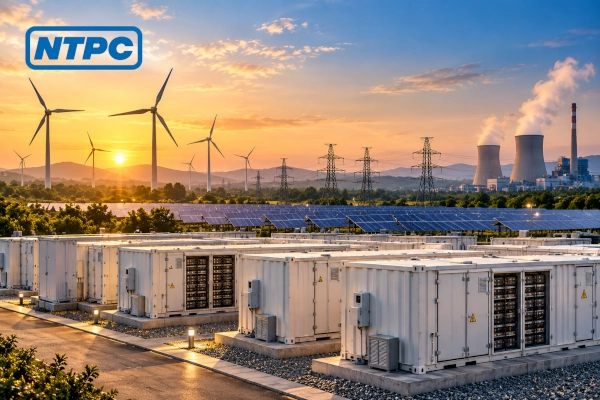
NTPC Vidyut Vyapar Nigam Limited (NVVN), a wholly owned subsidiary of NTPC Limited, is preparing to begin commercial operations of 500 megawatt-hours (MWh) of battery energy storage capacity, marking an important development in India’s expanding electricity storage infrastructure. The company is also targeting an additional 500 MWh during the current financial year, taking its planned commissioning capacity to 1,000 MWh by March 2027.
NVVN Chief Executive Officer Somes Bandyopadhyay disclosed the plans on 8 October 2026 while speaking to reporters on the sidelines of the 18th India Coal Summit organised by the Indian Chamber of Commerce in New Delhi. He indicated that the first 500 MWh project would be synchronised with the electricity grid shortly, with commercial operations expected to follow.
The expansion comes as India develops large-scale battery energy storage systems (BESS) to accommodate growing renewable electricity generation. These systems can store surplus electricity and deliver it when demand increases, providing greater flexibility to the national power grid.
NVVN Prepares to Commission Its First 500 MWh Battery Storage Project
According to Bandyopadhyay, NVVN expects to synchronise its initial 500 MWh battery storage capacity within days. Grid synchronisation will allow the system to be connected and tested under operational conditions before commercial service begins.
The company plans to commission another 500 MWh before the conclusion of FY2026–27. Achieving both milestones would establish 1,000 MWh of operational storage capacity under NVVN’s near-term programme.
Bandyopadhyay explained that the company is developing projects through different implementation arrangements under a government-backed programme covering 3,000 MWh of battery storage. The programme provides a larger framework for NVVN’s entry into utility-scale energy storage.
While the management statement confirms the commissioning targets, detailed information on the first project’s location, technology supplier, investment and commercial operating arrangements has not been publicly established. The additional 500 MWh also remains a target rather than commissioned capacity.
Government-Backed Programme Supports 3,000 MWh Storage Development
NVVN’s battery storage plans are linked to government initiatives intended to accelerate the deployment of energy storage infrastructure across India.
The Ministry of Power has introduced viability gap funding arrangements to support battery storage projects that may otherwise face financial challenges during their initial development.
Viability gap funding provides financial assistance to eligible infrastructure projects, helping bridge the difference between their commercial revenues and the investment required for development.
Battery storage projects require substantial upfront expenditure on battery modules, power conversion equipment, control systems, cooling infrastructure and grid connections. Government support can improve their financial viability while encouraging competitive procurement.
In February 2024, the Ministry of Power announced mechanisms for implementing a 4,000 MWh battery storage programme, with NVVN participating in discussions alongside major electricity sector organisations.
The subsequent expansion of storage procurement reflects the government’s increasing emphasis on flexible electricity infrastructure capable of supporting renewable generation and peak demand management.
How Battery Energy Storage Systems Work
A Battery Energy Storage System stores electrical energy in rechargeable batteries and releases it when required.
Unlike conventional electricity generation facilities, a battery storage installation does not produce primary energy. Instead, it temporarily stores electricity obtained from the grid or generation sources such as solar and wind power plants.
During periods of high renewable electricity generation, the system can absorb surplus power that might otherwise be curtailed or sold at low prices. The stored energy can then be delivered during evening demand peaks or periods when renewable generation declines.
A utility-scale installation generally consists of battery modules, a battery management system, bidirectional power converters, thermal management equipment and supervisory control software. These components coordinate charging, discharging and safe operation.
Modern battery storage facilities also employ monitoring and protection systems to manage temperature, electrical conditions and equipment performance.
The ability to respond rapidly to changing grid requirements makes battery storage particularly useful for electricity systems integrating increasing quantities of renewable energy.
Understanding the Difference Between MW and MWh
Battery storage projects are commonly described using two measurements: megawatts (MW) and megawatt-hours (MWh).
Megawatts indicate the amount of electrical power a system can deliver at a particular moment. Megawatt-hours measure the total quantity of energy the battery can store or supply over time.
For example, a 500 MWh battery installation configured to deliver 125 MW could theoretically operate at that output for four hours. The same storage capacity configured for 250 MW could theoretically supply electricity for two hours.
Actual performance depends on battery operating limits, efficiency, system configuration and discharge requirements.
Consequently, NVVN’s 1,000 MWh target describes its planned energy storage capacity rather than its instantaneous electricity output. The corresponding MW rating depends on the specifications of individual projects.
NVVN Develops Battery Storage Projects Across Indian States
NVVN has already initiated competitive procurement processes for utility-scale battery storage projects in different parts of India.
In December 2025, the company issued a tender for the development of a 125 MW/500 MWh standalone battery energy storage system in Chhattisgarh. The project was structured under a build-own-operate model, with the selected developer responsible for establishing and operating the facility.
The tender contemplated a four-hour storage configuration, enabling the system to deliver electricity over an extended period rather than providing only short bursts of power.
NVVN also initiated procurement for a 250 MW/500 MWh battery storage installation in Kerala for the Kerala State Electricity Board. That procurement was designed to support electricity system requirements through grid-connected storage infrastructure.
These projects demonstrate how NVVN is building a portfolio of storage developments through competitive bidding and partnerships with electricity utilities.
They also establish the company’s growing role as a facilitator of energy storage deployment rather than merely a conventional electricity trading organisation.
Battery Storage Can Reduce Pressure During Peak Electricity Demand
India’s electricity demand varies significantly throughout the day, with consumption influenced by industrial activity, commercial operations, agricultural requirements and household electricity usage.
Demand frequently increases during evening hours, when residential lighting, cooling appliances and other electrical equipment are operating simultaneously.
At the same time, solar electricity generation declines as daylight fades. This creates a period when power utilities must rely more heavily on other generating sources to maintain supply.
Battery storage can help bridge this gap by supplying electricity accumulated during periods of lower demand or higher renewable generation.
Utilities can also use storage systems to reduce their dependence on expensive short-term electricity purchases during selected peak periods.
The economic benefits depend on electricity prices, charging costs, battery efficiency, operating patterns and contractual arrangements. Nevertheless, storage provides an additional resource for managing fluctuations between electricity supply and consumption.
Expanding Renewable Energy Requires Greater Grid Flexibility
India’s electricity system is undergoing a significant transformation as solar and wind power account for a growing proportion of installed generating capacity.
Unlike conventional thermal power stations, solar and wind facilities produce electricity according to changing weather conditions and resource availability.
Solar output follows the daily movement of the sun, while wind generation can vary across hours and seasons. These characteristics increase the importance of technologies capable of balancing electricity supply with demand.
Battery storage can absorb electricity during periods of surplus generation and return it when production declines. It can also provide rapid responses to selected grid disturbances and assist with frequency regulation when appropriately configured.
Storage does not replace the need for transmission expansion, flexible generation or improved electricity forecasting. Instead, it forms part of a wider collection of technologies required to operate an increasingly diverse power system.
For India, the development of battery storage infrastructure can support the more efficient utilisation of renewable electricity while improving the ability of power utilities to manage demand fluctuations.
NTPC Expands Beyond Conventional Power Generation
NTPC has traditionally been associated with large coal-based thermal power stations, but its business portfolio is increasingly extending into renewable energy, nuclear power, energy storage and emerging energy technologies.
NVVN was established as NTPC’s power trading subsidiary and has progressively expanded its activities to include electricity procurement and new energy infrastructure development.
Battery storage introduces additional flexibility into NTPC’s wider electricity business. It allows the group to participate in the growing market for grid-scale energy management while complementing its renewable generation activities.
NTPC’s broader investments in pumped-storage hydropower and other electricity storage technologies provide further options for addressing different operating requirements.
While battery systems can respond quickly to changes in demand, pumped-storage installations can provide large-scale storage over longer operating periods, depending on their design.
A combination of these technologies can improve the reliability and operational flexibility of India’s future electricity supply infrastructure.
NVVN’s Next Milestone Is Commercial Operation
NVVN’s immediate priority is to complete grid synchronisation and begin commercial operations of its first 500 MWh battery storage capacity.
The company must subsequently progress its additional 500 MWh target through commissioning and operational readiness before the end of FY2026–27.
Future announcements are expected to provide greater clarity on project locations, developers, storage technologies, commercial arrangements and implementation schedules.
The development of these facilities will also create opportunities for companies supplying batteries, power electronics, transformers, electrical protection equipment, energy management software and associated engineering services.
NVVN’s planned expansion to 1,000 MWh by March 2027 represents another step in India’s transition towards a more flexible electricity system. By developing utility-scale battery storage alongside conventional and renewable generating capacity, NTPC is contributing to the infrastructure required for reliable electricity supply and continued growth in clean energy generation.
References
- NTPC Vidyut Vyapar Nigam to Start Commercial Operations of 500 MWh Battery Storage Capacity — Press Trust of India, 8 October 2026. Published by Business Standard.
https://www.business-standard.com/companies/news/ntpc-arm-to-soon-start-commercial-operations-of-500-mwh-bess-capacity-ceo-126100800714_1.html - NVVN to Synchronise First Battery Storage Project of 500 MWh in Days — Energy Watch, 8 October 2026.
https://www.energywatch.in/renewable-energy/nvvn-to-synchronise-first-battery-storage-project-of-500-mwh-in-days-ceo - NTPC’s NVVN to Commission 500 MWh BESS Capacity Soon, Plans Another 500 MWh by End of FY27 — Indian Masterminds, 8 October 2026.
https://indianmasterminds.com/news/ntpc-nvvn-500-mwh-bess-commissioning-1000-mwh-fy27-240574/ - NTPC Vidyut Vyapar Nigam — Official Tender for 125 MW/500 MWh Battery Energy Storage System in Chhattisgarh, December 2025.
https://ntpctender.ntpc.co.in/Uploads/job_44908.pdf - NTPC — Official Tender for 250 MW/500 MWh Battery Energy Storage System in Kerala, October 2025.
https://ntpctender.ntpc.co.in/NITDetails/NITs/29105 - Ministry of Power — Mechanisms for Deployment of Battery Energy Storage Systems to Deliver Round-the-Clock Renewable Energy, 25 February 2024. Press Information Bureau, Government of India.
https://www.pib.gov.in/PressReleasePage.aspx?PRID=2008863
You may also like
-
OBSC Perfection Secures ₹8.9 Crore Israeli Defence Order for Precision Fuze Components
-
India’s Wind Energy Capacity Reaches 59.20 GW as Government Targets 100 GW by 2030
-
GST Council Recommends Major Compliance Reforms, Raises Prosecution Threshold to ₹5 Crore
-
DFCCIL Sets New Freight Operations Record with 946 Train Interchanges in a Single Day
-
NTPC Identifies Three Nuclear Power Plant Sites as India Advances 30 GW Atomic Energy Expansion
