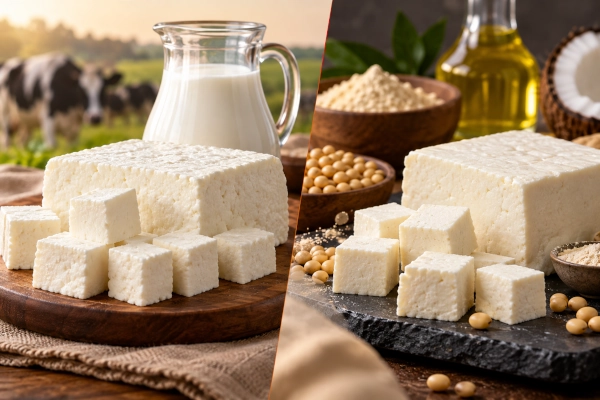
India’s food regulator has proposed a significant change to the rules governing the sale and labelling of paneer, seeking to prevent products made from non-milk ingredients from being marketed under the familiar name. The Food Safety and Standards Authority of India has proposed an amendment that would restrict the use of the term “Paneer” for products made from constituents not derived from milk.
The proposal targets products presently classified under the “Analogue in Dairy Context” category. If the draft regulation is finalised in its present form, products licensed or registered under this category would no longer be permitted to use “Paneer” in their product name, labelling or marketing.
What FSSAI Is Proposing
The proposed Food Safety and Standards (Prohibition and Restrictions on Sales) Amendment Regulations, 2026 would introduce a new provision under Regulation 2.1.1 of the Food Safety and Standards (Prohibition and Restrictions on Sales) Regulations, 2011.
The new provision specifically addresses paneer made using constituents that are not derived from milk. Its central purpose is to ensure that products presented to consumers as paneer correspond to the nature and composition traditionally associated with the dairy product.
Products manufactured using alternative ingredients may continue to exist as food products subject to the applicable regulatory framework, but the draft amendment seeks to prevent them from being represented to consumers using the name “Paneer”.
Analogue Products Would Need a Different Name
The change is particularly relevant to manufacturers of dairy analogue products. Such products can be formulated using ingredients that partially or completely replace milk-derived constituents with other ingredients, including vegetable-based fats or proteins.
Under the proposed amendment, products already licensed or registered by FSSAI under the “Analogue in Dairy Context” category would have to discontinue the term “Paneer” from their nomenclature, labels and marketing material.
The distinction is important because consumers purchasing a product labelled as paneer may reasonably expect it to be a conventional dairy product made from milk. FSSAI’s proposal seeks to ensure that the name displayed on a product accurately communicates what the consumer is buying.
Why the Definition of Paneer Matters
Paneer occupies a distinctive place in the Indian food market and is consumed extensively in households, restaurants, catering establishments and the packaged-food industry. Its familiar appearance and texture can make it difficult for consumers to distinguish conventional paneer from analogue products merely by looking at the finished food.
This becomes particularly relevant when analogue products are supplied to restaurants, caterers or other food businesses and subsequently served as paneer. Clear product nomenclature at the manufacturing and supply stages can therefore play an important role in maintaining transparency throughout the food chain.
The proposed regulation addresses this issue at its source by drawing a clearer distinction between milk-derived paneer and products manufactured from non-milk constituents.
Stronger Protection Against Misleading Labelling
The proposed amendment forms part of FSSAI’s broader regulatory approach of ensuring that the identity and presentation of a food product correspond to its actual composition.
Food labelling is not merely a matter of packaging design. Product names provide consumers with information about the nature of the food they are purchasing and can directly influence purchasing decisions. A familiar dairy name appearing on a product containing substantially different ingredients can create confusion even when additional ingredient information is printed elsewhere on the package.
By restricting “Paneer” to the appropriate milk-derived product category, the proposed regulation seeks to make the primary identity of the product clearer rather than requiring consumers to identify the difference only after studying the ingredient list.
From Enforcement to a Clearer Regulatory Rule
FSSAI has already been paying increased attention to the marketing of dairy analogues and the possibility of such products being passed off as conventional dairy products. The latest proposal would strengthen the regulatory framework by placing a specific restriction within the Food Safety and Standards regulations themselves.
Once implemented, the change would provide manufacturers, distributors, retailers and food-service establishments with a clearer distinction between genuine paneer and analogue products.
For consumers, the practical result would be straightforward: a food product presented and marketed as “Paneer” would have to correspond to the prescribed dairy identity rather than being an analogue made from non-milk constituents.
The Amendment Is Still in Draft Form
The proposed regulation has not yet become a final rule. FSSAI has published it as a draft and invited objections and suggestions from stakeholders and members of the public.
The regulator will consider representations received during a period of 60 days from the date on which copies of the Official Gazette containing the notification are made available to the public. Stakeholders can submit their observations to the Chief Executive Officer of FSSAI in New Delhi or through the email channel specified in the official notification.
Following the consultation period, FSSAI can consider the representations received before finalising the amendment. Until that process is completed and the final regulation is notified, the proposal should therefore be understood as a draft regulatory measure rather than an immediately applicable prohibition.
A Clearer Identity for One of India’s Most Familiar Dairy Foods
The proposed amendment addresses a deceptively simple question: what should consumers receive when they buy something called paneer?
FSSAI’s answer is to link the name more firmly with its dairy identity. Instead of allowing analogue products made from non-milk constituents to use the same familiar terminology, the proposed framework would require those products to be identified differently.
For India’s large dairy and food-service markets, the change could bring greater clarity to product labelling, procurement and consumer choice. It would also establish a much clearer regulatory boundary between traditional milk-derived paneer and the growing range of analogue products designed to resemble it.
References
Press Information Bureau, Ministry of Health and Family Welfare — “FSSAI proposes draft amendment to ensure only milk-derived products are represented as ‘Paneer’,” 24 September 2026.
Food Safety and Standards Authority of India — Draft Food Safety and Standards (Prohibition and Restrictions on Sales) Amendment Regulations, 2026.
The Gazette of India — Official notification relating to the proposed amendment to the Food Safety and Standards (Prohibition and Restrictions on Sales) Regulations, 2011, September 2026.
Official Gazette notification:
https://egazette.gov.in/WriteReadData/2026/276430.pdf
You may also like
-
Bengaluru Startup ImmunitoAI Uses Artificial Intelligence to Develop Next-Generation Antibody Medicines
-
Mindful Eating in Ayurveda: Why Paying Attention to Food Is Essential for Healthy Digestion
-
Ministry of Ayush Issues Standard Treatment Guidelines for Skin Disorders Across Ayurveda, Siddha, Unani and Homoeopathy
-
Centre Caps Cancer Drug Trade Margins at 30%, Patients Expected to Save ₹2,500 Crore Annually
-
India Establishes First High-Altitude Health Research Centre in Himachal Pradesh
