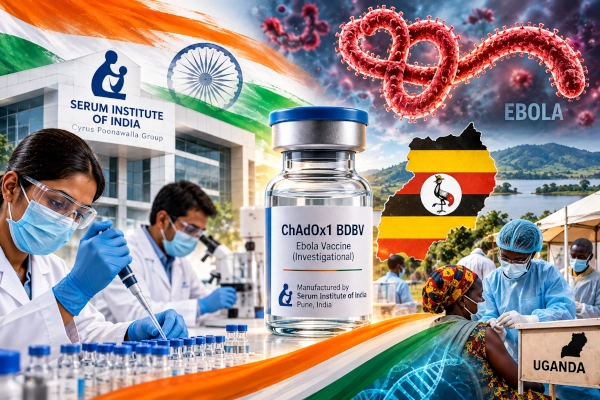
India’s vaccine manufacturing capabilities have achieved another important milestone as an experimental Ebola vaccine produced by the Serum Institute of India (SII) enters Phase I clinical testing in Uganda. The vaccine, developed by scientists at the University of Oxford, targets Bundibugyo virus disease, a severe form of Ebola for which no specifically licensed vaccine is currently available.
The first participants in the Ugandan clinical study received the investigational vaccine on 6 October 2026 in Masaka City, according to the University of Oxford and the London School of Hygiene & Tropical Medicine. The partners formally announced the development on 7 October 2026. The trial follows an earlier Phase I study initiated in the United Kingdom in July.
The Pune-based Serum Institute has manufactured and stockpiled approximately 620,000 doses of the ChAdOx1 BDBV vaccine candidate within two weeks, demonstrating its ability to rapidly scale production during an infectious disease emergency. The company also supplied around 3,000 investigational doses for the Ugandan clinical trial.
The international initiative combines British vaccine research, Indian pharmaceutical manufacturing, Ugandan clinical expertise and funding from the Coalition for Epidemic Preparedness Innovations (CEPI). Its objective is to accelerate the development of a vaccine that could help protect vulnerable communities during future Bundibugyo Ebola outbreaks.
Uganda Begins Phase I Clinical Trial of ChAdOx1 BDBV Vaccine
The Medical Research Council/Uganda Virus Research Institute and London School of Hygiene & Tropical Medicine Uganda Research Unit is conducting the clinical study at its research facility in Masaka City, southwestern Uganda.
The trial will evaluate the safety and immunogenicity of ChAdOx1 BDBV in healthy adult volunteers. Immunogenicity refers to a vaccine’s ability to stimulate an immune response, including the production of antibodies and other immune mechanisms that may contribute to protection against infection.
Professor Eugene Ruzagira, Head of Clinical Research and Trials at the Ugandan research unit, is leading the study. The University of Oxford sponsors the trial, while the Ugandan institution manages its implementation under national regulatory requirements and international ethical standards.
The research centre has more than three decades of experience conducting vaccine studies and clinical trials. Its established laboratory infrastructure, trained personnel and community relationships support the evaluation of investigational vaccines in an African setting.
Phase I studies primarily establish whether a candidate vaccine has an acceptable initial safety profile and produces measurable immune responses. They do not, by themselves, establish whether vaccination prevents disease in the wider population.
Serum Institute Manufactures 620,000 Investigational Vaccine Doses in Two Weeks
The Serum Institute of India’s contribution centres on the rapid production, stockpiling and supply of the experimental vaccine.
Scientists at Oxford’s Clinical Biomanufacturing Facility produced and quality-tested the viral seed stock used as the starting material for manufacturing. The Serum Institute then applied its industrial production capabilities to manufacture approximately 620,000 doses within two weeks.
The company supplied 300 vials to the United Kingdom and approximately 3,000 investigational doses for the clinical study in Uganda. The larger stockpile is intended to support potential future requirements as vaccine development progresses.
Producing large quantities of a vaccine candidate before completion of clinical testing involves manufacturing and development risks. The product must still demonstrate acceptable safety, generate appropriate immune responses and undergo further evaluation before authorities can consider its wider use.
Nevertheless, early manufacturing can reduce delays between successful clinical evaluation and the availability of doses for additional trials or emergency preparedness.
Dr Umesh Shaligram, Executive Director of the Serum Institute of India, described the initiation of the Ugandan study as an important step towards addressing an unmet need in Ebola preparedness. He emphasised the role of rapid manufacturing and international collaboration in advancing vaccines against emerging infectious diseases.
India’s contribution therefore extends beyond supplying investigational material. It demonstrates the country’s ability to provide manufacturing capacity during the early stages of an international public health response.
What Is Bundibugyo Ebola Virus Disease?
Bundibugyo virus disease is caused by Bundibugyo ebolavirus, a member of the group of viruses associated with Ebola virus disease.
Ebola is a severe infectious disease that can produce fever, weakness, muscle pain, vomiting, diarrhoea and, in some cases, bleeding and multiple-organ complications.
The disease spreads primarily through direct contact with infected bodily fluids or contaminated materials. Human-to-human transmission can occur when people come into contact with infected individuals, particularly during caregiving or burial practices involving exposure to infectious fluids.
Different Ebola viruses belong to distinct viral species. This distinction is important because vaccines developed against one species do not necessarily provide reliable protection against another.
Licensed Ebola vaccines are available against disease caused by Zaire ebolavirus. However, those vaccines are not established as effective against Bundibugyo ebolavirus, which creates a separate need for vaccine development.
The continuing public health threat posed by Bundibugyo virus has encouraged researchers to develop vaccines specifically targeting this pathogen.
How the ChAdOx1 BDBV Vaccine Works
The ChAdOx1 BDBV vaccine uses a non-replicating viral vector platform developed through Oxford’s vaccine research programme.
A viral vector vaccine employs a modified virus to deliver genetic instructions that enable human cells to produce a selected antigen from the pathogen being targeted.
In this case, the vaccine uses a modified chimpanzee adenovirus vector to deliver instructions associated with Bundibugyo ebolavirus.
The vector is designed to stimulate an immune response without causing Bundibugyo Ebola virus disease. Because the vaccine does not contain a replication-competent Bundibugyo ebolavirus, it cannot produce Ebola infection through that mechanism.
Once the antigen is expressed, the immune system can recognise it and generate responses that researchers hope will provide protection during future exposure to the pathogen.
The platform is related to the technology used in the Oxford–AstraZeneca COVID-19 vaccine, which was deployed internationally during the coronavirus pandemic.
That experience provides an established technological foundation for manufacturing and studying the new candidate. However, its safety and effectiveness against Bundibugyo Ebola must be evaluated independently through clinical trials.
Oxford Begins First Human Trial Before Expansion to Uganda
The University of Oxford launched the first Phase I clinical trial of ChAdOx1 BDBV on 13 July 2026.
The study, known as BD-Ebov, was designed to evaluate the vaccine in 50 healthy adults between 18 and 55 years of age.
On 24 July 2026, Oxford announced that the first volunteer had received the investigational vaccine, marking the beginning of human administration of the candidate.
Researchers are monitoring participants for adverse reactions and measuring immune responses following vaccination.
The Ugandan study represents a further stage in the international clinical development programme. It allows researchers to investigate the vaccine’s safety and immunogenicity in a different population and research setting.
Combining evidence from multiple clinical sites can strengthen understanding of a vaccine candidate’s performance and help inform the design of subsequent studies.
The research remains at an early stage, and neither trial has yet established the vaccine’s ability to prevent Bundibugyo Ebola disease.
CEPI Supports Vaccine Development with an $8.6 Million Programme
The Coalition for Epidemic Preparedness Innovations is supporting the research through a programme valued at approximately US$8.6 million, announced in July 2026.
The funding supports collaboration between the University of Oxford and the Serum Institute of India to advance the development of Bundibugyo vaccines.
CEPI works with research organisations, governments and pharmaceutical manufacturers to accelerate the development of vaccines against infectious diseases with epidemic or pandemic potential.
Its involvement in the ChAdOx1 BDBV programme supports clinical research, manufacturing preparations and the broader objective of improving vaccine availability in regions vulnerable to outbreaks.
The Serum Institute also participates in CEPI’s Vaccine Manufacturing Facility Network, an international initiative intended to strengthen geographically distributed vaccine manufacturing capabilities.
Such arrangements seek to reduce dependence on a limited number of production centres during health emergencies and improve access to vaccines where outbreaks occur.
The programme brings together research, manufacturing and clinical evaluation through institutions operating across three continents.
Rapid Vaccine Manufacturing Strengthens Epidemic Preparedness
Developing vaccines during an infectious disease outbreak requires close coordination between scientific discovery, manufacturing, regulatory authorities and clinical researchers.
A candidate vaccine must undergo laboratory development, preclinical evaluation, production under appropriate quality standards and carefully monitored human studies.
Manufacturing can become a major constraint when a vaccine candidate advances rapidly but production facilities are not prepared to supply sufficient doses.
The Serum Institute’s ability to produce a substantial investigational stockpile within two weeks illustrates the value of established manufacturing infrastructure and experience with viral vector technologies.
It also demonstrates how early collaboration between vaccine developers and industrial manufacturers can shorten the interval between research advances and clinical evaluation.
The Oxford team had already begun working with the Serum Institute during the initial response to the Bundibugyo outbreak in May 2026.
That early engagement helped establish the manufacturing arrangements required to support the subsequent clinical studies.
For global health institutions, the development offers an example of how research laboratories and manufacturing companies can coordinate their capabilities before a vaccine receives regulatory approval.
What Happens After Phase I Clinical Trials?
The Ugandan and British studies will provide early evidence concerning the candidate vaccine’s safety and ability to stimulate immune responses.
Researchers will examine adverse events, laboratory markers of immunity and the consistency of responses among vaccinated volunteers.
The findings will help determine whether the vaccine should advance to larger studies involving broader participant populations.
Later-stage trials may investigate immune responses in greater detail and evaluate whether vaccination protects people against disease. Demonstrating effectiveness during outbreaks can be challenging because cases may occur unpredictably and are concentrated in particular geographical areas.
CEPI has indicated that successful early-stage studies could support further clinical development aimed at generating evidence for emergency-use authorisation or full regulatory approval.
Any such decision would depend on the available scientific evidence and assessments by the relevant regulatory authorities.
The approximately 620,000 doses manufactured by the Serum Institute remain investigational and are not equivalent to an approved public vaccination supply.
The immediate priority is to generate reliable clinical evidence while maintaining readiness for subsequent development stages.
India’s Vaccine Industry Strengthens Its International Research Role
India has established substantial pharmaceutical manufacturing capabilities through decades of vaccine development, production and international supply.
The Serum Institute of India occupies a prominent position in this ecosystem through its experience manufacturing vaccines for infectious diseases and supplying international immunisation programmes.
The Bundibugyo vaccine initiative illustrates how Indian manufacturing expertise can complement scientific research conducted by international institutions.
Oxford developed the vaccine candidate and its initial biological materials, while the Serum Institute provided industrial production capacity. Ugandan researchers are now contributing clinical evidence through a locally conducted trial.
This division of responsibilities demonstrates the importance of specialised institutions working together across national boundaries.
It also highlights a significant opportunity for India’s pharmaceutical sector to participate in emerging vaccine platforms, epidemic preparedness programmes and advanced biotechnology partnerships.
The country’s manufacturing infrastructure can support not only established immunisation programmes but also the development of new vaccines against diseases for which effective preventive options remain unavailable.
Indian Manufacturing Contributes to the Next Generation of Ebola Vaccines
The launch of the Ugandan clinical study marks an important development in international efforts to address Bundibugyo Ebola virus disease.
While the vaccine’s safety and protective effectiveness remain under investigation, the programme has already demonstrated the value of coordinated scientific research and rapid pharmaceutical manufacturing.
The Serum Institute of India’s production of approximately 620,000 investigational doses within two weeks provides the clinical development partnership with a substantial manufacturing foundation.
The initiative also reinforces India’s contribution to global health preparedness through cooperation with research institutions, international funding organisations and public health authorities.
As the programme progresses through clinical evaluation, the combined expertise of Oxford, the Serum Institute and Ugandan researchers will generate evidence needed to guide future development.
India’s ability to rapidly manufacture vaccines for emerging infectious diseases is strengthening its role in international biotechnology partnerships and contributing to efforts to make future outbreak responses faster, more coordinated and more accessible.
References
- Serum Institute of India — 7 October 2026. Uganda Launches Phase I Clinical Study of Bundibugyo Virus Disease Vaccine. Official company announcement detailing vaccine manufacturing, stockpiling and the Ugandan clinical trial.
https://www.seruminstitute.com/uganda-launches-phase-i-clinical-study-of-bundibugyo-virus-disease-vaccine.php - University of Oxford — 7 October 2026. Phase I Clinical Study of ChAdOx1 BDBV Vaccine Launches in Uganda. Official research announcement covering the trial, international partnership and vaccine development programme.
https://www.ox.ac.uk/news/2026-10-07-phase-i-clinical-study-of-chadox1-bdbv-vaccine-launches-in-uganda - London School of Hygiene & Tropical Medicine — October 2026. Uganda Launches Phase I Clinical Study of Bundibugyo Virus Disease Vaccine. Details of the Ugandan clinical research programme.
https://www.lshtm.ac.uk/research/units/mrc-uganda/news/498871/uganda-launches-phase-i-clinical-study-bundibugyo-virus-disease-vaccine - University of Oxford — 13 July 2026. World’s First Phase I Bundibugyo Ebolavirus Vaccine Trial Launched by Oxford Vaccine Group. Original UK clinical trial announcement and CEPI funding information.
https://www.ox.ac.uk/news/2026-07-13-worlds-first-phase-i-bundibugyo-ebolavirus-vaccine-trial-launched-by - University of Oxford — 24 July 2026. First Volunteer Vaccinated in the World’s First Bundibugyo Ebolavirus Vaccine Trial. Confirmation of the first human vaccination and manufacturing progress.
https://www.ox.ac.uk/news/2026-07-24-first-volunteer-vaccinated-in-the-worlds-first-bundibugyo-ebolavirus-vaccine-trial - University of Oxford — 22 May 2026. Statement on Vaccine Efforts Relating to the Bundibugyo Ebolavirus Outbreak in the Democratic Republic of the Congo. Background on the initial collaboration between Oxford and the Serum Institute of India.
https://www.ox.ac.uk/news/2026-05-22-statement-on-vaccine-efforts-relating-to-the-bundibugyo-ebolavirus-outbreak-in-the
You may also like
-
Punjab’s Rail Coach Factory Advances Vande Bharat Manufacturing as 16-Coach Trainset Undergoes 180 kmph Trial
-
Gujarat’s Svaayatt Systems Proposes Nine-Drone Autonomous Swarm for Indian Armed Forces
-
EndureAir and Maraal Aerospace Partner to Develop Indigenous High-Altitude Pseudo-Satellite for India
-
Larsen & Toubro Selects Australian Orbital’s 350HFE Heavy-Fuel Engines for Indian Tactical UAV Programme
-
Indian Navy Receives Two Indigenous TROUT Military-Grade Underwater Robots from Kochi Startup EyeROV
