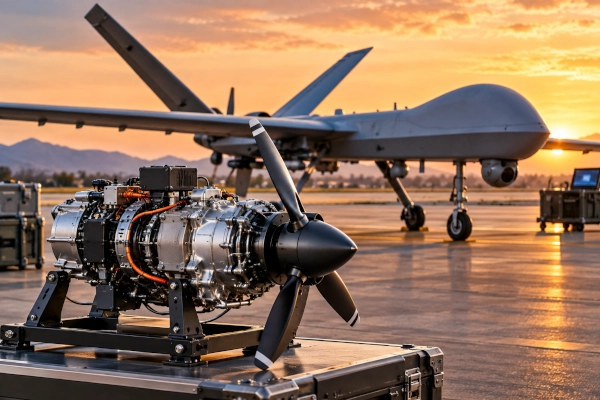
Indian engineering and defence manufacturing company Larsen & Toubro (L&T) has selected Australian aerospace manufacturer Orbital Corporation Limited to supply three 350HFE heavy-fuel propulsion systems for its Group 3 tactical Unmanned Aerial Vehicle (UAV) programme. The agreement introduces advanced engine and electrical power-management technology into an Indian military drone development programme, strengthening defence industrial cooperation between India and Australia.
Orbital Corporation announced the order on October 5, 2026, through a regulatory disclosure to the Australian Securities Exchange (ASX). Each propulsion system will incorporate the company’s second-generation Power Management System (Gen II PMS), marking the first external customer adoption of the technology.
The initial three systems will support engine integration and further testing of L&T’s tactical UAV platform. The Indian company selected Orbital following technical evaluations that included a visit to its manufacturing facility in Western Australia, engine inspections and extensive bench testing.
The agreement represents an important development in India’s expanding military drone industry, where advanced propulsion systems are becoming increasingly necessary to support larger payloads, longer missions and more demanding operational requirements.
Larsen & Toubro Selects Orbital After Technical Evaluation
L&T selected Orbital’s 350HFE propulsion system following a structured evaluation of the Australian company’s engine technology and manufacturing capabilities.
The assessment included a visit by L&T representatives to Orbital’s facility in Western Australia, where they inspected the propulsion systems and conducted extensive bench testing. These evaluations allowed the Indian engineering company to examine the engine’s performance against the requirements of its tactical UAV programme.
Following the technical assessment, L&T selected Orbital’s technology to replace the existing engine solution on its Group 3 unmanned aircraft platform. The decision introduces a new propulsion configuration into the ongoing development programme.
The initial order covers three integrated propulsion systems rather than a fleet-scale engine procurement. These units will support the installation, integration and testing activities needed to assess the engine’s suitability for the aircraft.
Orbital has not disclosed the financial value of the contract. The announcement also does not establish a delivery schedule, a first-flight date for the engine-equipped UAV or a confirmed production order from the Indian Armed Forces.
Orbital’s 350HFE Engine Designed for Tactical Military Drones
The 350HFE is a 350 cc heavy-fuel engine developed for unmanned aircraft that require sustained propulsion performance and the ability to carry demanding mission payloads.
According to Orbital’s published product information, the engine produces approximately 28.4 horsepower and has a reported specific fuel consumption of around 325 grams per kilowatt-hour. These specifications position it within the company’s range of propulsion systems for larger tactical unmanned aircraft.
Heavy-fuel engines are particularly relevant to military aviation because they can operate on aviation fuels commonly used within defence logistics systems. Orbital’s propulsion technologies support fuels such as Jet-A and military aviation fuel grades, depending on the engine configuration.
The company employs its proprietary FlexDI direct-injection technology, which is designed to provide precise fuel delivery and efficient engine operation.
Fuel efficiency is an important consideration for tactical UAVs because the quantity of fuel carried directly influences endurance, payload capacity and aircraft design. More efficient propulsion can allow designers to examine different combinations of mission duration, onboard equipment and fuel reserves.
The 350HFE is intended to address these engineering requirements while supporting the operating conditions encountered by military and commercial unmanned aircraft.
Gen II Power Management System Provides Up to 1 kW of Electrical Power
A significant feature of the L&T order is the inclusion of Orbital’s second-generation Power Management System, which increases available onboard electrical power to 1 kilowatt.
Orbital states that the new system provides approximately twice the electrical output of its previous configuration. This additional capacity is relevant because modern tactical UAVs must supply power not only to their propulsion-related equipment but also to sensors, communications systems and other onboard electronics.
Military surveillance drones may carry electro-optical cameras, infrared imaging equipment, communication links, navigation systems and mission computers. These components require dependable electrical power throughout the aircraft’s flight.
The Gen II system integrates engine operation with electrical power generation and management. It also introduces remote engine starting, propeller-stop functionality and in-flight battery charging.
Remote starting enables the engine to be started through the aircraft’s control architecture without requiring direct manual interaction with the engine. Propeller-stop functionality provides additional control over propulsion operation, while in-flight charging supports the management of onboard electrical reserves.
By combining these capabilities into an integrated system, Orbital is offering L&T a propulsion and electrical power package designed to operate as a coordinated unit.
The arrangement may simplify aspects of system integration compared with separately sourcing and adapting engine and electrical power components. Actual performance benefits will depend on the final aircraft configuration and results from integration testing.
Electrical Power Becomes Critical for Advanced UAV Payloads
The increasing sophistication of unmanned aircraft is creating greater demand for onboard electrical power.
Earlier generations of smaller reconnaissance drones often carried relatively simple imaging and communications equipment. Modern tactical platforms can incorporate stabilised electro-optical systems, thermal cameras, advanced data links and computing equipment for processing mission information.
These systems place additional demands on the aircraft’s electrical architecture. A drone must maintain sufficient power for essential flight-control systems while supporting mission equipment during prolonged operations.
For example, electro-optical sensor turrets require electrical power for imaging, stabilisation and control. Communication systems must maintain reliable data transmission, while onboard computers process navigation and mission information.
Power-management systems help coordinate these requirements by distributing electricity and maintaining suitable battery conditions.
Orbital’s Gen II technology addresses this challenge by offering increased electrical output alongside functions associated with engine operation and battery management.
The integration of these capabilities is particularly relevant to tactical UAVs intended for intelligence, surveillance and reconnaissance missions, where sensor performance and reliable communication are essential.
Group 3 Tactical UAVs Support Extended Military Missions
L&T’s programme involves a Group 3 tactical unmanned aerial vehicle, a category generally associated with medium-sized military drones capable of carrying more substantial payloads than smaller short-range systems.
Under the classification used by the United States Department of Defense, Group 3 UAVs generally weigh between 55 and 1,320 pounds and operate below 18,000 feet at speeds below 250 knots. However, this classification provides a broad reference rather than a confirmed technical specification for L&T’s aircraft.
Platforms in this category commonly support intelligence gathering, battlefield surveillance, reconnaissance and communications-related missions. Their larger size allows manufacturers to integrate more capable sensors and fuel systems than those typically accommodated by smaller tactical drones.
The propulsion system plays a central role in determining the aircraft’s operational characteristics. Engine output, fuel consumption, aircraft weight and aerodynamic efficiency collectively influence endurance, payload capacity and flight performance.
L&T has not publicly disclosed the final aircraft specifications associated with the Orbital contract, including its wingspan, maximum take-off weight, operational range or planned endurance.
The selection of the 350HFE nevertheless indicates that the programme requires a propulsion system suitable for a larger tactical aircraft with significant onboard electrical power demands.
Why Heavy-Fuel Engines Matter for Military UAVs
Military drone operators increasingly examine heavy-fuel propulsion systems because they can offer logistical advantages over engines that depend exclusively on conventional automotive petrol.
Military aviation organisations commonly maintain established fuel supply chains for aircraft and other equipment. Propulsion systems compatible with appropriate aviation fuels can reduce the requirement to maintain separate fuel stocks for certain unmanned platforms.
Heavy-fuel engines also provide an alternative to purely electric propulsion for aircraft undertaking extended missions. Battery-powered drones offer advantages in selected applications, but their endurance can be constrained by onboard energy storage capacity.
Internal combustion engines carry liquid fuel, allowing aircraft designers to accommodate longer missions where aircraft weight, engine efficiency and fuel capacity permit.
Orbital’s 350HFE employs its proprietary fuel-injection technology to support efficient fuel delivery and engine operation. The company has developed these systems specifically for unmanned aircraft, where weight, reliability and endurance are important design considerations.
The suitability of the engine for L&T’s programme will ultimately depend on the results of aircraft-level integration and testing. Engine performance figures alone cannot establish the endurance or operational range of the completed drone.
Orbital Expands Its Presence in India’s Military Drone Industry
The L&T agreement makes Larsen & Toubro the second Indian customer for Orbital’s UAV propulsion technology, extending the Australian company’s involvement in India’s emerging unmanned aircraft manufacturing sector.
Orbital previously secured an Indian propulsion system order associated with Dynamatic Technologies and its Cheel UAV development programme. That engagement involved the evaluation and integration of heavy-fuel engine technology for an Indian tactical unmanned aircraft.
The company announced a further Indian propulsion system order in April 2026, reflecting continuing opportunities within the country’s UAV development ecosystem.
Orbital manufactures propulsion systems for Group 2 and Group 3 unmanned aircraft, with its product portfolio covering engine capacities from 50 cc to 350 cc.
Its technology has also been supplied to international defence and aerospace customers, including programmes associated with established unmanned aircraft manufacturers.
The addition of L&T provides Orbital with another Indian industrial partner evaluating its propulsion systems for a military UAV development programme.
For India, the agreement demonstrates increasing cooperation between domestic aircraft developers and international suppliers of specialised propulsion technology.
Larsen & Toubro Strengthens Its Tactical UAV Development Capabilities
Larsen & Toubro is one of India’s major engineering and defence manufacturing companies, with experience across naval systems, land platforms, aerospace equipment and advanced engineering.
Its defence business contributes to the development and manufacture of equipment for the Indian Armed Forces, drawing on the company’s capabilities in mechanical engineering, electronics, system integration and complex manufacturing.
Unmanned aerial vehicles represent an important area of defence technology development because they combine aeronautical engineering with sensors, communication systems, navigation equipment and increasingly sophisticated onboard electronics.
Developing a tactical UAV requires the integration of these subsystems into an aircraft capable of maintaining stable and reliable flight under different operating conditions.
The selection of Orbital’s propulsion system addresses one part of this engineering challenge. L&T must evaluate how the engine and its power-management equipment perform within the aircraft’s structural, electrical and flight-control architecture.
The initial three-system order supports this evaluation process. Successful integration would provide the company with additional technical information as the programme progresses towards further testing and qualification.
The announcement does not identify the aircraft’s final configuration or establish that the Indian military has placed an order for the completed platform.
India–Australia Defence Industrial Cooperation Expands
The agreement also reflects the growing defence industrial relationship between India and Australia under their Comprehensive Strategic Partnership.
Both countries have identified defence technology, industrial cooperation and maritime security as important areas of bilateral engagement.
The development of specialised equipment for unmanned systems offers opportunities for companies from both countries to collaborate on technologies relevant to evolving military requirements.
Orbital’s Chief Executive Officer, Stephen Pearce, highlighted the role of the India–Australia Comprehensive Strategic Partnership in supporting defence industry cooperation. He described the L&T relationship as an opportunity to supply propulsion technology designed and manufactured in Western Australia for an Indian military UAV programme.
The arrangement brings together an Indian defence engineering company developing an unmanned aircraft and an Australian manufacturer specialising in propulsion systems.
It also demonstrates how international technology sourcing can support Indian-led defence development programmes when specialised subsystems are required.
The propulsion equipment covered by this order is Australian-developed and manufactured. The agreement should therefore be understood as international defence technology cooperation rather than an indigenous Indian engine development milestone.
Engine Integration and Testing Will Determine Future Orders
The next stage of the programme involves integrating the three 350HFE propulsion systems with L&T’s Group 3 tactical UAV platform and conducting further technical evaluations.
Aircraft integration requires more than installing an engine. Engineers must establish compatibility between the propulsion system, aircraft structure, fuel supply, electrical architecture and flight-control equipment.
Testing must also examine vibration, thermal management, engine response and the reliability of associated control systems.
For UAVs carrying sophisticated mission equipment, the ability to generate and distribute electrical power is another important consideration. L&T will need to evaluate the Gen II Power Management System alongside the propulsion system to establish its suitability for the aircraft’s operational requirements.
Orbital has stated that additional engine orders may follow successful integration and testing, provided the UAV programme advances towards military production.
At present, the confirmed transaction covers three propulsion systems for integration and evaluation. No bulk production order, aircraft induction date or operational deployment has been announced.
The outcome of the testing programme will determine the next stage of the propulsion partnership.
India’s Growing Drone Industry Requires Advanced Propulsion Technologies
India’s expanding defence drone industry is creating demand for a wider range of propulsion systems, from compact electric motors for small tactical drones to internal combustion engines for larger unmanned aircraft.
Small multirotor platforms commonly use electric propulsion because it offers precise control and relatively simple mechanical arrangements. Larger fixed-wing UAVs undertaking extended missions often require propulsion solutions suited to higher endurance and payload requirements.
These differences create opportunities for companies specialising in engines, power electronics, batteries, electric motors and hybrid propulsion architectures.
Indian manufacturers are developing capabilities across several of these areas, including indigenous UAV airframes, flight-control systems, mission electronics and propulsion technologies.
At the same time, international partnerships provide access to specialised equipment that can support ongoing aircraft development programmes.
L&T’s selection of Orbital’s 350HFE demonstrates the importance of matching propulsion technology to the requirements of an aircraft rather than treating the engine as an isolated component.
As domestic UAV programmes advance, expertise in propulsion integration, testing and system qualification will remain essential to developing reliable military aircraft.
L&T’s 350HFE Selection Advances India’s Tactical UAV Programme
The October 5, 2026, order marks a significant development in Larsen & Toubro’s work on a Group 3 tactical unmanned aerial vehicle.
Orbital’s 350HFE heavy-fuel engine provides the propulsion component, while the Gen II Power Management System introduces increased onboard electrical generation, remote engine starting and in-flight battery charging.
The initial three systems will allow L&T to conduct the integration and testing activities required to evaluate the technology within its aircraft.
The selection also strengthens India–Australia defence industrial cooperation by connecting an Indian UAV developer with an established Australian propulsion manufacturer.
The agreement represents another step in the development of India’s advanced tactical UAV capabilities. By combining domestic aerospace engineering and system integration with specialised international propulsion technology, L&T is expanding the technical foundation for its unmanned aircraft programme and contributing to the continued growth of India’s defence aerospace industry.
References
- Orbital Corporation Limited — October 5, 2026. Orbital Secures Indian Order. Official Australian Securities Exchange announcement confirming the three-system L&T order.
https://www.marketindex.com.au/asx/oec/announcements/orbital-secures-indian-order-6A1347610 - Orbital Corporation Limited — October 6, 2026. Orbital Secures L&T Order for Three Propulsion Systems. Company press release covering technical evaluation, integration testing and the Gen II Power Management System.
https://idrw.org/orbital-secures-lt-order-for-three-propulsion-systems/ - Orbital Corporation Limited — Official Website. Technical information on the 350HFE heavy-fuel engine, integrated propulsion systems and power-management technology.
https://www.orbitaluav.com/ - Orbital Corporation Limited — April 14, 2026. New Indian Propulsion System Order. Australian Securities Exchange announcement concerning the company’s earlier Indian UAV programme.
https://data-api.marketindex.com.au/api/v1/announcements/XASX%3AOEC%3A6A1320339/pdf/inline/new-indian-propulsion-system-order - Orbital Corporation Limited — August 31, 2026. Annual Results and FY2027 Outlook. Corporate disclosure describing expansion of the 350HFE engine and second-generation power-management product portfolio.
https://www.orbitaluav.com/investor-information - Larsen & Toubro Limited — Official Website. Precision engineering and defence manufacturing capabilities.
https://www.larsentoubro.com/
You may also like
-
Gujarat’s Svaayatt Systems Proposes Nine-Drone Autonomous Swarm for Indian Armed Forces
-
EndureAir and Maraal Aerospace Partner to Develop Indigenous High-Altitude Pseudo-Satellite for India
-
Serum Institute of India-Manufactured Ebola Vaccine Enters Clinical Trial in Uganda
-
Indian Navy Receives Two Indigenous TROUT Military-Grade Underwater Robots from Kochi Startup EyeROV
-
Colombia Seeks India’s Counter-Drone Technology and Stronger Security Cooperation to Combat Drug Cartels
