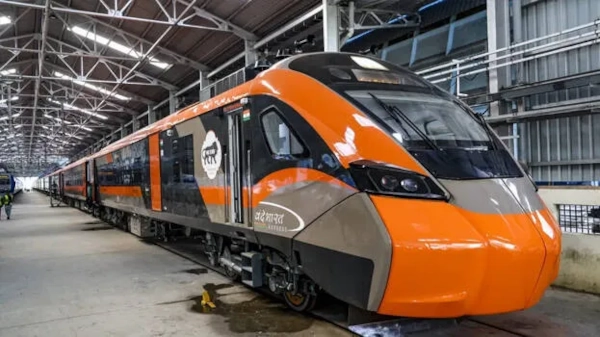
India’s indigenous railway manufacturing programme continues to expand, with Rail Coach Factory (RCF), Kapurthala, emerging as an important production centre for advanced Vande Bharat trainsets. A 16-coach Vande Bharat Chair Car train manufactured at the Punjab facility reportedly completed a high-speed trial at 180 kmph on the Mathura–Nagda railway section on October 8, 2026.
According to an October 9 report by ANI, the trial took place under the supervision of the Chief Commissioner of Railway Safety (CCRS). The inspection assessed the trainset’s high-speed performance, operational efficiency and safety characteristics, adding to the testing activities associated with RCF’s entry into modern self-propelled passenger train manufacturing.
The Ministry of Railways has previously confirmed that RCF Kapurthala received a production programme for 320 Vande Bharat coaches, reflecting Indian Railways’ efforts to expand trainset manufacturing across multiple domestic facilities. The development supports the wider Make in India initiative and strengthens Punjab’s contribution to advanced railway engineering.
RCF Kapurthala Expands into Vande Bharat Trainset Manufacturing
Rail Coach Factory Kapurthala is a production unit of Indian Railways with extensive experience manufacturing passenger coaches and self-propelled railway vehicles. The facility has contributed to India’s railway modernisation through the production of conventional coaches, Linke Hofmann Busch (LHB) coaches and specialised passenger rolling stock.
In a written reply to the Rajya Sabha on February 7, 2025, the Ministry of Railways confirmed that RCF had manufactured 5,414 coaches during the preceding three financial years. The factory produced 1,862 coaches in 2021–22, followed by 1,651 in 2022–23 and 1,901 in 2023–24.
The Ministry also confirmed that Kapurthala had received a production programme for 320 Vande Bharat coaches. This allocation marked an important expansion of the factory’s responsibilities into the manufacture of integrated electric passenger trainsets.
Vande Bharat manufacturing requires closer coordination between mechanical structures, electrical equipment, propulsion systems and onboard controls than conventional locomotive-hauled passenger coaches. Each trainset must operate as an integrated system, with its equipment functioning reliably across multiple coaches.
The development of these capabilities at Kapurthala strengthens Indian Railways’ manufacturing network and creates opportunities for domestic engineering and railway component suppliers.
Advanced Electric Propulsion Supports High-Speed Train Operations
Vande Bharat trains use distributed electric propulsion, in which traction equipment is incorporated into designated coaches rather than concentrated in a separate locomotive.
This arrangement allows powered axles across the trainset to contribute to acceleration and braking. It also supports modern control systems that coordinate traction, braking and other train functions.
The Ministry of Railways has identified distributed propulsion as a defining feature of the Vande Bharat programme. The technology supports rapid acceleration and efficient operation, particularly on passenger routes where trains must make scheduled stops.
Modern propulsion systems must work together with suspension, braking, electrical distribution and onboard monitoring equipment. Their integration is essential for achieving stable performance while maintaining passenger comfort.
The development of Vande Bharat production capabilities at RCF Kapurthala therefore involves more than coach assembly. It requires expertise in installing, integrating and testing the systems that allow a complete trainset to operate safely.
Indian Railways Uses 180 kmph Trials to Evaluate Trainset Performance
High-speed testing is an important stage in evaluating newly manufactured passenger trainsets. It allows railway engineers and safety authorities to examine vehicle behaviour under conditions that may exceed those encountered during regular passenger operations.
Official Ministry of Railways releases have documented Vande Bharat trials at speeds reaching 180 kmph, including detailed evaluations of train stability, vibration, braking and other safety parameters.
In December 2022, the Ministry outlined the testing undertaken by the Research Designs and Standards Organisation for improved Vande Bharat trainsets. These evaluations included oscillation trials, emergency braking tests, electromagnetic compatibility assessments, propulsion testing and checks of fire and smoke detection systems.
The Ministry subsequently confirmed another successful high-speed trial in December 2025, when a Vande Bharat Sleeper train achieved 180 kmph on the Kota–Nagda section under the supervision of the Commissioner of Railway Safety.
That inspection examined ride stability, oscillation, vibration, braking and emergency systems. The Ministry reported that the train’s performance was satisfactory during the trial.
These official records establish that 180 kmph testing forms part of India’s Vande Bharat evaluation framework. They do not, however, independently confirm the separate October 8, 2026, test reported for the Kapurthala-built Chair Car trainset.
Safety Evaluation Includes Braking, Stability and Passenger Protection
The Ministry of Railways has emphasised comprehensive safety testing as an essential part of introducing Vande Bharat trainsets into passenger service.
Oscillation trials assess the movement of coaches at different speeds, including lateral and vertical responses. Engineers use these evaluations to examine vehicle stability, suspension behaviour and the interaction between rolling stock and railway tracks.
Braking trials determine whether the train can reduce speed and stop within the limits established by applicable railway standards. Emergency braking performance is particularly important because high-speed trains require reliable and predictable deceleration under demanding conditions.
Electrical and electronic systems also undergo evaluation. Electromagnetic compatibility testing examines whether different onboard components can operate without causing unacceptable interference to one another.
Indian Railways has additionally highlighted fire detection, passenger communication, automatic doors and other onboard safety systems as important features of modern Vande Bharat trains.
These assessments help establish whether a trainset meets the technical requirements for its intended operating conditions. A successful high-speed run represents one part of this process rather than automatic authorisation to begin passenger operations.
Vande Bharat’s 180 kmph Trial Speed and 160 kmph Operating Speed
The Ministry of Railways has distinguished between the maximum speed achieved during testing and the speed authorised for regular passenger services.
Official railway information identifies Vande Bharat Express as a semi-high-speed trainset tested at 180 kmph, with a maximum passenger service speed of up to 160 kmph for applicable configurations.
The distinction reflects the requirements of railway operations, where permissible speed depends on track geometry, signalling systems, infrastructure condition and regulatory approval.
A train capable of reaching 180 kmph during testing cannot automatically operate at that speed on every railway route. Track infrastructure, safety systems and operational restrictions determine the speeds permitted for passenger services.
Consequently, the reported October 8 trial should be understood as a technical evaluation of the Kapurthala-manufactured trainset rather than confirmation of a new 180 kmph commercial service.
Vande Bharat Manufacturing Expands Beyond Chennai
India’s Vande Bharat programme began at the Integral Coach Factory in Chennai, which developed the country’s first indigenous semi-high-speed trainsets.
Indian Railways has subsequently expanded production capabilities to other manufacturing establishments, including Rail Coach Factory Kapurthala and Modern Coach Factory Raebareli.
On May 2, 2026, the Ministry of Railways officially announced that Modern Coach Factory Raebareli had rolled out its first 16-coach Vande Bharat Chair Car trainset. Equipped with a Siemens propulsion system, the train was dispatched for testing and field trials.
The Ministry explained that the train would undergo oscillation testing to evaluate ride quality, safety parameters and dynamic performance before entering regular passenger service.
The expansion into additional manufacturing facilities allows Indian Railways to develop a broader production base for modern trainsets. It also supports engineering expertise in propulsion integration, electrical systems, precision manufacturing and quality assurance.
RCF Kapurthala’s participation strengthens this manufacturing network by adding Punjab’s established railway engineering capabilities to the Vande Bharat programme.
Kapurthala Strengthens Punjab’s Railway Manufacturing Industry
Rail Coach Factory Kapurthala has played an important role in India’s passenger coach manufacturing industry for several decades.
According to the Ministry of Railways’ 2023–24 annual reporting, RCF manufactured 1,901 coaches during that financial year, including 1,574 LHB coaches, 316 Mainline Electric Multiple Unit (MEMU) coaches and 11 Vistadome coaches.
These production figures demonstrate the factory’s experience with different categories of passenger rolling stock, including self-propelled electric vehicles and specialised coaches.
RCF also participates in railway exports. In August 2026, the Ministry of Railways announced the rollout of a 19-coach LHB passenger rake for Bangladesh Railway.
The export order included air-conditioned sleepers, air-conditioned chair cars, non-air-conditioned chair cars and power cars. The factory incorporated design modifications intended to meet the specific requirements of Bangladesh Railway.
Such manufacturing activities contribute to India’s railway industrial ecosystem by supporting specialised engineering, component production, electrical integration and vehicle testing.
The addition of Vande Bharat trainsets expands the technical scope of RCF’s manufacturing operations and strengthens Punjab’s contribution to modern railway transportation.
Indigenous Trainset Production Supports Make in India
The Vande Bharat programme represents a significant development in India’s efforts to manufacture advanced passenger railway technology domestically.
Unlike conventional locomotive-hauled trains, Vande Bharat trainsets incorporate integrated propulsion, control and passenger systems within a coordinated vehicle architecture.
Manufacturing these trainsets requires expertise in structural engineering, electrical equipment, braking systems, suspension design and onboard electronics.
The expansion of production across Chennai, Kapurthala and Raebareli creates opportunities for Indian manufacturers to develop these capabilities while strengthening the domestic railway supply chain.
It also supports Indian Railways’ objective of improving passenger travel through modern trains designed around safety, efficiency and comfort.
Kapurthala’s participation adds an established manufacturing facility to this national effort, combining its experience in passenger coach production with the technical requirements of semi-high-speed electric trainsets.
Punjab-Built Vande Bharat Train Reflects India’s Railway Engineering Progress
The reported October 8, 2026, high-speed evaluation of the 16-coach Vande Bharat Chair Car trainset highlights the progress of RCF Kapurthala’s advanced train manufacturing programme.
The factory’s entry into Vande Bharat production follows an official manufacturing allocation of 320 coaches and decades of experience producing passenger railway vehicles.
Indian Railways’ established testing procedures provide the framework for evaluating the safety and performance of these advanced trainsets before their introduction into regular service.
The expansion of manufacturing across multiple railway production units also strengthens India’s ability to develop and produce modern passenger trains at scale.
RCF Kapurthala’s growing role in the Vande Bharat programme reflects India’s progress towards greater self-reliance in advanced railway manufacturing. The development of domestic trainset production, engineering expertise and railway component supply chains will continue to support safer, more efficient and technologically advanced passenger transportation.
References
- Ministry of Railways — Rajya Sabha, February 7, 2025. Manufacturing of Vande Bharat Coaches in Kapurthala Rail Coach Factory. Unstarred Question No. 605. Confirms RCF’s production figures and allocation of 320 Vande Bharat coaches.
https://sansad.in/getFile/annex/267/AU605_GzQKeA.pdf?source=pqars - Ministry of Railways — PIB, May 2, 2026. MCF Rolls Out Its First Vande Bharat Trainset, Dispatched for Testing & Field Trial.
https://www.pib.gov.in/PressReleasePage.aspx?PRID=2257500 - Ministry of Railways — PIB, December 31, 2025. Vande Bharat Sleeper Train Successfully Completes CRS High-Speed Trial at 180 kmph on Kota–Nagda Section.
https://www.pib.gov.in/PressReleasePage.aspx?PRID=2210145 - Ministry of Railways — PIB, December 14, 2022. New and Improved Vande Bharat 2.0 Trains with Enhanced Safety Features, Better Ride Index and Passenger Amenities Have Been Introduced.
https://www.pib.gov.in/Pressreleaseshare.aspx?PRID=1883511 - Ministry of Railways — PIB, June 1, 2023. Semi High-Speed Vande Bharat Trains — Leading Example of Make in India Initiative.
https://www.pib.gov.in/PressReleasePage.aspx?PRID=1929088 - Ministry of Railways — PIB, August 11, 2026. Rail Coach Factory, Kapurthala to Roll Out First Rake of LHB Coaches for Bangladesh Railway.
https://www.pib.gov.in/PressReleasePage.aspx?PRID=2297903 - Rail Coach Factory, Kapurthala — Official Website.
https://www.rcfkapurthala.in/ - Asian News International — October 9, 2026. Vande Bharat Train Manufactured in Punjab Completes 180 kmph Trial on Mathura–Nagda Section. Secondary source for the reported October 8 trial; independent official confirmation was not located.
You may also like
-
Larsen & Toubro and Spain’s Navantia Partner to Develop Four Amphibious Assault Ships for Indian Navy
-
Gujarat’s Svaayatt Systems Proposes Nine-Drone Autonomous Swarm for Indian Armed Forces
-
EndureAir and Maraal Aerospace Partner to Develop Indigenous High-Altitude Pseudo-Satellite for India
-
Serum Institute of India-Manufactured Ebola Vaccine Enters Clinical Trial in Uganda
-
Larsen & Toubro Selects Australian Orbital’s 350HFE Heavy-Fuel Engines for Indian Tactical UAV Programme
