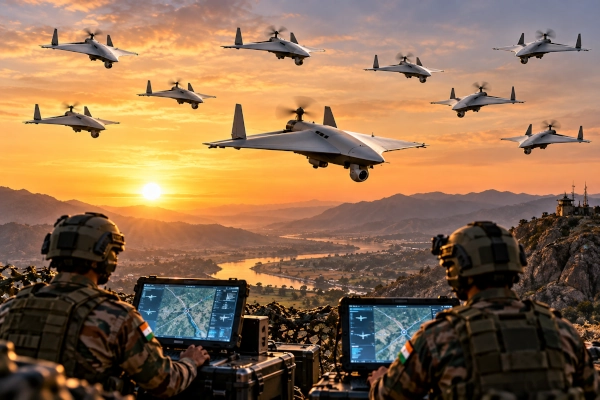
Indian defence technology company Svaayatt Systems, based in Gujarat, has proposed a Coordinated Autonomous Unmanned Aerial System (UAS) Swarm capable of operating up to nine drones under the supervision of just two personnel. The proposed system combines autonomous flight coordination, artificial intelligence, mesh-network communications and advanced navigation technologies to support military surveillance, reconnaissance and perimeter security operations.
The development was reported on October 7, 2026, as Svaayatt Systems explored opportunities to present its indigenous drone swarm technology to the Indian Armed Forces. The concept follows a distributed operational approach in which multiple unmanned aircraft coordinate their movements and mission responsibilities instead of requiring individual pilots to control each platform.
According to the reported specifications, the proposed swarm would consist of fixed-wing or delta-wing drones with an operating range exceeding 30 kilometres, an endurance of approximately 60 minutes and a payload capacity of 2 kilograms per aircraft. The system is designed for deployment from a mobile launcher in less than five minutes, supporting rapid response to emerging surveillance requirements.
The proposal reflects India’s increasing focus on indigenous autonomous systems capable of operating in electronically contested environments. However, Svaayatt’s nine-drone swarm remains a proposed system, with no publicly confirmed Indian Armed Forces procurement contract, completed military acceptance trial or operational induction.
Svaayatt Systems Develops a Coordinated Nine-Drone Swarm Concept
Svaayatt Systems has developed its proposed architecture around the principle of coordinating multiple autonomous aircraft as a single operational group. Rather than assigning a separate operator to every drone, the concept allows two personnel to supervise a formation of up to nine unmanned aircraft.
The proposed operating arrangement includes a swarm commander responsible for overall mission supervision and a mission monitor who oversees the aircraft and their assigned activities. Autonomous flight-control software would manage much of the coordination required between the participating drones.
Conventional remotely piloted drone operations often require continuous attention from operators responsible for navigation, surveillance and flight safety. Coordinating several aircraft independently can increase the workload associated with maintaining formation, managing routes and monitoring mission progress.
Svaayatt’s approach seeks to reduce this complexity by allowing aircraft to exchange information and coordinate selected activities through a common autonomy architecture. This would enable the operators to concentrate on mission objectives while onboard systems handle routine coordination.
The proposed configuration could support surveillance over multiple locations, allowing different aircraft to observe designated areas while remaining part of a coordinated mission. Its effectiveness will depend on the performance of the autonomy software, communication network and individual aircraft during operational testing.
Fixed-Wing and Delta-Wing Drones Designed for Tactical Missions
The proposed swarm uses fixed-wing or delta-wing unmanned aircraft rather than conventional multirotor platforms. This design approach is relevant to tactical surveillance missions requiring efficient forward flight over extended distances.
Fixed-wing drones generate lift primarily through their wings, allowing them to travel efficiently while maintaining forward motion. Multirotor aircraft, by comparison, must continuously generate lift through their powered rotors, making them particularly suitable for hovering and close-range observation.
Delta-wing configurations can offer structural and aerodynamic advantages for compact unmanned aircraft, although actual performance depends on the aircraft’s weight, wing design, propulsion system and flight conditions.
Images associated with Svaayatt’s proposal show aircraft with a blended central fuselage, rear-mounted propulsion and twin vertical tail surfaces. These characteristics suggest a compact platform designed for coordinated tactical operations.
The company has reported an endurance target of approximately one hour for each aircraft. Such endurance would allow the swarm to undertake time-limited surveillance and reconnaissance missions while operating from a mobile deployment system.
The final aircraft configuration, propulsion specifications and production design have not been independently established through a detailed technical release.
Proposed Swarm Offers More Than 30 Kilometres of Operating Range
According to the reported concept, each drone is intended to operate at distances exceeding 30 kilometres, with a maximum operating altitude of approximately 4,000 metres above mean sea level.
These specifications position the proposed system within the category of tactical unmanned aircraft intended for surveillance and reconnaissance over relatively limited geographical areas.
The altitude figure refers to height above mean sea level rather than height above the surrounding terrain. This distinction is important when considering operations in mountainous regions, where ground elevation can substantially affect an aircraft’s actual height above the surface.
Each unmanned aircraft is also designed to carry a payload of approximately 2 kilograms. This capacity could accommodate selected lightweight surveillance sensors, communication equipment or other mission-specific systems, depending on their dimensions, power requirements and integration arrangements.
The exact sensor packages intended for the proposed swarm have not been publicly identified. Similarly, the reported operating range does not establish the system’s maximum communication distance under all terrain and electronic warfare conditions.
These performance figures should therefore be understood as proposed design specifications rather than independently verified results from military field trials.
Autonomous Coordination Allows Multiple Drones to Work Together
The central technological feature of Svaayatt’s proposal is its autonomous swarm coordination capability.
A coordinated drone swarm differs from a group of independently operated aircraft because its members can exchange information and adapt their activities according to shared mission requirements.
For example, a surveillance mission may involve observing several locations across a designated area. Instead of manually controlling every aircraft, operators could assign the broader task while the swarm’s autonomy software coordinates individual flight paths and observation responsibilities.
Such coordination requires continuous awareness of aircraft positions, mission progress and the status of participating platforms. The software must also account for safe separation between aircraft and changes in operating conditions.
Svaayatt’s reported architecture is intended to support route adjustments and redistribution of responsibilities when one aircraft becomes unavailable or experiences communication problems.
This capability could help preserve part of a mission’s effectiveness even when the original formation changes. However, successful task redistribution depends on the availability of communication links, navigation information and suitable autonomy algorithms.
The company has not publicly released test results demonstrating the reliability of these functions during complex military exercises.
Peer-to-Peer Mesh Networking Supports Distributed Operations
Svaayatt proposes using peer-to-peer mesh communication technology to connect the aircraft within its autonomous swarm.
In a conventional point-to-point communication arrangement, individual drones may depend heavily on direct links to a ground control station. A mesh network introduces the possibility of exchanging information between participating aircraft, allowing data to move through multiple communication paths.
This arrangement can improve operational flexibility when aircraft are spread across a wider area or when direct communication between a particular drone and its control station becomes unreliable.
In a suitable architecture, aircraft can exchange position information, mission status and other relevant data. The network can also support coordination between drones undertaking different parts of a shared surveillance assignment.
Mesh communications do not automatically make a swarm immune to interference or signal loss. Network performance depends on radio equipment, transmission power, frequency selection, terrain, antenna design and the ability of participating aircraft to maintain suitable communication links.
Svaayatt’s proposal identifies mesh networking as an important element of its distributed architecture. The company intends this capability to support continued coordination when individual aircraft become unavailable or experience communication disruption.
The practical resilience of the system remains subject to validation under realistic operating conditions.
CRPA Navigation Technology Designed to Improve Resistance to Interference
Another important feature of the proposed swarm is its use of Controlled Reception Pattern Antenna (CRPA) technology, alongside visual and local positioning methods.
Military unmanned aircraft commonly depend on satellite navigation systems for positioning and route management. In electronically contested environments, these signals can become unreliable because of interference or deliberate jamming.
CRPA technology uses controlled antenna reception patterns to reduce the influence of interference arriving from particular directions. In suitable configurations, the system can improve a receiver’s ability to maintain access to legitimate satellite-navigation signals.
Svaayatt’s proposal combines this approach with navigation methods intended to supplement conventional satellite positioning.
Visual positioning systems can use information from onboard cameras and other sensors to estimate movement relative to environmental features. Local positioning methods may also support navigation when satellite signals are unavailable or degraded.
Combining different navigation sources can improve resilience by reducing dependence on a single positioning system.
However, no navigation architecture can guarantee uninterrupted performance in every contested environment. The effectiveness of CRPA and alternative positioning technologies depends on implementation, sensor quality and the conditions encountered during operation.
The publicly available information does not establish that Svaayatt’s nine-drone system has completed military testing under realistic electronic warfare conditions.
Mobile Launch System Targets Deployment in Less Than Five Minutes
Svaayatt’s proposed system includes a mobile launcher intended to support rapid deployment of the unmanned aircraft.
The company has identified a deployment objective of less than five minutes, allowing the swarm to be prepared and launched quickly when surveillance or reconnaissance requirements emerge.
Mobile launch systems offer operational flexibility because they can allow unmanned aircraft to operate from locations without conventional runways or permanent aviation infrastructure.
For tactical military units, this can be relevant when conducting operations from forward positions or temporary deployment areas.
A compact launch arrangement may also simplify transportation and reduce the infrastructure required to operate fixed-wing drones.
The proposed deployment time would depend on the final launcher configuration, number of aircraft being prepared and operational procedures adopted by the user.
Svaayatt has not released detailed information about the launch mechanism, vehicle platform or recovery arrangements for the proposed system.
Consequently, the reported five-minute deployment capability remains a design objective rather than a verified military performance benchmark.
Nine-Drone Swarm Intended for Surveillance and Reconnaissance
Svaayatt is positioning the coordinated swarm primarily for intelligence, surveillance and reconnaissance (ISR), border observation and perimeter protection.
These missions require timely information about activity across designated geographical areas. Unmanned aircraft can assist by carrying sensors capable of observing terrain, infrastructure and movement from above.
A coordinated swarm offers the possibility of distributing surveillance tasks across several aircraft operating simultaneously. Different drones could observe separate sectors while sharing relevant information through the communication network.
For perimeter security, the proposed system could support observation around sensitive installations or designated areas. In border surveillance applications, coordinated aircraft could examine multiple routes or terrain features during a single mission.
The concept may also support reconnaissance activities by allowing operators to gather information from different observation positions.
Actual surveillance performance would depend on the sensors installed, aircraft endurance, communication reliability and the ability of the swarm to process and transmit useful information.
The reported proposal focuses on reconnaissance and security applications. It does not establish that the system has been configured, tested or procured as an autonomous offensive weapon platform.
Indian Army Pursues Indigenous Swarm Control Technologies
Svaayatt’s proposal comes amid wider efforts by the Indian Army to develop indigenous capabilities for operating multiple unmanned aircraft through coordinated control systems.
In May 2026, the Army initiated a programme seeking a development partner for an indigenous swarm algorithm and unified command-and-control architecture.
The initiative aims to establish an Indian-controlled software framework capable of coordinating multiple drones without relying exclusively on proprietary foreign autonomy technologies.
The reported development programme includes an initial phase focused on a common ground control station and software integration, followed by work on decentralised swarm autonomy.
The intended capabilities include coordinated surveillance, task reassignment, collision avoidance and continued operation under disrupted communication or navigation conditions.
This initiative reflects the importance of maintaining domestic control over the software and algorithms that govern military unmanned systems.
Svaayatt’s nine-drone concept addresses several related technological areas, including distributed communication, autonomous coordination and navigation resilience.
However, the company’s proposal should not be confused with an award under the Army’s separate indigenous swarm development programme. No confirmed link between Svaayatt’s nine-drone concept and a specific Army procurement award has been established.
Svaayatt Systems Develops Autonomous Aerial and Ground Technologies
Svaayatt Systems is an Indian defence technology company based in Gujarat, with activities covering unmanned aircraft, autonomous ground vehicles and artificial intelligence-driven control systems.
According to its official website, the company focuses on autonomous navigation, GPS-denied operations, real-time embedded AI and mission-specific integration for defence and civilian applications.
Its engineering activities include developing unmanned platforms capable of operating in demanding environments where reliable navigation, communication and autonomous decision-making are important.
Svaayatt has also worked on unmanned ground systems, including the SGV-500, which incorporates drone-supported communication relay concepts for operations beyond direct line of sight.
These technologies reflect the company’s interest in combining aerial and ground robotics with advanced autonomy.
The development of a coordinated drone swarm represents an extension of this expertise into multi-aircraft operations, where the challenge involves managing cooperation between several autonomous platforms rather than controlling a single vehicle.
The company has also pursued opportunities involving military unmanned systems and specialised surveillance applications.
Its proposed swarm architecture builds on this broader engineering focus while targeting requirements associated with tactical reconnaissance and distributed operations.
Autonomous Drone Swarms Support India’s Defence Technology Development
India’s defence industry is increasingly developing unmanned systems for surveillance, logistics, reconnaissance and specialised military operations.
The growing importance of drones has created demand for technologies that extend beyond basic aircraft manufacturing. Modern unmanned platforms require reliable flight-control software, navigation systems, communication networks, sensors and onboard computing capabilities.
Swarm coordination introduces additional requirements because multiple aircraft must operate together while maintaining safe separation and adapting to changing mission conditions.
Developing these technologies domestically is relevant to India’s Aatmanirbhar Bharat initiative because control over software, system architecture and integration capabilities can be as important as manufacturing aircraft structures.
Indian companies are gaining experience in embedded artificial intelligence, autonomous navigation and communications technologies that support more sophisticated unmanned systems.
Svaayatt’s proposed nine-drone architecture reflects this direction by focusing on the coordination of multiple aircraft through an indigenous technology framework.
Its potential contribution lies in combining autonomous flight, mission management and distributed communication within a system intended for military surveillance applications.
The next stage of development will require engineering validation and realistic demonstrations to establish whether the proposed capabilities can be delivered reliably.
Svaayatt’s Nine-Drone Proposal Highlights India’s Growing Swarm Technology Capabilities
The Coordinated Autonomous UAS Swarm proposed by Svaayatt Systems represents an ambitious development concept within India’s expanding unmanned defence technology sector.
Designed around nine aircraft supervised by two operators, the system aims to combine tactical surveillance capabilities with autonomous mission coordination and peer-to-peer communication.
Its proposed specifications include more than 30 kilometres of operating range, approximately one hour of endurance, a 2-kilogram payload capacity per aircraft and rapid deployment from a mobile launcher.
The inclusion of mesh communications, CRPA technology and alternative positioning methods reflects the company’s emphasis on maintaining navigation and coordination in demanding operational environments.
Although the system has not yet been confirmed as operationally qualified or procured by the Indian Armed Forces, the proposal demonstrates the technological direction being pursued by Indian unmanned systems developers.
Svaayatt Systems’ nine-drone swarm concept adds to India’s growing expertise in autonomous defence technologies and distributed unmanned operations. Its continued development will contribute to the domestic engineering capabilities needed for advanced surveillance systems, intelligent drone coordination and India’s broader pursuit of self-reliance in military technology.
References
- AFI / IDRW — October 7, 2026. Svaayatt Unveils 9-Drone Autonomous Swarm Concept. Details of the proposed aircraft configuration, operator requirements, navigation architecture and intended missions.
https://idrw.org/svaayatt-unveils-9-drone-autonomous-swarm-concept/ - Svaayatt Systems — Official Website. Autonomous unmanned systems, GPS-denied navigation, embedded artificial intelligence and defence technology capabilities.
https://svaayattsystems.com/ - Svaayatt Systems — Official Corporate Information. Company expertise in autonomous navigation, tactical ISR systems and unmanned vehicle development.
https://svaayattsystems.com/investments - The New Indian Express — May 2, 2026. Army Launches Sovereign Swarm Capability Push, Seeks Partner. Reporting on the Indian Army’s indigenous swarm algorithm and unified control architecture initiative.
https://www.newindianexpress.com/nation/2026/may/02/indian-army-seeks-indigenous-swarm-drone-system-invites-bids-for-unified-control-framework - Raksha Anirveda — May 3, 2026. Indian Army Seeks Joint Development Partner for Sovereign Swarm Capability. Details of the proposed indigenous swarm development framework.
https://raksha-anirveda.com/indian-army-seeks-joint-development-partner-for-sovereign-swarm-capability/
You may also like
-
Larsen & Toubro and Spain’s Navantia Partner to Develop Four Amphibious Assault Ships for Indian Navy
-
Punjab’s Rail Coach Factory Advances Vande Bharat Manufacturing as 16-Coach Trainset Undergoes 180 kmph Trial
-
EndureAir and Maraal Aerospace Partner to Develop Indigenous High-Altitude Pseudo-Satellite for India
-
Serum Institute of India-Manufactured Ebola Vaccine Enters Clinical Trial in Uganda
-
Larsen & Toubro Selects Australian Orbital’s 350HFE Heavy-Fuel Engines for Indian Tactical UAV Programme
