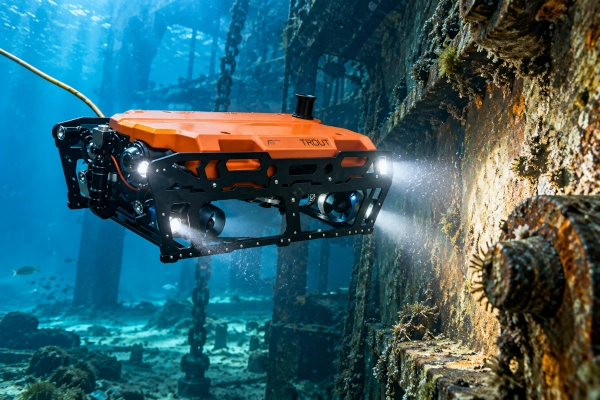
India’s indigenous underwater defence technology has achieved an important milestone as Kochi-based marine robotics startup EyeROV has delivered two TROUT military-grade Remotely Operated Vehicles (ROVs) to the Indian Navy. The delivery represents a significant advancement in India’s ability to develop specialised underwater robotic systems domestically for maritime security, naval infrastructure inspection and demanding subsea operations.
Announced on October 7, 2026, the delivery forms part of an Indian Navy order for five TROUT systems. EyeROV developed the platform under the Innovations for Defence Excellence (iDEX) DISC 7 SPRINT Challenge, an initiative designed to encourage Indian startups and technology companies to develop indigenous solutions for the Armed Forces.
According to EyeROV, TROUT is India’s first indigenously designed, developed, manufactured and military-qualified underwater ROV intended for naval operations. The platform underwent extensive field trials and qualification procedures before delivery, covering underwater manoeuvrability, deep-diving performance, navigation, endurance and operation in strong underwater currents.
The achievement marks an important transition from technology development and qualification to the supply of advanced underwater robotic equipment for naval use. It also strengthens India’s growing domestic marine robotics industry, which is developing technologies for defence, offshore infrastructure, scientific research and maritime security.
EyeROV Delivers First Two TROUT Systems Under Five-Vehicle Indian Navy Order
EyeROV, formally known as IROV Technologies Private Limited, has supplied the first two TROUT underwater robotic systems under a five-vehicle programme for the Indian Navy. The delivery follows a development and qualification process involving specialised engineering, system integration and field testing.
TROUT is a rugged underwater robotic platform designed to undertake missions in environments where conventional underwater operations may be difficult, time-consuming or hazardous. Its intended applications include underwater inspection, surveillance, reconnaissance, search and recovery, detection and robotic intervention.
The company describes the delivery as a milestone in its transition from developing underwater robotic technology to supplying military-grade equipment for naval requirements. The remaining three systems form part of the wider order, although a detailed delivery schedule has not been established in the publicly available October announcement.
EyeROV has confirmed the delivery through its official communications. A separate Indian Navy announcement specifying a formal induction date or operational deployment has not been identified. The confirmed achievement is therefore the successful delivery of two military-grade underwater ROVs following their development and qualification.
TROUT Designed for Demanding Underwater Naval Operations
The TROUT platform has been engineered to operate in challenging underwater environments involving strong currents, poor visibility, substantial depths and restricted access. These conditions can complicate underwater inspection and intervention activities, particularly when operations require divers to approach submerged structures or examine potentially hazardous locations.
Remotely operated underwater vehicles provide an alternative by allowing personnel to control robotic equipment from a safer location. Such systems can carry cameras, lights, sensors and mission-specific equipment to examine underwater objects and environments.
TROUT is intended to support missions requiring underwater observation, detection and limited robotic intervention. Its capabilities can assist personnel in examining submerged infrastructure, investigating underwater objects and collecting information from locations that are difficult to access directly.
The platform is particularly relevant to naval operations because warships, submarines, berthing infrastructure and other maritime installations require regular underwater inspection. Robotic systems can help conduct preliminary assessments, document conditions and support decisions about subsequent maintenance or specialist intervention.
EyeROV has designed TROUT as a military-grade platform rather than a conventional commercial inspection vehicle, placing emphasis on reliability and operational performance under demanding environmental conditions.
How Remotely Operated Underwater Vehicles Work
A Remotely Operated Vehicle is an unmanned underwater robotic platform controlled by an operator, usually from a ship, shore installation or other suitable control station. Unlike autonomous underwater vehicles, which can execute programmed missions with varying degrees of independence, conventional ROVs remain under direct human control during operations.
ROVs commonly use a tether to provide communication between the submerged vehicle and its control system. Depending on the design, the tether may also transmit electrical power, video feeds, sensor information and control commands.
The vehicle moves through the water using electrically driven thrusters arranged to provide directional control. These propulsion systems allow operators to adjust depth, position and orientation while examining underwater locations.
Cameras and lighting systems provide visual information, while additional sensors can support navigation, positioning and detection in conditions where visibility is limited. Some ROV configurations also incorporate robotic manipulators for interacting with underwater objects.
TROUT combines several engineering disciplines within a single underwater platform, including mechanical design, electronics, embedded software, navigation, sensing, communication and robotic control.
The exact propulsion configuration, sensor specifications and tether characteristics of the naval TROUT variant have not been fully disclosed. Its confirmed capabilities nevertheless place it within the category of remotely controlled underwater systems designed for inspection and specialised subsea missions.
TROUT Completes Extensive Underwater Field Trials
Before delivery, EyeROV subjected TROUT to field trials and system-level validation intended to assess its performance under demanding operational conditions.
According to the company, the evaluation covered underwater manoeuvrability, deep-diving capability, performance in strong currents, detection, navigation, endurance and operator control. These characteristics are important because underwater robotic vehicles must maintain reliable movement and communication while operating in environments that can differ considerably from controlled test facilities.
Strong currents can affect a vehicle’s stability and ability to maintain position near underwater structures. Poor visibility creates additional challenges for operators attempting to identify objects or inspect equipment. Greater operating depths also expose underwater systems to increased external pressure, requiring suitable mechanical design and sealing arrangements.
Testing these capabilities helps manufacturers establish whether a robotic system can perform its intended functions within specified environmental limits.
TROUT also completed type testing, which assesses whether a product design performs according to defined technical requirements. The combination of field trials and qualification procedures formed an important part of preparing the platform for naval supply.
EyeROV has not publicly released complete results from these trials, including detailed endurance measurements, current resistance limits or the full operating envelope of the delivered configuration.
Military Qualification Involves Naval Quality Assurance Standards
One of TROUT’s distinguishing features is its reported qualification against military requirements.
EyeROV states that the platform underwent the quality assurance framework of the Directorate of Quality Assurance (Naval), or DQA(N). The company also reports that TROUT was engineered to comply with Environmental Stress Screening requirements under applicable naval quality assurance policies and military standards.
Environmental Stress Screening is used to identify weaknesses that may emerge when equipment encounters specified environmental conditions. Depending on the equipment and applicable standards, testing can examine factors such as temperature variation, vibration and other stresses relevant to operational reliability.
Military equipment must also demonstrate that its mechanical, electrical and electronic components can function together under demanding conditions. For an underwater robotic system, this requires particular attention to sealing, electrical protection, pressure resistance, propulsion reliability and communication performance.
TROUT’s qualification process distinguishes the delivered platform from an experimental prototype undergoing early development. According to EyeROV, the completion of field trials, type testing and naval quality assurance procedures supports its readiness for sustained service.
The company has not released the full qualification documentation or the detailed military standards applied to each subsystem. Nevertheless, the reported completion of these procedures represents an important stage in the development of an indigenous underwater defence platform.
Indian Navy Can Use TROUT for Underwater Inspection and Surveillance
Underwater inspection is an important naval requirement because ships and maritime infrastructure contain submerged components that must be examined regularly.
Warship hulls, propulsion-related structures, underwater fittings and harbour installations can require visual inspection or specialised assessment. Conducting such activities through divers alone may be difficult when visibility is poor, currents are strong or access is restricted.
ROVs can support inspection teams by transmitting underwater imagery and other available sensor information to operators. They can also help document the condition of submerged structures and identify locations requiring closer examination.
TROUT’s intended surveillance and reconnaissance capabilities provide opportunities for investigating underwater activity around naval facilities and designated maritime locations. The platform can support the examination of underwater objects and contribute information to maritime security operations.
Its search-and-recovery role is relevant to missions involving submerged equipment, lost objects or other underwater targets. Robotic intervention capabilities may also support selected tasks requiring interaction with objects beneath the surface.
These applications make TROUT a specialised tool for naval personnel rather than a replacement for submarines, autonomous underwater vehicles or other major underwater surveillance systems.
Harbour Security and Underwater Infrastructure Protection
India’s ports, naval bases and offshore installations form an extensive network of maritime infrastructure that requires protection and maintenance.
Harbours contain submerged structures, berthing facilities, underwater pipelines, cables and other installations that may require periodic inspection. Naval facilities also need capabilities for examining suspicious underwater objects and assessing potential threats in restricted maritime areas.
ROVs can help security personnel conduct targeted inspections without exposing divers unnecessarily to hazardous underwater conditions. They are particularly useful for examining confined spaces or locations where currents and visibility complicate conventional operations.
TROUT’s combination of remote operation, underwater observation and robotic intervention is relevant to these requirements. The platform could support inspection and reconnaissance activities around naval infrastructure while providing additional information to personnel responsible for maritime security.
Such systems also have potential applications in offshore energy infrastructure, including the examination of submerged installations and equipment.
The extent of TROUT’s operational deployment across specific naval bases, ports or offshore facilities has not been publicly disclosed. Its delivery nevertheless expands the range of indigenous robotic technologies available for naval underwater missions.
EyeROV Developed TROUT Under the iDEX SPRINT Challenge
TROUT emerged from the iDEX DISC 7 SPRINT Challenge, part of India’s defence innovation framework intended to connect military requirements with technology development by domestic startups and smaller enterprises.
The Innovations for Defence Excellence initiative supports the development of technologies that address requirements identified by India’s Armed Forces. It provides opportunities for Indian companies to undertake defence-oriented research and development while engaging with military organisations.
The Indian Navy’s SPRINT initiative, launched in 2022, forms part of a broader effort to accelerate the development and adoption of indigenous naval technologies. SPRINT brings together iDEX, the Naval Innovation and Indigenisation Organisation and the Navy’s Technology Development Acceleration Cell.
Under this framework, participating companies work on challenges associated with operational requirements, creating opportunities to develop prototypes and advance suitable technologies towards qualification and procurement.
EyeROV’s TROUT programme involved the design and integration of an underwater robotic ecosystem with the Indian Navy serving as the nodal organisation.
The delivery of two systems demonstrates progress beyond the prototype stage. It also illustrates how a defence innovation challenge can provide a pathway for an Indian startup to develop equipment for an identified military requirement.
Kochi Startup EyeROV Builds Indigenous Marine Robotics Expertise
EyeROV is a Kochi-based marine robotics and artificial intelligence company specialising in underwater robotic vehicles, unmanned maritime systems and subsea inspection technologies.
The company was founded by Johns T. Mathai and Kannappa Palaniappan P, who have worked on developing robotic platforms for underwater operations. Its technologies address applications across defence, offshore infrastructure, maritime security, environmental monitoring and scientific research.
EyeROV’s broader product and technology activities include remotely operated underwater vehicles, autonomous underwater platforms, unmanned surface systems and software for analysing underwater inspection information.
The company has also developed EVAP, a visualisation and analytics platform intended to support the processing and reporting of underwater inspection data.
Developing underwater robots requires specialised expertise because vehicles must operate in an environment where conventional wireless communication is severely limited and access to equipment can be difficult once deployed.
Marine robotic systems must therefore combine reliable mechanical structures, propulsion, electronics, sensors and control software within compact, water-resistant platforms.
EyeROV’s development of TROUT demonstrates the company’s progress in integrating these capabilities into equipment intended for demanding defence applications.
EyeROV Founders Highlight India’s Underwater Engineering Capabilities
Johns T. Mathai, Chief Executive Officer and Co-Founder of EyeROV, described the delivery as an important milestone in the company’s development of indigenous military-grade underwater robotics.
Mathai stated that TROUT had progressed from an ambitious engineering programme into a mission-ready robotic platform intended for the Indian Navy. He emphasised that the achievement demonstrated India’s ability to develop advanced marine technologies domestically and contribute to national maritime security.
Kannappa Palaniappan P, Chief Technology Officer and Co-Founder, highlighted the complexity involved in developing an underwater robotic platform that meets military requirements.
He explained that such systems require mechanical engineering, electronics, embedded systems, software, navigation, sensing, communication and robotic control to operate reliably as an integrated platform.
The founders’ remarks reflect the multidisciplinary engineering challenges associated with underwater robotics. Unlike conventional software products, these systems depend on close integration between physical hardware and digital control technologies.
Their development also requires extensive testing because failures in underwater environments can make equipment recovery and repair difficult.
TROUT’s completion of qualification procedures and subsequent delivery represents a significant milestone for EyeROV’s engineering team and its transition towards defence equipment supply.
Military ROVs Complement Autonomous Underwater Vehicles
Remotely operated underwater vehicles and autonomous underwater vehicles serve different purposes within modern maritime operations.
ROVs generally remain under direct operator control and are particularly useful for inspection, observation and tasks requiring human decisions during a mission. Their operating arrangements allow personnel to examine live information and adjust the vehicle’s movements according to the conditions encountered underwater.
Autonomous underwater vehicles, by contrast, can execute programmed missions using onboard navigation, sensing and decision-making systems. These platforms are suited to applications such as underwater mapping, environmental surveys and systematic searches across larger areas.
Both categories can support naval operations, but their operational characteristics differ. ROVs provide direct human supervision and can support close inspection or intervention, while AUVs offer greater independence for missions where continuous remote control is impractical.
India’s expanding underwater robotics ecosystem includes the development of both remotely operated and autonomous platforms.
TROUT contributes to this wider technological effort by providing an indigenous military-grade ROV intended for specialised underwater missions. Its development strengthens a particular segment of naval robotics without replacing the need for other underwater surveillance and operational systems.
Indigenous Underwater Robotics Supports Aatmanirbhar Bharat
The development of TROUT aligns with India’s efforts to strengthen indigenous defence technology and reduce dependence on foreign equipment in strategically important sectors.
Underwater robotics is a specialised engineering field requiring expertise in mechanical design, propulsion, sensors, communications, embedded electronics and software integration.
Domestic development allows Indian companies to build experience across these technologies while creating opportunities for local suppliers and engineering specialists.
Military applications also demand systems adapted to the operational requirements of Indian users. Developing equipment through direct engagement with the Armed Forces can help manufacturers understand these requirements and incorporate relevant design features.
The iDEX framework supports this approach by creating opportunities for startups to address defence challenges through indigenous innovation.
EyeROV’s TROUT programme demonstrates how a domestic technology company can progress from developing a specialised robotic platform to supplying equipment for the Indian Navy.
The wider benefits extend beyond a single product. Experience gained through underwater robotics development can support related technologies in offshore engineering, marine infrastructure inspection, environmental monitoring and commercial subsea operations.
TROUT Delivery Strengthens India’s Indigenous Naval Technology Ecosystem
The delivery of two TROUT military-grade underwater robots marks an important development in India’s domestic marine robotics capabilities.
The systems were developed under an Indian Navy-backed innovation challenge and underwent field trials, qualification procedures and system-level validation before delivery.
Their intended applications cover underwater inspection, surveillance, reconnaissance, search and recovery, detection and robotic intervention. These capabilities address operational requirements in an environment where difficult conditions can limit conventional inspection and observation methods.
The programme also demonstrates the contribution of Indian startups to defence technology development. EyeROV has brought together multiple engineering disciplines to produce a specialised underwater platform intended for naval use, reflecting the growing maturity of India’s private defence innovation ecosystem.
With the first two systems delivered under a five-vehicle programme, TROUT represents another milestone in India’s transition from indigenous defence technology development to equipment supply. The achievement strengthens the foundation for continued progress in underwater robotics, supports Aatmanirbhar Bharat and reinforces the role of Indian engineering companies in developing advanced technologies for the country’s maritime security.
References
- EyeROV — Official Company Announcement, October 2026. Delivery of two TROUT military-grade underwater ROV systems to the Indian Navy under a five-system programme.
https://www.linkedin.com/company/eyerov/ - EyeROV — Official Website. Indigenous underwater robotics, defence applications and iDEX collaboration.
https://eyerov.com/ - The New Indian Express — October 7, 2026. Kochi Startup EyeROV Delivers India’s First Military-Grade ROV to Indian Navy.
https://www.newindianexpress.com/cities/kochi/2026/Oct/07/kochi-startup-eyerov-delivers-indias-first-military-grade-rov-to-indian-navy - The Week — October 8, 2026. Indian Navy Gets India’s First Military-Grade Underwater ROV: What Makes EyeROV TROUT Special?
https://www.theweek.in/news/defence/2026/10/08/indian-navy-gets-indias-first-military-grade-underwater-rov-what-makes-eyerov-trout-special.html - Press Information Bureau, Ministry of Defence — July 18, 2022. Prime Minister Unveils SPRINT Challenges to Promote Indigenous Naval Technologies.
https://www.pib.gov.in/PressReleasePage.aspx?PRID=1842449 - Press Information Bureau, Ministry of Defence — September 18, 2023. Second Edition of Indian Navy’s Naval Innovation and Indigenisation Seminar, Swavlamban 2023.
https://www.pib.gov.in/PressReleasePage.aspx?PRID=1958527
You may also like
-
Serum Institute of India-Manufactured Ebola Vaccine Enters Clinical Trial in Uganda
-
Larsen & Toubro Selects Australian Orbital’s 350HFE Heavy-Fuel Engines for Indian Tactical UAV Programme
-
Colombia Seeks India’s Counter-Drone Technology and Stronger Security Cooperation to Combat Drug Cartels
-
Himachal Startup Tecnod8.AI Develops Industrial AI Copilot for Advanced Manufacturing
-
Skyroot Aerospace Partners with Brazil’s Concert Technologies to Develop New Orbital Launch Vehicle
