Introduction: The Fort as an Instrument of State Power
In Kauṭilya’s Arthaśāstra, the fort, or durga, occupies a central position in the organisation and protection of the state. It is not conceived merely as a defensive wall surrounding a settlement but as an integrated military, administrative and economic establishment capable of protecting the kingdom during periods of external aggression and internal instability. Its effectiveness depends upon the relationship between geography, engineering, water resources, communications, military preparedness and the availability of essential supplies.
The Arthaśāstra provides an unusually detailed examination of fortifications in Book II, Chapter 3, traditionally titled Construction of Forts. The succeeding chapter, Buildings Within the Fort, extends this discussion into the organisation of urban settlements, administrative institutions, roads, water supplies, storage facilities and military establishments. Together, these chapters demonstrate that Kauṭilya regarded the defence of a kingdom as a comprehensive responsibility extending far beyond the construction of physical barriers.
The underlying strategic principle is that a fortified settlement must be capable of resisting external threats while preserving the essential functions of government and society. A strong defensive position becomes ineffective if its inhabitants lack water, food, communications or the resources necessary to sustain prolonged resistance. Kauṭilya’s prescriptions therefore connect military engineering with environmental conditions, urban planning and the economic foundations of state power.
Strategic Geography: Choosing the Right Location for Defence
Kauṭilya begins his discussion of fortifications by emphasising the importance of selecting locations that possess natural defensive advantages. Rather than recommending a single model suitable for every region, he identifies different categories of fortifications according to the geographical conditions in which they are established.
The opening passage of Book II, Chapter 3, describes four principal types of forts: audaka, or water fortifications; pārvata, or mountain fortifications; dhānvana, or desert fortifications; and vanadurga, or forest fortifications. Each category reflects a different method of using the natural environment to strengthen defensive capabilities.
Original Sanskrit — Arthaśāstra 2.3.1
चतुर्दिशं जनपदान्ते साम्परायिकं दैवकृतं दुर्गं कारयेत् ।
Transliteration: Caturdiśaṃ janapadānte sāmparāyikaṃ daivakṛtaṃ durgaṃ kārayet.
Meaning: Defensive fortifications should be established towards the four directions along the boundaries of the kingdom, using locations that possess natural advantages during warfare.
The instruction reveals that Kauṭilya did not regard defensive construction as a purely architectural undertaking. The location of a fort determines the approaches available to an attacking force, the resources accessible to its defenders and the ease with which it can communicate with surrounding settlements. Geography therefore becomes an active component of military planning rather than a passive background against which warfare takes place.
The recommendation to establish fortifications along the boundaries of the kingdom also indicates an interest in territorial protection. Such positions could help secure vulnerable approaches and support the defence of populated regions. Their effectiveness would depend upon the particular landscape, the resources available and the wider military organisation of the state.
Water Fortifications: Rivers, Islands and Natural Barriers
The first category described by Kauṭilya is the audaka durga, a fortification protected by water. The text identifies locations such as islands within rivers and areas surrounded by lower ground that can provide defensive advantages. Water serves as a natural obstacle that may restrict an attacking army’s movement and complicate the transportation of personnel, animals and equipment.
A water fortification offers particular advantages when the surrounding terrain limits the number of approaches available to an enemy. Rivers, channels and other water bodies can create difficult crossing conditions, allowing defenders to concentrate their resources upon selected points. However, such advantages depend upon the reliability of the water source and the ability to protect essential access routes.
Kauṭilya’s interest in water-based defence extends beyond the use of natural barriers. His prescriptions for the fortified capital include locations near river confluences, perennial water bodies, lakes and reservoirs. This emphasis demonstrates that water was understood as both a defensive resource and an essential requirement for sustaining the population.
The distinction is important because a fort surrounded by water may still remain vulnerable if its inhabitants cannot obtain sufficient drinking water. Effective planning must therefore address two separate requirements: using water to obstruct an enemy and ensuring that reliable supplies remain available to the defenders. The Arthaśāstra’s discussion of water fortifications and urban wells addresses these complementary concerns.
Mountain Fortifications: Elevation and the Control of Approaches
The second category is the pārvata durga, or mountain fortification. Kauṭilya identifies rocky terrain and caves as examples of naturally defensible positions. Such locations can provide protection through elevation, difficult approaches and the limited accessibility of surrounding terrain.
Mountain fortifications can impose considerable difficulties upon attacking forces. Steep slopes and narrow passages may restrict the movement of large formations, while elevated defensive positions can provide opportunities for observation and the protection of important approaches. These geographical advantages may enable a comparatively smaller defending force to resist an opponent operating under less favourable conditions.
Nevertheless, elevation alone does not guarantee security. Mountain positions may present significant challenges in transporting food, water, equipment and reinforcements. Their defenders must therefore ensure that the advantages of terrain are supported by sufficient logistical preparation and dependable access to essential resources.
Kauṭilya’s treatment of mountain fortifications illustrates a broader principle of strategic geography. A naturally strong position becomes militarily valuable when its physical characteristics can be integrated with the requirements of defence. Terrain should strengthen the capabilities of the defending force without creating vulnerabilities that undermine its endurance.
Desert and Forest Fortifications: Defence Through Difficult Terrain
The Arthaśāstra also identifies dhānvana durga, or desert fortifications, and vanadurga, or forest fortifications. These categories differ from water and mountain forts because their defensive advantages arise primarily from the difficulties imposed by the surrounding environment.
The desert fortification is associated with barren terrain and the scarcity of water. An attacking army operating through such a region may encounter difficulties in obtaining supplies and maintaining its movement. However, these same conditions can threaten the defenders unless adequate resources have been secured within the fortified position.
The forest fortification relies upon wooded terrain, dense vegetation and the obstacles created by the natural landscape. Forests can restrict visibility, complicate movement and make it difficult for an unfamiliar force to maintain effective coordination. At the same time, defending forces must possess sufficient knowledge of the environment to avoid becoming isolated by the terrain intended to protect them.
Kauṭilya distinguishes the strategic functions of these fortifications. Water and mountain forts are identified as particularly suitable for defending populated regions, while desert and forest fortifications are associated with wilderness locations and places of refuge during danger. This distinction indicates that the selection of a fort must reflect the function it is expected to perform.
The underlying lesson is that geographical conditions should determine military infrastructure rather than the reverse. A defensive position suitable for a river valley may be inappropriate in a mountainous or arid region. Successful fortification therefore begins with understanding the environment and adapting defensive arrangements to its opportunities and limitations.
The Fortified Capital: Security at the Centre of the Kingdom
Kauṭilya’s discussion moves from frontier fortifications to the establishment of a fortified capital, or sthānīya. In Arthaśāstra 2.3.3, he recommends locating the principal administrative centre in a naturally favourable part of the kingdom, preferably near reliable water resources. The proposed sites include river confluences, perennial pools, lakes and reservoirs.
The fortified capital is described as the principal seat of authority and the concentration of important state resources. Its location within the kingdom reflects the need to protect the political and administrative institutions upon which government depends. A fortified capital must provide a secure environment for the ruler and his officials while maintaining connections with the wider territory.
Kauṭilya permits different shapes for the fortified settlement, including circular, elongated and quadrangular forms, depending upon the suitability of the site. He also recommends access through both land and water routes. These provisions demonstrate that the fort’s layout should respond to geographical conditions and the practical requirements of movement and communication.
The combination of defensibility and connectivity is especially significant. A capital that cannot communicate with surrounding regions may become vulnerable to isolation, even when its walls remain intact. Kauṭilya’s prescriptions therefore suggest that defensive strength must be balanced with the ability to sustain the movement of personnel, information and essential resources.
Moats and Defensive Layers: Engineering a Fortified Perimeter
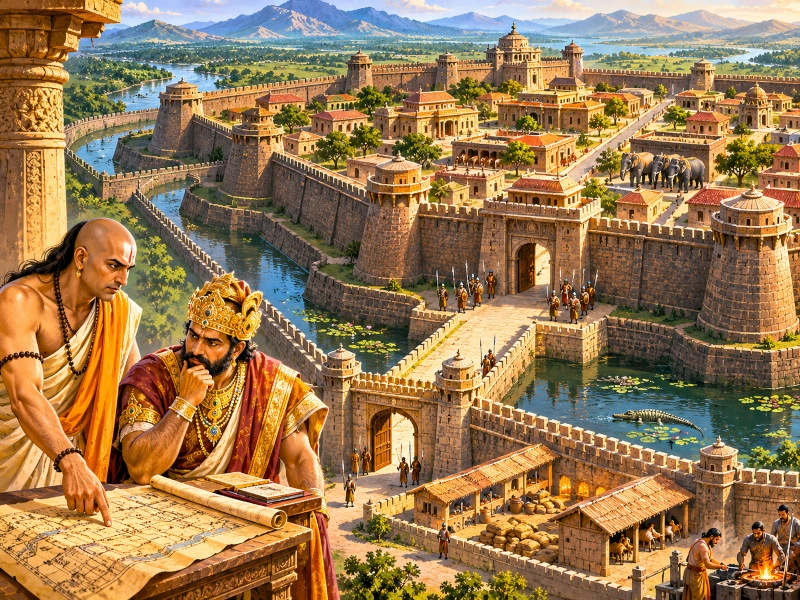
One of the most technically detailed sections of the Arthaśāstra concerns the construction of moats, ramparts and defensive walls. In Book II, Chapter 3, Kauṭilya recommends a system of three surrounding ditches separated by specified distances. The text gives their respective widths as fourteen, twelve and ten daṇḍas, with prescribed proportions for their depth and construction.
These ditches are to be strengthened with stone or brick where appropriate and supplied with water from perennial sources or other available arrangements. The text also describes lotus plants and crocodiles within the defensive waters, reflecting the military practices and environmental assumptions of the period. These are historical prescriptions rather than recommendations for contemporary fortification design.
The purpose of the moat system is to create successive obstacles between an approaching enemy and the principal defensive wall. Multiple barriers can increase the difficulty of reaching the fortification and require an attacking force to overcome several distinct challenges before approaching the main defended position.
Behind the ditches, Kauṭilya prescribes an earthen rampart of substantial height and breadth. The text describes methods of shaping and consolidating the earth, together with the construction of walls and parapets above the rampart. Towers, gateways and protected positions for archers form additional elements of the defensive arrangement.
The significance of this design lies in its layered character. The outer obstacles, rampart, wall and elevated defensive positions perform different but complementary functions. An attacker who overcomes one barrier still faces additional defensive measures, while the defenders can make use of the fortification’s depth and internal arrangements.
This approach demonstrates that Kauṭilya understood fortification as a coordinated system rather than a single architectural structure. Its effectiveness depends upon the interaction of terrain, obstacles, defensive positions and the personnel responsible for protecting them.
Water Security: The Foundation of Defensive Endurance
Water occupies a particularly important position in Kauṭilya’s conception of fortified settlements. Its strategic value extends beyond natural barriers and defensive moats to the everyday requirements of urban life and the ability to withstand disruption.
In Arthaśāstra 2.4.26, the text provides a specific instruction concerning water availability within the fortified city.
Original Sanskrit — Arthaśāstra 2.4.26
दशकुलीवाटं कूपस्थानम् ।
Transliteration: Daśakulīvāṭaṃ kūpasthānam.
Meaning: Provision should be made for a well serving every ten households.
This concise prescription is one of the clearest examples of the relationship between urban planning and security in the Arthaśāstra. By providing for water access within the settlement, Kauṭilya addresses a fundamental requirement of population survival. The instruction also has military implications because a fortified city cannot sustain prolonged resistance without reliable internal supplies.
A settlement dependent entirely upon water transported from outside its walls would face serious difficulties if access routes were interrupted. Internal wells and reservoirs could reduce this vulnerability, although their effectiveness would still depend upon water availability, maintenance and protection from contamination.
The instruction should be understood within its historical context rather than treated as a universal modern standard for the provision of drinking water. Its enduring significance lies in the recognition that water infrastructure is essential to urban resilience and cannot be separated from defensive planning.
Water security thus becomes a component of political and military preparedness. A fortified settlement must preserve access to the resources required for its inhabitants to survive, particularly when external conditions become hostile.
Urban Planning Within the Fort: Organising the Defensive City
Book II, Chapter 4, extends Kauṭilya’s discussion from fortification engineering to the internal organisation of the fortified city. The chapter begins by prescribing the division of urban space through principal roads running in different directions. It then identifies locations for royal establishments, administrative offices, commercial activities, storage facilities and other institutions.
The arrangement of streets serves several purposes. Roads enable the movement of people and goods, connect important institutions and provide routes through which officials and military personnel can reach different parts of the settlement. During an emergency, the accessibility of these routes can influence the ability of the administration to coordinate its response.
Kauṭilya also describes multiple gates and concealed routes associated with the fortified city. These provisions indicate an awareness that communication and movement must be maintained without exposing every available approach to potential adversaries. The arrangement of access points therefore forms part of the larger defensive organisation.
The chapter further assigns different activities and institutions to particular sections of the city. Administrative offices, treasuries, arsenals, manufactories, stables and storage establishments all receive attention. These prescriptions reveal an approach to urban planning in which the location of essential functions contributes to the efficiency of the settlement.
The text also contains social and occupational divisions characteristic of its historical setting, including provisions based upon the hierarchical social order of the period. Such arrangements should be studied as features of the ancient text rather than treated as models for contemporary civic equality.
The broader administrative principle remains significant. A fortified city requires more than walls and military personnel. It must possess an internal organisation capable of supporting government, economic activity, essential services and the coordinated movement of resources.
Food, Materials and the Economics of Siege Resistance
Kauṭilya’s recommendations concerning storage provide another important dimension of defensive planning. In Arthaśāstra 2.4.27, he prescribes the accumulation of essential commodities in quantities sufficient to support the fortified settlement over extended periods.
The materials identified include grains, oils, salt, medicines, vegetables, fuel, metals, timber, weapons, armour and other necessities. The text further instructs that older stocks should be replaced by new supplies, indicating concern for the continued usefulness of stored resources.
These provisions recognise that the endurance of a fortified settlement depends upon the availability and management of supplies. Even a well-defended city may become vulnerable if its food reserves are exhausted or essential materials cannot be replaced. The storage system must therefore address civilian requirements as well as the needs of the defending forces.
The recommendation to maintain supplies for years is particularly revealing. It suggests that Kauṭilya considered prolonged disruption a serious possibility and regarded advance preparation as necessary for the preservation of the state. Defensive strength was consequently measured not only by the fort’s ability to resist an initial assault but also by its capacity to remain functional over time.
This connection between economic resources and military security is central to the Arthaśāstra’s strategic outlook. The treasury, productive economy, storage establishments and military institutions are mutually dependent. The ruler must ensure that the resources required for defence are accumulated, maintained and made available when necessary.
Military Infrastructure and the Protection of Essential Institutions
Within the fortified city, Kauṭilya provides for arsenals, military establishments, stables and administrative departments responsible for different aspects of government. Their inclusion reflects the need to support armed forces through a permanent institutional framework.
An army cannot depend exclusively upon the weapons and equipment immediately carried by its soldiers. The maintenance of military capability requires storage, repair facilities, transport arrangements and the personnel necessary to manage these activities. Kauṭilya’s prescriptions place such requirements within the physical and administrative organisation of the fortified settlement.
The presence of manufacturing activities and skilled workers is also important. Equipment and defensive infrastructure require continuing maintenance, particularly when subjected to prolonged use or damage. The fort must therefore retain access to productive capabilities that support its military functions.
The chapter also addresses the organisation of different military branches, including elephants, cavalry, chariots and infantry. Kauṭilya recommends arrangements intended to reduce the possibility of enemy intrigue affecting military leadership. This reveals that the security of a fort depends not only upon external barriers but also upon the reliability of the personnel responsible for its defence.
The relationship between physical security and institutional integrity is particularly noteworthy. Strong defensive structures can be undermined by defective administration, inadequate supplies or disloyal commanders. Effective fortification therefore requires the coordination of military engineering with disciplined organisation and political oversight.
Strategic Geography and the Control of Communications
A recurring feature of Kauṭilya’s prescriptions is the relationship between defensive positions and the routes connecting different parts of the kingdom. The fortified capital is expected to possess both land and water communications, while the internal organisation of the city includes roads leading towards settlements, administrative centres and surrounding regions.
These requirements demonstrate that communications are fundamental to the functioning of a fortified state. Roads enable the movement of supplies, officials, commercial goods and military personnel. Water routes may provide additional access where rivers and other navigable waterways are available.
The strategic importance of these connections becomes particularly evident during periods of conflict. A fortified centre that remains connected to supporting territories may be better positioned to obtain resources and maintain communication with other institutions. Conversely, the interruption of important routes can weaken a settlement even when its physical defences remain secure.
Kauṭilya’s preference for naturally advantageous locations must therefore be understood alongside his concern for accessibility. The ideal fortified position is not necessarily the most isolated or difficult to reach. It is one that combines defensive advantages with the communications and resources required to sustain its intended political and military functions.
This relationship between geography and connectivity remains one of the most useful strategic ideas emerging from the text. Defensive infrastructure must be evaluated according to both its capacity to resist threats and its ability to remain integrated with the wider territory it protects.
The Strategic Significance of Fortifications in Kauṭilya’s Statecraft
The Arthaśāstra’s treatment of fortifications is consistent with its broader understanding of the state as an interconnected system of political, economic and military institutions. In Kauṭilya’s well-known saptāṅga framework, the fort, or durga, constitutes one of the seven constituent elements of the state.
The remaining elements include the ruler, ministers, territory and population, treasury, armed force and allies. Their relationship is important because the fort cannot operate independently of the other components. It requires financial resources, military personnel, administrative supervision and a productive territory capable of supporting its population.
This framework explains why the Arthaśāstra devotes attention to subjects that may initially appear unrelated to fortification, including water distribution, roads, markets and storage establishments. Each contributes to the stability and endurance of the fortified centre.
A well-positioned fort protects political authority, but the effectiveness of that protection depends upon the strength of the institutions operating within it. Similarly, the territory surrounding the fort provides resources and communications that support its continued functioning. The defensive position and the wider kingdom are therefore mutually dependent.
Fortifications consequently emerge as instruments of state power rather than isolated military installations. Their value derives from their ability to preserve essential institutions, protect resources and support the continuity of government during periods of danger.
Contemporary Relevance: Infrastructure Security and Urban Resilience
Kauṭilya’s prescriptions belong to an ancient military environment in which fortifications, siege warfare and the movement of armies were governed by technologies and conditions different from those of the present day. Nevertheless, several underlying principles provide useful material for contemporary reflection on infrastructure security, urban resilience and strategic planning.
The first is the importance of geography in determining the location of critical infrastructure. Natural features influence accessibility, vulnerability, transportation requirements and the availability of resources. Modern planning must additionally consider environmental protection, population needs, engineering safety and the changing risks associated with climate and technology.
The second principle concerns the security of essential supplies. Kauṭilya’s insistence upon wells, reservoirs and stored commodities demonstrates an understanding that physical protection is insufficient without the resources necessary to sustain human activity. In contemporary terms, this invites comparison with the resilience of water distribution, food logistics, energy infrastructure and emergency supply arrangements.
The third principle is the integration of defensive infrastructure with administrative and economic systems. The fortified settlement described in the Arthaśāstra contains the institutions and resources required for governance, commerce and military preparedness. Its effectiveness depends upon their ability to function together rather than independently.
The fourth concerns continuity during disruption. Kauṭilya’s instructions regarding storage, communications and internal organisation demonstrate an interest in preserving the settlement’s essential functions under adverse conditions. This principle offers a historical perspective on the importance of redundancy, preparedness and coordinated institutional responses.
These comparisons do not imply that ancient fortification designs should be reproduced in modern cities or that the Arthaśāstra anticipated contemporary military technologies. Their value lies in demonstrating how an early work of Indian political thought approached security as a combination of geography, infrastructure, resources and administrative capability.
Conclusion: Fortifications as the Foundation of a Resilient State
Kauṭilya’s discussion of fortifications in the Arthaśāstra reveals a sophisticated understanding of the relationship between military engineering, strategic geography and the economic foundations of political power. The fort is presented not merely as a structure designed to withstand enemy attacks but as an organised establishment capable of protecting essential institutions and sustaining the population during periods of danger.
The classification of water, mountain, desert and forest fortifications demonstrates the importance of adapting defensive arrangements to local geography. The detailed prescriptions for moats, ramparts, roads and gateways illustrate the integration of natural advantages with constructed defences. Equally significant are the provisions concerning wells, reservoirs, food storage, military establishments and administrative offices, which establish the resources necessary for a fortified settlement to remain functional.
The broader strategic lesson is that the security of a state depends upon much more than its visible defensive infrastructure. Physical protection must be supported by reliable resources, effective communications, institutional discipline and the capacity to preserve essential services under difficult conditions.
For students of Indian military history and strategic thought, the Arthaśāstra offers an important example of how defence, geography and governance were examined within a common intellectual framework. Its enduring contribution lies in recognising that a state’s strength rests upon the resilience of the systems that sustain it.
Kauṭilya’s vision of fortification ultimately rests upon a principle that extends beyond the walls of any ancient city: lasting security requires the coordinated protection of territory, resources, institutions and the people who depend upon them.
References
1. Kauṭilya’s Arthaśāstra — Book II, Chapter 3: Construction of Forts
Primary textual reference for the classification of water, mountain, desert and forest fortifications, the selection of locations for fortified capitals, and the construction of defensive moats, ramparts, walls, towers and gateways.
Sanskrit text with English translation based on R. Shamasastry.
https://indike.org/pramana/in.niti.artha.kautilya.2.3
2. Kauṭilya’s Arthaśāstra — Book II, Chapter 4: Buildings Within the Fort
Primary textual reference for the organisation of fortified settlements, internal roads, administrative establishments, arsenals, storage facilities, water wells, military infrastructure and essential supplies.
Sanskrit text with English translation based on R. Shamasastry.
https://indike.org/pramana/in.niti.artha.kautilya.2.4
3. R. Shamasastry — Kautilya’s Arthaśāstra
English translation originally published in 1915. The translation provides the principal textual basis for the discussion of fortification engineering, urban arrangements and the administrative responsibilities associated with fortified settlements.
https://en.wikisource.org/wiki/Arthashastra/Book_II
4. Kauṭilya’s Arthaśāstra — Book VI, Chapter 1: The Elements of Sovereignty
Primary reference for the saptāṅga conception of the state and the place of fortifications among its constituent elements.
https://en.wikisource.org/wiki/Arthashastra/Book_VI
Textual and Editorial Note: The article follows the structure and terminology of Kauṭilya’s Arthaśāstra, particularly Book II, Chapters 3 and 4. Sanskrit passages are accompanied by explanatory translations. The contemporary discussion of infrastructure security and urban resilience is an analytical interpretation of the ancient prescriptions, not a claim that the text describes present-day engineering standards or military systems. The Arthaśāstra is a historically layered work traditionally attributed to Kauṭilya, and its prescriptions should not automatically be treated as evidence that every arrangement was implemented uniformly across ancient Indian kingdoms.
You may also like
-
ArthX Delivers First Batch of YUKI Drones to Indian Army
-
Krishna’s Assault on Narakāsura’s Fortress: The Fall of Prāgjyotiṣa
-
Rāma’s Counsel to Bharata: Governance, Intelligence and the Responsibilities of Kingship
-
India May Extend Defence Trial Certification to Indigenous MALE Drones Without Domestic Orders
-
IG Defence Announces Successful Indian Army Trials of Indigenous 2.5 kg Anti-Personnel Warhead
