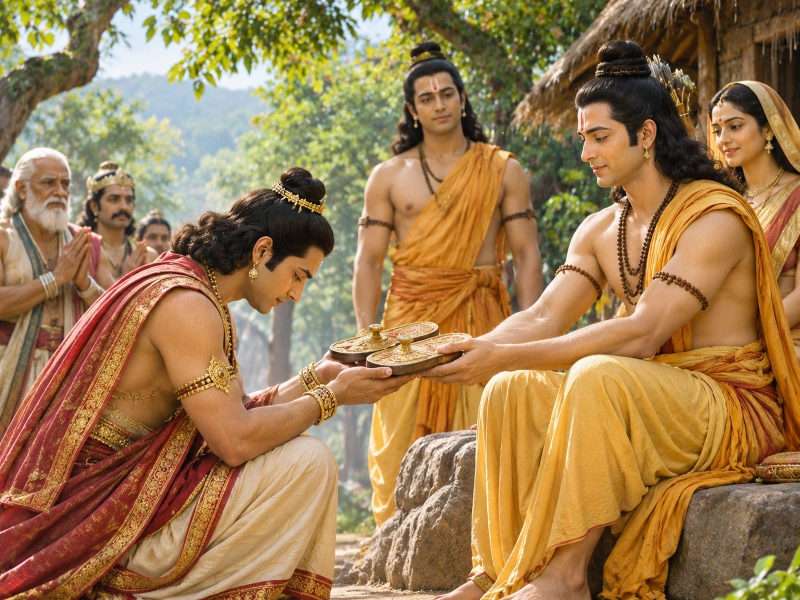
The Vālmīki Rāmāyaṇa presents an extraordinary example of political restraint, institutional continuity and legitimate governance through Bharata’s acceptance of Rāma’s Pādukās, or sandals, as the symbol of sovereign authority. Recorded in the Ayodhyā Kāṇḍa, Sarga 112, the episode emerges from a succession crisis that threatens the political stability of the kingdom of Kosala following the death of King Daśaratha. Rather than exploiting circumstances that could have secured him the throne, Bharata establishes an arrangement that enables the kingdom to function without abandoning his recognition of Rāma’s rightful kingship.
The diplomatic significance of Bharata’s decision extends beyond personal devotion and fraternal loyalty. His conduct demonstrates how political authority may be exercised without appropriating sovereignty, how competing obligations can be reconciled without confrontation, and how an administrative arrangement can preserve institutional legitimacy during an extraordinary constitutional predicament. The Pādukās become the visible representation of an absent sovereign, allowing Bharata to undertake the responsibilities of governance without claiming the ultimate authority associated with the throne.
The Succession Crisis in Ayodhyā
The political circumstances preceding Bharata’s meeting with Rāma at Citrakūṭa were exceptionally complex. Kaikeyī had invoked the two boons previously granted to her by Daśaratha, demanding Bharata’s coronation and Rāma’s exile for fourteen years. Daśaratha’s subsequent death left the kingdom without its reigning monarch, while Rāma’s departure deprived Ayodhyā of its intended successor and created uncertainty regarding the future of the royal administration.
Bharata inherited a political opportunity that many ambitious rulers might have regarded as favourable. He possessed a claim arising from Daśaratha’s commitment to Kaikeyī, belonged to the ruling dynasty and had access to the administrative machinery of the kingdom. Nevertheless, Bharata rejected the prospect of acquiring sovereignty through circumstances that had displaced his elder brother, demonstrating that access to political power does not necessarily establish its moral legitimacy.
His journey to Citrakūṭa was consequently more than an expression of personal grief. Accompanied by members of the royal household, ministers and religious authorities, Bharata sought a resolution capable of restoring stability while respecting the principles governing the Ikṣvāku dynasty. The resulting negotiations reveal the importance of reconciliation when competing interpretations of duty threaten the continuity of government.
The Diplomatic Deadlock at Citrakūṭa
The discussions between Rāma and Bharata reveal a fundamental conflict between two positions grounded in Dharma. Bharata believed that Rāma should return to Ayodhyā and assume kingship, while Rāma maintained that fulfilling their father’s commitment required him to remain in exile for the prescribed fourteen years. Neither brother sought personal advantage, yet their respective interpretations of duty prevented an immediate resolution.
The diplomatic difficulty arose because accepting either position in its entirety appeared to compromise an important principle. Rāma’s immediate return would undermine his commitment to honour Daśaratha’s word, while Bharata’s assumption of independent sovereignty would contradict his recognition of Rāma’s rightful position. A successful settlement therefore required an arrangement that accommodated both obligations without forcing either participant to abandon his fundamental convictions.
The eventual solution emerged through the separation of sovereign legitimacy from the practical responsibilities of administration. Bharata would return to govern the kingdom, but he would do so without presenting himself as the independent successor to Daśaratha. Rāma, meanwhile, would continue his exile while retaining the position that Bharata acknowledged as rightfully his.
The Pādukās as Symbols of Sovereign Authority
In Sarga 112 of the Ayodhyā Kāṇḍa, Bharata requests Rāma to place his feet upon a pair of ornamented sandals before handing them over. Rāma complies with the request, thereby enabling Bharata to return with a tangible symbol of his brother’s authority. The transfer of the Pādukās becomes the defining moment in the resolution of the succession dispute.
Bharata declares that he will reside outside the capital, adopt an austere manner of living and await Rāma’s return while entrusting the governance of the kingdom to the sandals. The arrangement establishes a clear distinction between the individual performing administrative responsibilities and the person recognised as the rightful sovereign. Bharata accepts the burdens associated with government while deliberately declining the privileges of independent kingship.
The expression nyasta-rājya-tantraḥ, appearing in the passage, is particularly significant from the perspective of political analysis. It conveys Bharata’s decision to entrust the administration of the kingdom to Rāma’s Pādukās. Although the epic does not describe this arrangement through the terminology of modern constitutional government, it provides a compelling narrative example of authority exercised on behalf of another.
The Separation of Political Authority and Administrative Responsibility
One of the most remarkable aspects of Bharata’s Pādukā diplomacy is the separation of political legitimacy from administrative control. A kingdom requires continuous decision-making, economic management, security arrangements and the maintenance of public order, regardless of the physical presence of its sovereign. Bharata recognises these practical necessities without interpreting them as justification for permanently transferring sovereignty to himself.
The arrangement can be understood, in modern analytical terms, as a form of temporary custodianship resembling a regency. Bharata undertakes the responsibilities necessary to preserve the kingdom while recognising Rāma as the ultimate source of authority. Such an interpretation does not imply the existence of a modern constitutional framework in the epic; rather, it highlights the political principles embodied in Bharata’s conduct.
This distinction is important because political instability frequently arises when temporary administrative authority develops into a permanent claim to power. Bharata prevents such a transformation by publicly defining the nature, purpose and duration of his responsibilities. His authority is presented not as personal ownership of the kingdom but as an obligation to safeguard it until Rāma’s return.
Symbolism as an Instrument of Diplomacy
Political institutions frequently depend upon symbols that communicate continuity, authority and collective identity. Royal insignia, seals, ceremonial objects and formal rituals can establish a visible connection between an institution and the legitimacy it represents. Within the narrative of the Rāmāyaṇa, the Pādukās perform a comparable symbolic function.
The sandals are significant because they belong to Rāma and are voluntarily entrusted to Bharata. Their authority arises from the relationship between the recognised sovereign and the individual accepting responsibility on his behalf. They provide a visible expression of the understanding reached at Citrakūṭa and communicate that Bharata’s administration is not intended to establish a competing kingship.
The diplomatic effectiveness of this symbolism rests upon the consistency between Bharata’s declaration and his subsequent conduct. A symbolic gesture would have possessed limited credibility had Bharata proceeded to appropriate the royal privileges he had renounced. By aligning his personal behaviour with the political meaning of the Pādukās, Bharata strengthens the credibility of the settlement and its underlying principles.
Establishing a Time-Bound Political Arrangement
Bharata’s undertaking is explicitly connected to the fourteen-year period of Rāma’s exile. This temporal boundary distinguishes his administrative responsibility from an indefinite transfer of sovereignty and establishes a clear expectation regarding the restoration of Rāma’s direct rule. The duration of the arrangement is therefore determined by the original commitment rather than by Bharata’s personal preferences.
From a diplomatic perspective, defining the duration of an interim political arrangement reduces uncertainty regarding its ultimate objective. Without such a limitation, temporary authority could gradually acquire the characteristics of permanent sovereignty, creating competing claims and complicating the eventual transfer of power. Bharata avoids this ambiguity by declaring that his responsibilities will remain connected to Rāma’s anticipated return.
The episode consequently illustrates the importance of a clearly defined exit condition in transitional governance. Bharata’s undertaking is not merely a commitment to administer the kingdom effectively; it is also a commitment to relinquish that responsibility when the circumstances requiring his custodianship cease to exist. The willingness to surrender authority becomes as important as the willingness to exercise it.
Nandigrāma and the Institutionalisation of Custodianship
The political arrangement established in Sarga 112 receives practical expression in the subsequent narrative. In Sarga 115 of the Ayodhyā Kāṇḍa, Bharata proceeds to Nandigrāma, where he establishes his residence and administers the kingdom while maintaining the Pādukās as the recognised symbols of Rāma’s authority. His decision to remain outside Ayodhyā reinforces the distinction between his temporary responsibilities and the permanent position of kingship.
Nandigrāma becomes the administrative expression of Bharata’s commitment. By declining the conventional comforts and privileges associated with royal residence, Bharata demonstrates that the purpose of his administration is service rather than personal advancement. His conduct establishes a visible relationship between political responsibility and personal restraint.
The distinction between the two Sargas is important for understanding the development of the arrangement. Sarga 112 records the diplomatic settlement and the transfer of the Pādukās, while Sarga 115 describes the subsequent administration from Nandigrāma. Together, these episodes demonstrate that an agreement achieves enduring significance only when its principles are translated into consistent institutional practice.
Preventing Dynastic Fragmentation
Succession disputes have historically possessed the potential to divide ruling families, administrative elites and military establishments. Competing claims to sovereignty can produce rival centres of authority, weaken public confidence and threaten territorial cohesion. The circumstances surrounding Daśaratha’s death presented the kingdom of Kosala with conditions from which such instability could potentially have emerged.
Bharata’s recognition of Rāma’s legitimacy prevents the development of competing royal claims within the narrative. Instead of establishing a separate political identity around his own entitlement, Bharata aligns his administrative responsibilities with the continuity of the existing dynasty. His decision transforms a potentially divisive succession dispute into a cooperative arrangement between the brothers.
The broader diplomatic lesson is that political reconciliation need not require the destruction or humiliation of competing participants. Through mutual restraint, Rāma and Bharata preserve their relationship while providing the kingdom with an arrangement capable of sustaining administrative continuity. The unity of the ruling family becomes an important foundation for the preservation of political stability.
Rāma’s Counsel Regarding Kaikeyī
An equally significant aspect of Sarga 112 is Rāma’s instruction to Bharata concerning Kaikeyī. Despite the circumstances that resulted in his exile, Rāma advises Bharata to protect his mother and refrain from harbouring anger towards her. The instruction extends the diplomatic settlement beyond the immediate question of succession and addresses the emotional divisions threatening the royal household.
Political settlements can remain fragile when they resolve questions of authority without addressing the grievances and resentments associated with the original conflict. Continued hostility towards individuals connected with a crisis can obstruct reconciliation and perpetuate divisions long after an administrative solution has been established. Rāma’s counsel reflects an understanding that restoring harmony requires restraint in personal relationships as well as clarity in political arrangements.
The narrative does not require Bharata to approve of Kaikeyī’s actions. Instead, it distinguishes disagreement with her conduct from the abandonment of familial responsibility. This distinction offers an important principle of reconciliation: accountability and moral disagreement need not develop into permanent hostility or collective fragmentation.
Dharma as a Constraint on Political Power
Bharata’s conduct illustrates the role of Dharma as a principle capable of restraining the pursuit of political advantage. His decision is particularly meaningful because he possesses the opportunity to exercise considerable authority, yet voluntarily limits the manner in which that authority may be claimed. His understanding of duty places the preservation of legitimacy above the satisfaction of personal ambition.
Rāma’s conduct reflects a complementary form of restraint. Although Bharata and others seek his return, Rāma refuses to alter his commitment merely because political circumstances have changed in his favour. Both brothers demonstrate that the legitimacy of leadership depends not only upon the capacity to govern but also upon fidelity to principles that constrain the exercise of power.
Within the political philosophy of the Rāmāyaṇa, Dharma is therefore not simply a personal virtue detached from public administration. It provides an ethical framework through which authority, responsibility, relationships and institutional continuity can be reconciled. Bharata’s Pādukā diplomacy demonstrates how adherence to such a framework can prevent political opportunity from becoming a justification for unrestricted ambition.
Contemporary Relevance: Custodianship, Legitimacy and Transitional Governance
The distinction between holding political office and possessing unrestricted entitlement to power remains relevant to contemporary governance. Caretaker administrations, interim leadership arrangements, delegated authority and institutional succession mechanisms all depend upon clearly defined responsibilities and limitations. Although these modern arrangements differ substantially from the monarchical setting of the Rāmāyaṇa, Bharata’s conduct provides an ethical perspective through which their underlying challenges may be examined.
Temporary administrators are entrusted with preserving institutions during periods of transition, rather than treating those institutions as instruments of personal advancement. Their credibility depends upon respecting the boundaries of their mandate, maintaining administrative continuity and facilitating an orderly transfer of responsibility. Bharata’s conduct embodies these principles through voluntary restraint and an unambiguous commitment to the restoration of Rāma’s direct authority.
The episode also offers lessons for organisational leadership, diplomatic negotiations and institutional crisis management. An effective interim leader must recognise that preserving the institution may require subordinating personal preferences to a larger collective purpose. The ability to exercise authority responsibly while remaining prepared to relinquish it represents an important measure of leadership maturity.
Strategic Lessons From Bharata’s Pādukā Diplomacy
The principal strategic lesson emerging from the episode is that effective diplomacy does not always require one participant to abandon his fundamental position. Rāma preserves his commitment to Daśaratha, while Bharata preserves his recognition of Rāma’s rightful kingship. The settlement succeeds by creating a practical arrangement that accommodates both commitments rather than insisting upon an absolute victory for either side.
A second lesson concerns the relationship between political symbolism and institutional credibility. The Pādukās acquire their significance not merely because they are associated with Rāma, but because Bharata consistently respects the limitations they represent. Symbols of authority become meaningful when they are supported by conduct, responsibility and fidelity to the principles from which their legitimacy originates.
The third lesson is that political stability depends upon establishing continuity during periods of exceptional uncertainty. Bharata does not permit his refusal of kingship to become an excuse for abandoning the responsibilities of government. By accepting administrative duty while renouncing personal sovereignty, he demonstrates that political restraint and effective governance can coexist within a coherent framework.
Conclusion
Bharata’s Pādukā diplomacy represents one of the most distinctive examples of ethical statecraft in the Vālmīki Rāmāyaṇa. Confronted with a succession crisis in which personal entitlement, dynastic continuity and competing obligations appeared difficult to reconcile, Bharata establishes an arrangement that preserves legitimate authority without compromising the administrative requirements of the kingdom. His decision transforms the Pādukās into symbols of political continuity, restrained leadership and institutional responsibility.
The enduring significance of the episode lies in its demonstration that political greatness need not be measured by the acquisition or retention of sovereign power. Leadership may also be expressed through the willingness to protect institutions, respect legitimate authority and undertake responsibilities without seeking personal ownership of them. Bharata’s example presents custodianship not as political weakness, but as a disciplined form of leadership grounded in Dharma.
Through the settlement at Citrakūṭa and its subsequent implementation at Nandigrāma, the Rāmāyaṇa offers a profound reflection on the relationship between authority and accountability. Bharata demonstrates that the preservation of a kingdom may depend less upon the ambition of those who govern it than upon their willingness to recognise the limits of their power. His Pādukā diplomacy remains an enduring contribution of Indian civilisational thought to the understanding of ethical governance, political reconciliation and responsible statecraft.
References
Vālmīki Rāmāyaṇa — Ayodhyā Kāṇḍa
- Sarga 100: Rāma’s counsel to Bharata concerning administration, governance and the responsibilities of kingship.
- Sargas 106–111: Discussions concerning succession, paternal obligations, Dharma and Rāma’s commitment to exile.
- Sarga 112, Verses 21–24: Bharata’s request for Rāma’s Pādukās, their transfer and his undertaking to govern without claiming independent sovereignty.
- Sarga 112, Verses 26–28: Rāma’s counsel regarding Kaikeyī and Bharata’s ceremonial acceptance of the Pādukās.
- Sarga 115, Verses 14–21: Bharata’s declaration that the kingdom has been entrusted to him and his commitment to restoring it to Rāma.
- Sarga 115, Verses 22–27: Bharata’s administration from Nandigrāma under the symbolic authority of Rāma’s Pādukās.
You may also like
-
Warcraft in the Purāṇas: Krishna’s Destruction of Mura and the Defences of Pragjyotiṣa
-
DRDO and Singapore Explore Quantum and Underwater Technology Cooperation
-
India and Nepal Sign Eight Cooperation Agreements
-
India and Netherlands Seek Deeper Defence and Technology Cooperation
-
India Retains Third Position in Lowy Institute’s Asia Power Index 2026
