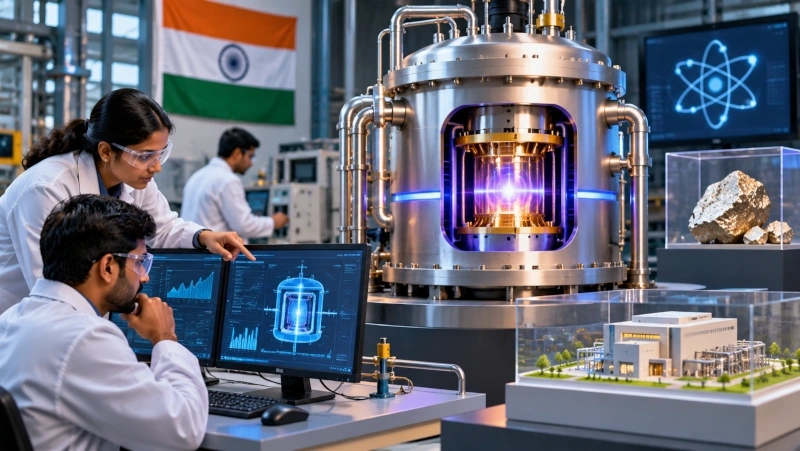
Indian nuclear technology venture SUK-M, developed by IYNS TechSolutions, has secured its first institutional pre-seed funding to advance the development of an indigenous thorium-based micro-modular nuclear reactor. The funding round, reported on 25 November 2026, was led by Speciale Invest and Navam Capital, with participation from BYT Capital and two angel investors. The investment will support the transition from computational research to laboratory experimentation, representing an important milestone in private-sector participation in India’s advanced nuclear technology ecosystem.
Developing an Indigenous Thorium-Based Microreactor
Founded in April 2021 by Dr Nitendra Singh and Dr Samyak Munot, SUK-M is working towards developing compact nuclear reactors capable of meeting industrial electricity and thermal energy requirements. According to Speciale Invest’s official portfolio description, the project envisages a micro-modular reactor based on Generation IV molten-salt reactor technology. The proposed system targets an electrical output of 10 megawatts or a thermal output of 30 megawatts per unit.
The company intends to develop a compact, factory-assembled reactor that can be transported to its intended location, subject to applicable regulatory and safety requirements. This approach differs from conventional large nuclear power stations, which typically require substantial site-specific infrastructure and extended construction periods. The proposed modular architecture seeks to make nuclear energy accessible to a wider range of industrial applications.
Advancing India’s Long-Term Thorium Vision
Thorium has occupied an important position in India’s long-term nuclear energy strategy since the formulation of the three-stage nuclear power programme under Dr Homi Jehangir Bhabha. India’s substantial thorium resources provide a strategic incentive for developing technologies capable of utilising this material for peaceful energy generation. However, commercial thorium utilisation involves considerable scientific, engineering and regulatory challenges.
SUK-M seeks to advance indigenous research into thorium-based nuclear energy while developing the specialised engineering capabilities required for its eventual commercial application. The initiative represents a private-sector effort to complement India’s established nuclear research ecosystem. Its progress will depend on successful experimental validation, comprehensive safety assessments and compliance with India’s nuclear regulatory framework.
Moving from Computational Research to Experimental Validation
The newly secured funding will enable SUK-M to expand its scientific and engineering team and establish dedicated experimental infrastructure in India. Having undertaken initial computational studies, the venture intends to progress towards laboratory-based validation of its proposed technology. Experimental observations will help researchers evaluate design assumptions, refine engineering approaches and assess safety-related characteristics.
This transition represents an essential stage in the development of advanced nuclear technologies, where theoretical performance must be supported by independently verifiable experimental evidence. The current investment is directed towards research and development rather than commercial reactor deployment. No operational nuclear reactor or regulatory clearance for commercial operation has been announced.
Potential Applications Across India’s Industrial Economy
SUK-M is exploring potential applications in energy-intensive industries that require dependable electricity and high-temperature process heat. These include steel manufacturing, hydrogen production, desalination and data centre operations. The ability to provide thermal energy alongside electricity could potentially broaden the role of nuclear technology beyond conventional grid-based power generation.
Reliable low-carbon energy could help industrial enterprises reduce their dependence on fossil fuels while supporting long-term decarbonisation objectives. Compact nuclear energy systems may also offer opportunities for industries whose energy requirements differ considerably from those served by large centralised power stations. Their eventual commercial viability, however, will depend on demonstrated safety, economic competitiveness and regulatory approval.
Supporting India’s Nuclear Energy Mission
The development comes against the backdrop of India’s Nuclear Energy Mission, announced in the Union Budget 2025–26. The Government of India has allocated ₹20,000 crore towards the research, development and deployment of indigenous small modular reactors, with the objective of operationalising at least five such reactors by 2033. The broader national mission seeks to expand India’s nuclear power generation capacity to 100 GW by 2047.
The Sustainable Harnessing and Advancement of Nuclear Energy for Transforming India (SHANTI) Act, 2025, also provides a framework for wider private-sector participation in peaceful nuclear energy activities. This evolving policy environment creates opportunities for domestic enterprises to contribute to nuclear research, specialised manufacturing and technological innovation. SUK-M remains an independently funded private-sector initiative, and its inclusion among the government’s designated reactor development projects has not been established.
Building an Indigenous Nuclear Technology Ecosystem
The emergence of Indian private-sector ventures in advanced nuclear research highlights the expanding scope of the country’s deep-tech entrepreneurial ecosystem. Beyond reactor development, such initiatives could encourage the growth of specialised engineering expertise, domestic intellectual property, advanced materials research and precision manufacturing capabilities. Collaboration among research institutions, industrial enterprises and patient capital providers will remain important in translating scientific concepts into validated technologies.
SUK-M’s institutional funding represents an early but meaningful step towards developing indigenous thorium-based microreactor technology. With sustained scientific research, rigorous safety validation and responsible regulatory oversight, initiatives of this nature could contribute to India’s long-term energy security, industrial competitiveness and technological self-reliance. They also offer a new avenue for carrying forward India’s longstanding vision of harnessing thorium resources for peaceful and sustainable economic development.
References
- Speciale Invest — SUK-M, Official Investment Portfolio.
- SUK-M — Company funding announcement, 25 November 2026, as reported by Business Standard and ET Entrepreneur.
- Ministry of Finance, Government of India — Nuclear Energy Mission for Research and Development of Small Modular Reactors, Union Budget 2025–26, 1 February 2025.
- Department of Atomic Energy, Government of India — Parliament Question: Nuclear Energy, 5 February 2026, Press Information Bureau.
You may also like
-
India Tracks ₹38.11 Lakh Crore Infrastructure Investment Pipeline
-
Suzlon Energy Lays Foundation Stone for 1 GW AI-Enabled Wind Turbine Blade Factory in Tamil Nadu
-
Avore Electric Reports 90 Per Cent Domestic Component Sourcing for Electric Motorcycles
-
Jupiter Wagons Partners South Korea’s Woojin to Manufacture Metro Trains and Propulsion Systems in India
-
Gujarat’s Kalpasar Project: India’s Ambitious Freshwater Reservoir and Dutch Engineering Cooperation
