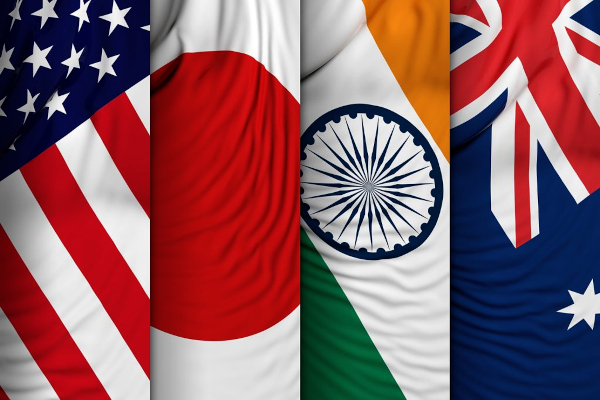
The Quad has moved to accelerate practical cooperation across maritime security, emerging technologies, economic resilience and humanitarian assistance as senior officials from India, the United States, Japan and Australia met in New Delhi to review the grouping’s expanding Indo-Pacific agenda.
Foreign Secretary Vikram Misri hosted a meeting of Quad Sherpas in New Delhi on September 3, bringing together senior representatives responsible for coordinating the four countries’ work ahead of future ministerial and leaders-level engagements.
According to India’s Ministry of External Affairs, the Sherpas reviewed progress across the Quad’s principal areas of cooperation, including maritime security, economic prosperity, critical and emerging technologies, and humanitarian assistance and disaster relief, or HADR. The officials welcomed the growing pace of practical activities under the grouping and also discussed possible new initiatives that could be announced at the next meeting of Quad Foreign Ministers.
The meeting reflects the continuing transformation of the Quad from a diplomatic consultation mechanism into a platform increasingly focused on delivering practical projects across the Indo-Pacific. India, the United States, Japan and Australia have progressively expanded cooperation into areas that directly affect regional security and economic resilience, ranging from maritime surveillance and critical supply chains to telecommunications, disaster response and advanced technologies.
Maritime Security Remains at the Core
Maritime security continues to occupy a central place in the Quad agenda because the Indo-Pacific contains some of the world’s most important shipping routes and commercial sea lanes. The four countries have repeatedly emphasised that peace and stability in the maritime domain are essential to the region’s security and economic prosperity.
At the Quad Foreign Ministers’ Meeting in New Delhi in May 2026, the four countries launched the Indo-Pacific Maritime Surveillance Collaboration, aimed at strengthening coordination in maritime surveillance. The initiative added to a growing network of Quad activities designed to improve maritime awareness and help countries monitor developments across their surrounding waters.
The Quad’s maritime agenda has gradually broadened beyond conventional naval security. It now encompasses maritime-domain awareness, protection of shipping routes, transnational crime, illegal activities at sea and cooperation among regional information-sharing centres.
For India, these initiatives have particular importance because of its geographical position at the centre of the Indian Ocean. Major energy and trade routes connecting the Gulf, Africa, Southeast Asia and East Asia pass through waters surrounding the Indian subcontinent, making maritime stability directly relevant to India’s economic and national-security interests.
The Quad’s emphasis on maritime cooperation also complements India’s wider engagement with Indian Ocean and Indo-Pacific countries through naval exercises, capacity building, hydrographic assistance, maritime surveillance and humanitarian operations.
Critical and Emerging Technologies Become Strategic Priority
Technology has emerged as another major pillar of Quad cooperation. The four countries increasingly view leadership in areas such as advanced telecommunications, artificial intelligence, cyber security, semiconductors and resilient digital infrastructure as closely connected with both economic prosperity and national security.
Quad initiatives have previously included cooperation on secure telecommunications networks, including Open RAN technologies, as well as efforts to strengthen critical-technology supply chains and develop common approaches to technology standards.
The grouping has also established mechanisms connecting governments, researchers and private investors in emerging technologies. The objective is not simply technological innovation but the development of dependable and diversified ecosystems that reduce excessive dependence on vulnerable supply chains.
The Quad’s work on critical and emerging technologies therefore sits at the intersection of strategic security and economic policy. Semiconductor shortages, telecommunications vulnerabilities and disruptions to critical minerals have demonstrated how technological supply chains can influence the security and resilience of major economies.
For India, greater Quad cooperation offers opportunities to strengthen domestic capabilities while attracting investment, research partnerships and advanced manufacturing. India’s rapidly growing electronics, semiconductor, digital public infrastructure and technology sectors provide substantial scope for deeper collaboration with the United States, Japan and Australia.
Economic Security Gains Greater Importance
Economic prosperity has similarly developed into a broader concept within the Quad. Rather than focusing narrowly on trade, the four countries are increasingly examining how resilient supply chains, strategic technologies, critical minerals, secure infrastructure and investment can protect Indo-Pacific economies against external disruptions.
This shift reflects lessons from the COVID-19 pandemic, geopolitical tensions and global supply-chain disruptions. Governments around the world have become increasingly concerned about excessive concentration of production in strategically important sectors.
The Quad provides a mechanism through which four major Indo-Pacific democracies can coordinate policies intended to make supply chains more diversified and resilient.
Critical minerals are particularly important because they are required for semiconductors, electric vehicles, renewable-energy systems, aerospace equipment, batteries and advanced defence technologies. Australia possesses major mineral resources, India has substantial processing and manufacturing ambitions, while Japan and the United States bring advanced technology, investment and industrial capabilities.
Cooperation among the four could therefore create complementary supply chains extending from raw materials through processing and advanced manufacturing.
HADR Gives Quad a Practical Regional Role
Humanitarian assistance and disaster relief is another important area reviewed by the Sherpas. The Indo-Pacific is one of the world’s most disaster-prone regions, frequently affected by cyclones, earthquakes, tsunamis, volcanic eruptions and other emergencies.
The Quad itself has historical roots in disaster response. India, the United States, Japan and Australia coordinated relief operations following the catastrophic 2004 Indian Ocean tsunami, demonstrating the ability of the four countries to rapidly combine naval, logistical and humanitarian capabilities.
HADR cooperation has subsequently become institutionalised within the Quad’s broader agenda. The four countries have worked on interoperability, procedures and coordination that could allow them to respond more quickly when major natural disasters strike Indo-Pacific countries.
Such cooperation is significant because all four possess substantial naval, airlift, logistics and disaster-relief capabilities. Coordinated deployment can provide affected countries with emergency supplies, medical assistance, transport, engineering support and other capabilities during the critical period immediately following a disaster.
India has already demonstrated substantial regional disaster-response capacity through evacuation missions, humanitarian assistance and emergency deployments across the Indian Ocean and neighbouring regions. Working within the Quad could further improve coordination when disasters require multinational responses.
Quad Increasingly Focused on Delivering Practical Outcomes
The September 3 Sherpas’ meeting comes after a series of Quad engagements during 2026 aimed at advancing the grouping’s work programme.
At the Quad Foreign Ministers’ Meeting in Manila in July, the four countries again reaffirmed their commitment to a free and open Indo-Pacific and highlighted maritime and transnational security, economic prosperity, critical and emerging technologies and emergency response as major areas of cooperation. They also reiterated support for ASEAN unity and centrality in the regional architecture.
This continuity demonstrates how the Quad is increasingly organising its activities around a relatively stable set of practical priorities rather than constantly expanding into unrelated areas.
The emphasis on implementation is important because the Quad has sometimes faced questions about whether it can translate diplomatic statements into tangible regional outcomes. The growing number of technology, maritime, infrastructure and HADR programmes suggests that the four countries are increasingly attempting to answer that criticism by developing projects that have visible applications.
The Sherpas’ decision to welcome the acceleration of practical activities therefore provides an indication of where the Quad is heading. Instead of functioning primarily as a forum for strategic discussion, the grouping is seeking to build a portfolio of initiatives that can demonstrate measurable benefits across the Indo-Pacific.
A Different Model of Indo-Pacific Cooperation
The Quad is not a formal military alliance and does not operate with a collective-defence commitment similar to NATO. Its agenda instead brings together security, economic, technological and humanitarian cooperation.
That distinction is important for understanding the grouping’s expanding role. While maritime security remains central, much of the Quad’s work now involves capabilities that fall outside traditional military cooperation.
Secure telecommunications networks, disaster preparedness, infrastructure resilience, critical-mineral supply chains and technology standards may appear separate from conventional security, but they increasingly determine how effectively countries can withstand geopolitical and economic shocks.
This broader concept of security has allowed the Quad to engage Indo-Pacific countries through practical programmes rather than requiring them to join a formal strategic bloc.
The four governments have also repeatedly stressed support for ASEAN centrality and an inclusive Indo-Pacific, an approach designed to reassure smaller regional countries that Quad cooperation is intended to complement rather than replace existing regional institutions.
India’s Growing Role in the Quad
The New Delhi meeting also underlines India’s increasingly important position within the grouping. India brings a combination of geographic location, military capability, economic scale and longstanding relationships with countries across the Indian Ocean and Southeast Asia.
Unlike its three Quad partners, India continues to pursue a particularly strong policy of strategic autonomy. New Delhi maintains extensive relationships with countries across competing geopolitical alignments while participating in the Quad where its interests converge with those of the United States, Japan and Australia.
This allows India to support a free, open and stable Indo-Pacific while preserving an independent foreign policy.
The practical nature of the current Quad agenda fits particularly well with that approach. Maritime-domain awareness, resilient supply chains, HADR, technology partnerships and infrastructure cooperation provide India with opportunities to strengthen regional security without entering into a formal military alliance structure.
India’s own expanding capabilities in digital technology, pharmaceuticals, space, maritime security and disaster response also mean that it increasingly contributes capabilities to Quad initiatives rather than functioning solely as a recipient of technology or investment.
Next Foreign Ministers’ Meeting Could Bring New Initiatives
One of the most important outcomes from the September 3 Sherpas’ meeting was the discussion of possible new issues and initiatives for announcement at the next Quad Foreign Ministers’ Meeting.
The official readout has not disclosed the details of these potential initiatives, meaning it would be premature to identify specific programmes. However, the existing direction of Quad cooperation suggests that maritime awareness, economic resilience, emerging technologies and disaster preparedness will remain central to future work.
The Sherpas play an important role in converting political commitments into practical initiatives. By coordinating across governments ahead of ministerial and leaders-level meetings, they help ensure that proposals are sufficiently developed before being formally announced.
The New Delhi discussions therefore provide an early indication that another round of Quad initiatives could be under preparation.
The larger significance of the meeting lies in the continued institutionalisation of the grouping. What began as an occasional strategic dialogue has developed into a network of government officials, diplomats, security agencies, researchers and technical working groups addressing an increasingly interconnected set of Indo-Pacific challenges.
For India, the United States, Japan and Australia, the challenge now is less about defining what the Quad represents and increasingly about demonstrating what it can deliver.
The September 3 meeting suggests that the four countries intend to answer that challenge by accelerating practical cooperation in maritime security, critical technologies, economic resilience and disaster response — areas where tangible results could make the Quad an increasingly consequential element of the Indo-Pacific regional architecture.
You may also like
-
India and Azerbaijan Agree to Strengthen Security, Trade, Energy and Economic Cooperation
-
Jaishankar Meets Azerbaijan President Ilham Aliyev in Baku, Discusses Trade, Technology and Strategic Cooperation
-
Piyush Goyal Holds High-Level Talks in Berlin to Strengthen India–Germany Trade, Investment and Industrial Cooperation
-
Indian Navy to Host Indo-Pacific Regional Dialogue 2026 with Experts from 18 Countries on Maritime Science and Technology
-
Russia Ratifies Temporary Employment Agreement with India, Expanding Opportunities for Skilled Workers
