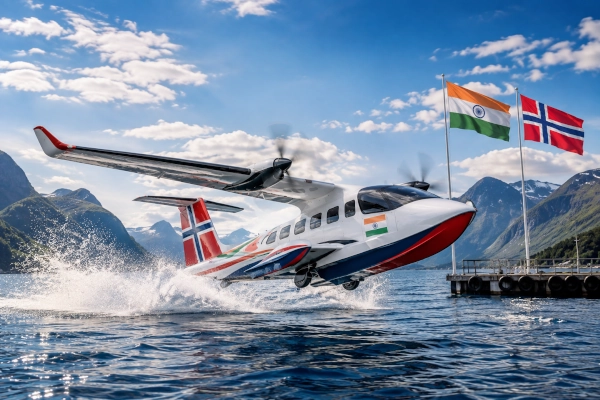
State-owned aviation company Pawan Hans Limited has signed a non-binding memorandum of understanding with Norway-based Noemi Aerospace, also known as Elfly AS, to examine the feasibility of introducing electric seaplanes in India.
The agreement was exchanged by Pawan Hans Chairman and Managing Director Sunil Kumar Nagdawne and Noemi Aerospace Chief Executive Officer Eric François Lithun in the presence of Civil Aviation Minister Ram Mohan Naidu Kinjarapu and Civil Aviation Secretary Samir Kumar Sinha.
The partnership will focus on electric amphibious-aircraft technology, technical cooperation, knowledge-sharing, training, workshops and capacity development. The two companies also plan to conduct joint feasibility studies covering operational models, infrastructure needs and possible applications in different parts of India.
The memorandum represents an exploratory arrangement. Neither company has announced an aircraft order, investment commitment, route network or timetable for commercial deployment.
Exploring a New Model of Regional Connectivity
Electric seaplanes could provide an alternative form of regional transport for islands, coastal settlements and remote areas where constructing a conventional airport may be difficult or commercially unviable.
Aircraft capable of operating from both water and land could connect communities through existing lakes, harbours and coastal facilities while also using ordinary runways when available.
For India, such aircraft could have potential applications in passenger transport, tourism, medical evacuation, light cargo movement and emergency services.
Pawan Hans already operates helicopter services in geographically challenging regions, including the North-East, Lakshadweep and the Andaman and Nicobar Islands. Originally created to support India’s offshore oil and gas sector, the company has gradually explored opportunities beyond conventional helicopter operations.
Amphibious aircraft and small fixed-wing services could support this diversification by allowing the company to reach destinations that lack large aviation infrastructure.
NOEMI Electric Amphibious Aircraft
The proposed cooperation centres on Noemi Aerospace’s NOEMI aircraft, whose name is derived from “No Emissions.”
The aircraft is being developed as a fully electric amphibious platform for short-distance regional operations. It is designed to take off and land on both water and conventional runways.
The planned passenger configuration will accommodate nine passengers and one or two pilots. It is expected to have a payload capacity of around 1,000 kilograms.
A 400-kWh battery system will supply power to two electric motors with a combined maximum output of approximately 1,200 kW.
The company is targeting a cruising speed of about 100 knots and a flight duration of up to 60 minutes, excluding mandatory energy reserves.
The aircraft is expected to measure approximately 16 metres in length and have a wingspan of about 21 metres, increasing to 23.1 metres when fitted with winglets.
Noemi Aerospace plans to develop passenger, executive, cargo and special-mission versions. These configurations could make the aircraft suitable for tourism, corporate travel, medical transport, logistics and public-service operations.
Testing and Certification Still Ahead
The NOEMI design has undergone water-tank testing, wind-tunnel evaluation, computer simulation and sub-scale flight trials.
A full-scale prototype is currently being developed. Its first flight is planned for 2027, while entry into commercial service has been targeted for 2030.
These dates remain dependent on the completion of development, flight testing and regulatory certification.
The aircraft’s flight-test programme has received €3 million from Innovation Norway. Together with private investment, the project’s total funding has reached approximately €7 million.
NOEMI has also generated preliminary interest from operators in several regions. The company has reported more than 70 soft orders across five continents.
Announced agreements include interest from UrbanLink and Pan Am for 10 aircraft with options for another 10, Nordic Seaplanes for five aircraft with 10 options, Cambodia’s VET Airways for five aircraft and Hellenic Seaplanes for as many as 10.
These commitments are provisional. They do not amount to final aircraft purchases and remain subject to certification, binding contracts, delivery schedules and commercial terms.
India Eyes Domestic Seaplane Manufacturing
Civil Aviation Minister Ram Mohan Naidu said India’s objective was not limited to importing or operating seaplanes. The government also wants to encourage their domestic production under the Make in India programme.
India has previously explored seaplane services as a way to improve connectivity and tourism in regions with suitable water bodies. However, the commercial viability of such operations depends on several factors, including aircraft cost, maintenance, passenger demand, water aerodromes, regulatory approvals and environmental clearances.
Electric propulsion adds another set of requirements. Charging facilities, battery-management systems, technical support and specialised maintenance networks would need to be developed before regular services could begin.
The government has also proposed incentives for domestic seaplane manufacturing and viability-gap support for selected operations. Such measures could help reduce the financial risks associated with introducing a new category of aircraft.
Potential Benefits and Challenges
Electric seaplanes could offer quieter operations and lower direct emissions than aircraft powered by conventional aviation fuel. Their amphibious capability could also reduce dependence on costly airport infrastructure.
India’s long coastline, island territories, inland waterways and reservoir network provide several possible areas for evaluation.
Yet technical suitability does not automatically guarantee commercial success. Any future service will have to demonstrate adequate range, reliability, passenger demand and operating economics.
Battery weight and charging time remain major constraints for electric aviation. Operators will also need reliable access to electricity at remote locations, while aviation regulators must approve the aircraft, its systems and proposed operating procedures.
Water-based aviation introduces further considerations, including weather conditions, wave height, marine traffic, docking facilities and corrosion protection.
An Early Step Towards Electric Amphibious Aviation
The Pawan Hans–Noemi Aerospace agreement is therefore best viewed as an initial assessment rather than a confirmed aircraft acquisition programme.
The proposed feasibility studies will determine where electric seaplanes could operate, what infrastructure would be required and whether the aircraft can meet India’s regional-connectivity needs at a commercially sustainable cost.
Should the technology prove viable, electric amphibious aircraft could complement helicopters and small regional aeroplanes in areas that remain difficult to reach through conventional aviation.
For now, the memorandum establishes a framework for cooperation while leaving decisions on procurement, manufacturing and commercial operations to a later stage.
You may also like
-
India’s Economic Warfare Challenge: Strategic Autonomy, Energy Security and the Rise of a Global Power
-
India-US Trade Deal Stalemate: Why Washington’s Tariff Pressure Has Failed to Secure an Agreement
-
US Double Standards in Foreign Policy: 16 Recent Cases Involving India, Russia, China and Global Trade
-
India’s Arctic Energy Ambitions: Russian Oil, LNG and a New Sea Route to Indian Ports
-
India and Russia Explore Joint Icebreaker Construction as Maritime Industrial Cooperation Expands
