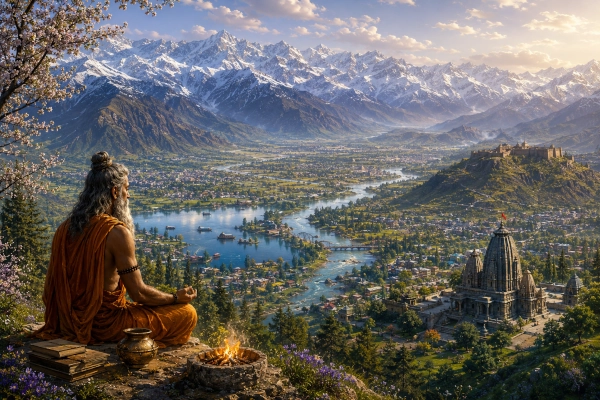
Long before Kashmir became the subject of modern borders, diplomatic disputes and political arguments, it occupied a revered place in the sacred geography of Bharat. Ancient Indian literature remembered the valley through its rivers, mountains, sages, temples, pilgrimage centres and association with the Divine Mother.
The Vedas do not describe Kashmir as a modern political territory, and the name Kāśmīra does not appear clearly in the surviving Vedic Samhitas. Kashmir nevertheless enters the Vedic world through the Vitasta—the ancient name of the Jhelum, the great river flowing through the centre of the valley.
The Puranas later transform this Vedic riverine memory into a detailed sacred landscape. Kashmir appears as a northern region of Bharat, the dwelling place of sages and deities, the land of Sharada, the visible form of Goddess Uma and a country associated with Kashyapa, Vishnu, Shiva and Ananta.
These texts were not written as modern territorial documents. They preserve something older and deeper: Kashmir was never regarded as a remote or culturally disconnected frontier. It belonged to the spiritual, geographical and intellectual imagination of Indian civilisation.
Vitasta: Kashmir’s Presence in the Rigveda
The earliest important connection between Kashmir and Vedic literature is found in the celebrated Nadistuti Sukta, the hymn in praise of rivers, in the Rigveda.
Rigveda 10.75.5 invokes several of the great rivers known to the Vedic world:
“Accept this my praise, O Ganga, Yamuna, Sarasvati, Shutudri and Parushni; with Asikni, Marudvridha and Vitasta, listen with Arjikiya and Sushoma.”
Vitasta is the ancient Sanskrit name of the Jhelum, the principal river of the Kashmir Valley. Its memory survives in the Kashmiri names Vyeth and Veth, both derived from Vitasta.
The significance of this verse lies in the company in which Vitasta appears. It is invoked alongside the Ganga, Yamuna, Sarasvati, Sutlej and other rivers forming the sacred geography of ancient northern Bharat.
The hymn does not present these rivers as isolated waterways. They are addressed as living and sacred presences connected through the wider river system of the Sindhu. The Vitasta of Kashmir therefore forms part of the same Vedic landscape as the Ganga and Yamuna.
Kashmir’s Vedic connection begins with water. Before the valley was described through kingdoms, cities or political institutions, its central river had already entered one of the oldest surviving sacred compositions of India.
Kashmir in the Geography of the Puranas
The Puranas contain extensive descriptions of Bharatavarsha, its mountains, rivers, regions and peoples. These were not political maps in the modern sense. They represented Bharat as a civilisational and sacred geography united through pilgrimage, ancestry, rivers, deities and shared cultural traditions.
The Markandeya Purana names the Kāśmīras among the peoples of the northern regions. Kashmir is listed alongside other Himalayan and northwestern communities such as the Daradas, Kambojas and Tanganas.
This geographical placement is important. Kashmir was not presented as a land outside the civilisational field of Bharat. It was recognised as one of its northern regions, connected to neighbouring janapadas while retaining its own distinctive identity.
The Mahabharata preserves a similar understanding. The Bhishma Parva names the Kashmiris together with the peoples of Sindhu-Sauvira, Gandhara, Abhisara, Kuluta and Bahlika.
Such references reveal an ancient Indian civilisation capable of accommodating strong regional identities within a wider cultural unity. Kashmir could possess its own customs, rulers and traditions while remaining part of the interconnected world of Bharat.
The Nilamata Purana: Kashmir’s Sacred Chronicle
The most important Puranic work concerning ancient Kashmir is the Nilamata Purana. Composed within the cultural world of the valley, it preserves Kashmir’s sacred geography, festivals, rivers, pilgrimage centres, social customs and origin traditions.
The work begins with King Janamejaya asking the sage Vaishampayana why the ruler of Kashmir had not participated in the great Bharata war. The question itself is revealing. Kashmir is treated as an important kingdom whose absence from an event involving the rulers of Bharat required an explanation.
Vaishampayana explains that Krishna had earlier defeated the ruler of Kashmir. However, out of respect for the kingdom, Krishna installed the king’s pregnant queen upon the throne so that her son could inherit the realm. Since the future ruler was still a child, Kashmir did not join either side in the Kurukshetra war.
The narrative then makes a remarkable declaration:
“The goddess Uma is the same as Kashmir.”
Kashmir is presented not merely as a land protected by a goddess but as a visible manifestation of the goddess herself. Its mountains, springs, rivers and fields become parts of a sacred body.
The text describes Kashmir as a prosperous country filled with rice fields, fruit-bearing trees, medicinal plants, gardens, temples and hermitages. It speaks of Vedic scholars, religious observances, festivals, music, recreation and the sound of sacred recitation throughout the land.
It further declares that the sacred places of the earth are represented in Kashmir through its mountains, lakes, rivers, Naga springs, temples and hermitages. Through the centre of this sacred landscape flows the Vitasta, poetically compared to the parting in a woman’s hair.
Kashmir therefore appears in the Nilamata Purana as a complete sacred world—a valley in which nature, human society and divine presence exist together.
From Satisara to Kashmir
The Nilamata Purana preserves the famous tradition that the Kashmir Valley was originally covered by an enormous lake called Satisara, the Lake of Sati.
A powerful water-born being named Jalodbhava lived within the lake. Protected by a boon that made him invincible while he remained in water, he terrorised the surrounding regions and drove away their inhabitants.
The sage Kashyapa learned of the suffering caused by Jalodbhava and appealed to the gods. Vishnu, Shiva, Brahma, Ananta and numerous divine beings assembled near the lake. Vishnu then instructed Ananta, the divine serpent associated with the plough, to break through the mountain barrier and release the waters.
Ananta struck the Himalayan barrier with his plough. As the waters flowed out of the valley, Jalodbhava lost his protection and was destroyed by Vishnu. Hermitages, settlements and sacred places were subsequently established across the newly revealed land.
This is a sacred origin narrative rather than a scientific geological account. Yet it preserves an enduring cultural memory of Kashmir as a valley associated with an ancient body of water and the eventual emergence of habitable land.
The Nilamata Purana connects Kashmir with the sage Kashyapa and the removal of water from the country. Kashyapa appears as the sage who makes the land suitable for habitation and establishes an ordered relationship among human beings, Nagas, rivers and sacred places.
Kashmir consequently becomes Kashyapa’s land in the civilisational imagination—a region brought into order through wisdom, divine cooperation and the restoration of balance.
Vitasta as the Flowing Form of Goddess Uma
After the land became habitable, Kashyapa requested the goddesses to purify and nourish it through their waters.
The Nilamata Purana states that Uma entered Kashmir in the form of the Vitasta. Lakshmi became the river Vishoka, while Aditi, Sachi, Diti and other divine mothers manifested as additional rivers of the valley.
Shiva opened a passage with his spear through which the goddess emerged. Because the opening measured a vitasti, the river received the name Vitasta. The tradition therefore unites the geography of Kashmir with the presence of Shiva and Shakti.
Elsewhere, the Nilamata Purana declares that rivers, springs, mountains and images established by sages possess sacred power, with such sanctity being especially concentrated in Kashmir. The Vitasta is described as particularly purifying and capable of elevating those who approach it with devotion.
The river praised in the Rigveda is thus understood in the Puranic tradition as the visible form of the Divine Mother flowing through Kashmir.
The connection between the Vedic and Puranic worlds is clear. The Rigveda knows Vitasta as part of the sacred network of the Sindhu. The Nilamata Purana knows the same river as the goddess who gives life, purity and identity to Kashmir.
Kashmir and the Wider World of the Mahabharata
The Mahabharata provides another bridge between Kashmir and the wider civilisation of Bharat.
In the Sabha Parva, the ruler of Kashmir is counted among the many kings who attend Yudhishthira’s Rajasuya sacrifice. The gathering includes rulers from numerous regions of the subcontinent, symbolising the extensive political and cultural world recognised by the epic.
The Anushasana Parva also refers to the rivers of the Kāśmīra-maṇḍala flowing towards the great Sindhu. These waters are treated as sacred and associated with religious merit.
Such references do not erase Kashmir’s regional individuality. They demonstrate that Kashmir possessed both a distinct identity and a recognised place within the interconnected world of ancient Bharat.
Kashmir as the Land of Sharada
Kashmir’s importance in Indian civilisation was intellectual as well as spiritual. The Skanda Purana refers to Goddess Sharada as being established in Kashmir:
“There is another goddess named Sharada, established in Kashmir.”
Sharada is a form of Sarasvati, the goddess of knowledge, speech, learning and refined understanding. The association of the goddess with Kashmir became so powerful that the region came to be remembered as Sharada Desha—the land of Sharada.
This sacred identity was reflected in Kashmir’s later achievements in Sanskrit learning, philosophy, grammar, aesthetics, poetry, Shaiva thought and religious commentary. Scholars from Kashmir produced intellectual traditions that influenced learning across India.
The Sharada script, named after the goddess, became an important writing system of the northwestern Himalayan region. Kashmir’s monasteries, temples and centres of learning helped preserve and transmit Sanskrit literature, philosophical texts and scriptural commentaries.
Kashmir’s civilisational importance was therefore not based merely upon its strategic location or natural beauty. It was a land from which knowledge travelled to the rest of Bharat.
Kashmir in the Sacred Geography of Bharat
Ancient texts must be interpreted responsibly. Neither the Rigveda nor the Puranas were composed to settle modern constitutional or international disputes. Their geographical descriptions should not be converted mechanically into twenty-first-century legal maps.
Their significance lies in the civilisational memory they preserve.
These texts demonstrate that Kashmir was woven into the consciousness of Bharat across many centuries. Its principal river was praised in the Rigveda. Its people were included in the geographical catalogues of the Puranas and the Mahabharata. Its land was identified with Uma. Its waters were connected with Shiva and Shakti. Its origin was associated with Kashyapa, Vishnu and Ananta. Its intellectual personality was represented by Sharada.
The relationship between Kashmir and Bharat therefore did not begin with colonial boundaries, modern armies or twentieth-century political negotiations. Kashmir had already existed for centuries within India’s sacred geography, pilgrimage networks, literary imagination and intellectual traditions.
This civilisational relationship did not require cultural uniformity. Kashmir developed its own language, customs, artistic expressions and philosophical schools. Its distinctiveness enriched Bharat rather than separating it from the larger civilisation.
A Future of Restoration and Renewal
The deepest lesson of Kashmir’s sacred traditions is not one of conflict but of restoration.
The Nilamata Purana does not celebrate Kashmir primarily as a battlefield. It celebrates the valley as a land of rivers, learning, agriculture, festivals, gardens, music, temples, contemplation and shared prosperity. Its ideal Kashmir is inhabited, fertile, joyful and protected from fear.
That is the future India must help Kashmir reclaim.
Restoring Kashmir’s civilisational heritage should include the conservation of ancient temples and archaeological sites, the revival of Sanskrit and Sharada studies, the preservation of manuscripts and the ecological renewal of the Vitasta, lakes and sacred springs.
The restoration of Kashmir must also honour the living communities of the valley. The dignified return and rehabilitation of displaced Kashmiris, including the Kashmiri Pandit community, should form part of a larger process of reconciliation, justice and cultural renewal.
Every peaceful resident of Kashmir deserves security, education, economic opportunity and the freedom to build a dignified future. Development must reach villages and cities alike, while the valley’s environment, architecture, crafts and spiritual heritage are protected for future generations.
India does not honour Kashmir by regarding it merely as territory to be defended. India honours Kashmir by accepting it as a sacred responsibility—a living civilisation whose people, environment, memories and traditions must all be protected.
The Vedic hymn to Vitasta continues to carry its message across the centuries. Kashmir’s river was invoked alongside the Ganga, Yamuna and Sarasvati because it belonged to the same sacred landscape. The Puranas continued that memory by describing Kashmir as Uma herself and as the northern home of Sharada.
The wounds left by history have been deep, but they need not determine the valley’s destiny. A peaceful, prosperous and culturally renewed Kashmir can once again become a great centre of knowledge, pilgrimage, creativity and beauty.
When the Vitasta flows cleanly, when ancient shrines stand protected, when scholars once again study Sharada, when displaced families return with dignity and when Kashmir’s children inherit opportunity instead of fear, the valley will not merely have been secured.
It will have been restored.
In that restoration, Kashmir will shine not as a troubled edge of India but as one of the radiant crowns of Bharat—ancient in memory, secure in identity, prosperous in the present and confident in its Indian future.
Reference
Rigveda, Mandala 10, Sukta 75, Verse 5 — The Nadistuti Sukta, invoking Vitasta alongside the other great rivers.
Nilamata Purana, translated by Dr Ved Kumari — Passages concerning Kashmir as Uma, the Satisara tradition, Kashyapa, Jalodbhava, the emergence of the valley and the sanctity of Vitasta.
Markandeya Purana, Chapter 57 — Geographical description naming the Kashmiris among the peoples of northern Bharat.
Mahabharata, Sabha Parva, Section 33 — Reference to the ruler of Kashmir in connection with Yudhishthira’s Rajasuya sacrifice.
Mahabharata, Bhishma Parva, Chapter 10 — Kashmiris included among the peoples and kingdoms of the northern regions.
Mahabharata, Anushasana Parva, Chapter 26 — Reference to the rivers of the Kashmir region flowing towards the Sindhu.
Skanda Purana — Reference to Goddess Sharada being established in Kashmir.
You may also like
-
Sindhu: The Indus Kingdom of Jayadratha in the Mahabharata
-
Kuninda or Kulinda: The Himalayan Realm of the Mahabharata in Uttarakhand and Himachal Pradesh
-
Durga versus Mahishasura: Weapons, Battlefield Tactics and the Triumph of Shakti
-
Kuluta: The Kullu Valley Kingdom of the Mahabharata
-
Trigarta: The Kangra–Jalandhar Kingdom of the Mahabharata
