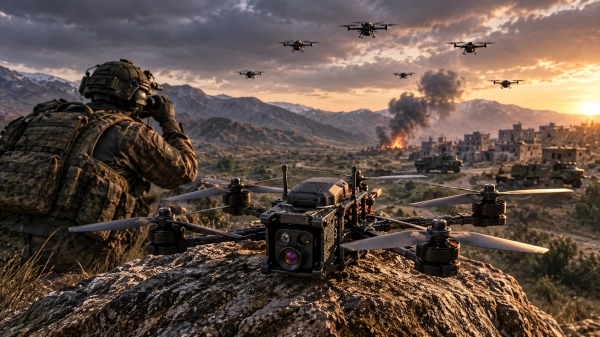
India’s domestic drone industry has expanded dramatically since the introduction of the Drone Rules 2021, Production Linked Incentive scheme and restrictions on imports of fully built foreign drones, according to Drone Federation of India President Smit Shah. Speaking on the completion of twelve years of the Make in India initiative, Shah said annual revenue generated by India’s drone ecosystem had risen from about ₹60 crore in 2021 to approximately ₹3,000–4,000 crore.
The figures are an industry estimate provided by the Drone Federation chief. They nevertheless illustrate the scale of transformation underway across India’s civilian and defence drone ecosystem, where domestic companies are increasingly designing and manufacturing unmanned aircraft, avionics, communication systems, payloads, propulsion systems and related components.
Shah expects the sector to expand further and estimated that India’s drone industry could eventually reach around ₹19,000–20,000 crore. The growth is being driven by rising military procurement, agricultural applications, surveying, infrastructure inspection, logistics, surveillance and a rapidly developing domestic manufacturing base.
Drone Industry Revenue Has Expanded Rapidly Since 2021
According to Shah, India’s drone ecosystem generated only around ₹60 crore in revenue in 2021, when the domestic industry was still relatively small and dependent on imported platforms and components. He said that figure has now expanded to approximately ₹3,000–4,000 crore as Indian manufacturers have entered both civilian and defence markets.
The expansion has coincided with a major change in the regulatory environment. The Drone Rules 2021 simplified the framework governing ownership, registration and operation of unmanned aircraft and reduced several regulatory barriers that had previously constrained companies entering the sector.
The combination of easier regulation and expanding domestic demand encouraged new companies to enter drone manufacturing while existing aerospace, electronics and engineering firms began developing unmanned platforms of their own. India consequently moved from a relatively limited commercial drone ecosystem towards a broader industrial base covering airframes, electronics, sensors, communications and software.
Drone Rules 2021 Changed the Regulatory Environment
The Drone Rules 2021 represented an important change in India’s approach to unmanned aviation. The framework reduced paperwork, simplified approval procedures and created a more predictable regulatory environment for companies developing or operating drones.
For manufacturers, regulatory simplification lowered one of the barriers to commercialisation. Companies could concentrate more resources on design, testing, manufacturing and deployment rather than navigating a highly restrictive licensing environment.
The reforms also encouraged the development of applications beyond recreational flying. Agricultural spraying, land surveys, mapping, industrial inspection, infrastructure monitoring, disaster response and security operations increasingly emerged as viable commercial markets for Indian drone companies.
PLI Scheme Encouraged Domestic Drone Manufacturing
The government subsequently introduced the Production Linked Incentive scheme for drones and drone components, providing an additional manufacturing incentive to Indian companies. The programme was notified in September 2021 with an approved outlay of ₹120 crore.
Unlike conventional manufacturing incentives based mainly on investment, the drone PLI programme focused heavily on domestic value addition. This encouraged companies to manufacture more components in India and gradually develop indigenous supply chains rather than merely assembling imported systems.
The resulting ecosystem now extends beyond complete aircraft. Indian firms are working on flight controllers, propulsion systems, communications equipment, electro-optical payloads, navigation systems, software, counter-drone technologies and increasingly sophisticated autonomous systems.
Restrictions on Imported Drones Created Space for Indian Manufacturers
Another major policy shift came in 2022 when India restricted the import of foreign drones in Completely Built Unit, Semi-Knocked Down and Completely Knocked Down forms, subject to specified exemptions for areas such as defence, security and research.
The policy did not amount to a blanket prohibition on every foreign drone-related product. Imports of drone components remained permitted, allowing Indian companies to source specialised parts while developing domestic manufacturing capacity.
For Indian drone manufacturers, the restriction on complete imported platforms created a larger protected domestic market. Companies that had previously competed directly against inexpensive imported drones gained time and commercial space to develop Indian alternatives.
This combination of regulatory liberalisation, manufacturing incentives and import restrictions formed the policy foundation that Shah identified as particularly important to the industry’s rapid expansion.
Defence Demand Is Becoming a Major Growth Driver
India’s defence sector has become one of the most important markets for domestic drone manufacturers. The armed forces are procuring increasing numbers of surveillance drones, tactical unmanned aircraft, loitering munitions, logistics drones and counter-UAS systems, creating opportunities for both established defence companies and specialised startups.
Recent military operations have also increased attention on the battlefield value of unmanned systems. Shah specifically referred to the performance of the domestic drone ecosystem during Operation Sindoor, arguing that Indian military and civilian drone technologies have increasingly demonstrated operational capability.
The wider defence trend extends beyond complete drones. Battlefield requirements are creating demand for indigenous navigation systems, secure datalinks, electro-optical sensors, artificial intelligence, swarm technologies and electronic-warfare-resistant communications, expanding the economic opportunity available to Indian suppliers.
Civilian Applications Are Expanding the Market
Military procurement is only one part of the emerging Indian drone economy. Agriculture has become an important civilian market as drones are increasingly used for crop spraying, mapping and monitoring, while government programmes have encouraged rural and agricultural deployment.
Surveying and infrastructure applications are also expanding. Drones can rapidly map land, inspect power lines, monitor construction projects, assess mining operations and survey roads, railways and pipelines without requiring extensive ground teams.
Disaster management provides another growing use case. Unmanned aircraft can quickly survey flood zones, landslides, forest fires and inaccessible regions, allowing emergency agencies to collect information without exposing personnel to unnecessary risk.
As these applications become routine rather than experimental, recurring demand for platforms, maintenance, training, software and data services could become as important as the initial sale of the drone itself.
India Is Building a Wider Drone Supply Chain
The most significant change since 2021 may be the gradual emergence of an Indian drone manufacturing supply chain. Early domestic manufacturers often relied heavily on imported motors, electronics, flight controllers, sensors and communications equipment, limiting the amount of value actually created within India.
The policy emphasis has increasingly shifted from assembling drones in India towards developing critical subsystems domestically. Indian companies are now working on propulsion, autopilots, communication systems, electro-optical payloads, navigation technologies and specialised materials.
Greater localisation carries strategic importance for defence applications because dependence on foreign electronics or software can create vulnerabilities during conflict. A domestic ecosystem also makes it easier to modify platforms rapidly for Indian operating conditions and specific requirements of the armed forces.
The Next Growth Phase Will Be More Technology Intensive
The next stage of India’s drone industry is likely to depend less on simply manufacturing airframes and increasingly on technologies that determine autonomy, survivability and mission effectiveness. Artificial intelligence, machine vision, swarm coordination, secure communications, navigation without satellite signals and advanced payloads are becoming central areas of competition.
Indian companies are already moving into several of these areas, particularly through the country’s expanding defence and deep-tech startup ecosystem. The ability to integrate Indian sensors, communications equipment and software with domestically manufactured drones could substantially increase the value retained within the country.
Exports could provide another major growth opportunity. Indian companies are beginning to develop platforms specifically for overseas defence and civilian markets, while competitive manufacturing costs could make India an increasingly important supplier of unmanned systems to countries seeking alternatives to established Western, Chinese, Israeli and Turkish manufacturers.
From ₹60 Crore to a Potential ₹20,000-Crore Industry
The increase cited by the Drone Federation of India—from around ₹60 crore in 2021 to ₹3,000–4,000 crore today—illustrates how quickly the sector has expanded following regulatory and industrial-policy changes. Shah’s projection of a future ₹19,000–20,000 crore industry suggests that the domestic drone market could become substantially larger as defence procurement, civilian adoption and exports expand.
India’s drone sector has therefore progressed from a small emerging industry into a broader aerospace and electronics ecosystem within a relatively short period. The next phase will be determined by how successfully Indian companies move from assembling platforms towards controlling the high-value technologies inside them — sensors, propulsion, navigation, communications, artificial intelligence and autonomous systems.
That transition will ultimately decide whether India becomes merely a large consumer of drones or develops into one of the world’s significant centres for unmanned-system design, manufacturing and exports.
References
Drone Federation of India — Statements by President Smit Shah on the growth of India’s drone-sector revenue and the impact of Make in India, Drone Rules 2021 and the Production Linked Incentive scheme.
Ministry of Civil Aviation — Drone Rules 2021 and subsequent regulatory framework governing India’s civilian drone ecosystem.
Ministry of Civil Aviation / Press Information Bureau — Production Linked Incentive Scheme for drones and drone components, notified in September 2021 with an approved outlay of ₹120 crore.
Directorate General of Foreign Trade — February 2022 notification restricting imports of complete drones in CBU, CKD and SKD form while permitting imports of drone components.
Prime Minister’s Office — Official communication marking twelve years of the Make in India initiative on 25 September 2026.
You may also like
-
India and Russia Hold Seventh Strategic Security Dialogue on Pakistan and Afghanistan
-
Rolls-Royce and Reliance Advance Indigenous 120 kN AMCA Engine Plans with Focus on Indian Design and Manufacturing
-
Indian Coast Guard and Korea Coast Guard Strengthen Maritime Cooperation at 14th High-Level Meeting in Incheon
-
Ministry of Defence Signs ₹4,106 Crore Contracts for GSAT-7C Satellite and Varunastra Torpedoes
-
AVNL, Indian Army and Russian Delegation Explore Modernisation of Armoured Vehicles
