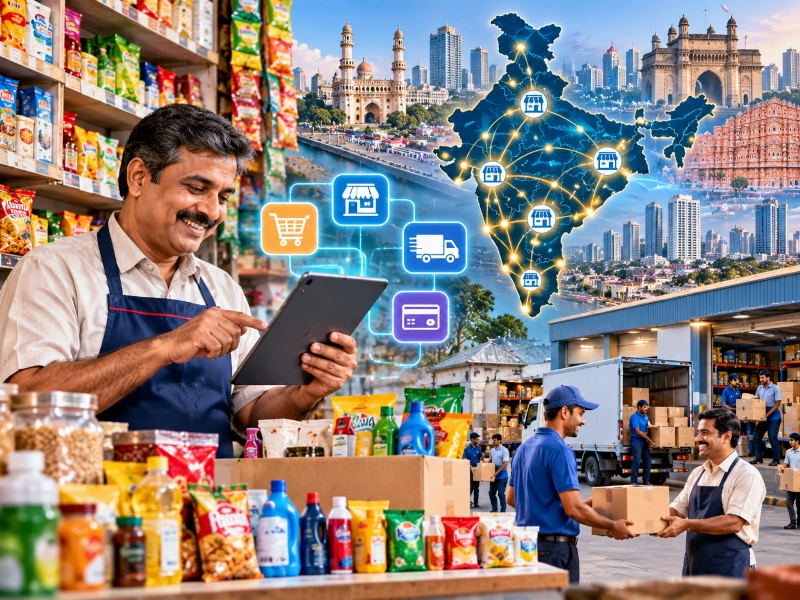
The Open Network for Digital Commerce (ONDC) has connected more than 21,000 kirana retailers with over 450 brands across Hyderabad, Jaipur and Mumbai through its DigiDukaan initiative, marking progress in the digitisation of India’s traditional retail ecosystem. The achievement was highlighted during the Bharat Commerce Chintan Shivir chaired by Union Minister of Commerce and Industry Piyush Goyal in New Delhi on 30 October 2026.
The high-level CEO roundtable, organised by the Department for Promotion of Industry and Internal Trade (DPIIT) and ONDC at Vanijya Bhawan, brought together more than 40 leaders from major Fast-Moving Consumer Goods (FMCG) companies. The discussions focused on strengthening India’s General Trade ecosystem through digital procurement, improved supply-chain efficiency and greater participation by neighbourhood retailers.
DigiDukaan Expands Digital Procurement Across Three Cities
According to the Ministry of Commerce and Industry, DigiDukaan had connected more than 21,000 retailers with over 450 brands across Hyderabad, Jaipur and Mumbai as of September 2026. This represented an increase from more than 12,000 participating retailers in the preceding quarter.
Hyderabad accounted for more than 16,000 onboarded retailers, with monthly repeat-ordering rates ranging between 73% and 78%.
An initial ONDC retailer study also found that 40% of surveyed retailers reported lower inventory holdings for products procured through DigiDukaan.
The initiative enables kirana retailers to discover and order products from multiple brands, distributors and wholesalers through a single digital interface. Retailers can access information on pricing, trade schemes and product availability while continuing to work with existing distribution networks.
Piyush Goyal Calls for Wider Digital Adoption Among Kirana Retailers
Addressing the gathering, Union Commerce and Industry Minister Piyush Goyal highlighted the importance of developing open digital infrastructure around the requirements of small retailers.
He emphasised that simplifying procurement, improving transparency and strengthening existing distribution networks could help neighbourhood retailers manage working capital more effectively.
The Minister invited FMCG companies to collaborate in expanding DigiDukaan across India and encouraged the industry to support the initiative’s wider adoption.
DPIIT Secretary Amardeep Singh Bhatia also highlighted the role of open digital infrastructure in connecting retailers, manufacturers and distributors through interoperable networks.
He noted that DigiDukaan demonstrates how neighbourhood retailers can participate more effectively in digital procurement while maintaining relationships with established distributors.
Government and FMCG Companies Discuss Five Priority Areas
The Bharat Commerce Chintan Shivir examined five areas intended to strengthen India’s General Trade ecosystem.
One of the major priorities was developing a common digital identity for kirana retailers, enabling them to engage more easily with multiple brands, distributors and service providers.
The discussions also covered shared logistics and micro-warehousing infrastructure to improve distributor reach and support reliable next-day replenishment, including in areas beyond existing delivery routes.
Another priority was improving access to formal credit through financing solutions linked to digital procurement and transaction activity. These arrangements were discussed as a means of improving retailers’ access to working capital.
Participants also examined technology integration through plug-and-play Distributor Management System connectors, standardised product catalogues and common digital interfaces.
The fifth area concerned aligning commercial incentives for FMCG companies, sales teams, distributors and other channel partners to encourage digital ordering and sustained retailer participation.
Major FMCG Companies Participate in Digital Trade Initiative
The roundtable included senior representatives from Hindustan Unilever, Coca-Cola India, ITC, Procter & Gamble, Marico, CavinKare, Pidilite, Britannia, Adani Wilmar, LT Foods, Anmol Industries, Haldiram’s, Emami, Veeba and Nilon’s.
According to the Ministry, leading FMCG companies, including Hindustan Unilever, Marico, Colgate-Palmolive, Emami and Amul, are already participating in DigiDukaan through their distribution networks.
ITC, Tata Consumer Products and Britannia are at different stages of integration or discussion.
Technology providers including Paytm for Business, Qwipo and Mulltiply.ai are live on the network, while other technology and distributor-management service providers are progressing towards integration.
Logistics and warehousing partners associated with the expanding ecosystem include ElasticRun, Shiprocket, India Post and Moeving.
ONDC Seeks to Strengthen Existing Distribution Networks
DigiDukaan focuses on digitising kirana retailers as buyers rather than replacing traditional distribution arrangements.
The initiative is designed to allow retailers to procure products digitally while maintaining established relationships with distributors and wholesalers.
ONDC Managing Director and Chief Executive Officer Vibhor Jain explained that digital adoption has already progressed among distributors, particularly in billing, order placement and related business operations.
However, many neighbourhood retailers continue to depend on manual records and traditional ordering practices.
DigiDukaan seeks to address this gap by providing common digital infrastructure for India’s General Trade ecosystem.
The initiative also aims to support shared logistics, formal credit access and other services through an interoperable network connecting retailers, brands and distributors.
National Traders’ Welfare Board Supports Kirana Digitisation
The National Traders’ Welfare Board, chaired by Sunil J. Singhi, has been working with ONDC to encourage DigiDukaan adoption among kirana retailers.
The collaboration focuses on engaging local trade associations, increasing retailer participation and supporting the use of digital procurement systems.
As part of its next phase, ONDC is concentrating on strengthening brand and distributor participation in Mumbai, particularly North Mumbai, while consolidating operations across existing markets.
The initiative forms part of ONDC’s broader efforts to develop open digital commerce infrastructure and improve access for small businesses.
ONDC Crosses 500 Million Transactions
The Ministry of Commerce and Industry also reported that ONDC has enabled more than 500 million transactions across its network.
Beyond DigiDukaan, ONDC supports several other digital commerce initiatives, including Amazing India, which seeks to help farmers, artisans, cooperatives and other micro-producers make their products available through e-commerce channels.
ONDC-enabled public transport services facilitate more than five lakh metro and bus journeys daily through over 40 consumer applications.
The network also supports logistics infrastructure used by more than 80,000 merchants and over 30 small and micro fleet operators.
In tourism, the network provides access to more than 1,000 experiences, including 170 Archaeological Survey of India monuments and 29 museums.
ONDC has also enabled digital investment and credit solutions aimed at expanding access to financial services.
Expanding Digital Opportunities for India’s Small Retailers
The Ministry of Commerce and Industry has identified open digital infrastructure as an important component of efforts to strengthen India’s traditional retail economy.
DigiDukaan’s expansion to more than 21,000 retailers and 450 brands demonstrates the progress reported under the initiative, while the participation of FMCG companies, distributors, logistics providers and technology firms reflects the collaborative approach being pursued.
The government has emphasised that the initiative is intended to strengthen existing distribution relationships, simplify procurement and improve the accessibility of digital services for neighbourhood retailers.
Union Commerce and Industry Minister Piyush Goyal called upon the FMCG industry to work collectively towards extending DigiDukaan to every corner of Bharat, with the objective of empowering kirana retailers through simpler procurement, greater transparency and stronger distribution networks.
You may also like
-
NTPC Subsidiary’s First 250 MW Battery Energy Storage Project Begins Commercial Operations in Rajasthan
-
PM-KISAN Releases Over ₹18,690 Crore to 9.34 Crore Farmers as Total Assistance Crosses ₹4.64 Lakh Crore
-
India, Belgium and Luxembourg Strengthen Trade and Investment Cooperation Across Key Sectors
-
India Establishes Social Security Boards for Gig, Platform and Unorganised Workers
-
Bhandara Chinoor Rice of Maharashtra: The GI-Tagged Aromatic Heritage of Vidarbha
