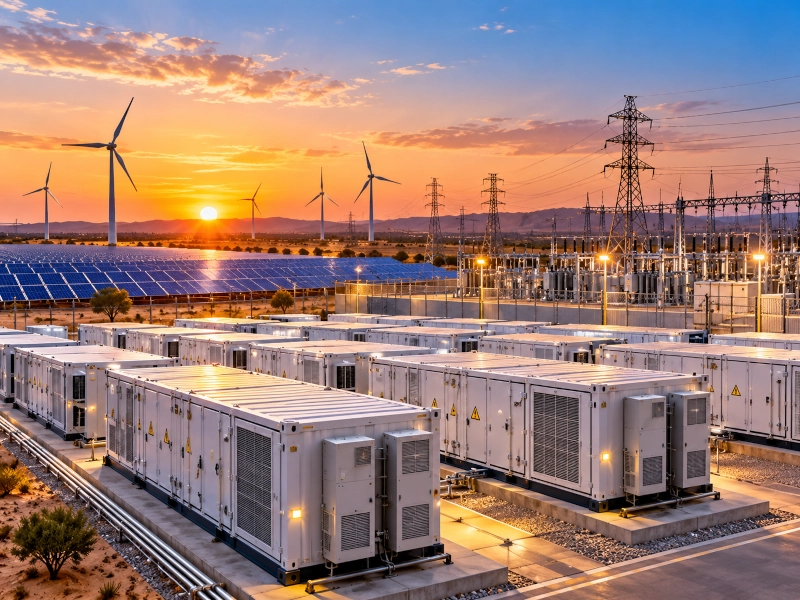
NTPC Vidyut Vyapar Nigam Limited (NVVN), a wholly owned subsidiary of NTPC Limited, has announced the commencement of commercial operations of its first Battery Energy Storage System (BESS) project, with a capacity of 250 MW and an energy storage capability of 500 MWh. The project, developed in Rajasthan, represents an important addition to India’s growing grid-scale energy storage infrastructure.
According to a regulatory disclosure submitted by NTPC Limited to the Bombay Stock Exchange (BSE) and National Stock Exchange (NSE) on 29 October 2026, the project achieved commercial operation status with effect from midnight on 27 October 2026. Power scheduling commenced the following day, on 28 October.
The facility has been developed through Rajasthan BESS Private Limited, a special-purpose vehicle associated with IndiGrid Infrastructure Trust. NVVN serves as the Battery Energy Storage System Implementing Agency and contracting counterparty for the project.
The commissioning comes as India expands its renewable energy generation capacity and increases investments in technologies that can store electricity, manage fluctuations in power supply and strengthen grid reliability.
250 MW Battery Storage Facility Begins Commercial Operations
The newly commissioned project has a rated power capacity of 250 MW and an energy storage capacity of 500 MWh.
These two measurements describe different aspects of battery storage performance. Megawatts measure the rate at which electricity can be supplied, while megawatt-hours measure the quantity of electrical energy that can be stored and delivered.
A 250 MW / 500 MWh battery storage system can theoretically provide electricity at its full rated output of 250 MW for approximately two hours.
The actual amount of energy delivered to the grid depends on operational conditions, battery efficiency, state of charge and applicable technical requirements.
This combination of power and energy capacity makes the system suitable for applications such as peak-demand management, renewable energy integration and grid balancing.
NTPC’s regulatory announcement confirmed that the project entered commercial operation on 27 October, followed by the commencement of power scheduling on 28 October.
The commencement of scheduled power services indicates that the facility has moved beyond construction and commissioning into its operational phase.
IndiGrid Develops Project Under Build-Own-Operate Model
The battery energy storage facility was developed by IndiGrid Infrastructure Trust through Rajasthan BESS Private Limited.
The project was awarded by NVVN in November 2024 following a tariff-based competitive bidding process.
Under the build-own-operate model, the developer is responsible for establishing and operating the storage infrastructure in accordance with the contractual requirements.
A Battery Energy Storage Service Agreement was subsequently signed in December 2024.
The facility has been developed to provide storage services over a concession period of 12 years.
According to IndiGrid’s disclosures, the project is expected to generate annual revenue exceeding ₹71 crore during the concession period.
The project was executed in collaboration with energy technology and infrastructure partners, including EnerGrid and AmpereHour Energy.
Its commissioning represents the third operational utility-scale battery energy storage project in IndiGrid’s portfolio.
The facility is located in Rajasthan, one of India’s major renewable energy-producing states, where large solar power installations create increasing demand for flexible electricity storage infrastructure.
Battery Storage to Support India’s Renewable Energy Expansion
Battery energy storage systems are becoming increasingly important as India expands its solar and wind power capacity. Unlike conventional thermal power plants, solar and wind installations depend on environmental conditions that change throughout the day.
Solar power generation typically increases during daylight hours and declines after sunset, while wind generation varies according to wind conditions.These fluctuations create challenges for electricity grid operators, who must continuously balance power generation with consumption.
Battery energy storage systems can help address these challenges by storing electricity when it is available and releasing it when demand increases or generation declines. During periods of high renewable electricity production, batteries can absorb energy that might otherwise be difficult to accommodate within the grid.
The stored electricity can subsequently be discharged during periods of higher demand, including evening hours when solar generation falls. This capability can improve the flexibility of electricity networks and support the integration of larger quantities of renewable power.
However, batteries do not generate electricity themselves. Their contribution lies in storing previously generated energy and making it available at a different time.
Understanding the Technology Behind Grid-Scale Battery Storage
A Battery Energy Storage System consists of battery modules, power conversion equipment, control systems, electrical protection devices and associated grid infrastructure. The battery modules store electrical energy through electrochemical processes.
Power conversion systems manage the conversion between alternating current used by the electricity grid and direct current used by the battery modules. Advanced control systems monitor battery performance, temperature, charging conditions and electricity dispatch requirements.
These systems help operators manage charging and discharging cycles while maintaining safe operating conditions.Battery installations also incorporate thermal management and fire protection arrangements to address operational risks associated with large-scale electrical energy storage.
Modern grid-scale battery storage facilities can respond rapidly to changes in electricity demand and system conditions.
This ability to adjust output makes battery storage useful for supporting grid stability, particularly in power systems with increasing renewable generation. The 250 MW / 500 MWh facility adds to India’s operational battery storage capacity and demonstrates the expanding commercial deployment of these technologies.
Grid Stability and Peak Power Management
One of the principal applications of battery energy storage is managing differences between electricity generation and consumption.
Electricity demand changes throughout the day according to industrial activity, commercial operations, agricultural consumption and household requirements. In many electricity systems, demand rises during evening hours when residential and commercial consumption increases.
At the same time, solar power generation declines as sunlight becomes unavailable. Battery storage can help address this mismatch by charging during periods of available electricity and discharging during periods of greater demand. This process is commonly referred to as energy shifting.
Battery systems can also support grid operators by providing rapid responses to changes in power system conditions, where the installation’s technical capabilities and contractual arrangements permit. Such capabilities can reduce the need for certain forms of short-duration balancing generation and improve the flexibility of electricity supply.
The newly commissioned Rajasthan facility is expected to provide peak power support and contribute to the integration of renewable energy into the grid. Its actual contribution will depend on dispatch schedules, operating conditions and the requirements established under the battery storage service agreement.
NVVN Expands Beyond Conventional Power Trading
NTPC Vidyut Vyapar Nigam Limited has traditionally operated in electricity trading and related energy services.The company’s participation in battery energy storage represents an expansion into infrastructure that supports the changing requirements of India’s power sector.
NVVN has been entrusted with implementing battery storage projects under the Government of India’s Viability Gap Funding framework. Viability Gap Funding provides financial support intended to improve the commercial feasibility of infrastructure projects that serve important public objectives but may face challenges in attracting investment solely through market revenues.
India has introduced support mechanisms to encourage the development of grid-scale battery energy storage as part of its wider energy transition. These initiatives are intended to accelerate the creation of storage infrastructure while encouraging participation by public and private enterprises.
NVVN’s role as a battery storage implementing agency allows it to participate in procurement, contractual arrangements and the development of energy storage services.The commissioning of its first 250 MW / 500 MWh project establishes an operational milestone in this expanding area of activity.
The project also demonstrates how public sector electricity companies can work with private infrastructure developers to establish large-scale energy storage facilities.
NTPC Group Strengthens Energy Storage Portfolio
NTPC Limited, India’s largest integrated power utility, is expanding its activities beyond conventional electricity generation into renewable energy and energy storage.
The company has identified battery storage and pumped-storage hydropower as important technologies for supporting a power system with increasing renewable energy generation.
Pumped-storage hydropower uses electricity to pump water to a higher reservoir when power is available and releases it through turbines when electricity is required.Battery storage performs a similar energy-shifting function through electrochemical storage rather than the movement of water.
Both technologies can contribute to power system flexibility, although their operational characteristics and suitable applications differ.NTPC’s expanding interest in these technologies reflects the broader transformation of India’s electricity infrastructure.
As renewable generation increases, power utilities must develop methods for maintaining reliable electricity supply during periods of fluctuating generation.The commissioned Rajasthan battery project represents one component of this transition.
Public-Private Cooperation in Energy Infrastructure
The development of the Rajasthan battery energy storage project illustrates the growing role of cooperation between public sector enterprises and private infrastructure investors.
While NVVN acted as the implementing agency and contracting counterparty, the project was developed through IndiGrid’s infrastructure investment structure.The use of competitive bidding and long-term contractual arrangements provides a framework for private developers to invest in electricity storage infrastructure.
Under such arrangements, the developer establishes and operates the facility, while the contracting entity obtains storage services according to agreed terms.This structure allows electricity storage capacity to be developed without necessarily requiring the public sector contracting agency to own the underlying physical infrastructure.
The Rajasthan project also involved international infrastructure investors, including British International Investment and KNI India AS, during its development.Such investment structures reflect the increasing interest in India’s energy storage sector among domestic and international infrastructure investors.
The successful commencement of commercial operations provides an example of how large-scale battery storage projects can progress from competitive procurement to operational electricity services.
Supporting India’s Long-Term Energy Transition
India’s electricity sector is undergoing a transformation as renewable energy capacity expands and the demand for reliable power continues to grow.Solar and wind power are expected to account for an increasing share of electricity generation, creating a greater requirement for storage and flexible grid infrastructure.
Battery energy storage is one of several technologies being developed to address these requirements.
Its ability to store electricity and discharge it during periods of greater demand can contribute to the effective utilisation of renewable generation.Large-scale storage installations can also provide additional flexibility to electricity system operators, although the precise services available depend on system design and operating agreements.
The commissioning of the 250 MW / 500 MWh project in Rajasthan adds operational storage capacity to India’s power infrastructure.For NTPC and NVVN, the development represents progress in establishing battery-based electricity services alongside conventional power generation and trading activities.
The project also highlights the role of competitive procurement and public-private partnerships in expanding India’s energy storage infrastructure.
As renewable electricity generation continues to increase, the deployment of battery systems and other energy storage technologies will remain important for maintaining reliable and flexible power supply.
Official References
1. NTPC Limited — Corporate Announcements
Disclosure date: 29 October 2026
Announcement: NVVN’s First BESS Project (250 MW / 500 MWh) Declared Commercial.
Company: NTPC Limited
Regulatory filing reference: 01:SEC:LA:1
BSE security code: 532555
NSE symbol: NTPC
https://ntpc.co.in/index.php/investors/disclosures-announcements/corporate-announcements
2. National Stock Exchange of India — NTPC Regulatory Disclosure
Date: 29 October 2026
Official filing: NVVN’s First BESS Project (250 MW / 500 MWh) Declared Commercial.
https://nsearchives.nseindia.com/corporate/NTPC_29102026181643_20261029_NVVNCOD.pdf
3. National Stock Exchange of India — IndiGrid Infrastructure Trust Disclosure
Date: 28 October 2026
Announcement: Commercial Operation of Rajasthan BESS Private Limited Project.
https://nsearchives.nseindia.com/corporate/INDIGRID_28102026125551_IndiGrid_Update_on_RBPL_27102026.pdf
4. NTPC Limited — Annual Reports
Official information concerning NTPC Group’s business activities, subsidiaries and emerging energy storage portfolio.
https://ntpc.co.in
5. Ministry of Power, Government of India
Official information concerning India’s electricity infrastructure, renewable energy integration and battery energy storage policy.
https://powermin.gov.in
You may also like
-
ONDC DigiDukaan Connects 21,000 Kirana Retailers With Over 450 Brands as Government Pushes Digital Trade
-
PM-KISAN Releases Over ₹18,690 Crore to 9.34 Crore Farmers as Total Assistance Crosses ₹4.64 Lakh Crore
-
India, Belgium and Luxembourg Strengthen Trade and Investment Cooperation Across Key Sectors
-
India Establishes Social Security Boards for Gig, Platform and Unorganised Workers
-
Bhandara Chinoor Rice of Maharashtra: The GI-Tagged Aromatic Heritage of Vidarbha
