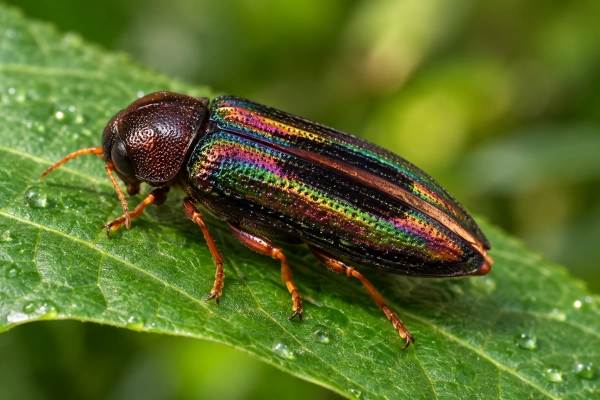
The forests of Kerala’s Western Ghats have yielded another species new to science, with researchers describing a striking metallic darkling beetle from the Wayanad Wildlife Sanctuary.
Named Steneucyrtus wayanadensis, the beetle was discovered in the Chethalayam forest area of Wayanad Wildlife Sanctuary during scientific surveys conducted by researchers associated with the Zoological Survey of India’s Western Ghat Regional Centre in Kozhikode, MES Mampad College and the University of Calicut.
The species has a predominantly blackish body covered by a distinctive uniform golden-green metallic iridescence, giving the small forest beetle an appearance that immediately separates it from some of its closest known relatives.
The discovery has been published in the Records of the Zoological Survey of India by T.K. Viswanath, V.D. Hegde and K.M. Remia.
Found During Night Surveys in Wayanad
Researchers collected specimens of the new beetle during night surveys using light traps inside the Chethalayam forest area.
Light trapping is commonly used in insect surveys because many nocturnal beetles and other insects are attracted to artificial light, allowing researchers to document species that can remain extremely difficult to locate during daytime searches.
Detailed examination subsequently showed that the Wayanad specimens represented a species that had not previously been scientifically described.
The researchers named it Steneucyrtus wayanadensis after Wayanad, permanently linking the species’ scientific identity with its type locality in the wildlife sanctuary.
Golden-Green Iridescence Helps Distinguish New Species
The new beetle belongs to the family Tenebrionidae, commonly known as darkling beetles, and to the genus Steneucyrtus.
Its metallic appearance is one of its most conspicuous features. The researchers describe the body as greenish metallic with a relatively uniform iridescence.
But colour alone is not sufficient to establish a new beetle species. Taxonomists compared a series of structural features with closely related Steneucyrtus species.
One important comparison was made with Steneucyrtus pexicollis, the species historically known from India. While S. pexicollis has a brownish metallic body displaying varying bluish, greenish and purple tones, the Wayanad species exhibits a much more uniform golden-greenish sheen.
The two also differ in the structure of their elytra, the hardened forewings that form the protective outer covering characteristic of beetles. In S. wayanadensis, these are completely flat, with shallower rows of punctures and without the transverse wrinkling seen in parts of S. pexicollis.
Beetle Also Differs From Sri Lankan Relative
Researchers also compared the Wayanad beetle with Steneucyrtus srilankae, a related species known from Sri Lanka.
The Indian species possesses a golden-greenish metallic appearance rather than the more brassy sheen associated with the Sri Lankan species. Its elytral interspaces are also completely flat, whereas those of S. srilankae become slightly convex towards the descending rear portion of the wing cases.
Such apparently small anatomical differences are important in beetle taxonomy, where closely related species can resemble each other externally while differing consistently in body sculpture, wing-case structure and other morphological characters.
Study Also Rediscovered an Indian Beetle Lost From Records Since 1896
The study produced another notable result alongside the description of the Wayanad species: researchers rediscovered Steneucyrtus pexicollis in India more than a century after its original description.
The genus Steneucyrtus itself was established by French entomologist Léon Fairmaire in 1896, with S. pexicollis as its type species. The original Indian material came from Belgaum, present-day Belagavi in Karnataka.
Despite being the species on which the genus was established, researchers noted that there had been no subsequent documented Indian record of S. pexicollis since its description in 1896.
The new study has now confirmed its continued presence, accompanied by a fresh diagnosis and examination of identifying anatomical characters.
That means the research contributes both a completely new Indian species and the return to scientific records of another beetle that had effectively disappeared from documented collections for around 130 years.
A Little-Known Genus of Tropical Darkling Beetles
Steneucyrtus remains a relatively small and poorly known group compared with many better studied beetle genera.
Prior to the latest Indian description, researchers recognised about 27 species worldwide within the genus. Until now, S. pexicollis was the only species originally known from India.
The description of S. wayanadensis therefore expands India’s known diversity within the group and provides further evidence that the forests of the Western Ghats continue to harbour insect diversity that remains incompletely documented.
The type specimen of the new species has been deposited at the Zoological Survey of India, Western Ghat Regional Centre in Kozhikode, ensuring that it remains available for future taxonomic comparison and scientific study.
Wayanad Continues to Reveal Undocumented Diversity
The discovery adds to the growing catalogue of species being documented from Kerala’s section of the Western Ghats.
Unlike large mammals and birds, much of the region’s insect diversity remains poorly recorded. Many species occupy narrow ecological niches and may only be detected through targeted surveys using methods such as light traps, pitfall traps and systematic collection.
Taxonomic studies of such organisms are important because documenting a species is the first step towards understanding its distribution, ecology and conservation requirements.
For Steneucyrtus wayanadensis, much remains to be learned about its biology, habitat preferences, life cycle and wider geographical distribution. The published work establishes its identity and type locality rather than attempting to assign conservation status without sufficient population data.
Its discovery nevertheless demonstrates how even well-known protected landscapes such as Wayanad Wildlife Sanctuary can continue to yield animals previously unknown to science.
With its distinctive golden-green metallic sheen and a scientific name derived directly from its forest home, Steneucyrtus wayanadensis now adds another species to the exceptionally rich insect diversity of the Western Ghats — while the accompanying rediscovery of S. pexicollis reconnects modern Indian entomology with a record dating back to 1896.
You may also like
-
ICAR-CIFRI Pushes Conservation of Indigenous Himalayan Fish for Biodiversity and Livelihood Security
-
Indian-Born Cheetah KJP21 Gives Birth to Five Cubs at Kuno, India’s Cheetah Population Reaches 60
-
ZSI and Mahatma Gandhi University Discover New Earthworm Species in Western Ghats
-
ZSI Scientists Identify New Fish Species Bathymyrus perplexus From the Bay of Bengal
-
Rare Afro-Asian Sand Snake Rediscovered in Kutch After More Than 150 Years
