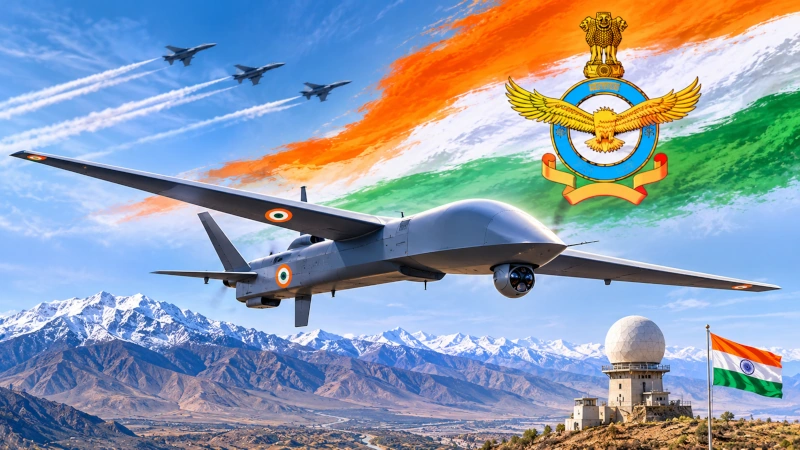
The Indian Air Force (IAF) has issued a Request for Information (RFI) seeking 500 indigenous fixed-wing Unmanned Aerial Systems (UAS) designed for Intelligence, Surveillance and Reconnaissance (ISR) missions. The requirement, issued by the Directorate of Plans at Air Headquarters on 18 November 2026, seeks domestically developed platforms capable of operating beyond 200 kilometres, with a minimum flight endurance of six hours. The initiative opens an important opportunity for India’s growing unmanned aviation industry, including established aerospace manufacturers, defence startups and specialised technology companies.
The proposed acquisition is intended to strengthen the IAF’s surveillance and intelligence-gathering capabilities through the deployment of advanced unmanned platforms. The requirement covers not only aircraft manufacturing but also electro-optical sensors, electronic intelligence equipment, secure communications, autonomous navigation and operations in environments where satellite navigation signals may be disrupted.
Indian Air Force Seeks 500 Fixed-Wing Indigenous UAVs
According to the RFI, the IAF is seeking 500 fixed-wing unmanned aerial systems under the category of expendable Intelligence, Surveillance and Reconnaissance platforms. The aircraft are expected to provide extended-range surveillance capabilities while operating at altitudes of up to 25,000 feet.
The specified operational range exceeds 200 kilometres, while the minimum endurance requirement stands at six hours. The platforms are expected to operate within a speed range of approximately 80–200 km/h, with a preferred cruising speed of around 120 km/h. The requirement also specifies runway-independent launch capability, allowing the aircraft to operate without conventional runway infrastructure.
The RFI additionally specifies a radar cross-section below 0.25 square metres. This requirement indicates an emphasis on reducing the aircraft’s radar visibility during surveillance missions. The proposed platforms are expected to support rapid operational deployment, with a turnaround time of less than 10 minutes specified in the technical requirements.
Advanced EO/IR Sensors for Day and Night Surveillance
An important component of the IAF’s requirement is the integration of advanced Electro-Optical and Infrared (EO/IR) sensor systems. The aircraft are expected to carry gimballed imaging equipment capable of supporting day-and-night surveillance operations.
Electro-optical sensors provide visual observation and target identification capabilities during daylight, while infrared systems enable thermal imaging and observation under low-light conditions. Their integration allows unmanned aircraft to gather intelligence across different environmental and visibility conditions.
Such sensor capabilities are particularly relevant for monitoring sensitive border regions, observing military movements and providing situational awareness to operational commanders. The integration of indigenous imaging payloads would also create opportunities for Indian manufacturers specialising in electro-optical equipment, thermal imaging technologies and airborne surveillance systems.
Electronic Intelligence and Passive Signal Detection
Beyond conventional imaging, the IAF’s requirement includes Electronic Support Measures (ESM) capabilities. The proposed aircraft are expected to incorporate passive broadband receivers covering the 2–18 GHz frequency range.
These systems are designed to detect and analyse electromagnetic emissions from radar and other electronic equipment. Passive electronic surveillance allows an aircraft to collect information about electromagnetic activity without necessarily transmitting signals of its own.
The integration of ESM equipment alongside EO/IR sensors would provide the IAF with complementary intelligence-gathering capabilities. While imaging systems offer visual information about the operating environment, electronic support equipment can help identify and analyse electromagnetic activity.
This combination is increasingly relevant in modern military operations, where electronic intelligence and persistent surveillance contribute to battlefield awareness and operational planning.
Autonomous Navigation and Secure Communications
The RFI also addresses the need for reliable operations in environments where Global Navigation Satellite System (GNSS) signals may be unavailable or disrupted. The aircraft must therefore support navigation capabilities that allow continued operation in GNSS-denied environments.
Secure communications form another important part of the proposed system architecture. The requirements include Line-of-Sight (LOS) and Satellite Communication (SATCOM) links, alongside AES-256 encryption for protecting communications and operational data.
The aircraft are also expected to incorporate onboard data-protection mechanisms. These requirements highlight the importance of secure information exchange, resilient communications and autonomous navigation in the development of modern military unmanned systems.
For Indian technology companies, these specifications create opportunities across flight-control software, navigation systems, encrypted communication equipment, electronic warfare technologies and onboard computing.
Opportunities for India’s Indigenous Drone Industry
The proposed requirement for 500 aircraft represents a substantial opportunity for India’s domestic aerospace and defence manufacturing ecosystem. The programme could encourage participation from companies developing fixed-wing UAV platforms, surveillance payloads, propulsion systems, communication equipment and autonomous flight technologies.
India’s private defence sector has witnessed increasing participation from startups and established manufacturers working on unmanned aircraft, loitering munitions, high-altitude platforms and autonomous systems. Companies developing indigenous airframes and propulsion technologies could explore the requirements outlined in the IAF’s RFI.
The programme also creates opportunities for specialised component manufacturers. Indigenous EO/IR payloads, electronic support receivers, navigation equipment, secure data links and lightweight airborne electronics will be important elements of any proposed solution.
The requirement therefore extends beyond the production of 500 aircraft. It highlights the need for a domestic industrial ecosystem capable of integrating multiple advanced technologies into operationally suitable unmanned platforms.
Procurement Process and Important Clarification
The IAF’s document is an RFI, which seeks information from prospective manufacturers regarding their technical capabilities and ability to meet the stated requirements. The procurement reference is RFI_EISRUAS_ASR_IAF_18NOV26, issued by the Directorate of Plans at Air Headquarters.
The submission deadline is 12 January 2027, according to the published procurement details. The RFI is an initial information-gathering stage and does not constitute a confirmed procurement order, contract award or selection of manufacturers.
The document also uses the designation expendable ISR UAS while specifying recovery and reuse-related operational requirements, including a turnaround time of less than 10 minutes. These requirements should be considered together when assessing the intended operational configuration.
IAF’s Broader Unmanned and Autonomous Systems Roadmap
The requirement for 500 surveillance drones forms part of the Indian Air Force’s wider efforts to expand its unmanned and autonomous capabilities. The IAF has been engaging with domestic manufacturers, technology companies, startups and research organisations to communicate its future requirements and encourage indigenous development.
The IAF Unmanned and Autonomous Systems Roadmap, presented during Dronathon 2026 at Pokhran on 14 September 2026, identified several technology areas requiring greater domestic capabilities. These include indigenous propulsion, autonomous software, resilient navigation and standardised interfaces.
The subsequent Industry Outreach Programme in New Delhi on 21 October 2026 provided another platform for the IAF to interact with India’s defence manufacturing and technology ecosystem. The engagement highlighted the importance of closer cooperation between military users and domestic industry in developing next-generation unmanned systems.
The latest RFI translates this broader technological direction into a specific requirement for long-endurance surveillance platforms, providing prospective manufacturers with an opportunity to demonstrate their indigenous capabilities.
Strengthening India’s Indigenous Aerospace Capabilities
The Indian Air Force’s requirement for 500 indigenous surveillance drones highlights the growing importance of unmanned systems in India’s defence modernisation programme. The combination of extended operational range, six-hour endurance, advanced imaging equipment, electronic intelligence capabilities and secure communications reflects the increasing technological complexity of modern military UAVs.
For India’s aerospace industry, the programme offers opportunities to strengthen domestic capabilities across aircraft design, propulsion, sensors, navigation, electronics and autonomous systems integration. It also provides a potential pathway for Indian startups and established manufacturers to contribute to advanced military aviation requirements.
As the procurement process progresses, the RFI will provide an important opportunity for India’s indigenous UAV industry to demonstrate its engineering capabilities and develop technologies that support the Indian Air Force’s evolving operational requirements. The initiative reinforces India’s broader ambition to establish a strong domestic foundation for unmanned aviation and advanced defence technologies under the Aatmanirbhar Bharat programme.
You may also like
-
Hoverit Develops Indigenous RATO System and Successfully Launches Divyastra Mk1 Strike Drone
-
Adani Defence Demonstrates Bagheera AT1 Vehicle-Mounted Anti-Tank Missile System at Pokhran
-
AERB Approves First Approach to Criticality for Rajasthan Nuclear Reactor Unit 8
-
SG Defence Secures Manufacturing Order for Indigenous Pinaka Mk-I Rocket Nozzles
-
Voltas and Atomberg Sign ₹200 Crore Joint Venture Agreement for Indigenous AC Compressors
