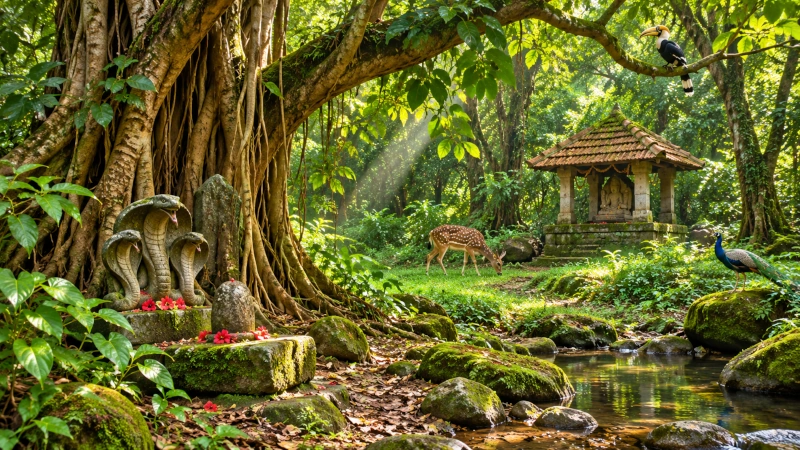
Across India, thousands of small forests, wooded landscapes and patches of natural vegetation have survived for generations because local communities regard them as sacred. Known by different names across the country, these sacred groves represent one of India’s most distinctive traditions of community-based environmental protection. From the serpent groves of Kerala and the Devrais of Maharashtra to the Orans of Rajasthan and the sacred forests of Meghalaya, these landscapes demonstrate how cultural beliefs, traditional institutions and community responsibilities have contributed to the preservation of natural ecosystems.
Long before biodiversity conservation emerged as a formal scientific discipline, communities across the Indian subcontinent developed customary practices that restricted activities such as tree felling, hunting and the removal of vegetation from particular forest patches. These restrictions were often associated with village deities, ancestral traditions, sacred natural features and beliefs concerning the spiritual significance of forests. Although the original purpose of protecting these places was not necessarily ecological conservation in the modern scientific sense, their continued preservation has frequently benefited plants, animals, soil organisms and local water resources.
Today, scientific research increasingly recognises sacred groves as important examples of biocultural conservation, a concept that acknowledges the close relationship between biological diversity and cultural traditions. These forest patches can preserve native vegetation, provide habitats for wildlife, support local ecological processes and retain traditional knowledge associated with the natural environment. Their significance extends beyond religious practices, offering valuable lessons for contemporary biodiversity conservation and community participation in environmental management.
The Ancient Tradition of Protecting Sacred Forests
The practice of protecting particular trees, forest patches and natural landscapes through cultural or religious beliefs has deep roots in Indian society. Across different regions, communities developed traditions in which certain areas were associated with divine presence, ancestral guardianship or obligations inherited from previous generations. Such places were often protected through customary rules governing access, resource extraction and activities considered harmful to the sacred landscape.
In many communities, cutting trees, removing branches, hunting animals or disturbing the vegetation within a sacred grove was prohibited or strictly regulated. The belief that violations could offend a local deity or ancestral guardian helped reinforce these restrictions. In some regions, only particular individuals were permitted to enter certain sections of the grove, while elsewhere access was allowed during festivals, ceremonies or other culturally important occasions.
These traditions were not uniform across India. They developed through different religious beliefs, local ecological conditions and systems of community governance. Some groves were closely associated with Hindu temples and village deities, while others were maintained through indigenous belief systems that recognised forests, mountains, springs and other natural features as sacred.
The historical importance of sacred groves lies in the way they connected community identity with the protection of particular landscapes. Rules governing these areas were often maintained through collective memory, oral traditions and the authority of local institutions rather than written conservation legislation. Their continued existence demonstrates how cultural practices can influence the treatment of natural resources over extended periods.
Sacred Groves Across India’s Diverse Landscapes
Sacred groves occur across several of India’s ecological regions, although their local names, sizes, vegetation and management practices vary considerably. Some consist of a small cluster of trees surrounding a shrine, while others preserve extensive forest patches containing mature trees, streams, wetlands and specialised plant communities.
In Kerala, sacred groves are commonly known as Kavus, with serpent-associated groves often called Sarpa Kavus. Maharashtra’s sacred forests are known as Devrais or Dev Vans, while Karnataka has traditions associated with Devarakadus. In Tamil Nadu, sacred woodland areas may be associated with village guardian deities such as Ayyanar and Amman.
In Rajasthan, sacred landscapes are known by names including Orans and Devbanis. These areas may include trees, scrublands, grasslands, water sources and grazing landscapes rather than dense forests alone. Meghalaya’s Khasi and Jaintia communities maintain sacred forests known by terms such as Law Kyntang, Law Lyngdoh and Law Niam.
Similar traditions are found in several Himalayan and central Indian communities, where forests may be associated with local deities, ancestral customs and traditional institutions responsible for managing shared resources.
The diversity of these practices demonstrates that sacred grove conservation is not restricted to a particular religion, region or vegetation type. Instead, it represents a broad family of traditions through which communities have protected selected natural landscapes for cultural and spiritual reasons.
Kerala’s Kavus: Living Forests of Traditional Conservation
Kerala’s sacred groves represent one of the most distinctive expressions of the relationship between traditional cultural practices and biodiversity conservation. Known locally as Kavus, these patches of vegetation are frequently associated with serpent worship, village deities and longstanding family or community traditions.
Many Kavus preserve remnants of the evergreen and semi-evergreen vegetation that historically occupied larger portions of Kerala’s lowland landscapes. As agriculture, settlements and infrastructure expanded, some of these groves remained protected because of their sacred status.
A traditional Sarpa Kavu may contain mature trees, shrubs, climbers, medicinal plants, leaf litter and small water bodies. Some groves also include ponds or wells associated with ritual activities. The relatively undisturbed vegetation can provide habitats for reptiles, amphibians, insects, birds and other organisms.
The association of certain Kavus with serpent worship is particularly significant. Snakes occupy an important place in several Kerala traditions, and the protection of serpent groves has often contributed to the preservation of vegetation and microhabitats suitable for reptiles and other wildlife.
Scientific studies have demonstrated that Kerala’s sacred groves can support considerable plant diversity despite occupying comparatively small areas. Some contain species associated with more extensive forest ecosystems, making them valuable remnants of vegetation within heavily modified landscapes.
However, Kerala’s Kavus face increasing pressures from urban expansion, land fragmentation, changes in property ownership and the gradual weakening of traditional protection practices. Recognising their ecological importance alongside their cultural value is therefore essential for ensuring their continued survival.
Maharashtra’s Devrais: Forests Protected by Village Traditions
In Maharashtra, sacred groves known as Devrais have historically been maintained through community beliefs concerning local deities and the sanctity of particular forest areas. These groves occur in different parts of the state, including the biodiversity-rich Western Ghats.
Many Devrais contain relatively undisturbed native vegetation surrounded by agricultural fields, settlements or forests affected by other forms of human activity. Their protection has often been associated with restrictions on tree cutting, grazing and the extraction of forest products.
The ecological importance of these forests is particularly evident in regions where surrounding vegetation has undergone substantial modification. A surviving Devrai may preserve mature trees, forest-floor vegetation and other features that have disappeared from nearby landscapes.
Research in Maharashtra has examined the relationship between cultural beliefs and the conservation of sacred forests. A study involving 66 sacred groves in the Western Ghats found that awareness of their religious and cultural importance remained widespread, while understanding of their broader ecological functions was considerably less common.
The findings highlight an important challenge for modern conservation. Traditional beliefs may continue to protect a grove, but long-term preservation can benefit from greater public awareness of its biodiversity, soil conservation and other ecological values.
The Devrai tradition demonstrates how village institutions and customary restrictions can contribute to forest protection. It also illustrates the importance of combining inherited conservation practices with scientific knowledge and contemporary environmental management.
Meghalaya’s Sacred Forests: Community Guardianship in the Khasi Hills
Meghalaya contains some of India’s best-known examples of sacred forests maintained through indigenous community traditions. Among them, the Mawphlang Sacred Forest in the Khasi Hills has attracted considerable attention because of its cultural significance and rich biological diversity.
The forest is protected through traditional beliefs associated with the local community and its sacred landscape. Customary restrictions have historically regulated the removal of vegetation and other materials from the grove.
Mawphlang supports a variety of plant communities, including mature trees, shrubs, ferns, orchids and other vegetation associated with Meghalaya’s humid hill environments. Its forest structure provides habitats for birds, insects and numerous smaller organisms.
The preservation of such forests is particularly important in Meghalaya because the region contains extensive biological diversity associated with the northeastern hills. Its climate, topography and forest ecosystems support many species adapted to moist subtropical environments.
The sacred forest tradition among Khasi communities demonstrates how collective responsibility and customary institutions can contribute to the protection of natural habitats.
These practices also illustrate an important feature of indigenous conservation systems: environmental responsibilities are frequently embedded in social relationships, community authority and inherited cultural obligations.
Modern conservation initiatives can benefit from understanding these governance arrangements rather than treating sacred forests simply as unoccupied land requiring external management.
Rajasthan’s Orans: Sacred Landscapes in an Arid Environment
Rajasthan’s Orans demonstrate that sacred landscape conservation extends beyond conventional forest environments. In the state’s arid and semi-arid regions, sacred areas may include grasslands, thorn forests, scrub vegetation, grazing lands and water sources.
These landscapes have traditionally been protected through community customs associated with local deities and village institutions. In several areas, Orans provide important resources for livestock and contribute to the maintenance of vegetation in environments where water availability is limited.
Unlike some sacred groves where the extraction of natural resources is largely prohibited, certain Orans are managed as community landscapes in which specific activities, including regulated grazing, may be permitted.
Their ecological importance arises from the preservation of native vegetation, soil cover, local habitats and natural resource systems within dry landscapes.
Rajasthan’s Forest Department has documented the significance of sacred groves and Orans as examples of traditional resource management and biodiversity conservation. The department has also undertaken initiatives aimed at improving the documentation and conservation of these landscapes.
The Oran tradition highlights the importance of understanding conservation within its regional ecological context. In dry environments, protecting grasslands and scrub ecosystems may be just as important as preserving dense tree cover.
The survival of these landscapes also demonstrates how cultural traditions can support the management of shared natural resources where ecological conditions require careful balancing of human needs and environmental protection.
Sacred Groves as Refuges for Rare and Native Plant Species
One of the most important ecological functions of sacred groves is their ability to preserve native plant communities within landscapes that have undergone substantial human modification.
Agricultural expansion, urbanisation, infrastructure development and changes in land use can reduce the extent of natural vegetation. Small protected patches may therefore become refuges for plant species that are less common in the surrounding landscape.
Sacred groves often contain mature trees, shrubs, climbers, herbs and other vegetation that together create complex ecological communities. In some locations, their relatively undisturbed conditions allow species associated with older forest ecosystems to survive.
These habitats can be particularly important for plants that depend on shade, moisture, stable soil conditions or interactions with specific pollinators and seed-dispersing animals.
Scientific investigations have documented the biodiversity value of sacred groves in several Indian regions. A study of 59 sacred groves in Madhya Pradesh recorded 109 tree species belonging to 90 genera and 40 families, demonstrating the diversity that community-protected forest patches can support.
Such findings strengthen the scientific understanding of sacred groves as repositories of native vegetation.
However, their conservation value varies according to size, habitat condition, surrounding land use and management history. Not every sacred grove contains rare or threatened species, and small forest fragments may remain vulnerable to disturbance and ecological isolation.
Wildlife Conservation Beyond National Parks and Sanctuaries
Sacred groves also contribute to wildlife conservation by providing habitats for animals that can survive within small patches of natural vegetation.
Depending on their location and ecological characteristics, groves may support birds, reptiles, amphibians, butterflies, pollinating insects and small mammals. The vegetation can provide nesting locations, shelter, feeding opportunities and protected microhabitats.
In agricultural landscapes, sacred groves may function as small ecological refuges surrounded by fields and settlements. Their trees and shrubs can provide resting places for birds and other organisms moving through the wider landscape.
In some regions, a network of forest patches may help maintain habitat connections, although the effectiveness of such connections depends on the distances between groves and the suitability of the intervening landscape.
The protection of flowering plants and mature trees can also benefit pollinating insects and other organisms associated with plant reproduction.
These ecological relationships demonstrate that sacred grove conservation can support wildlife beyond the boundaries of formally designated protected areas.
National parks and wildlife sanctuaries remain essential for protecting extensive habitats and species requiring large territories. Sacred groves perform a complementary role by conserving smaller patches of vegetation, particularly in landscapes where larger natural ecosystems have been fragmented.
Their importance is therefore not measured solely by their size but also by their contribution to maintaining ecological diversity within human-dominated environments.
Water Conservation and the Protection of Local Microclimates
Sacred groves can contribute to the protection of soil and local water resources through the ecological functions of their vegetation.
Trees and other plants intercept rainfall, while roots help stabilise soil and support its structure. Leaf litter and organic matter influence the movement of water through the upper soil layers and provide conditions for soil organisms.
The vegetation cover can also reduce direct exposure to sunlight and wind, creating relatively cool and humid conditions within some groves.
These microclimatic characteristics may support moisture-dependent plants, amphibians and other organisms that are sensitive to environmental fluctuations.
In Kerala and other high-rainfall regions, some sacred groves contain ponds, streams or wells that are culturally and ecologically important.
Research has identified associations between sacred groves, soil protection and local water resources. However, the precise influence of individual groves on groundwater recharge, streamflow and water availability requires site-specific hydrological investigation.
It would therefore be inaccurate to assume that every sacred grove automatically increases groundwater levels or produces measurable improvements in water supply.
Nevertheless, the preservation of vegetation, soil cover and small water bodies can make sacred groves important components of local environmental management.
Sacred Groves and Carbon Storage
The ecological significance of sacred groves also extends to carbon storage within vegetation and soils.
Trees absorb carbon dioxide during photosynthesis and store carbon in their trunks, branches, roots and other tissues. Forest soils can also retain carbon through the accumulation and decomposition of organic matter.
Sacred groves containing mature trees and relatively undisturbed soils may therefore contribute to local carbon storage.
Research conducted in central India has examined the relationship between sacred grove biodiversity and carbon stocks, documenting the contribution of these protected patches to both vegetation and soil carbon.
A more recent study of 55 sacred groves across different geographical regions of Kerala investigated how grove size, elevation, vegetation characteristics and management history influence plant diversity and carbon storage.
Such investigations demonstrate growing scientific interest in understanding sacred groves as nature-based conservation systems.
However, carbon storage differs considerably between individual groves. A small patch of young vegetation cannot be assumed to store the same amount of carbon as a larger, mature forest.
The contribution of sacred groves to climate mitigation must therefore be evaluated through appropriate scientific measurements rather than broad generalisations.
Their importance lies in conserving existing vegetation and soil systems while supporting biodiversity and maintaining ecological functions within the surrounding landscape.
Traditional Ecological Knowledge and Community Stewardship
Sacred groves preserve not only biological diversity but also cultural knowledge associated with plants, animals and natural environments.
Community traditions may include information about seasonal changes, flowering periods, particular tree species, local wildlife and customary rules governing the use of natural resources.
In some regions, festivals and ceremonies reinforce community relationships with sacred landscapes. These activities can help transmit knowledge and responsibilities between generations.
The management of sacred groves may involve village elders, traditional custodians, temple institutions, families or community organisations.
These arrangements are important because conservation decisions are shaped by local relationships and systems of authority.
Traditional ecological knowledge can complement scientific research by providing information about the historical use of landscapes and changes observed over extended periods.
However, such knowledge should not be treated as uniform across communities or automatically assumed to be equivalent to modern scientific findings.
Its value is strongest when respected within its cultural context and considered alongside evidence from ecology, botany, hydrology and other relevant disciplines.
The preservation of sacred groves therefore involves both biological conservation and the continuation of community knowledge systems.
Why Sacred Groves Have Survived for Generations
The survival of sacred groves can be understood partly through the effectiveness of social rules maintained within local communities.
Where particular trees or forest patches are regarded as sacred, activities that might damage them may be discouraged through moral obligations, social expectations and customary restrictions.
These practices can create a form of protection that does not depend entirely on continuous government enforcement.
Community members may monitor the grove, discourage unauthorised resource extraction and participate in activities intended to maintain the sacred landscape.
The strength of these arrangements varies, however, depending on local institutions, community participation, land ownership and changing social conditions.
Some sacred groves have remained relatively undisturbed for long periods, while others have experienced degradation despite their cultural significance.
The central lesson is that community involvement can be an important element of conservation when local people recognise responsibility for protecting a landscape.
Modern conservation programmes increasingly acknowledge that ecological protection is more effective when communities are treated as participants in decision-making rather than merely as people affected by externally imposed restrictions.
Sacred grove traditions provide examples of how such relationships between communities and landscapes have developed through cultural practices.
Modern Threats to India’s Sacred Groves
Despite their historical importance, many sacred groves face increasing environmental and social pressures.
Urban expansion, agricultural development, infrastructure construction and changes in land ownership can reduce the area available for natural vegetation.
Some groves have become isolated fragments surrounded by buildings, roads or cultivated land, limiting ecological connections with other habitats.
The gradual weakening of customary protection practices presents another challenge. As communities undergo demographic and economic changes, traditional institutions responsible for maintaining groves may lose influence or continuity.
In some locations, the construction or expansion of religious infrastructure can alter the vegetation and natural character of the grove. Replacing native vegetation with paved surfaces, ornamental gardens or built structures may reduce its ecological value even when the site continues to be culturally important.
Invasive plant species, waste disposal, excessive visitation and uncontrolled resource extraction can create additional pressures.
Small groves are particularly vulnerable because disturbances affecting a limited area may influence a substantial proportion of their remaining habitat.
Conservation efforts must therefore recognise that the cultural survival of a sacred site does not automatically guarantee the ecological integrity of its vegetation.
Protecting both dimensions requires careful planning and cooperation between communities, researchers and relevant authorities.
Sacred Groves in India’s Modern Conservation Framework
India’s contemporary environmental framework provides several opportunities to recognise and support community-managed biodiversity sites.
The Biological Diversity Act, 2002, as amended, provides for the identification and notification of Biodiversity Heritage Sites through the prescribed processes involving state governments, biodiversity institutions and local consultation.
Such provisions can support the recognition of ecologically important landscapes, including suitable sacred groves, where the relevant legal requirements are fulfilled.
However, sacred status does not automatically make a grove a legally notified Biodiversity Heritage Site. Formal recognition depends on the applicable statutory procedures.
Biodiversity Management Committees established at the local level can also contribute to documenting biological resources and associated traditional knowledge.
People’s Biodiversity Registers provide a mechanism for recording locally available biodiversity and knowledge concerning its use and conservation.
These institutions offer opportunities to integrate sacred grove conservation into broader environmental planning while recognising the importance of local participation.
The Kerala Forest Department has undertaken initiatives supporting the conservation of sacred groves, including programmes involving community participation and site-specific management planning.
Such approaches demonstrate how traditional practices can be complemented by scientific assessment, institutional support and contemporary conservation measures.
Scientific Research and the Documentation of Sacred Groves
Scientific investigation plays an increasingly important role in understanding the ecological value of sacred groves.
Researchers from Indian universities and environmental institutions have examined their plant diversity, wildlife, soil characteristics, carbon storage and cultural management systems.
The Indian Institute of Science has contributed research examining the biodiversity and ecological characteristics of sacred groves across different regions.
Studies from Maharashtra, Kerala, Madhya Pradesh and other states have demonstrated that sacred groves can contain diverse plant communities and provide ecological functions within modified landscapes.
The Ministry of Environment, Forest and Climate Change has also supported coordinated research examining sacred grove ecosystem services across multiple Indian states.
Such investigations help establish the ecological characteristics of individual sites and provide evidence for conservation planning.
Accurate documentation is particularly important because estimates of the total number of sacred groves in India vary considerably depending on the definitions used and the completeness of regional surveys.
A small shrine surrounded by several protected trees may be included in one inventory, while another survey may count only larger forest patches.
A consistent national understanding therefore requires improved documentation of grove boundaries, vegetation, ecological condition, cultural management and land tenure.
Scientific inventories can support conservation decisions while helping identify sites requiring urgent protection.
Integrating Traditional Protection with Modern Biodiversity Conservation
The most effective approach to sacred grove conservation is likely to involve cooperation between traditional custodians, local communities, scientific institutions and government agencies.
Traditional practices can provide a foundation for maintaining community commitment, while scientific research can help identify threats, monitor biodiversity and guide ecological restoration.
Conservation planning should begin with an understanding of the particular grove, including its cultural significance, ownership arrangements, ecological characteristics and management history.
Where vegetation has been degraded, restoration may involve protecting existing native plants, managing invasive species and supporting natural regeneration.
Introducing large numbers of ornamental or non-native trees may not provide the same ecological benefits as conserving the original plant community.
Water bodies, soil conditions and natural vegetation structures should also be considered when developing restoration measures.
Community participation remains essential because conservation measures that disregard established cultural practices may undermine local support.
At the same time, traditional management arrangements may benefit from greater ecological awareness, particularly where the surrounding environment has changed substantially.
Combining these approaches can help preserve sacred groves as living ecosystems rather than reducing them to isolated cultural monuments.
Sacred Groves as Models of Community-Based Conservation
The conservation significance of sacred groves extends beyond the protection of individual forest patches.
They demonstrate that communities can develop and maintain rules governing natural resources through shared values, social responsibilities and collective institutions.
This experience is relevant to contemporary environmental management, which increasingly recognises the importance of community participation and locally appropriate conservation measures.
Sacred groves also illustrate the relationship between biodiversity and cultural diversity. Different communities have developed distinct ways of understanding their responsibilities towards forests, water bodies, trees and other natural features.
These traditions cannot be transferred mechanically from one region to another because they depend on particular social and ecological conditions.
However, their broader principles can inform conservation planning by emphasising local stewardship, respect for ecological limits and continuity of responsibility across generations.
The preservation of sacred groves also demonstrates that protecting biodiversity need not always involve separating human communities completely from natural landscapes.
In many cases, long-term conservation has emerged from relationships in which people recognised certain places as deserving special protection.
Understanding these relationships can contribute to more inclusive and effective environmental policies.
Protecting Sacred Groves for Future Generations
India’s sacred groves represent a valuable intersection of cultural heritage, ecological knowledge and biodiversity conservation.
Their continued existence demonstrates how traditional beliefs and community responsibilities have contributed to protecting natural vegetation across very different landscapes.
From Kerala’s Kavus and Maharashtra’s Devrais to Meghalaya’s sacred forests and Rajasthan’s Orans, these traditions have helped preserve habitats that might otherwise have been altered by changing land use.
Scientific research increasingly confirms that many sacred groves contribute to plant conservation, wildlife habitat protection, soil stability and local ecological functions.
At the same time, their survival cannot be taken for granted. Development pressures, habitat fragmentation, changes in social practices and inadequate ecological management threaten many of these landscapes.
Protecting sacred groves requires recognition of both their cultural and environmental significance. Community institutions must remain central to their management, while scientific research and appropriate institutional support can strengthen conservation outcomes.
Their preservation also offers an opportunity to reconnect younger generations with local biodiversity and the traditional knowledge associated with natural landscapes.
India’s Sacred Groves: An Enduring Heritage of Living Conservation
The sacred groves of India offer an important perspective on the relationship between civilisation and the natural environment. They demonstrate that the protection of forests and other ecosystems has long been embedded in the cultural practices of communities across the subcontinent.
Although sacred groves were not originally established through modern biodiversity science, the restrictions and responsibilities associated with them have often produced valuable ecological benefits.
Their significance is especially apparent in contemporary landscapes where natural vegetation has become increasingly fragmented and small habitat patches perform important conservation functions.
The traditions associated with these forests also highlight the importance of community stewardship, local ecological knowledge and the transmission of environmental responsibilities between generations.
Modern science provides an opportunity to understand these landscapes more fully, document their biodiversity and develop conservation measures suited to their changing circumstances.
The most promising path forward lies in combining traditional protection practices with scientific monitoring, ecological restoration and meaningful participation by local communities.
By conserving sacred groves as both cultural landscapes and living ecosystems, India can protect important elements of its natural heritage while strengthening community-based approaches to biodiversity conservation.
The enduring significance of India’s sacred groves lies in a principle that remains relevant today: protecting nature is most sustainable when ecological responsibility becomes part of the values, institutions and everyday practices of society.
You may also like
-
Indra Loses Svarga to Bali: Strategic Withdrawal, Political Defeat and the Preservation of Military Power
-
Rāma’s Approach to Rāvaṇa: The Role of Negotiation Before the Use of Force
-
New Micro-Moth Species Discovered in Assam After Nearly a Century
-
Botswana-Born Cheetah Gives Birth to Four Cubs in Wild, India’s Cheetah Population Reaches 62
-
The Nair Military System: Organisation, Training and Changing Warfare Traditions in Kerala
