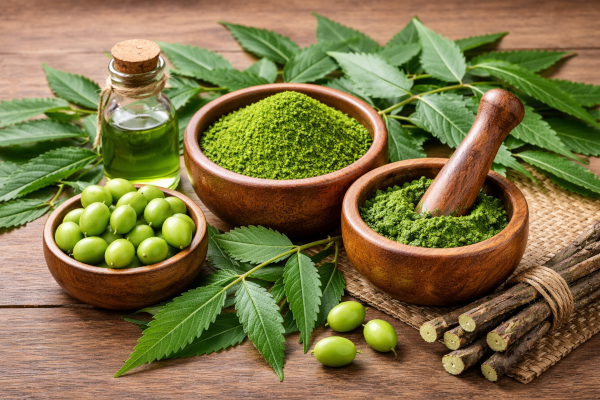
Neem, botanically known as Azadirachta indica, occupies a respected place in Ayurveda under the name Nimba. In classical Ayurvedic understanding, neem is valued chiefly for its tikta (bitter) and kashaya (astringent) qualities, along with laghu (light), ruksha (dry), and sheeta (cooling) properties. The Ayurvedic Pharmacopoeia describes these actions in a way that aligns with neem’s traditional use in conditions associated with excess pitta and kapha, especially in skin disorders, itching, wounds, and certain inflammatory states.
From an Ayurvedic perspective, neem is often discussed as a plant that helps cleanse and regulate. Its bitterness is not treated merely as a taste, but as a functional quality associated with reducing heat, dampness, irritation, and metabolic excess. That is why neem appears so often in discussions of kushta (skin disorders), kandu (itching), vrana (wounds), and blood-heat-related conditions in traditional literature.
Modern science gives this traditional reputation a biochemical basis. Neem contains a wide range of bioactive compounds, including limonoids such as azadirachtin, nimbin, nimbolide, and gedunin, along with flavonoids, polyphenols, tannins, and other antioxidant constituents. Reviews of the scientific literature describe neem as having notable antimicrobial, anti-inflammatory, antioxidant, and immunomodulatory potential, although the strength of evidence varies depending on the condition, the plant part used, and whether the data come from laboratory, animal, or human studies.
Ayurveda describes neem through its actions on the body’s functional balance; biomedicine describes it through phytochemistry and pharmacology. The languages differ, but there is overlap. Neem’s traditional use in skin care, oral hygiene, and wound management corresponds reasonably well with modern findings on its antibacterial, antifungal, anti-inflammatory, and antioxidant activity. NIH material also notes that neem preparations have long been used for skin conditions, septic sores, and infected burns, especially as an antiseptic-type botanical.
Nutritional information of neem
One important clarification: neem is primarily a medicinal plant, not a staple food, so “nutritional information” is usually reported for neem leaf flour or dried neem leaves, not for ordinary culinary intake. The exact numbers vary by geography, season, processing method, and whether fresh leaves, dried leaves, bark, flowers, or seed products are analyzed.
Reported analyses of neem leaf flour show that neem leaves contain measurable amounts of protein, fiber, ash, and minerals, especially calcium, potassium, phosphorus, iron, manganese, and sodium. One recent review summarizing earlier studies reports approximate mineral levels in neem leaf flour of about 0.71% calcium, 0.28% phosphorus, 0.58% sodium, and 2% potassium, with iron also present in notable amounts.
In practical terms, the nutritional profile of dried neem leaf powder can be summarized like this:
- Protein: present in meaningful quantities for a leaf material, though figures vary across studies.
- Dietary fiber: relatively high, especially in dried leaf preparations.
- Minerals: especially calcium, potassium, iron, and phosphorus.
- Phytonutrients: polyphenols, flavonoids, tannins, limonoids, and other bitter compounds that contribute more to medicinal action than calorie value.
So nutritionally, neem is best understood not as a calorie-dense “superfood,” but as a mineral-rich, phytochemical-dense medicinal leaf. Its significance lies less in macronutrients and more in its bioactive compounds.
Neem in Ayurvedic use
In Ayurvedic practice, neem is most often associated with:
Skin support: Traditionally used in acne-prone, itchy, inflamed, or infection-prone skin states. This remains one of the strongest bridges between classical use and contemporary herbal practice.
Oral hygiene: Neem twigs and extracts have long been used for dental cleaning and gum health, and modern research interest supports its antimicrobial value in the oral cavity.
Wound care: Neem’s traditional use in cleansing and supporting wound healing is consistent with its antimicrobial and anti-inflammatory profile.
Metabolic and inflammatory support: Some studies explore possible roles in glucose metabolism, oxidative stress, and inflammation, but these uses should be presented carefully because evidence is still mixed and often preclinical rather than definitive human evidence.
Scientific caution and safety
Neem is useful, but it is not harmless simply because it is natural. That point matters. Reviews and NIH resources note that dose, preparation, and route of use matter greatly. Neem oil, especially when ingested, is of particular concern. NIH’s LiverTox notes severe toxicity has been reported with margosa/neem oil, particularly in children, and historical NIH material warns that even small oral amounts of neem oil have caused serious harm.
Neem should therefore be approached with caution in pregnancy, and oral self-medication with concentrated neem products is unwise without professional guidance. The evidence base suggests that while certain neem preparations may be safe at controlled doses, toxicity has also been documented, especially with more concentrated extracts and oils.
Conclusion
Neem is one of the clearest examples of how Ayurvedic plant knowledge and modern phytoscience can speak to one another. Ayurveda sees neem as a bitter, cooling, cleansing herb that helps pacify aggravated pitta and kapha, especially in the skin, blood-associated heat states, wounds, and inflammatory disorders. Modern science sees a phytochemically rich medicinal tree whose leaves, bark, seeds, and oil contain compounds with antimicrobial, antioxidant, and anti-inflammatory potential.
Its nutritional value is real, especially in terms of minerals and phytochemicals, but neem is best understood as a therapeutic botanical rather than a conventional food. In that sense, Ayurveda was already treating neem correctly long before laboratories began isolating its active compounds: not as something eaten for pleasure, but as something used with purpose.
Reference:
https://miracledrinksclinic.com/Liquids/Sugar_Care/Nimba_Lf_St_Bk.pdf
https://pmc.ncbi.nlm.nih.gov/articles/PMC4791507/
https://pmc.ncbi.nlm.nih.gov/articles/PMC4441161/
https://www.ncbi.nlm.nih.gov/books/NBK548429/
https://pmc.ncbi.nlm.nih.gov/articles/PMC11521714/
https://pmc.ncbi.nlm.nih.gov/articles/PMC9195866/
You may also like
-
Ayurveda on Cold Foods and Iced Drinks: Why Food Temperature Matters for Digestion
-
Serum Institute of India-Manufactured Ebola Vaccine Enters Clinical Trial in Uganda
-
Ayurveda and Hydration: How Much Water Should We Really Drink?
-
Warm Water in Ayurveda: When and Why It Is Recommended
-
Women Make Up 43% of India’s Ayush Workforce as Sector Supports 17.6 Lakh Livelihoods
