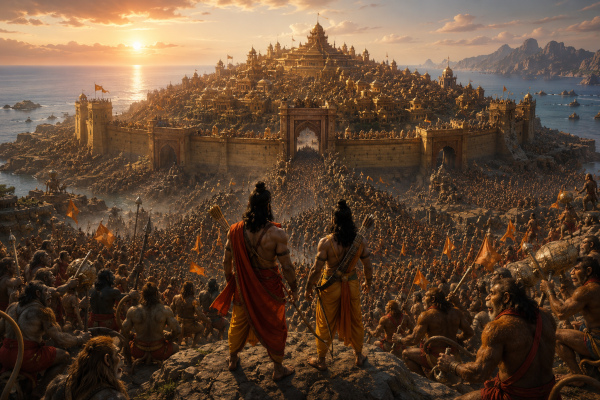
The assault on Lanka begins with the calm of a commander who has already seen the battlefield in his mind. Rama stands before a fortified island capital, a city raised on high ground, protected by walls, gates, towers, armed Rakshasa formations and the psychological weight of Ravana’s power. The Vanara army has crossed the sea, reached enemy soil and gathered before one of the most formidable citadels in the epic imagination. At this moment, Rama’s genius lies in order. He turns a vast forest army into a structured siege force, dividing pressure across the four gates of Lanka and placing commanders where their strength can shape the battle.
The plan is simple in appearance and sophisticated in execution. Lanka has four principal gates, each capable of becoming a killing zone if attacked without coordination. Rama assigns Vanara leaders to different sectors, turning the battlefield into a controlled grid. Each gate becomes a theatre of action with its own commander, troops, objectives and pressure points. The city is surrounded through disciplined placement, and Ravana’s army is forced to defend every direction at once. This is siege warfare in its pure strategic form: isolate the enemy, divide his attention, deny easy movement, test his defences and create openings through sustained pressure.
The northern gate becomes the most important sector because Ravana himself is positioned there. Rama goes to that gate with Lakshmana. This is a powerful command decision. The supreme leader chooses the sector where the enemy king stands, taking responsibility for the most decisive axis of battle. In modern military language, this is the main effort. A commander identifies the centre of gravity, places his finest combat strength against it and keeps personal control over the point where the outcome may turn. Rama’s presence at the northern gate signals confidence to his army and sends a direct message to Lanka: the war has reached Ravana’s own threshold.
The other gates are entrusted to Vanara generals who carry their own battlefield personalities. These commanders are warriors of speed, strength, mobility and shock action. Their task is to hold their sectors, press the walls, engage defenders and prevent Lanka’s garrison from concentrating at one point. A siege succeeds when the besieged force loses freedom of choice. Every gate under pressure becomes a chain around the city. Every commander outside the walls becomes a lock on Ravana’s movement. The Vanara army, which had earlier moved like a living storm through forests and across the ocean, now settles into a deliberate ring of force around Lanka.
Vanara formations massing before the gates, rocks and trees carried as assault weapons, war cries rising against stone walls, banners moving in the sea wind, commanders watching towers and battlements, scouts reporting movement, and Rama surveying the northern approach with Lakshmana at his side. The siege transforms Lanka from a shining capital into a trapped fortress. Its gold, towers and ramparts still gleam, but the outside world has closed around it. The city’s strength now becomes its prison, because every road outward is watched and every gate has a warrior waiting.
Modern warfare follows the same logic in urban operations. A city or fortified zone is rarely attacked as a single object. It is divided into sectors, corridors, entry points, fire zones and command responsibilities. Units are assigned axes of advance. One formation blocks escape routes, another secures bridges and road junctions, another isolates command centres, while special teams gather intelligence and strike key nodes. The language has changed into grids, sectors, cordons, ISR feeds, drones, armour columns and command posts, but the central principle remains ancient: a defended urban space must be surrounded, studied, divided and pressured in a coordinated manner.
Rama’s four-gate deployment also shows an early understanding of command and control. A massive army can become a burden if every warrior rushes toward the same wall. By assigning commanders to separate gates, Rama creates clarity. Each leader knows his zone. Each formation knows its direction. Each sector has responsibility. This prevents crowding, confusion and wasted strength. Modern armies use the same method through brigade sectors, battalion objectives, phase lines and operational boundaries. A commander gives every unit a defined space so that courage becomes organised violence and movement becomes a deliberate instrument.
The siege also carries a psychological dimension. Ravana is inside the city, watching pressure grow from every side. His commanders must defend multiple gates, maintain reserves, watch internal morale and respond to sudden breakthroughs. The besieged force feels the shrinking of space. Soldiers on the walls see the enemy everywhere. The population senses the closing ring. The ruler feels his authority challenged in full view of his own capital. In modern warfare, encirclement has the same mental effect. When roads are cut, supply lines are watched, drone feeds expose movement and artillery holds exits under threat, the defender begins to fight within a tightening circle of fear.
The placement of Rama and Lakshmana at the northern gate adds another layer to the siege plan. Leadership near the decisive front raises morale across the army. Soldiers fight harder when they know their commander shares the danger. This principle runs through military history. Commanders who appear near the main effort create emotional force beyond orders and signals. Rama’s presence becomes a battle standard. Lakshmana’s presence adds disciplined fury. Together, they give the northern gate a gravity that pulls the war toward its central confrontation.
The Vanara army’s natural strength also suits siege pressure in a unique way. They are agile, fearless, physically powerful and capable of climbing, leaping and improvising weapons from the environment. Against a walled city, such troops become ideal assault infantry. They can swarm approaches, scale broken sections, throw massive stones, disrupt defenders and exploit sudden gaps. Modern siege warfare uses engineers, assault teams, breaching charges, armoured vehicles, drones and precision fire to create entry points. The Vanara method belongs to an older world, yet the operational idea remains familiar: find the wall’s weak rhythm, break the defender’s confidence and force the fortress to fight everywhere.
A siege also depends on patience. The army outside must maintain food, water, rest, communication and discipline. The crossing to Lanka had already proved the importance of logistics. Once the army surrounds the city, supply becomes even more essential. Troops need staging areas, wounded warriors need care, messengers need routes and commanders need constant reports. Modern operations around cities demand the same foundation. Fuel convoys, ammunition dumps, medical posts, satellite communications, mobile repair teams and drone batteries sustain the ring of pressure. The weapon may be a missile or a mountain rock, but the army still survives through supply.
Rama’s plan shows a clear understanding of battlefield geometry. The four gates are more than architectural features. They are access points, movement channels and tactical arteries. Control the gates, and the city’s ability to manoeuvre begins to fade. In modern terms, gates are like road junctions, ports, bridges, tunnels and airfields. A commander who controls these nodes controls the tempo of the battle. Rama’s army surrounds Lanka by reading the city as a system, then placing force at the places where that system breathes.
A maritime echo of the same principle appeared in India’s Operation Cactus in 1988, when Indian forces intervened after mercenaries attempted to seize power in the Maldives. The crisis unfolded in an island capital, where control of movement mattered as much as combat itself. Indian troops secured Malé with speed, while the Indian Navy extended the operation into the surrounding sea lanes, cutting off the attackers’ escape route and intercepting the fleeing vessel MV Progress Light. This was the oceanic form of siege warfare: the city’s gates had become harbours, sea approaches and routes of withdrawal. Rama’s siege of Lanka worked through the same military logic. The Vanara commanders held the four gates so Ravana’s forces could neither mass freely nor escape pressure. In the Maldives, India used airlift, naval reach and sea control to close the operational space around the hostile force. The weapons, platforms and geography had changed, but the principle remained ancient and clear — an island fortress is mastered when its approaches are controlled, its exits are sealed and its defenders lose the freedom to choose the next move.
The siege of Lanka also reveals the value of matching leadership to terrain. A gate battle is different from open-field fighting. It demands stamina, coordination and the ability to absorb sudden enemy sorties. Ravana’s warriors can charge out, strike hard and withdraw behind walls. Rama’s commanders must hold formation, respond quickly and keep pressure alive. Modern armies face similar problems in fortified urban zones where defenders use buildings, basements, tunnels and narrow streets for sudden attacks. Sector commanders must hold nerve, maintain communication and keep the larger plan intact even when local fighting becomes chaotic.
What makes this episode powerful is the fusion of epic grandeur and military realism. The scene carries divine purpose, heroic warriors and a golden fortress, yet the planning is practical. Rama studies the enemy position. He divides the battlefield. He assigns commanders. He identifies the decisive gate. He places himself where Ravana stands. He turns moral purpose into military design. The war for Lanka becomes a campaign of structure, pressure and leadership.
In the larger arc of the Ramayana, the siege marks the moment when the campaign changes from movement to confrontation. The search for Sita had required intelligence. The alliance with Sugriva had required diplomacy. The crossing of the ocean had required engineering and logistics. The encampment on Lanka had required staging and supply. Now the siege requires command architecture. Every earlier phase feeds this moment. Rama arrives at the walls of Lanka with information, allies, morale, logistics and a battle plan.
That is why the four-gate siege still feels modern. It teaches that victory begins before the first clash at the wall. It begins with understanding the enemy’s layout, dividing responsibilities, protecting flanks, holding reserves, pressuring multiple points and placing leadership at the decisive axis. Rama’s army may carry rocks, trees and mountain-born strength, but the mind behind the siege works with the clarity of a modern operations room. Lanka is surrounded through courage, but it is endangered through planning.
The siege of Lanka is therefore one of the Ramayana’s finest military lessons. A fortress falls when its walls are challenged by discipline, when its gates are fixed by pressure, when its ruler is drawn into the decisive sector and when the attacking army moves as one body with many limbs. Rama’s command before Lanka shows warfare as organised purpose. The Vanaras bring energy, the generals bring sector control, Lakshmana brings relentless resolve, and Rama brings the calm centre of the entire operation. The golden city stands before them, magnificent and armed, while the siege ring tightens with the certainty of a strategy already set in motion.
You may also like
-
Indian Navy Vice Chief Inspects Japan’s Mogami-Class Stealth Frigate as India-Japan Shipbuilding Cooperation Expands
-
Philippine Marine Wargames Reportedly Show BrahMos Can Penetrate Chinese Destroyer Air Defences
-
Safran Signs 18 Agreements with Indian Aerospace Suppliers, Expanding Make in India Manufacturing Partnerships
-
Indian Army’s Vajra Corps Certifies First Batch of Drone Operators, Strengthens Battlefield Surveillance
-
India to Seek 35% Increase in Defence Modernisation Budget for FY 2027–28
