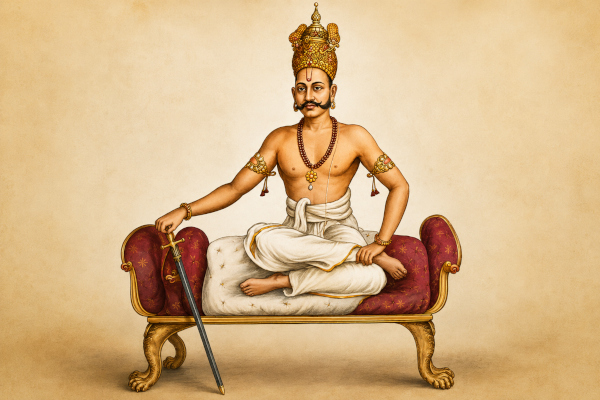
Veera Kerala Varma is one of the most recurring and meaningful royal names in the history of the Kochi dynasty. It was not merely the name of one ruler. It was a dynastic title carried by several kings across different centuries, linking the royal house of Kochi to its origin legends, political memory and long struggle for survival on the Malabar coast. The name itself carries the weight of kingship: “Veera” suggests courage, “Kerala” anchors the ruler to the land, and “Varma” belongs to the old Kshatriya naming tradition of South Indian royalty.
The story of Veera Kerala Varma begins in the larger historical memory of the Perumpadappu Swaroopam, the royal house that later became the Kingdom of Kochi. Traditional accounts connect the dynasty to the final phase of the Chera order in Kerala. According to this memory, the last Chera ruler divided his domains, and a nephew named Veera Kerala Varma received the Perumpadappu territory. From this inheritance, the Kochi royal house traced its descent and legitimacy. Whether read as legend, political memory or dynastic tradition, the figure of Veera Kerala Varma stands at the symbolic beginning of Kochi’s royal identity.
Perumpadappu was more than a place. It was the cradle of a ruling house that gradually moved through changing political geography. The Kochi dynasty had to adapt to the shifting power centres of Kerala, the rise and fall of ports, the pressure of rival chiefs, the influence of temples, the arrival of European powers and the growing importance of maritime trade. In this long journey, names such as Veera Kerala Varma gave continuity to the dynasty. When the same royal name appeared across generations, it reminded subjects, nobles and foreign powers that the ruler belonged to an old and recognised line.
The early Kochi state emerged in a region shaped by rivers, backwaters, temples, Brahmin settlements, warrior houses and trade routes. Its rulers needed religious legitimacy, military caution and diplomatic skill. They held authority over territories that connected inland Kerala with the Arabian Sea. Pepper, spices, elephants, timber and coastal commerce gave Kochi importance beyond its size. A ruler bearing the name Veera Kerala Varma therefore stood within a world where kingship was never purely ceremonial. It required negotiation with local elites, protection of temple rights, management of trade and survival among stronger neighbours.
The arrival of the Portuguese changed Kochi’s destiny. When the Portuguese entered the Malabar coast at the end of the fifteenth century, Kochi became one of their most important allies. The Zamorin of Calicut was the major regional power, and Kochi’s rivalry with Calicut gave the Portuguese a strategic opening. Several Kochi rulers, including those bearing the Veera Kerala Varma name, ruled during a period when local kingship became tied to global maritime competition. The Arabian Sea was no longer only a commercial space. It became a battlefield of fleets, forts, treaties and trading monopolies.
During the Portuguese phase, Kochi gained protection and prestige but also entered a new dependence on European military power. The ruler had to balance local honour with foreign alliance. Forts, churches, warehouses and trading factories began to reshape the coastline. The Portuguese alliance strengthened Kochi against Calicut, while it also brought new pressures into the royal court. A ruler such as Veera Kerala Varma in this period had to govern a kingdom standing between traditional Kerala politics and the first wave of European imperial competition in India.
The Dutch arrival in the seventeenth century changed the balance again. The Dutch East India Company challenged the Portuguese and eventually displaced them from Kochi. Kochi rulers had to adjust to a new European power that was more commercial, disciplined and treaty-driven. The royal house continued, but its room for independent action was increasingly shaped by external military and economic forces. The name Veera Kerala Varma appears again in this broad period, showing how the dynasty preserved its own ceremonial and political identity even as foreign companies fought for control of coastal trade.
Kochi’s kingship was also shaped by Kerala’s internal social order. The ruler was a political head, a patron of temples, a protector of customs and a figure of ritual importance. The Maharaja of Kochi was associated with the title Gangadhara Kovil Adhikaarikal, reflecting a sacred dimension to kingship. The royal household followed the matrilineal system of inheritance, common among many ruling and aristocratic houses of Kerala. Succession passed through the female line, and this gave the dynasty a distinctive structure. A recurring royal name like Veera Kerala Varma therefore moved through branches of the family rather than through direct father-to-son succession.
This matrilineal inheritance is important for understanding why the same royal names return across the Kochi line. The dynasty was organised through thavazhis, or branches of the royal family. Rulers came from eligible male members within this wider matrilineal structure. A royal name could therefore reappear in different generations and branches, carrying memory rather than simple numbering alone. Veera Kerala Varma became one of those names that linked different rulers into one long dynastic chain.
The eighteenth century brought another period of pressure. Mysore under Hyder Ali and Tipu Sultan expanded into Kerala, and Kochi found itself caught between regional military powers and changing alliances. The kingdom had to survive through diplomacy, tribute arrangements and careful positioning. Later, British influence grew stronger after the defeat of Mysore. Kochi entered the era of British paramountcy, becoming a princely state under colonial supervision. The royal house retained dignity and internal authority, while strategic power increasingly passed into British hands.
In the British period too, the name Veera Kerala Varma continued to appear. One important ruler, Kerala Varma III, also known as Veera Kerala Varma, ruled from 1809 to 1828. This was a difficult time after the turbulence linked with Velu Thampi Dalawa and Paliath Achan’s revolt against British power. Kochi’s rulers had to rebuild stability under the shadow of British control. The ruler’s authority now depended on ceremonial legitimacy, administrative cooperation and political restraint. The old warrior resonance of the name Veera Kerala Varma remained, but the nature of kingship had changed.
Another ruler associated with the name, Kerala Varma IV or Veera Kerala Varma, had a brief reign from 1851 to 1853. Short reigns were common in several princely states where succession depended on age, health and the seniority of matrilineal branches. Even a short reign mattered because each ruler formed part of the continuity of the royal house. The throne was not only an office of administration. It was a sacred and dynastic seat that carried memory from Perumpadappu to Thrippunithura.
Kerala Varma V, who ruled from 1888 to 1895, is another significant bearer of the name. By this time, Kochi had become a princely state within the British Indian system. The ruler’s world was now filled with residents, diwans, modern departments, revenue reforms, education policies and infrastructure demands. The monarchy had to adapt to the language of modern administration while preserving its ritual identity. This later Veera Kerala Varma stood at the edge of a new age, just before the celebrated reign of Rama Varma XV, known as Rajarshi, who became one of Kochi’s most reformist rulers.
The recurring presence of Veera Kerala Varma in Kochi’s royal history shows how names can act as political anchors. A royal name preserves memory during change. It tells the people that the dynasty continues even when capitals shift, foreign powers arrive, trade routes change and administrative systems evolve. For Kochi, this mattered deeply because the kingdom survived by adapting rather than by expanding into a large empire. Its strength lay in continuity, diplomacy, maritime importance and cultural legitimacy.
Veera Kerala Varma also represents the layered nature of Kerala kingship. Kochi’s rulers were not conquerors in the style of vast northern empires. Their power was more delicate, negotiated and regionally rooted. They had to deal with temple networks, noble houses, European companies, rival kingdoms, colonial residents and local communities. Their authority came from inheritance, ritual, alliance and survival. The repeated use of a name like Veera Kerala Varma gave this fragile political structure a sense of age and dignity.
The cultural setting of Kochi adds further richness to the story. The kingdom was home to Hindus, Christians, Jews and Muslims, with trade bringing Arabs, Portuguese, Dutch, English and other communities into its ports. Mattancherry, Fort Kochi, Thrippunithura and Thrissur all became connected with different phases of the kingdom’s life. Royal names lived in palaces, temples, copper-plate memories, court rituals and public festivals. The story of Veera Kerala Varma belongs to this mixed world of Sanskritic kingship, Malayalam culture and oceanic exchange.
The Athachamayam tradition of Thrippunithura also preserves the memory of royal ceremony connected with the Kochi rulers. The festival recalls the royal procession associated with Onam and the ceremonial world of the Maharaja. In such traditions, the past does not remain locked in chronicles. It survives in public movement, music, caparisoned elephants, martial displays, folk art and local memory. The name Veera Kerala Varma, linked to the origin imagination of the dynasty, fits naturally into this ceremonial universe.
By the twentieth century, the Kochi kingdom moved toward integration with modern India. The princely order ended, and Kochi became part of the Travancore-Cochin union before Kerala state was formed. Royal power passed into history, but the memory of the dynasty remained. Names such as Veera Kerala Varma became markers of a long regional past, connecting modern Kerala to Perumpadappu, the spice coast, European contact, princely administration and the cultural life of central Kerala.
Veera Kerala Varma should therefore be understood as a name of continuity rather than as a single biography. It belongs to the founding legend of the Kochi royal family, appears across the list of rulers, and reflects the dynasty’s ability to endure through centuries of pressure. The name carried courage, land, lineage and memory. It moved from the early Perumpadappu tradition to the Portuguese age, from the Dutch phase to the British princely state, and finally into the historical imagination of Kerala.
In the story of Kochi, empires came by sea, armies marched through the land, treaties were signed, forts changed hands and colonial power reshaped kingship. Through all this, the royal house survived by holding on to lineage and adapting to time. Veera Kerala Varma remains one of the names through which that survival can be read. It is the echo of a dynasty that began in legend, matured through diplomacy, endured through foreign pressure and left behind a deep imprint on Kerala’s history.
You may also like
-
Sindhu: The Indus Kingdom of Jayadratha in the Mahabharata
-
Kuninda or Kulinda: The Himalayan Realm of the Mahabharata in Uttarakhand and Himachal Pradesh
-
Durga versus Mahishasura: Weapons, Battlefield Tactics and the Triumph of Shakti
-
Kuluta: The Kullu Valley Kingdom of the Mahabharata
-
Israel to Honour Indian Pilot Smit Machchhar with Highest Civilian Bravery Award for Saving Flydubai Flight
