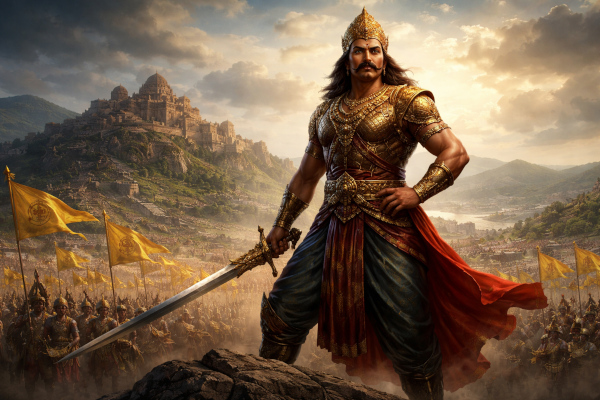
Pulakeshin II stands among the grandest rulers of early medieval India not merely because he won battles, but because he altered the political map of the subcontinent at a moment when northern imperial power seemed ready to spill deep into the peninsula. He ruled the Chalukya kingdom of Vatapi, present-day Badami, from about 610 to 642 CE, and under him Chalukya power reached its high noon. He was the son of Kirtivarman I, and he inherited not a settled throne, but a kingdom already bruised by succession conflict. The sources do not preserve a secure birth date for him, so his childhood survives only in outline, but they do make clear that when his father died, Pulakeshin was still young enough for his uncle Mangalesha to take power first. That early displacement shaped the whole drama of his rise: Pulakeshin did not simply succeed to rule; he fought his way into it.
The beginning of his reign therefore has the feel of a prince returning through fire. The early years were consumed by civil war, after which he had to rebuild authority almost from scratch, reconquering territory and forcing wavering feudatories back into obedience. This is one reason Pulakeshin appears so imposing in the historical record: his kingship was not cushioned by easy inheritance. He emerged from internal rupture as a ruler hardened by necessity, and that severity became the foundation of his later expansion. By the time he stabilized the throne at Vatapi, he was no longer merely a regional claimant; he was becoming the architect of a Deccan empire.
What followed was one of the most energetic campaigns of state-building in 7th-century India. Pulakeshin moved first through the Deccan and the south, bringing the Kadambas, Alupas, and Gangas under his control or suzerainty. He then pushed northward and defeated the Latas, Malavas, and Gurjaras, extending Chalukya influence into western and central India. This was not random raiding. It was strategic consolidation. He was stitching together river valleys, trade routes, feudatory networks, and military corridors into a larger imperial structure. Under him, the Chalukya state became the dominant power of the Deccan plateau, with control reaching across key inland and coastal zones.
His most famous achievement, and the one that still gives his name a kind of metallic brightness in Indian history, was his successful resistance to Harsha of Kannauj, the most powerful ruler in northern India at the time. Harsha had expanded across much of the north, but when he advanced toward the Deccan, Pulakeshin stopped him. The political line between the two realms came to be fixed at the Narmada River, and this was no small frontier adjustment. It was a civilizational moment in which the Deccan decisively refused absorption into a northern imperial order. Even the Chinese pilgrim Xuanzang, writing from outside the immediate courtly rivalries of Indian kings, confirms that Harsha could not subdue Pulakeshin’s realm, which he called Mo-ho-la-cha, generally understood as Maharashtra. That one victory made Pulakeshin more than a conqueror; it made him the king who drew a limit across the subcontinent and enforced it.
But Pulakeshin was not only a northern check. He also turned eastward and conquered Vengi from the Vishnukundins, then installed his younger brother Kubja Vishnuvardhana there. This was one of the most consequential dynastic decisions of his reign, because it laid the basis for the Eastern Chalukya line, which would endure long after his own death. A great ruler is often measured not merely by the lands he takes, but by the institutions he leaves behind. In that sense, Pulakeshin’s eastern policy had a long afterlife. He was not just expanding a kingdom; he was creating a political family of states.
His power also faced south, where he campaigned against the Pallavas and defeated Mahendravarman I, beginning a struggle between Chalukyas and Pallavas that would shape peninsular politics for generations. At this stage Pulakeshin looked almost unstoppable. He had checked Harsha in the north, spread across the Deccan, secured the eastern coast, and humbled a major southern rival. The empire under him controlled crucial inland river systems and, significantly, access to both coasts. Britannica notes that this gave the Chalukyas strong command over trade routes linking the Deccan with western Asia on one side and Southeast Asia on the other. This was not merely military geography. It was economic power. Under Pulakeshin, the Deccan was not an inland afterthought but a commanding commercial zone.
That wider horizon can also be seen in his diplomacy. Pulakeshin sent an embassy to the Sasanian Persian court of Khosrow II, a gesture that suggests not only confidence but cosmopolitan reach. The Deccan under him was not sealed inside local warfare; it was plugged into a larger world of prestige diplomacy and long-distance exchange. This is one of the most attractive things about his reign. He was at once a battlefield king and a ruler of routes, ports, embassies, and cross-cultural contact.
As for his contribution to society, it lies in more than military glory. Pulakeshin’s reign represents the political maturity of the early Chalukya state, and with that came administrative stabilization, patronage, and a climate in which culture flourished. The famous Aihole inscription of his court poet Ravikirti, dated 634–635 CE, is one of the most important historical records for early medieval South India. It is not only a eulogy but a major literary and political document, preserving genealogy, campaigns, and self-image. It was set into the Meguti Jain temple at Aihole, and the inscription itself shows a world in which royal power, Sanskrit literary culture, and religious patronage were closely linked. The text also presents Pulakeshin as a ruler who honored gods and Brahmins, even while the inscription was composed by a Jain poet and associated with a Jain temple—an important reminder that the Chalukya court operated within a plural religious environment rather than a narrow sectarian frame.
His reign also coincided with the flowering of the Chalukya heartland around Aihole, Badami, Pattadakal, and Mahakuta, one of the great experimental zones of early Indian temple architecture. It would be too simple to credit every monument directly to Pulakeshin personally, but it is fair to say that his reign belongs to the period in which Chalukya power created the conditions for this architectural brilliance to thrive. The empire’s wealth, confidence, and political coherence helped make the Deccan not only a battlefield of kings but a workshop of stone, style, and sacred form.
Xuanzang’s portrait of Pulakeshin and his people adds another layer of life to the picture. He describes the ruler as a man of farsighted resource and astuteness, and he depicts the people of his kingdom as proud, sturdy, grateful for kindness, and fierce in revenge for wrongs. Such accounts must always be read carefully, but they are valuable precisely because they show how Pulakeshin’s realm appeared to a foreign observer: disciplined, warlike, and self-respecting. This was not the image of a fragile court living on borrowed legitimacy. It was the image of a kingdom conscious of its own force.
And yet, like many great reigns, his ended not in serene triumph but in turbulence. After Pulakeshin’s early successes against the Pallavas, the conflict turned. The Pallava king Narasimhavarman I eventually struck back, and the struggle culminated in the capture of Vatapi by the Pallavas in the 640s. The broad historical outline is secure: Pulakeshin’s power was broken in the later phase of this war, and his reign ended around 642 CE. What is less certain is the exact manner of his death. Many later summaries state or assume that he was killed when the Pallavas captured Vatapi, but the surviving evidence is not as explicit as one might wish. So the careful conclusion is this: Pulakeshin almost certainly fell in the catastrophe that overtook Vatapi during the Pallava counteroffensive, but the exact details of his demise remain historically indistinct.
That uncertainty around his death has an oddly fitting quality. Pulakeshin II lived in inscriptions, campaigns, embassies, and frontiers, and he disappears into the smoke of one last war. But the shape of his achievement is unmistakable. He transformed the Chalukyas into the paramount power of the Deccan. He halted Harsha and kept the north from swallowing the peninsula. He extended power eastward and founded a collateral line that would matter for centuries. He presided over a court that produced one of the great inscriptions of Indian history. He ruled at a moment when the Deccan stood not as a buffer between north and south, but as a center in its own right.
That is why Pulakeshin II still matters. He was one of those rare rulers who gave a region political self-confidence. In his hands, the Deccan ceased to be a prize to be contested by others and became, for a time, the commanding stage of Indian power itsel
Reference:
Encyclopaedia Britannica — Pulakeshin II
https://www.britannica.com/biography/Pulakeshin-II
Encyclopaedia Britannica — Chalukya dynasty
https://www.britannica.com/topic/Chalukya-dynasty
Encyclopaedia Britannica — India: The Deccan / Pulakeshin II, Harsha, Pallavas, and embassy to Khosrow II
https://www.britannica.com/place/India/Literature
Wikipedia — Pulakeshin II
https://en.wikipedia.org/wiki/Pulakeshin_II
Wikipedia — Aihole inscription
https://en.wikipedia.org/wiki/Aihole_inscription
You may also like
-
Sindhu: The Indus Kingdom of Jayadratha in the Mahabharata
-
Kuninda or Kulinda: The Himalayan Realm of the Mahabharata in Uttarakhand and Himachal Pradesh
-
Durga versus Mahishasura: Weapons, Battlefield Tactics and the Triumph of Shakti
-
Kuluta: The Kullu Valley Kingdom of the Mahabharata
-
Israel to Honour Indian Pilot Smit Machchhar with Highest Civilian Bravery Award for Saving Flydubai Flight
