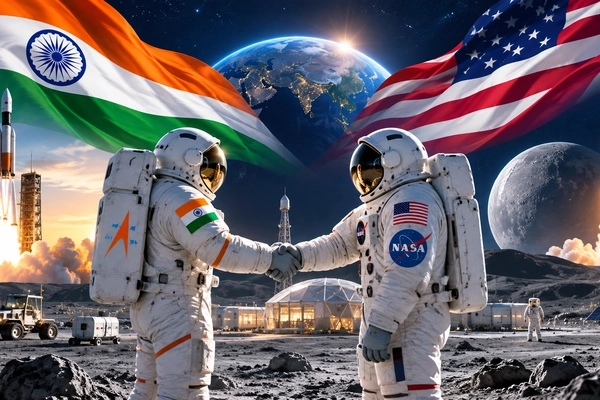
India and the United States are preparing to take their space partnership into a new phase, with NASA formally inviting ISRO to participate in its emerging Moon Base programme while Washington is simultaneously encouraging India’s rapidly expanding private space industry to pursue deeper opportunities in the American market.
The invitation was publicly highlighted again on September 7, 2026, when US Ambassador to India Sergio Gor addressed the Bengaluru Space Expo and said the United States wanted India alongside it as it worked toward a sustained human presence on the Moon. The invitation itself had been extended earlier. ISRO officially disclosed on August 12, 2026 that NASA had invited the Indian space agency to join the Moon Base programme during the ninth India-US Civil Space Joint Working Group meeting, held at ISRO Headquarters in Bengaluru on August 5 and 6.
Gor’s remarks at the Bengaluru Space Expo therefore represented a strong public reaffirmation of a proposal that had already entered formal bilateral discussions. The development could eventually bring India into a much wider lunar architecture than individual scientific missions, potentially involving technologies and infrastructure required for long-duration human operations on the lunar surface.
India already has significant lunar experience through the Chandrayaan programme. The success of Chandrayaan-3 in 2023, which made India the first country to achieve a soft landing close to the lunar south polar region, established the country’s capability in autonomous navigation, lunar descent, landing systems and surface operations. Participation in an international Moon Base programme could allow India to apply those capabilities to a broader effort aimed at sustained exploration.
The Moon Base invitation also reflects a wider transformation in India-US space cooperation. Speaking in Bengaluru, Gor described the relationship as increasingly moving beyond conventional cooperation toward co-creation, with both countries potentially working together on technologies, research and future exploration systems.
The same direction was visible during the August Civil Space Joint Working Group meeting. The discussions involved ISRO, NASA and other officials and focused on expanding civil and commercial cooperation under the US-India TRUST Initiative — Transforming the Relationship Utilizing Strategic Technology. ISRO said the two sides discussed future cooperation in science and human-spaceflight technologies while building on existing joint programmes.
One of the most important examples of that cooperation is the NASA-ISRO Synthetic Aperture Radar mission, or NISAR. The satellite was jointly developed by the two agencies and carries complementary L-band and S-band radar systems. It represents one of the most technically sophisticated joint projects ever undertaken by India and the United States in space.
NISAR is designed to measure changes across Earth’s surface with high precision, including movements associated with glaciers, forests, agriculture, earthquakes, landslides and other environmental processes. The programme required extensive cooperation between Indian and American engineers across spacecraft development, radar systems, launch preparations and mission operations.
That experience provides a useful model for future lunar cooperation. Rather than one country simply supplying hardware or services to the other, both sides contribute specialised technologies and engineering capabilities toward a common mission. A similar approach could eventually be adopted in areas connected with lunar surface infrastructure, science and human exploration.
India-US cooperation has also expanded into human spaceflight. The Axiom-4 mission, which carried Indian Air Force Group Captain and ISRO astronaut Shubhanshu Shukla to the International Space Station, marked another major step. Shukla became the first Indian astronaut to visit the ISS and participated in scientific investigations and technology demonstrations during the mission.
The experience was also important for India’s Gaganyaan human-spaceflight programme, giving Indian mission planners and scientists additional exposure to crewed orbital operations. Gor indicated that future cooperation could include areas such as docking standards, interoperability and astronaut training, all of which could become increasingly important if Indian spacecraft and astronauts eventually operate alongside American and other international systems.
Interoperability is particularly important in any future multinational lunar architecture. Spacecraft, docking mechanisms, communications networks and operational procedures must be capable of working together safely. Cooperation in these areas could therefore influence how India participates in future missions beyond low-Earth orbit.
Another major feature of Gor’s September 7 address was his direct message to India’s private space sector. He specifically highlighted companies such as Pixxel, GalaxEye, Digantara, Bellatrix Aerospace, Skyroot Aerospace and Agnikul Cosmos, while encouraging Indian space companies to pursue opportunities in the United States.
These companies represent the rapid diversification of India’s private space ecosystem. Skyroot Aerospace and Agnikul Cosmos are developing launch vehicles, while Pixxel is building advanced Earth-observation satellite constellations. GalaxEye is working on multi-sensor imaging satellites, Digantara is developing space-domain-awareness infrastructure, and Bellatrix Aerospace is building advanced satellite-propulsion systems.
Their growth illustrates how India’s space industry is moving beyond the traditional model in which private companies primarily supplied components to ISRO. Indian startups are increasingly designing complete launch vehicles, satellites, propulsion systems, sensors, software platforms and orbital services of their own.
Greater access to American customers, investors and technology partners could significantly expand the commercial opportunities available to these firms. It could also strengthen India’s role in global space supply chains and create possibilities for Indian startups to participate in programmes extending beyond Earth orbit.
This gives the India-US space relationship a broader dimension than government-to-government cooperation alone. For decades, bilateral space engagement was driven primarily by ISRO and NASA. India’s space-sector reforms and the opening of the industry to private companies have changed that structure.
ISRO now operates alongside IN-SPACe, which facilitates and regulates private space activity, and NewSpace India Limited, which commercialises Indian space capabilities. The Bengaluru Space Expo reflects this changing ecosystem by bringing together government agencies, established aerospace manufacturers, startups, investors and international companies.
As a result, India-US cooperation could increasingly develop along two parallel tracks. One could involve government-led programmes such as human spaceflight, lunar exploration, scientific missions and Earth observation. The other could involve private companies developing satellites, launch systems, propulsion, sensors, data services and other technologies for customers in both countries.
Over time, these two tracks could converge. Indian private companies that today work primarily in Earth orbit could eventually find opportunities in lunar communications, navigation, propulsion, logistics, surface systems or space infrastructure if commercial activity around the Moon expands.
India’s own lunar ambitions are also growing. The Chandrayaan missions have demonstrated the country’s ability to orbit, map and land on the Moon, while future programmes are expected to involve increasingly complex exploration technologies. India’s longer-term ambitions include advanced robotic missions, sample-return capabilities and eventual human activity beyond low-Earth orbit.
Cooperation with the United States could complement those indigenous efforts rather than replace them. India brings experience in cost-effective spacecraft development, lunar navigation, landing technologies, propulsion and deep-space communications, while the United States has extensive experience in crewed exploration, life-support systems, surface infrastructure and large-scale space logistics.
The most significant outcome would therefore be a partnership based on genuine technological collaboration rather than a simple supplier-customer relationship. ISRO’s participation in the Moon Base programme could become especially important if Indian technologies are incorporated into the systems and infrastructure required for sustained lunar operations.
At the same time, the present status should not be overstated. NASA’s invitation to ISRO is officially confirmed, but neither agency has yet announced exactly what India would contribute to the programme. There is currently no confirmed Indian lunar habitat, rover, astronaut mission, communications package or surface-infrastructure commitment attached to the invitation.
What makes the invitation important is its timing. India is being brought into discussions while the architecture for sustained international lunar activity is still evolving. That gives ISRO an opportunity to shape potential cooperation from an early stage rather than joining only after the major technical frameworks have already been decided.
India-US space cooperation has expanded rapidly in recent years. NISAR demonstrated that the two countries could jointly build a sophisticated scientific satellite. Axiom-4 extended the relationship into human spaceflight. The Civil Space Joint Working Group is now discussing future exploration, data sharing, interoperability and advanced technologies.
The Moon Base invitation potentially takes that progression another step forward. For India, it provides an opportunity to apply decades of indigenous space-engineering experience to a wider multinational exploration architecture. For the United States, India offers a mature space agency, a successful lunar programme and a fast-growing private space industry.
The September 7 remarks at the Bengaluru Space Expo therefore carry significance beyond diplomatic symbolism. They point toward a future in which ISRO, NASA and private companies from both countries could increasingly work together across Earth observation, human spaceflight and eventually sustained operations on the lunar surface.
The details still have to be negotiated, but the direction is becoming clearer. India-US space cooperation is moving beyond individual joint missions and toward a broader partnership that could influence the technologies, commercial networks and infrastructure shaping the next phase of lunar exploration.
You may also like
-
IIT Hyderabad Develops Lung-Derived Bioink for 3D Bioprinting and Regenerative Medicine
-
Indian Scientists Discover Molecular Switch That Can Regulate Cellular Autophagy
-
Scientists Map Earliest Glow of Hydrogen, Opening A New Window to the Universe
-
Indian Researchers Study RAD51 DNA-Repair Gene Variant in Prostate Cancer
-
TDB Backs Multi Nano Sense With ₹37.51 Crore to Build Indigenous Multi-Gas Sensor Platform
