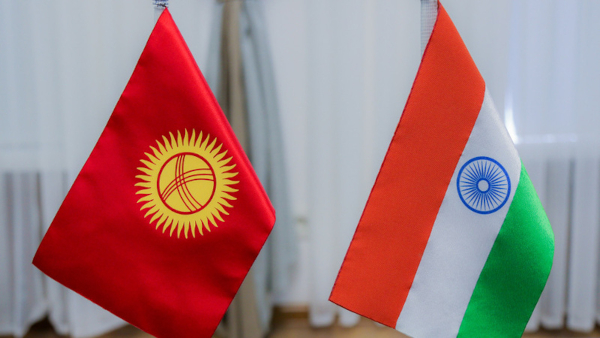
Prime Minister Narendra Modi met Kyrgyz President Sadyr Zhaparov in Bishkek on 31 August 2026, with the two leaders reviewing the India–Kyrgyz Republic Strategic Partnership and agreeing to expand economic, commercial, educational and cultural cooperation.
The bilateral meeting took place on the sidelines of the 26th Shanghai Cooperation Organisation Summit, hosted by the Kyrgyz Republic. The summit also coincided with Kyrgyzstan’s Independence Day, adding a symbolic dimension to Modi’s visit to Bishkek.
Modi congratulated President Zhaparov and the people of the Kyrgyz Republic on their Independence Day and also congratulated the Kyrgyz President on hosting the SCO Summit. The two leaders reviewed progress in bilateral relations and reaffirmed their commitment to further strengthening the strategic partnership between their countries.
India and Kyrgyzstan Look to Expand Economic Cooperation
Economic and commercial ties formed an important part of the discussions. Modi and Zhaparov agreed that the complementarities between the Indian and Kyrgyz economies provide opportunities for expanding bilateral commerce.
Although political relations between India and Kyrgyzstan have traditionally been warm, economic engagement remains relatively modest compared with the potential of the relationship. Bilateral trade reached a new high of approximately $116 million in 2024, according to the Indian Embassy in Bishkek, with Indian exports accounting for around $89 million and imports from Kyrgyzstan about $27 million.
This leaves considerable scope for deeper cooperation in areas such as pharmaceuticals, healthcare, information technology, agriculture and food processing, textiles, machinery, education and services.
Greater business-to-business interaction has consequently become an important objective. An India–Kyrgyz Business Forum organised in Bishkek in July 2025 brought together businesses from both countries to explore opportunities for increasing bilateral trade and investment.
The discussions between Modi and Zhaparov therefore reinforce an ongoing effort to give the economic component of the strategic partnership greater weight.
Strategic Partnership Dates Back to 2019
India and Kyrgyzstan established diplomatic relations in March 1992, shortly after the Kyrgyz Republic emerged as an independent state following the dissolution of the Soviet Union. The relationship was elevated to a Strategic Partnership in June 2019 during Modi’s official visit to Bishkek.
That visit produced a substantial expansion of the institutional framework for bilateral relations. The two sides signed agreements covering areas including investment, taxation, health, information technology and defence cooperation, while also adopting a roadmap for increasing trade and economic engagement.
India also announced a $200 million Line of Credit for development projects in the Kyrgyz Republic during the 2019 visit. The financing was intended to support priority sectors including connectivity, energy, information technology, healthcare, education and agriculture.
The two countries have since continued their high-level political consultations both bilaterally and through wider forums involving Central Asia.
Education Is One of the Strongest People-to-People Links
Education has developed into one of the most visible connections between the two societies. More than 15,000 Indian students are pursuing medical education in universities across the Kyrgyz Republic, according to information published by the Indian Embassy in Bishkek.
Indian students are present in several Kyrgyz cities, including Bishkek, Osh, Jalal-Abad, Kant and the Issyk-Kul region. The scale of this educational presence makes student welfare and academic cooperation an important dimension of the bilateral relationship.
The Indian Embassy continues to maintain dedicated mechanisms for students and updated its advisory for Indians seeking medical education in Kyrgyzstan in April 2026. Among other measures, students have been advised to verify universities and educational consultants carefully and register with the Indian authorities after arriving in the country.
Against this background, the decision by Modi and Zhaparov to place student exchanges and wider people-to-people contacts prominently on the agenda carries practical significance beyond conventional diplomatic engagement.
Cultural Connections Stretch Back to the Silk Route
India’s relationship with Kyrgyzstan also draws upon much older civilisational links between the Indian subcontinent and Central Asia. For centuries, trade routes connecting India with Central Asia carried not only merchandise but also religious ideas, artistic traditions and cultural influences.
The historical Silk Route provided channels through which Buddhism, philosophy, art and commerce moved between India and Central Asia. These older connections continue to form part of the cultural narrative underpinning present-day India–Kyrgyz relations.
Modern cultural cooperation encompasses music, dance, theatre, literature, archaeology, exhibitions, festivals, Yoga and academic exchanges. India has also established an India Study Centre at the National Library in Bishkek, which promotes Indian education and culture and provides instruction in areas including Hindi, English, Yoga and Kathak.
The agreement between Modi and Zhaparov to encourage further cultural collaboration therefore builds upon an existing institutional and historical foundation.
Defence and Security Form Another Important Pillar
India and Kyrgyzstan also maintain defence and security cooperation, although this area was not identified as a principal subject of the 31 August bilateral announcement.
Existing cooperation has included training of Kyrgyz military personnel at Indian institutions, military exchanges, joint exercises and biomedical research related to high-altitude environments.
One distinctive example is the Kyrgyz-India Mountain Biomedical Research Centre, which undertakes research into the physiological effects of high-altitude conditions. A high-altitude research facility associated with the project operates at more than 4,000 metres.
Both countries also share concerns over terrorism, extremism and narcotics trafficking, giving security cooperation a broader regional dimension.
Kyrgyzstan Is Important to India’s Central Asia Strategy
The relationship has importance beyond purely bilateral considerations because the Kyrgyz Republic occupies a strategically significant position in Central Asia.
India has increasingly sought deeper economic and political engagement with the five Central Asian republics—Kazakhstan, Kyrgyzstan, Tajikistan, Turkmenistan and Uzbekistan—through bilateral relationships as well as the India–Central Asia Dialogue and the India–Central Asia Summit process.
Central Asia is important to India for energy security, regional connectivity, counterterrorism cooperation, trade and access to Eurasian markets. However, India’s lack of a direct land connection with the region has historically constrained commercial ties.
New Delhi has therefore supported alternative connectivity routes linking India with Central Asia through Iran and other corridors, while simultaneously expanding digital, educational, financial and institutional links with Central Asian countries.
Kyrgyzstan’s location at the heart of Central Asia and its participation in the SCO make it an important component of this wider Indian engagement.
SCO Cooperation Reflects Growing Strategic Convergence
The meeting took place during an important year for the Shanghai Cooperation Organisation. The 26th SCO Summit marks the organisation’s 25th anniversary, while India has been a full SCO member since 2017.
During his visit, Modi was expected to present India’s priorities within the organisation around the themes of Security, Connectivity and Opportunity.
Kyrgyzstan’s chairmanship provided another platform for closer coordination between New Delhi and Bishkek. Modi specifically praised India’s strong participation in SCO meetings organised during the Kyrgyz chairmanship, describing this engagement as a reflection of the mutual trust and respect between the countries.
India and Kyrgyzstan have also established a programme of diplomatic cooperation for 2025–2027, providing for continued political consultations, exchanges of high-level visits and coordination on international and regional issues.
From Political Friendship to Greater Economic Substance
The main significance of the Modi–Zhaparov meeting lies in the attempt to translate an already friendly political relationship into broader economic and societal cooperation.
India and Kyrgyzstan already have an established strategic partnership, defence links, development cooperation, substantial educational connections and regular interaction through the SCO. The next phase of the relationship is increasingly focused on increasing trade, encouraging investment and creating stronger commercial networks between businesses in the two countries.
Education is likely to remain particularly important because the large community of Indian medical students in Kyrgyzstan has created one of India’s strongest people-to-people bridges anywhere in Central Asia.
The Bishkek meeting consequently brought together several strands of India’s Central Asian policy: strategic engagement, economic expansion, education, cultural diplomacy and multilateral cooperation through the SCO.
By reaffirming their Strategic Partnership and agreeing to deepen commercial and people-to-people ties, Modi and Zhaparov signalled that India and Kyrgyzstan intend to build a broader relationship in which economic cooperation increasingly complements their longstanding political and strategic friendship.
You may also like
-
US Double Standards in Foreign Policy: 16 Recent Cases Involving India, Russia, China and Global Trade
-
Indian Navy Vice Chief Inspects Japan’s Mogami-Class Stealth Frigate as India-Japan Shipbuilding Cooperation Expands
-
INS Trishul Arrives in UK for Exercise KONKAN 2026 as India and Royal Navy Expand Maritime Cooperation
-
INS Sahyadri Arrives in Russia for Exercise INDRA 2026 to Strengthen India-Russia Naval Cooperation
-
India and Qatar Deepen Strategic Partnership with Focus on Energy Security, Trade and West Asia
