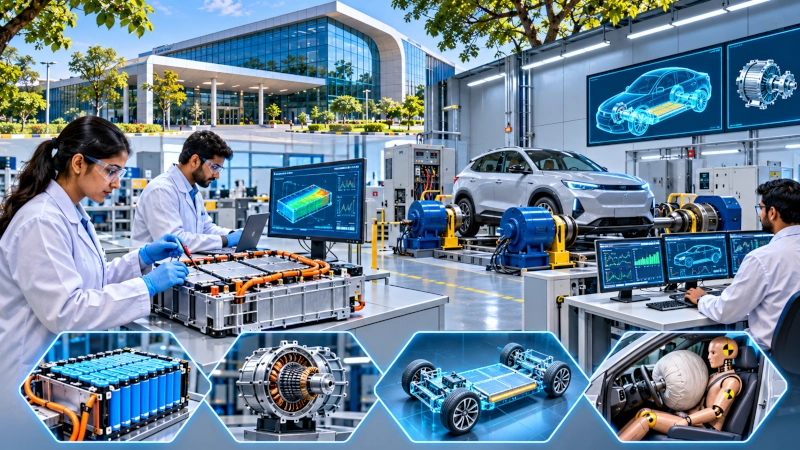
India has strengthened its automotive research and testing infrastructure with the inauguration of two advanced facilities at the Automotive Research Association of India (ARAI) in Pune, Maharashtra. Union Minister for Heavy Industries and Steel H. D. Kumaraswamy virtually inaugurated an Advanced Battery Laboratory and an Advanced Two-Dynamometer E-Axle and Electric Vehicle Powertrain Test Facility during the institution’s Diamond Jubilee celebrations, marking an important development in the country’s efforts to support electric mobility, advanced vehicle engineering and indigenous automotive technologies.
The newly inaugurated facilities are intended to expand India’s capabilities in battery performance evaluation, electric propulsion system development, technical validation and automotive safety testing. Their establishment reflects the increasing importance of specialised research infrastructure as India’s automobile industry transitions towards electric and hybrid vehicles while continuing to develop technologies that improve energy efficiency, reliability and environmental performance.
The Advanced Battery Laboratory has been established with an investment of approximately ₹55 crore, supported by the Ministry of Heavy Industries and ARAI under the second phase of the Scheme for Enhancement of Competitiveness in the Indian Capital Goods Sector. The laboratory will support the testing, validation and certification of automotive batteries, while the new powertrain facility will enable advanced evaluation of electric motors, integrated electric axles and associated propulsion systems.
The inauguration also formed part of a wider programme of automotive research and industrial cooperation, including an agreement relating to the development of an advanced crash-testing facility, the launch of a nationwide road safety outreach campaign and initiatives intended to strengthen collaboration between researchers, manufacturers and emerging automotive technology companies.
Advanced Battery Laboratory Strengthens India’s Domestic Testing Infrastructure
The establishment of the Advanced Battery Laboratory represents an important addition to India’s capabilities for testing and evaluating batteries used in electric vehicles. Modern battery systems are complex assemblies that must perform reliably under varying electrical, mechanical and environmental conditions, making specialised testing essential before their commercial deployment.
Electric vehicle batteries must be evaluated for safety, energy storage performance, durability and their behaviour under different operating conditions. These assessments help manufacturers understand whether battery systems can withstand the demands associated with vehicle operation while complying with applicable technical and safety requirements.
According to the Ministry of Heavy Industries, the new laboratory has been designed to support battery testing, design validation, safety evaluation and certification in accordance with existing and emerging national and international standards. The facility will also contribute to export compliance testing, enabling Indian manufacturers to assess whether their products satisfy technical requirements applicable in overseas markets.
These capabilities are particularly relevant as India’s automotive sector expands its production of electric two-wheelers, passenger vehicles, commercial vehicles and specialised electric mobility systems. Each vehicle category presents different requirements concerning battery capacity, operating conditions, thermal management and performance.
Reliable laboratory testing allows manufacturers to evaluate these requirements systematically and identify potential design limitations before incorporating battery systems into production vehicles. Such evaluations can contribute to improved product quality and help reduce the risks associated with inadequate battery performance or safety-related failures.
The availability of sophisticated domestic testing infrastructure may also reduce the need for Indian manufacturers to rely exclusively on overseas laboratories for certain development and certification activities. This could improve access to specialised facilities for domestic automotive companies, component suppliers and technology startups.
₹55-Crore Investment Supports Battery Research and Certification
The Advanced Battery Laboratory has been developed with an investment of approximately ₹55 crore under the Ministry of Heavy Industries’ programme for strengthening India’s capital goods sector.
The investment reflects the growing importance of developing domestic capabilities in technologies associated with electric mobility and energy storage. As battery systems become increasingly important to transportation and industrial applications, specialised research and certification facilities are necessary to support manufacturers working with different battery designs and technologies.
The laboratory is expected to provide infrastructure for evaluating battery characteristics and validating designs under controlled conditions. These activities are essential for identifying technical limitations, improving product reliability and establishing compliance with relevant standards.
Battery evaluation is particularly important because energy storage systems must combine several demanding requirements, including safety, efficient energy delivery, operational durability and predictable performance over extended periods.
Manufacturers also need to understand how battery systems behave under conditions that differ from ordinary laboratory environments, including changes in temperature, electrical load and repeated charging and discharging.
Access to domestic evaluation facilities can help engineering teams refine battery designs and improve their understanding of performance characteristics before undertaking large-scale commercial production.
The Ministry of Heavy Industries has identified advanced testing infrastructure as an important component of India’s efforts to strengthen automotive manufacturing and support the development of emerging mobility technologies.
New Electric Powertrain Facility to Support Advanced Propulsion Systems
Alongside the battery laboratory, ARAI inaugurated an Advanced Two-Dynamometer E-Axle and Electric Vehicle Powertrain Test Facility to support research, development and validation of electric propulsion technologies.
An electric vehicle powertrain consists of the components responsible for converting electrical energy into mechanical power and transmitting that power to the wheels. These systems typically involve electric motors, power electronics, control units and mechanical transmission components.
An electric axle, commonly referred to as an e-axle, integrates important elements of the propulsion system into a compact assembly. Such arrangements can help manufacturers develop electric drive systems suited to different vehicle architectures and performance requirements.
The new facility will provide testing infrastructure for examining the characteristics of electric propulsion systems under controlled operating conditions. The use of two dynamometers enables engineers to evaluate important mechanical parameters associated with the operation of electric drive units.
Dynamometers are specialised testing instruments used to measure characteristics such as torque, rotational speed and mechanical power. In automotive research, these measurements are essential for understanding how propulsion systems respond to different loads and operating requirements.
The ability to examine electric propulsion systems under controlled conditions can help engineers identify efficiency losses, assess mechanical performance and refine system configurations.
Such evaluations are particularly important for electric vehicles because motor efficiency, power electronics and drivetrain integration directly influence energy consumption and vehicle performance.
The facility is expected to support automotive manufacturers and technology developers working on next-generation electric drive systems, providing access to infrastructure required for advanced engineering evaluation and product development.
Importance of Integrated Battery and Powertrain Testing
Electric vehicles depend on the coordinated performance of their batteries, propulsion systems and electronic control units. Unlike conventional vehicles powered by internal combustion engines, battery electric vehicles require specialised systems to manage energy storage, power delivery and electric motor operation.
The battery provides the electrical energy required for propulsion, while the motor and associated power electronics convert this energy into mechanical movement. Efficient operation depends on the compatibility and performance of these interconnected systems.
Testing batteries and electric powertrains therefore represents an important part of the overall vehicle development process. Battery systems must supply energy reliably, while propulsion components must convert that energy efficiently across different operating conditions.
The establishment of advanced facilities for both technologies at ARAI provides manufacturers with opportunities to evaluate important aspects of electric vehicle performance within the domestic research ecosystem.
Such infrastructure can also support engineering efforts intended to improve vehicle efficiency, optimise component designs and enhance operational reliability.
For India, the development of specialised testing capabilities is relevant to the broader objective of strengthening indigenous technologies and improving the competitiveness of domestic automotive manufacturers.
As the electric mobility industry continues to evolve, access to reliable testing and validation infrastructure will remain essential for translating engineering innovations into commercially viable products.
Supporting India’s Automotive Component Manufacturers and Startups
India’s automotive industry includes a substantial network of manufacturers, component suppliers, engineering companies and specialised technology developers. These enterprises contribute to the production of conventional vehicles as well as emerging electric mobility systems.
The transition towards electric propulsion has created opportunities for businesses developing electric motors, battery management systems, power electronics, charging technologies and integrated drive units.
However, developing commercially reliable automotive components requires extensive testing and validation. Companies must demonstrate that their technologies meet applicable performance, safety and reliability requirements before being incorporated into vehicles.
Establishing advanced testing facilities independently can involve substantial financial investment, particularly for smaller manufacturers and research-intensive startups.
Institutions such as ARAI can help address this challenge by providing access to specialised engineering infrastructure and technical expertise.
The newly inaugurated facilities could therefore benefit a wider range of enterprises beyond established automobile manufacturers, including startups developing indigenous electric propulsion and energy storage technologies.
The availability of domestic research infrastructure may also encourage collaboration between automotive manufacturers, component suppliers, academic institutions and technology developers.
Such cooperation can help strengthen India’s automotive innovation ecosystem by connecting product development with testing, certification and industrial applications.
ARAI Plans Advanced Crash-Testing Facility With Skoda Auto Volkswagen India
The Diamond Jubilee programme also included the announcement of an agreement involving ARAI and Skoda Auto Volkswagen India Private Limited for the development of an Advanced Crash Test Facility.
The memorandum of understanding concerns the transfer of a land parcel intended to support the establishment of advanced vehicle crash-testing infrastructure.
The proposed facility is expected to expand India’s capabilities in evaluating vehicle safety, supporting regulatory compliance and conducting homologation activities.
Crash testing involves examining how a vehicle and its safety systems perform under specified collision conditions. These assessments help engineers evaluate structural behaviour, occupant protection and the effectiveness of equipment designed to reduce injury risks.
As automobile manufacturers introduce new materials, vehicle architectures and propulsion technologies, crash-testing requirements are becoming increasingly complex.
Battery electric vehicles present additional engineering considerations because their high-voltage battery systems and electrical components must be appropriately protected during collisions.
Advanced crash-testing infrastructure can help manufacturers examine these requirements and improve vehicle designs before commercial deployment.
According to the Ministry of Heavy Industries, the proposed facility is intended to support the implementation of the Bharat New Car Assessment Programme, evolving vehicle safety regulations and export homologation requirements.
The initiative could strengthen India’s domestic vehicle safety evaluation capabilities and reduce dependence on overseas facilities for selected testing requirements.
However, the agreement represents a step towards establishing the proposed infrastructure. The government announcement does not indicate that the Advanced Crash Test Facility has already been constructed or commissioned.
Strengthening Vehicle Safety and Regulatory Compliance
Vehicle safety has become an increasingly important consideration in automotive engineering as manufacturers develop new technologies and introduce more sophisticated systems.
Modern vehicles incorporate advanced structural materials, electronic safety equipment, sensors and other technologies designed to improve occupant protection and operational reliability.
Testing these systems requires specialised infrastructure capable of evaluating vehicle performance under controlled conditions.
The Bharat New Car Assessment Programme provides a structured framework for evaluating the crash safety of eligible passenger vehicles in India.
Advanced domestic testing facilities can assist manufacturers in assessing vehicle designs and understanding their performance against applicable safety requirements.
For companies planning to export vehicles, homologation and compliance testing are also essential because different international markets may apply distinct technical regulations.
The development of additional crash-testing infrastructure could therefore support both domestic safety objectives and the international competitiveness of Indian automotive manufacturers.
ARAI’s proposed collaboration with Skoda Auto Volkswagen India reflects the importance of cooperation between research institutions and industry in developing such facilities.
The initiative is particularly relevant as India’s automotive sector expands into electric vehicles, advanced driver assistance systems and increasingly sophisticated vehicle architectures.
ARAI Celebrates Six Decades of Automotive Research
The inauguration of the new facilities formed part of ARAI’s Diamond Jubilee celebrations, marking six decades since the institution was established in 1966.
Over the years, ARAI has developed into an important organisation supporting automotive research, testing, certification and technology development in India.
The institution has worked with automobile manufacturers, component suppliers, government authorities and research organisations across several areas of automotive engineering.
Its activities have contributed to the development and implementation of vehicle standards, emissions testing, safety evaluation and emerging automotive technologies.
During the Diamond Jubilee programme, ARAI highlighted its contributions to India’s automotive sector and outlined priorities for future technological development.
These priorities include sustainable mobility, advanced safety systems, electric propulsion and technologies associated with the next generation of vehicles.
The inauguration of the Advanced Battery Laboratory and electric powertrain testing facility demonstrates the institution’s continuing adaptation to changes taking place in automotive engineering.
As vehicle technologies become increasingly dependent on electronics, software, energy storage and advanced materials, research organisations must develop the facilities and expertise required to support new technical requirements.
The expansion of ARAI’s testing infrastructure reflects this transformation.
Government Emphasises Indigenous Automotive Innovation
Addressing the Diamond Jubilee programme, Union Minister H. D. Kumaraswamy highlighted the importance of research, innovation and advanced testing infrastructure in strengthening India’s automotive industry.
The Minister emphasised the contribution of ARAI to the development of domestic automotive capabilities and the need to support emerging technologies associated with sustainable mobility.
The newly inaugurated facilities are intended to strengthen India’s ability to evaluate advanced battery systems, electric propulsion technologies and vehicle performance using domestic infrastructure.
The government’s emphasis on indigenous testing capabilities is relevant to its broader objectives concerning advanced manufacturing, industrial competitiveness and technology development.
Automotive manufacturers increasingly require access to sophisticated laboratories capable of supporting engineering development and certification activities.
By expanding these capabilities within India, institutions such as ARAI can contribute to the availability of technical expertise and improve the infrastructure supporting domestic innovation.
The initiative also reflects the importance of sustained investment in research facilities as the automotive industry undergoes technological change.
Nationwide Road Safety Campaign Launched
ARAI also launched a nationwide Road Safety Outreach Campaign during the Diamond Jubilee celebrations.
The initiative is intended to improve public awareness of road safety and encourage responsible behaviour among road users.
The campaign will focus on educational activities, driver awareness and digital engagement intended to strengthen understanding of safe mobility practices.
Road safety involves several interconnected factors, including vehicle design, road infrastructure, driver behaviour, enforcement and public awareness.
Although advances in automotive technology can improve the safety characteristics of vehicles, responsible road use remains essential for reducing accidents and injuries.
The outreach campaign therefore complements ARAI’s research and testing activities by addressing the human and behavioural dimensions of road safety.
The Ministry of Heavy Industries highlighted the importance of treating road safety as a shared responsibility involving drivers, passengers, manufacturers and public authorities.
The initiative reflects ARAI’s broader role in supporting safe transportation through both technical research and public engagement.
SIAT 2028 to Promote International Automotive Research Collaboration
Another development announced during the programme was the launch of the Symposium on International Automotive Technology 2028.
SIAT is ARAI’s flagship international conference, providing a platform for interaction among automotive manufacturers, researchers, academic institutions and policymakers.
The symposium facilitates discussions on emerging technologies, engineering developments and the future direction of the mobility sector.
The 2028 edition is intended to continue this engagement as the global automotive industry experiences substantial technological transformation.
Electric mobility, advanced propulsion systems, vehicle safety, connected technologies and sustainable manufacturing are among the broad areas influencing future automotive research.
International conferences provide opportunities for technical experts to exchange knowledge, present research findings and explore potential collaborations.
Such engagement can support the development of domestic expertise while connecting Indian researchers and manufacturers with international technological developments.
The announcement of SIAT 2028 reflects ARAI’s continuing emphasis on research collaboration and participation in global discussions concerning advanced mobility.
ARAI Expands Innovation and Industry Partnerships
The Diamond Jubilee programme also marked the launch of the ARAI-Advanced Mobility Transformation and Innovation Foundation website.
The initiative is intended to strengthen connections between automotive research, industrial development and technology innovation.
Research institutions and innovation platforms can help emerging technologies progress from early-stage concepts to commercially viable products by providing technical expertise, testing facilities and opportunities for industrial collaboration.
Such support is particularly relevant to electric mobility, where new technologies must undergo extensive engineering validation before they can be introduced into commercial vehicles.
ARAI has also outlined plans to expand its testing infrastructure further through additional facilities addressing emerging industry requirements.
These include proposed advanced fire safety testing infrastructure intended to strengthen the evaluation of vehicle and component safety.
The planned facilities would complement ARAI’s existing capabilities and support future research activities.
However, these remain proposed developments and should be distinguished from the battery and electric powertrain facilities inaugurated on October 31.
India’s Automotive Testing Infrastructure Continues to Expand
The developments at ARAI form part of a wider effort to strengthen India’s automotive research and testing capabilities.
The Ministry of Heavy Industries has been supporting investments in specialised infrastructure for electric vehicles, advanced propulsion technologies, battery evaluation and vehicle safety.
In September 2026, the ministry highlighted the expansion of testing infrastructure at the Global Automotive Research Centre in Oragadam, Chennai, under the PM Electric Drive Revolution in Innovative Vehicle Enhancement scheme.
The programme includes facilities associated with battery testing, electromagnetic compatibility, electric powertrain evaluation, advanced driver assistance systems and crash safety.
These investments reflect the changing technical requirements of India’s automotive industry as manufacturers introduce increasingly complex vehicle systems.
Electric mobility, in particular, requires specialised research infrastructure because battery systems, electric propulsion components and advanced electronic controls differ substantially from conventional automotive technologies.
The development of multiple testing centres across India can help expand the availability of engineering expertise and provide manufacturers with access to specialised validation capabilities.
The facilities inaugurated at ARAI represent another contribution to this evolving research ecosystem.
Towards a Stronger Indigenous Electric Mobility Ecosystem
The inauguration of the Advanced Battery Laboratory and Advanced Two-Dynamometer E-Axle and Electric Vehicle Powertrain Test Facility represents a significant expansion of India’s automotive research infrastructure.
The ₹55-crore battery laboratory will support the testing, validation, safety assessment and certification of advanced battery technologies, while the new powertrain facility will strengthen capabilities for evaluating electric motors and integrated propulsion systems.
The proposed crash-testing facility and additional research initiatives could further expand India’s domestic capabilities in vehicle safety and advanced engineering.
Together, these developments reflect the increasing importance of specialised infrastructure in supporting the transition towards electric mobility.
For Indian automobile manufacturers, component suppliers, engineering companies and technology startups, access to reliable testing facilities can provide important support during product development and commercialisation.
The expansion of indigenous research capabilities is also relevant to the country’s long-term efforts to strengthen domestic manufacturing, improve vehicle safety and participate more effectively in international automotive markets.
As India’s automotive sector continues to evolve, the availability of advanced testing and certification infrastructure will remain essential for transforming innovative technologies into reliable commercial products.
The initiatives announced at ARAI on October 31 demonstrate the continuing investment being made in the research, engineering and industrial capabilities required to support India’s next generation of vehicles.
References
1. Ministry of Heavy Industries, Press Information Bureau, Government of India, 31 October 2026. Official announcement on Union Minister H. D. Kumaraswamy’s participation in ARAI’s Diamond Jubilee celebrations and the inauguration of the Advanced Battery Laboratory and Advanced Two-Dynamometer E-Axle and Electric Vehicle Powertrain Test Facility. The release also covers the proposed Advanced Crash Test Facility, nationwide Road Safety Outreach Campaign and SIAT 2028.
https://www.pib.gov.in/PressReleseDetailm.aspx?PRID=2330746
2. Ministry of Heavy Industries, Press Information Bureau, Government of India, 28 September 2026. Official announcement concerning the expansion of automotive testing infrastructure at the Global Automotive Research Centre in Chennai under the PM E-DRIVE programme.
https://www.pib.gov.in/PressReleaseIframePage.aspx?PRID=2315890
3. Ministry of Heavy Industries, Press Information Bureau, Government of India, 27 January 2026. Official announcement concerning SIAT 2026 and ARAI’s contribution to automotive research, testing infrastructure and technology development.
https://www.pib.gov.in/PressReleasePage.aspx?PRID=2219263
4. Ministry of Heavy Industries, Press Information Bureau, Government of India, December 2024. Year End Review 2024, providing background on initiatives supporting advanced automotive testing, indigenous technology development and electric mobility research.
https://www.pib.gov.in/Pressreleaseshare.aspx?PRID=2085938
You may also like
-
Centre Approves ₹710 Crore for 509 Km of Rural Roads in Mizoram, Connecting 48 Habitations for First Time
-
India Plans EV Charging and Battery-Swapping Stations on Panchayat Land to Expand Rural Electric Mobility
-
India Launches DEPA Framework to Enable Secure AI Training While Protecting Data Sovereignty
-
Sun Pharma Reportedly Secures Indian Regulatory Approval for Generic Oral Semaglutide Tablets
-
India’s Startup Ecosystem Expands as Technology Companies Gain Greater Access to Public Capital Markets
