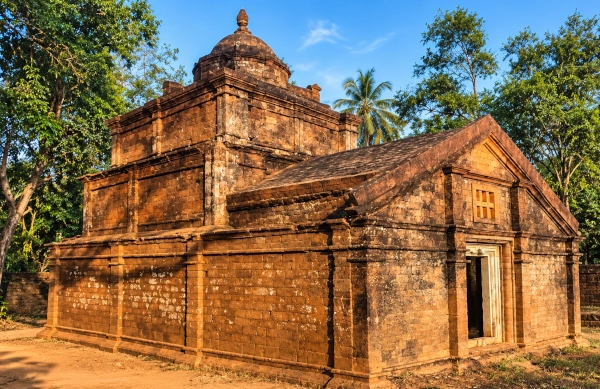
Important archaeological remains dating from roughly the 14th to the 16th centuries have emerged during restoration work at the historic Shree Saptakoteshwar Temple site at Divar in Goa, adding a new physical layer to the history of one of the state’s important sacred landscapes.
The discovery has been officially acknowledged by Goa Chief Minister Dr Pramod Sawant and was subsequently reported by Akashvani News on September 4, 2026. According to the official account, relics and structural remains were found along the old pathway connecting Koti Tirth and Madhavachi Talli. Their location suggests that the ancient religious complex extended beyond a single shrine and may once have included a broader sacred corridor.
Among the most notable objects is a Kirtimukh, the stylised protective face commonly incorporated into Indian temple architecture, particularly above entrances and architectural openings. Archaeologists have also identified the carved capital of a temple pillar and portions of a Dev Khostam or Devakoshta, an architectural feature associated with the placement of sacred images.
The importance of the discovery lies not merely in the age of individual fragments but in what they reveal about the evolution of the site. According to the official account, differences in stone types and architectural motifs indicate successive phases of construction and reconstruction during the Vijayanagara period, following the destruction of an earlier temple associated with the Kadamba period. The remains therefore provide archaeological evidence that can help researchers reconstruct the chronology of religious activity at Divar over several centuries.
Saptakoteshwar has a particularly important place in Goa’s temple heritage. The Government of Goa describes the present Saptakoteshwar temple at Narve in Bicholim as a protected archaeological site and a major heritage-conservation project. Official records also emphasise that the historical importance of Saptakoteshwar extends beyond the standing temple itself to the surrounding remains, antiquities, tanks, arcades and other elements of its sacred landscape.
That distinction is significant. The latest finds are associated with the historic site at Divar, while the surviving and restored Saptakoteshwar temple stands at Narve. The religious history of the deity therefore reflects both the earlier sacred landscape of Divar and the later continuation of worship elsewhere in Goa.
The newly uncovered remains have surfaced as the state proceeds with the Koti Tirth Corridor project. The Goa State Infrastructure Development Corporation formally invited specialist architectural and consultancy firms in March 2026 for the planning and design of the corridor at the Saptakoteshwar site in Divar, Tiswadi. The official document specifically sought firms experienced in heritage structures, religious buildings, monuments, museums and heritage corridors.
The scale of the government’s plans is also reflected in Goa’s 2026–27 Budget, which lists the development of the Koti Tirth Corridor at Shree Saptakoteshwar, Divar, at an estimated cost of ₹50 crore.
The discovery could consequently influence how the corridor itself is developed. Archaeological remains found during infrastructure or restoration work require careful documentation because their position, construction material and relationship with surrounding structures can reveal as much as the artefacts themselves. Preserving the archaeological context will therefore be important as conservation and visitor infrastructure advance.
For Goa, the finds provide rare physical evidence connecting different chapters of its medieval history. The Kadamba and Vijayanagara phases, later destruction and reconstruction, and the continued religious importance of Saptakoteshwar together show how sacred sites could survive major political transformations even when their buildings changed or disappeared.
What appeared initially to be the restoration of a historic pilgrimage landscape has therefore begun revealing something larger: traces of an extensive temple environment that had remained beneath and around the old route between Koti Tirth and Madhavachi Talli. Further archaeological study could establish the precise dates, architectural phases and original arrangement of the structures.
The discovery is authentic and officially corroborated. Akashvani’s September 4 bulletin independently records the same relics, dating range and archaeological interpretation announced by the Goa government. The existence and active development of the Koti Tirth Corridor are separately confirmed by official Government of Goa and GSIDC documents.
Official references
Akashvani News — Archaeological discoveries at Shree Saptakoteshwar Temple, 4 September 2026
Government of Goa — Restoration of Shri Saptakoteshwar Temple and heritage background
GSIDC — Official Koti Tirth Corridor Expression of Interest, March 2026
Government of Goa — 2026–27 Budget Speech listing ₹50-crore Koti Tirth Corridor project
You may also like
-
Gandhara: The Northwestern Kingdom of Gandhari and Shakuni in the Mahabharata
-
Kekaya or Kaikeya: The Western Punjab Kingdom Divided by the Kurukshetra War
-
Madra: The Ancient Punjab Kingdom of Shalya and Madri in the Mahabharata
-
BRICS Theatre Festival 2026 Opens in New Delhi, Bringing Together Nine Nations to Strengthen Cultural Cooperation
-
Sauvira: The Indus Realm Linked With Jayadratha in the Mahabharata
