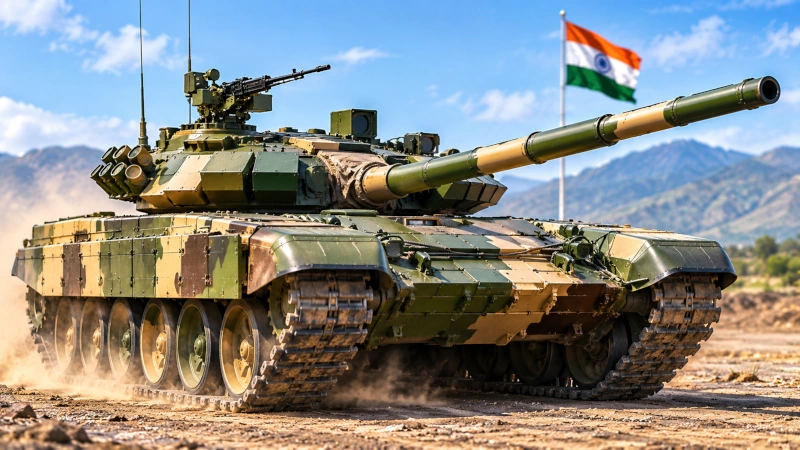
Armoured Vehicles Nigam Limited (AVNL), a Defence Public Sector Undertaking under the Ministry of Defence, has showcased an upgraded version of the Indian Army’s T-72 Ajeya main battle tank equipped with a powerful 1,000-horsepower engine. The upgraded configuration, highlighted in reporting on the company’s 2025–26 Annual Report, represents an important development in India’s efforts to modernise its existing armoured vehicle fleet through improvements in mobility, automotive performance and domestic manufacturing capabilities.
The upgraded tank replaces the existing 780 HP powerpack with a 1,000 HP engine, representing an increase of approximately 28 percent in engine output. With a reported combat weight of around 44 tonnes, the improved configuration delivers a power-to-weight ratio of approximately 22.7 horsepower per tonne, providing greater power availability for acceleration, manoeuvring and operations across challenging terrain. The development builds upon AVNL’s established capabilities in manufacturing, overhauling and upgrading armoured fighting vehicles at its production facilities in Avadi, Tamil Nadu.
Powerful 1,000 HP Engine Enhances Battlefield Mobility
The principal improvement in the upgraded T-72 Ajeya is its higher-output engine, which provides substantially greater power than the 780 HP diesel engine fitted to the existing configuration. The additional power is intended to improve the tank’s mobility and responsiveness, particularly during demanding battlefield manoeuvres and operations involving steep gradients, uneven surfaces and difficult terrain.
The upgraded vehicle has a reported combat weight of approximately 44 tonnes, resulting in a power-to-weight ratio of around 22.7 HP per tonne. By comparison, a 44-tonne tank equipped with the original 780 HP engine would have a ratio of approximately 17.7 HP per tonne. The increase provides additional engine power relative to vehicle weight, an important consideration for the mobility of tracked armoured vehicles.
Power-to-weight ratio is a significant measure of tank performance because it influences acceleration, responsiveness and the ability to maintain movement under demanding conditions. A more powerful engine can help compensate for increases in vehicle weight resulting from additional protective equipment, electronic systems and other modifications introduced during successive modernisation programmes.
The upgraded configuration also incorporates improvements to associated automotive components, according to the November 5 report. These modifications are important because engine performance must be matched by the capabilities of the transmission, cooling system, suspension and running gear to deliver effective improvements in battlefield mobility.
The modernisation reflects an approach to extending the operational usefulness of existing armoured platforms through targeted improvements rather than relying exclusively on the acquisition of entirely new vehicles.
Modernising the Indian Army’s T-72 Ajeya Fleet
The T-72 Ajeya has served as an important component of the Indian Army’s armoured formations for several decades. Developed from the Soviet-origin T-72 main battle tank, the platform entered Indian service during the early 1980s and subsequently became a major element of the country’s mechanised warfare capabilities.
India established domestic production and overhaul capabilities for the T-72 at the Heavy Vehicles Factory in Avadi, creating an industrial foundation for supporting the tank throughout its operational service. AVNL’s official records identify the rollout of the Ajeya from the Heavy Vehicles Factory in 1984, marking an important milestone in India’s armoured vehicle manufacturing history.
Over successive decades, the T-72 fleet has undergone maintenance, refurbishment and modernisation activities intended to sustain operational availability and improve performance. These efforts have included upgrades to automotive systems and other equipment, enabling the platform to remain part of India’s armoured inventory.
The latest powerpack upgrade addresses one of the important requirements associated with ageing armoured platforms: maintaining mobility as operational demands and equipment configurations evolve. A higher-output engine can provide additional performance margins while supporting the continued use of a familiar and well-established vehicle platform.
Modernisation of existing tanks also allows the Armed Forces to make continued use of established maintenance infrastructure, engineering expertise and trained personnel. This approach can complement the introduction of newer armoured platforms while supporting the operational requirements of existing mechanised formations.
Ministry of Defence’s $248 Million Engine Contract Supports T-72 Modernisation
The upgraded T-72 configuration is closely associated with a wider programme to improve the mobility of the Indian Army’s existing tank fleet. On March 7, 2025, the Ministry of Defence announced a contract worth $248 million with Russia’s Rosoboronexport for the procurement of 1,000 HP engines intended for T-72 tanks.
The agreement provides for the supply of engines in fully assembled, completely knocked-down and semi-knocked-down configurations. Importantly, it also includes the transfer of technology to Armoured Vehicles Nigam Limited’s Heavy Vehicles Factory at Avadi for engine integration and subsequent licensed production.
According to the Ministry of Defence, replacing the existing 780 HP engines with 1,000 HP powerpacks is intended to improve the battlefield mobility and offensive capabilities of the Indian Army’s T-72 fleet. The programme therefore addresses a major automotive requirement while strengthening India’s industrial capabilities in armoured vehicle propulsion systems.
The technology-transfer provisions are particularly significant because they establish a framework for developing domestic expertise in assembling and manufacturing advanced tank engines. Such capabilities are essential for supporting long-term fleet maintenance, replacement requirements and future improvements to armoured vehicle powertrains.
The March 2025 agreement represents a confirmed government procurement programme supporting T-72 engine modernisation. AVNL’s showcased upgraded tank demonstrates progress in this technological area, although the available official information does not establish a specific production or induction schedule for the newly reported vehicle configuration.
AVNL’s Long-Term Development Programme
AVNL’s work on the 1,000 HP T-72 powerpack predates the latest announcement. The company’s 2023–24 Annual Report documented the development of prototypes for upgrading T-72 tanks from 780 HP to 1,000 HP, with the project progressing through user trials and associated development activities.
The company’s subsequent 2024–25 Annual Report identified the uprating of the T-72 engine among three major research and development projects successfully completed during the preceding three years. The other projects included the development of a 6×6 mine-protected vehicle and an armament upgrade for the BMP-II infantry combat vehicle.
These developments demonstrate AVNL’s continuing involvement in modernising existing military platforms while developing additional capabilities in armoured vehicle engineering. Its work encompasses the integration of improved powertrains, automotive systems and other equipment required to sustain and enhance the performance of military vehicles.
The upgraded T-72 showcased in the latest reporting represents a continuation of this established development programme. The presentation of a vehicle configuration incorporating the higher-output engine illustrates how the company’s research and engineering activities are being applied to an existing main battle tank platform.
AVNL’s ability to undertake these modifications domestically is important for India’s defence manufacturing ecosystem, particularly because the Army operates substantial numbers of armoured vehicles requiring continuous technical support and periodic modernisation.
Heavy Vehicles Factory Avadi Strengthens Indigenous Tank Engineering
The Heavy Vehicles Factory at Avadi has played a central role in India’s armoured vehicle manufacturing and maintenance capabilities. The facility has been associated with the production, overhaul and modernisation of several important tank platforms, including the T-72 Ajeya, T-90 Bhishma and Arjun main battle tank.
As part of AVNL’s industrial network, the facility provides specialised manufacturing and engineering capabilities for integrating complex automotive, mechanical and armoured vehicle systems. The development of higher-output tank engines and their integration into existing platforms builds upon this established technical infrastructure.
The transfer of technology associated with the March 2025 engine procurement agreement is expected to strengthen these capabilities further. Domestic production and integration of tank engines can help improve technical support arrangements, develop specialised manufacturing expertise and strengthen the long-term sustainability of India’s armoured vehicle fleet.
Engine modernisation also involves supporting industrial activities in precision manufacturing, materials engineering, machining, testing and quality assurance. Expanding domestic expertise in these fields contributes to a broader manufacturing ecosystem capable of supporting sophisticated military vehicles.
AVNL’s continuing efforts in armoured vehicle development align with the Government of India’s Atmanirbhar Bharat initiative, which emphasises indigenous manufacturing and reducing dependence on imported defence equipment. The development of domestic tank engine capabilities represents an important component of this objective.
Improving Operational Performance Across Challenging Terrain
The mobility of a main battle tank depends on the effective integration of engine power, transmission efficiency, suspension performance, track characteristics and overall vehicle weight. Improvements in engine output can contribute to enhanced acceleration and manoeuvring capability, particularly when operating across difficult terrain or carrying additional equipment.
For the Indian Army, armoured vehicle mobility is an important requirement in the varied environments where mechanised formations may operate. Desert landscapes, uneven ground and other challenging conditions place substantial demands on propulsion and automotive systems, making power availability a significant factor in operational performance.
The upgraded T-72’s increased engine output provides additional power for overcoming these demands. The improvement is especially relevant to an established tank platform that has undergone successive modifications during its service life, as additional equipment and protective systems can increase weight and place greater demands on the powertrain.
The reported improvements to associated automotive components are also important for ensuring that the additional engine output can be effectively utilised. A well-integrated powertrain supports reliable vehicle movement and contributes to the overall responsiveness of armoured formations during tactical manoeuvres.
By focusing on propulsion and mobility improvements, AVNL’s T-72 upgrade addresses an important aspect of sustaining the operational usefulness of India’s existing tank inventory.
Advancing India’s Armoured Vehicle Modernisation
The presentation of the upgraded T-72 Ajeya with a 1,000 HP engine represents an important development in India’s continuing efforts to improve the performance of its existing armoured fighting vehicles. The higher-output powerpack offers a substantial increase in engine power, while the reported automotive improvements support the broader objective of enhancing battlefield mobility.
The programme also highlights the role of Armoured Vehicles Nigam Limited in developing and integrating technologies required for the maintenance and modernisation of India’s military vehicle fleet. Its work at Avadi, supported by the Ministry of Defence’s engine procurement and technology-transfer arrangements, contributes to the development of domestic expertise in specialised tank propulsion systems.
The November 2026 reporting establishes that AVNL has showcased an upgraded configuration, while official documentation confirms the earlier development programme and the government’s commitment to procuring higher-output engines. Fleet-wide induction of the newly showcased configuration has not been separately announced.
By strengthening the mobility of the T-72 Ajeya and expanding domestic capabilities in armoured vehicle engineering, the programme contributes to India’s broader objective of maintaining a capable, modern and increasingly self-reliant mechanised force.
You may also like
-
India’s Startup Revolution Enters a New Era as Growing Number of Companies Achieve Profitability
-
BITS Hyderabad Startup Beijan Develops Indigenous GPS-Independent Drone Navigation Technology for Indian Army
-
CFF Fluid Control and Germany’s TKMS Partner for Anti-Submarine Warfare Manufacturing
-
Martin-Baker Plans ₹380 Crore Ejection Seat Manufacturing Facility in Karnataka
-
Tonbo Imaging Plans High-Power Microwave Manufacturing and Testing Facilities in Karnataka
