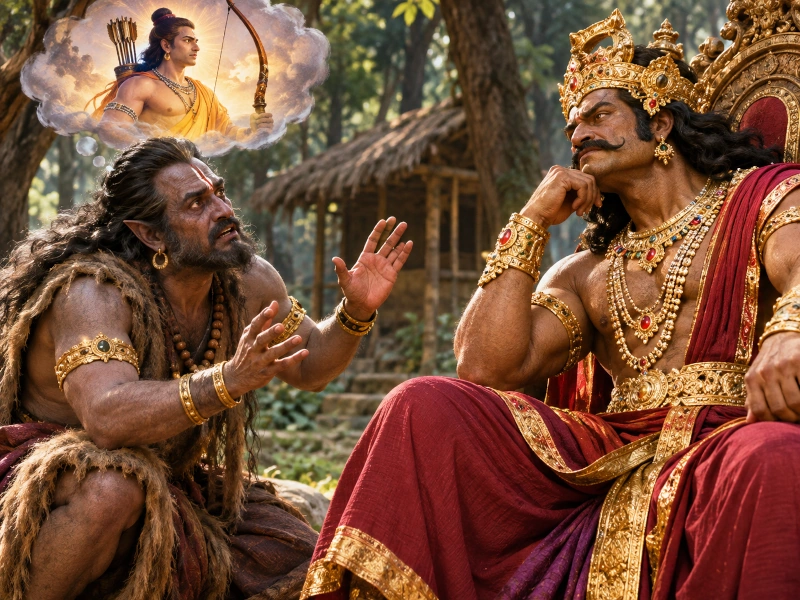
Ramayana Diplomacy Series | Vālmīki Rāmāyaṇa | Araṇya Kāṇḍa, Sargas 36–40
Introduction: When Political Authority Rejects Strategic Wisdom
The Vālmīki Rāmāyaṇa offers profound insights into political leadership, diplomacy, military intelligence and the responsibilities of those entrusted with governing powerful kingdoms. Among its most significant episodes of strategic consultation is the conversation between Rāvaṇa, the ruler of Laṅkā, and Mārīca, an experienced Rākṣasa who possessed firsthand knowledge of Rāma’s extraordinary military capabilities. Described in the Araṇya Kāṇḍa, particularly Sargas 36–40, their exchanges demonstrate how informed strategic advice can be rendered ineffective when political leadership becomes unwilling to reconsider a predetermined course of action.
Rāvaṇa approached Mārīca seeking assistance in a deception designed to facilitate the abduction of Sītā. Mārīca, however, recognised that the proposed operation would provoke an adversary whose military strength had already been demonstrated through repeated encounters. Rather than supporting the king’s intentions, he warned Rāvaṇa against confronting Rāma and explained why such an undertaking could ultimately threaten the security of Laṅkā itself. The central strategic lesson of this episode is that the possession of political authority does not guarantee sound judgment, particularly when leaders disregard intelligence that contradicts their personal ambitions.
The episode also raises an enduring question in political and military affairs: what happens when an experienced adviser recognises a dangerous course of action but the ruler refuses to listen? Through Mārīca’s warnings and Rāvaṇa’s response, the Rāmāyaṇa explores the relationship between knowledge, power, obedience and the potentially disastrous consequences of strategic miscalculation.
The Political Background: Rāvaṇa’s Decision to Confront Rāma
The circumstances leading to Rāvaṇa’s consultation with Mārīca arose from the destruction of the Rākṣasa forces commanded by Khara and Dūṣaṇa in the Daṇḍaka forest. Rāma had defeated these powerful warriors and their accompanying forces, demonstrating extraordinary combat proficiency despite living in exile without the conventional military resources of Ayodhyā. The defeat represented a serious indication of Rāma’s military strength, one that demanded careful consideration before any further confrontation.
Rāvaṇa, however, interpreted the situation through the combined influences of personal desire, anger and wounded prestige. Rather than examining the military implications of Rāma’s victory, he resolved to abduct Sītā. His decision was not directed towards protecting Laṅkā from an immediate threat or securing an essential political objective. Instead, it was a personal undertaking whose consequences could extend far beyond the individual participants. One of the fundamental principles of responsible statecraft is that the personal objectives of a ruler must never be confused with the strategic interests of the state.
Recognising that a direct confrontation with Rāma could prove dangerous, Rāvaṇa devised an indirect operation intended to separate Rāma from Sītā. He wanted Mārīca to assume the appearance of a magnificent golden deer and appear near the forest dwelling occupied by Rāma, Sītā and Lakṣmaṇa. The unusual beauty of the animal was expected to attract Sītā’s attention and persuade Rāma to pursue it, creating an opportunity for Rāvaṇa to carry out the abduction.
The proposed operation relied upon deception, diversion and the exploitation of a temporary separation between the intended victim and her protectors. Although the plan demonstrated an understanding of indirect methods, it contained a fundamental strategic weakness. Rāvaṇa concentrated upon the immediate objective of abducting Sītā without adequately considering how Rāma would respond once the deception was discovered. A military or intelligence operation cannot be considered strategically successful merely because it achieves its immediate objective; its long-term consequences must also serve the interests of the state.
Mārīca’s First Warning: The Importance of Accurate Threat Assessment
Mārīca’s response to Rāvaṇa was shaped by his direct experience of Rāma’s abilities. During an earlier encounter, Mārīca had attempted to disrupt the sacrifice conducted by Sage Viśvāmitra, only to be struck by an arrow released by the young Rāma. The force of the attack had thrown him an enormous distance, leaving him with a lasting understanding of the extraordinary power possessed by his opponent.
In the conversations described in Araṇya Kāṇḍa, Mārīca reminded Rāvaṇa of this experience and explained why Rāma should not be underestimated. He understood that Rāma’s residence in the forest, his lack of a royal entourage and his apparent isolation did not diminish his combat capabilities. Although Rāma was living as an exile, his demonstrated ability to defeat powerful opponents made him an exceptionally dangerous adversary.
Mārīca’s assessment illustrates the difference between political appearances and military realities. A ruler relying upon conventional indicators of power might assume that an exiled prince without an army presented little danger. Mārīca, however, evaluated Rāma according to his demonstrated battlefield performance rather than his immediate political circumstances. Effective strategic intelligence requires an assessment of an adversary’s actual capabilities, operational experience and demonstrated effectiveness rather than assumptions based upon status, resources or appearances.
This distinction remains central to military planning. States frequently evaluate opponents according to conventional military strength, territorial control, economic resources and technological capabilities. While these factors are important, they do not necessarily provide a complete understanding of an adversary’s capacity to impose costs or achieve decisive results. Mārīca’s warning demonstrates the importance of incorporating firsthand operational experience into strategic assessments, particularly when such experience challenges assumptions held by political leadership.
The Second Warning: Understanding the Consequences of Escalation
Mārīca’s warnings went beyond describing Rāma’s personal combat abilities. He recognised that the proposed abduction could generate a chain of events extending well beyond the immediate operation. Having experienced Rāma’s strength during more than one encounter, Mārīca understood that provoking him would create a conflict whose eventual consequences could be devastating for Rāvaṇa and the Rākṣasas.
In Araṇya Kāṇḍa, Sarga 39, Mārīca recalls another confrontation in which he and two companions attempted to attack Rāma while assuming the appearance of animals. Rāma’s response again demonstrated his extraordinary archery skills. Mārīca escaped, but his companions were killed. This second experience reinforced his conviction that Rāma was not an adversary who could be approached through ordinary calculations of strength.
Mārīca consequently urged Rāvaṇa to abandon the plan and preserve the peace and prosperity he already enjoyed in Laṅkā. His argument was grounded in the recognition that the proposed operation offered no comparable national advantage to justify the risks involved. Rāvaṇa already possessed a powerful kingdom, considerable resources and established political authority. By pursuing Sītā’s abduction, he would expose these advantages to danger without securing an objective essential to the kingdom’s survival.
The strategic significance of Mārīca’s warning lies in his understanding that escalation must be evaluated according to the relationship between anticipated gains and potential losses. A ruler who initiates confrontation without considering the adversary’s response may transform a limited objective into a conflict that threatens the entire state.
The distinction between tactical achievement and strategic success becomes particularly important in this context. Rāvaṇa’s deception might succeed in separating Sītā from Rāma, but the operation would not eliminate Rāma’s determination or ability to respond. Mārīca recognised this contradiction and attempted to explain that the apparent success of the immediate operation could become the beginning of a much greater disaster.
Political Leadership and the Rejection of Inconvenient Intelligence
The most revealing aspect of the episode emerges when Rāvaṇa refuses to accept Mārīca’s assessment. Despite receiving detailed warnings concerning Rāma’s capabilities and the dangers of confrontation, the king remains determined to proceed with his plan. Rather than treating Mārīca’s experience as valuable strategic intelligence, he regards the advice as an obstacle to the implementation of his wishes.
In Araṇya Kāṇḍa, Sarga 40, Rāvaṇa dismisses Mārīca’s arguments and makes clear that he expects obedience rather than further discussion. His position reflects a fundamental misunderstanding of the purpose of strategic consultation. Advisers are valuable precisely because they can identify weaknesses in proposed policies, question assumptions and provide information that political leaders may not otherwise possess.
A ruler who seeks advice only after reaching an irreversible decision reduces consultation to a formality. Under such circumstances, the function of advisers shifts from evaluating policy to implementing instructions. The greatest failure of intelligence is not always the inability to obtain accurate information; it can also arise when political leadership possesses reliable intelligence but refuses to incorporate it into strategic decisions.
Rāvaṇa’s conduct demonstrates how personal certainty can become a serious weakness in political leadership. His position as ruler of Laṅkā gave him extensive authority over military and administrative affairs, but that authority did not eliminate the need for informed judgment. By rejecting Mārīca’s warnings, he effectively subordinated strategic analysis to personal determination.
The episode illustrates an important distinction between decisiveness and inflexibility. Decisive leadership requires the capacity to evaluate competing assessments and act upon available evidence. Inflexible leadership, by contrast, treats reconsideration as weakness and interprets disagreement as resistance. Strong political leadership is not defined by the refusal to change a decision, but by the ability to distinguish between necessary determination and dangerous strategic rigidity.
From Strategic Consultation to Coercion
The deterioration of the conversation becomes particularly significant when Rāvaṇa threatens Mārīca with death if he refuses to assist in the abduction. What began as a request for assistance becomes an exercise in coercive authority. Mārīca is no longer permitted to function as an independent adviser whose knowledge can influence the ruler’s decision. Instead, he is compelled to participate in an operation whose dangers he has already explained.
This transformation reveals the destructive relationship between fear and strategic decision-making. When rulers punish disagreement, advisers may become reluctant to communicate inconvenient facts. Military commanders may hesitate to report operational weaknesses, intelligence officers may avoid challenging prevailing assumptions, and administrative officials may gradually replace independent assessments with statements designed to satisfy political expectations.
The result is an environment in which the appearance of unity conceals the deterioration of decision-making. Orders may be implemented efficiently, but the underlying policies may remain strategically unsound. A political system that demands unquestioning obedience from its advisers risks losing the very intelligence, judgment and institutional independence required to preserve national security.
Mārīca’s predicament demonstrates this danger with particular clarity. He possessed the experience necessary to identify the weaknesses in Rāvaṇa’s plan, yet the king’s threat deprived him of the freedom to act upon that knowledge. The ruler retained control over the immediate decision but destroyed the possibility of genuine strategic consultation.
The episode also highlights the importance of distinguishing loyalty from agreement. An adviser who warns a ruler against a dangerous decision may be acting in the interests of the kingdom rather than opposing its leadership. Mārīca’s warnings were intended to prevent Rāvaṇa from undertaking an action that could endanger Laṅkā. In responsible statecraft, the willingness to communicate difficult truths is an essential form of loyalty, while unquestioning agreement can become a source of national vulnerability.
Mārīca’s Final Decision: Compliance Without Strategic Agreement
Faced with Rāvaṇa’s determination and the threat of immediate death, Mārīca ultimately agrees to participate in the operation. His decision, however, does not indicate that he has accepted the wisdom of the king’s plan. On the contrary, he continues to recognise the danger and understands that confronting Rāma may result in his own destruction.
Mārīca’s eventual participation reveals a distinction between operational compliance and strategic conviction. A subordinate may execute an order because political or military authority leaves no alternative, even when the subordinate believes that the order will produce disastrous consequences. Rāvaṇa interprets Mārīca’s compliance as sufficient to proceed, but the underlying strategic objections remain unresolved.
The subsequent events of the Araṇya Kāṇḍa confirm the immediate consequences of this decision. Mārīca assumes the appearance of the golden deer and attracts Sītā’s attention. Rāma pursues the animal and eventually strikes Mārīca with an arrow. Before dying, Mārīca imitates Rāma’s voice and calls out in a manner that contributes to Lakṣmaṇa’s departure from the forest dwelling. Rāvaṇa then exploits the resulting circumstances to abduct Sītā.
The operation therefore succeeds in achieving its immediate objective. Yet that success proves strategically disastrous because it initiates the sequence of events that ultimately brings Rāma into direct conflict with Laṅkā. Mārīca’s participation demonstrates that the successful execution of a flawed political decision does not transform it into a sound strategy. Operational effectiveness cannot compensate for an objective that undermines the long-term security of the state.
The episode also illustrates the limitations of command authority. Rāvaṇa could compel Mārīca to carry out the deception, but he could not alter the realities that made the undertaking dangerous. Political power could secure obedience, yet it could not eliminate the consequences of strategic miscalculation.
Diplomatic Significance: Personal Ambition Versus National Interest
The conversation between Rāvaṇa and Mārīca offers a particularly important lesson concerning the distinction between the personal objectives of political leaders and the broader interests of the states they govern. Rāvaṇa’s intention to abduct Sītā arose from personal motivations, but the resulting consequences were borne by the kingdom of Laṅkā, its warriors and its people.
Mārīca attempted to redirect the king’s attention towards these wider implications. His warnings encouraged Rāvaṇa to consider the military strength of the intended adversary, the consequences of provoking him and the potential destruction that could follow. In doing so, Mārīca was effectively arguing that the ruler’s personal desires should not determine the strategic direction of the kingdom.
The fundamental diplomatic principle emerging from this episode is that state policy must be guided by national interests, realistic threat assessments and long-term security rather than the personal ambitions or emotions of political leadership.
Mārīca’s counsel also illustrates the strategic value of restraint. His recommendation to avoid confrontation was not based upon an inability to recognise military power. Rather, it emerged from an understanding of how that power should be employed. Avoiding unnecessary conflict can preserve political authority, military resources and national prosperity more effectively than initiating an operation whose consequences cannot be controlled.
The episode further demonstrates that diplomatic judgment requires the capacity to anticipate the reactions of other actors. Rāvaṇa concentrated upon what he intended to do, while Mārīca considered how Rāma would respond. This difference in perspective was decisive. Sound strategic planning requires leaders to examine not merely their own intentions but also the likely reactions, capabilities and determination of those affected by their decisions.
By failing to consider this wider strategic environment, Rāvaṇa transformed a personal undertaking into a confrontation that would eventually threaten the foundations of his kingdom.
Modern Strategic Parallel: The Cuban Missile Crisis and the Value of Competing Advice
A significant modern illustration of the relationship between political leadership and strategic consultation can be found in the Cuban Missile Crisis of October 1962. The discovery of Soviet nuclear missiles in Cuba created an exceptionally dangerous confrontation between the United States and the Soviet Union. President John F. Kennedy faced the possibility that a military response could escalate into a direct conflict between two nuclear-armed superpowers.
American policymakers considered several possible responses, including air strikes against Soviet missile installations, a military invasion of Cuba and a naval quarantine intended to prevent additional offensive military equipment from reaching the island. These options were examined through discussions involving senior military commanders, diplomatic officials, intelligence specialists and political advisers. The deliberations brought competing assessments before the president, allowing the implications of different courses of action to be considered.
Kennedy ultimately selected a naval quarantine as the initial public response while diplomatic efforts continued. The crisis was resolved through negotiations involving the withdrawal of Soviet missiles from Cuba, American assurances against invading Cuba and a confidential understanding concerning American missiles stationed in Turkey. The outcome demonstrated the importance of examining escalation risks and preserving diplomatic alternatives during an exceptionally dangerous confrontation.
The comparison with Mārīca’s warning is not based upon identical circumstances. The Cuban Missile Crisis involved nuclear deterrence and international security, while Rāvaṇa’s decision concerned the abduction of Sītā. Nevertheless, both situations raise the broader question of how political leaders respond when advisers identify serious risks associated with proposed actions.
The central lesson is that political authority becomes more effective when supported by informed debate, independent intelligence assessments and the willingness to consider alternatives before military decisions become irreversible.
Where Rāvaṇa rejected advice that challenged his intentions, the American deliberations during the Cuban Missile Crisis allowed different strategic perspectives to influence the decision-making process. The historical example demonstrates how structured consultation and diplomatic restraint can contribute to crisis management when the consequences of escalation are potentially catastrophic.
Strategic Lessons for Modern Political and Military Leadership
The episode of Mārīca and Rāvaṇa contains several enduring lessons for contemporary statecraft, particularly concerning the relationship between political leadership, intelligence institutions and military command. Mārīca’s assessment was valuable because it emerged from direct operational experience. He had personally encountered Rāma and understood the extraordinary danger associated with confronting him. His warnings therefore represented an informed evaluation of the adversary rather than a theoretical objection to the proposed operation.
The first strategic lesson is that intelligence must be evaluated according to its reliability and operational relevance, not according to whether its conclusions support the preferences of political leadership. Rāvaṇa possessed access to accurate information, but his refusal to accept it prevented that information from influencing policy. The episode demonstrates how dangerous decisions can emerge even when reliable intelligence is available.
A second lesson concerns the distinction between tactical planning and strategic judgment. Rāvaṇa’s proposed deception was carefully designed to create a temporary opportunity for abducting Sītā, yet it failed to account for the consequences of provoking Rāma. The operation could therefore succeed at the tactical level while producing a much greater strategic disaster. Military operations must be assessed not only by their probability of immediate success but also by their political consequences, escalation risks and effects upon long-term national security.
A third lesson concerns the treatment of independent advisers. Mārīca attempted to communicate uncomfortable truths, but Rāvaṇa responded by threatening him. Such coercion undermines the ability of advisers to perform their essential function of identifying risks and challenging assumptions. A leadership structure that suppresses disagreement may create the appearance of unity while weakening the accuracy and independence of strategic decision-making.
The fourth lesson concerns the importance of distinguishing national interests from personal objectives. Rāvaṇa exposed the security of Laṅkā to danger while pursuing an undertaking that did not serve the kingdom’s welfare. Mārīca, by contrast, recognised that avoiding confrontation would preserve the advantages Rāvaṇa already possessed. The responsibility of political leadership is to safeguard the long-term interests of the state, even when doing so requires abandoning personally desirable objectives.
Finally, the episode demonstrates that restraint can be an expression of strategic strength. Mārīca’s recommendation to avoid confrontation arose from experience and realistic assessment rather than weakness. His warnings reflected an understanding that unnecessary conflict can destroy the very advantages that military power is intended to protect. The ability to recognise when not to fight is as important to sound statecraft as the ability to determine how to fight.
Conclusion: The Price of Ignoring Informed Strategic Advice
Mārīca’s warning to Rāvaṇa stands among the most instructive episodes of political and strategic consultation in the Vālmīki Rāmāyaṇa. It presents a powerful ruler determined to pursue a personal objective and an experienced adviser who clearly understands the military dangers associated with that decision. Although Mārīca possesses relevant operational knowledge and repeatedly explains the consequences of confronting Rāma, his warnings fail because Rāvaṇa refuses to reconsider his intentions.
The episode demonstrates that strategic failure does not always originate in military weakness, inadequate resources or insufficient intelligence. It can arise from the inability of political leadership to distinguish reliable advice from unwelcome criticism. Rāvaṇa’s authority allowed him to compel Mārīca’s participation, but it could not protect Laṅkā from the consequences of the decision he had made.
The enduring principle of statecraft is that wise leadership requires more than the power to command. It demands the judgment to recognise strategic realities, the humility to consider informed disagreement and the responsibility to place national interests above personal ambition.
Through the tragic consequences of Rāvaṇa’s rejection of Mārīca’s advice, the Rāmāyaṇa demonstrates the importance of consultation, restraint and accurate intelligence in the exercise of political power. These principles remain relevant to modern governments, military establishments and diplomatic institutions, where decisions involving national security must be guided by credible assessments and careful consideration of their wider consequences.
The greatest strength of a ruler is not the unquestioning obedience of advisers, but the presence of knowledgeable counsellors whose warnings are heard, examined and incorporated into responsible decisions.
The lesson preserved through Mārīca’s counsel is therefore both practical and timeless: a kingdom is best protected when political authority is guided by strategic wisdom, independent advice and the courage to reconsider dangerous decisions before they become irreversible.
Scriptural Reference: Vālmīki Rāmāyaṇa, Araṇya Kāṇḍa, Sargas 36–40. The subsequent golden-deer episode and abduction of Sītā are narrated in later sargas of the Araṇya Kāṇḍa.
You may also like
-
India and ASEAN Expand Cooperation in Space, Cybersecurity and Critical Minerals at Manila Summit
-
INS Sahyadri and Japanese Warship JS Ise Conduct Bilateral Naval Exercise JAIMEX 2026
-
India and Philippines Strengthen Defence and Strategic Cooperation at Manila Meeting
-
India and Japan to Strengthen Defence Technology, Maritime Security and Industrial Cooperation at 2+2 Dialogue
-
India and Egypt Strengthen Strategic Partnership, Target USD 12 Billion Bilateral Trade
