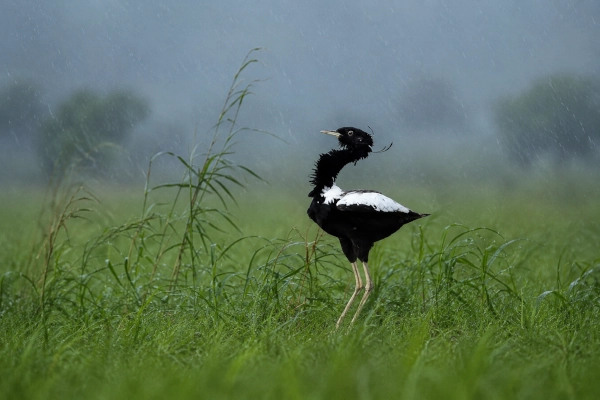
The Lesser Florican (Sypheotides indicus) is one of India’s most remarkable and threatened grassland birds. Famous for the spectacular vertical leaps performed by breeding males during the monsoon, it is the smallest member of the bustard family and the sole species placed in the genus Sypheotides. The bird is closely associated with the semi-arid grasslands, grazing lands and rain-fed agricultural landscapes of western and central India, particularly Gujarat, Rajasthan and Madhya Pradesh. Its dramatic decline has made it an important symbol of India’s disappearing grassland ecosystems.
Names and Identity
The Lesser Florican is known by several regional names. In parts of Gujarat and Rajasthan, it is commonly called Kharmor, Khamor, Tanmor or the “grass peacock,” names inspired by the male’s extraordinary monsoon display. The bird belongs to the family Otididae, which also includes the Great Indian Bustard and Bengal Florican.
The scientific name Sypheotides indicus reflects its distinct taxonomic identity. The Lesser Florican is endemic to the Indian subcontinent, although historical records indicate occasional movements beyond present-day India. Its principal surviving populations are now concentrated within a fragmented belt extending across western and central India.
Physical Appearance
The Lesser Florican is a compact, long-legged ground bird with a body built for walking and running through tall grass. Males and females differ greatly in appearance, particularly during the breeding season.
The breeding male is one of the most striking birds of the Indian grasslands. Its head, neck and underparts become largely black, while the wings and back show contrasting white and mottled brown markings. Several long, ribbon-like black feathers emerge from behind the head and curve backwards, giving the male an elegant and unmistakable appearance.
Outside the breeding season, the male loses much of this dramatic black-and-white plumage and becomes more similar to the female.
The female is larger and more heavily built than the male. Her plumage is predominantly sandy brown, buff and mottled black, providing excellent camouflage among dry grass, crops and scrub. This subdued colouring is especially valuable during nesting, when the female remains close to the ground.
Young birds resemble females and acquire adult plumage gradually.
The Famous Leaping Display
The Lesser Florican is best known for the extraordinary courtship performance of the male. During the southwest monsoon, males occupy display territories within tall grasslands and agricultural fields. From these sites, they repeatedly leap vertically above the vegetation, often rising more than a metre into the air.
During each leap, the male briefly becomes visible above the grass, flutters his wings, produces a characteristic croaking or knocking sound and then drops back into the vegetation. A displaying male may repeat this performance hundreds of times during the morning and evening.
These display areas are known as leks. Several males may occupy separate territories within the same grassland, while females visit and select mates. The repeated leaps allow males to advertise their presence above vegetation that would otherwise conceal them.
The display is closely linked with rainfall. Monsoon showers stimulate grass growth, insect abundance and breeding activity, creating the seasonal conditions required for courtship and nesting.
Distribution in India
The Lesser Florican was once distributed across a much wider portion of the Indian subcontinent. Its principal breeding range now lies in Gujarat, Rajasthan and western Madhya Pradesh.
Gujarat
Gujarat has historically supported some of the species’ most important breeding concentrations. The grasslands of Saurashtra, Kutch and central Gujarat, together with rain-fed agricultural fields, have provided seasonal habitat.
The Blackbuck National Park at Velavadar and surrounding landscapes have been particularly important. Areas near Bhavnagar, Surendranagar, Rajkot, Amreli and Kutch have also produced records, although the bird’s distribution varies considerably with rainfall and habitat conditions.
Rajasthan
In Rajasthan, Lesser Floricans occur mainly in the central and southern parts of the state during the monsoon. Important areas have included Ajmer, Tonk, Bhilwara, Nagaur, Kota and Chittorgarh.
Traditional breeding sites were associated with open grasslands and rain-fed agricultural fields. Their numbers have declined sharply in many of these landscapes, and recent surveys have detected only small and dispersed populations.
Madhya Pradesh
Western Madhya Pradesh once supported important Lesser Florican populations, particularly in grasslands and agricultural landscapes around Dhar, Ratlam, Mandsaur and adjoining districts.
The Sailana and Sardarpur regions became well known for florican conservation. These landscapes contain grassland patches, crop fields and village grazing areas that can provide breeding habitat during favourable monsoon seasons.
The species has also been recorded historically in Maharashtra, Andhra Pradesh and several other parts of India during seasonal movements, although strong breeding populations are now mainly associated with the western and central states.
Habitat
The Lesser Florican depends upon open landscapes containing grasses of varying heights. It favours semi-arid and subhumid grasslands, grazing lands, fallow fields and rain-fed farms with suitable vegetation.
Breeding males generally require grass tall enough to provide cover while remaining open enough for leaping displays. Females need dense vegetation for nesting and protection from predators. The birds may use fields growing millets, pulses, cotton and other monsoon crops where the vegetation resembles natural grassland.
Outside the breeding season, Lesser Floricans can travel over large distances and use a wider range of habitats, including dry grasslands, scrub, fallow land and agricultural mosaics. Satellite-tracking research in Gujarat has shown that individuals may occupy extensive home ranges and depend upon landscapes extending well beyond protected areas.
The species therefore requires connected landscapes rather than isolated reserves alone. Seasonal movement between breeding and non-breeding areas remains essential to its survival.
Food and Feeding Behaviour
The Lesser Florican is an opportunistic omnivore. Its diet includes grasshoppers, beetles, termites, ants, caterpillars and other invertebrates. It also consumes seeds, shoots, grains and plant material.
Insects become especially abundant during the monsoon and provide protein for breeding adults and growing chicks. Floricans usually forage while walking slowly through vegetation, pausing to seize prey from the ground or from plant stems.
Agricultural fields can provide food, yet intensive pesticide use may reduce insect availability and expose birds to harmful chemicals. The survival of the species therefore depends partly upon farming systems that retain insect diversity and areas of natural vegetation.
Breeding and Nesting
Breeding usually begins with the arrival of the monsoon, although the precise timing varies with rainfall. Males establish display territories and attract females through repeated jumping displays.
After mating, the female assumes responsibility for nest building, incubation and chick rearing. The nest is a shallow scrape on the ground, concealed among grass or crops. The eggs are mottled and blend closely with the surrounding soil and vegetation.
Ground nesting makes the species highly vulnerable. Eggs and chicks can be destroyed by agricultural machinery, livestock trampling, flooding and predators. Free-ranging dogs, jackals, crows and other animals may also take eggs or young birds.
Florican chicks are precocial and leave the nest shortly after hatching. They remain dependent on the female for protection and guidance while learning to feed.
Seasonal Movements
Lesser Floricans were once regarded mainly as local monsoon migrants, but tracking studies have revealed far more extensive movements. Satellite telemetry has shown that some birds travel hundreds of kilometres between breeding and non-breeding areas.
These movements may take birds through several states and across landscapes containing farms, grasslands, scrub and infrastructure. Their routes are influenced by rainfall, vegetation growth, food availability and land-use patterns.
This mobility presents a major conservation challenge. Protecting a single breeding site offers limited security when birds spend much of the year outside it. Conservation planning must therefore include migration corridors, temporary habitats and agricultural landscapes used during seasonal movement.
Ecological Importance
The Lesser Florican is an indicator of healthy grasslands. Its presence suggests that a landscape still retains appropriate vegetation structure, insect abundance and seasonal ecological processes.
Grasslands support far more than floricans. They provide habitat for blackbuck, wolves, foxes, harriers, larks, quails, reptiles, pollinators and numerous plant species. They also sustain pastoral livelihoods and livestock grazing.
Protecting the florican can therefore benefit an entire community of grassland wildlife. The species functions as an umbrella for ecosystems that have historically received less conservation attention than forests and wetlands.
Conservation Status
The Lesser Florican is considered to face an extremely high risk of extinction. Current conservation assessments describe a steep and continuing decline caused by extensive habitat loss, fragmentation and low breeding success. BirdLife International’s species assessment places it among the world’s most threatened birds, and Indian conservation programmes treat it as a priority species requiring urgent recovery measures.
It receives the highest level of legal protection available to wild birds under India’s wildlife legislation. International trade involving the species is also regulated.
Population estimates remain difficult because the birds are secretive outside the breeding season, highly mobile and widely scattered. Counts of displaying males provide valuable information, although they represent only part of the total population.
Principal Threats
Conversion of Grasslands
The greatest threat is the transformation of natural and semi-natural grasslands into intensive farmland, plantations, industrial areas, settlements and infrastructure. Many grasslands continue to be classified administratively as wastelands, making them vulnerable to conversion.
Agricultural Mechanisation
Floricans often nest in crop fields during the monsoon. Tractors, harvesters and other machinery can destroy nests, eggs and chicks. Operations carried out during the breeding season may eliminate an entire nesting attempt within minutes.
Pesticides
Heavy pesticide use reduces the abundance of insects required by adults and chicks. Direct exposure may also affect health and reproduction.
Overgrazing and Poorly Timed Grass Cutting
Traditional grazing can maintain open grassland structure, while excessive grazing during the breeding season removes cover and exposes nests. Grass cutting at critical times can destroy display and nesting habitat.
Invasive Plants
Prosopis and other invasive woody plants can transform open grasslands into dense scrub. Such vegetation reduces the visibility and open structure required for male display territories.
Power Lines
Bustards are heavy-bodied birds with limited frontal vision during flight. Collisions with overhead power lines can cause fatal injuries, especially along movement routes.
Predation and Disturbance
Free-ranging dogs are an increasing threat to eggs, chicks and adult birds. Human disturbance, vehicle movement and noise can also disrupt breeding territories.
Climate Variability
Breeding depends strongly upon monsoon rainfall. Delayed, weak or irregular rains can reduce grass growth, insect abundance and nesting success. More frequent climatic extremes may further reduce the number of suitable breeding seasons.
Protected Areas and Conservation Landscapes
Several protected areas and reserves have been established or managed partly for the Lesser Florican. Velavadar National Park in Gujarat is among the best known, although the bird also depends heavily on surrounding agricultural and community lands.
In Madhya Pradesh, the Sailana and Sardarpur florican sanctuaries were created to protect breeding habitat. Rajasthan has also identified conservation areas and important seasonal breeding grounds.
A large proportion of the species’ habitat remains outside formally protected areas. This makes cooperation with farmers, pastoralists and village communities essential.
Conservation Breeding
India has initiated conservation-breeding efforts for the Lesser Florican as part of wider programmes for endangered bustards. Facilities in Rajasthan and Gujarat have worked on egg collection, artificial incubation, chick rearing and the development of captive-breeding methods.
These efforts aim to establish a secure population that could eventually support carefully planned releases. Captive breeding remains technically difficult because the species has specialised courtship behaviour, seasonal breeding cycles and sensitivity to disturbance.
Conservation breeding is therefore treated as a safeguard alongside habitat protection rather than a replacement for wild populations. The survival of released birds will ultimately depend upon the availability of secure grasslands and agricultural landscapes.
Role of the Bustard Recovery Programme
The Wildlife Institute of India and state forest departments have undertaken surveys, satellite tracking, habitat studies and conservation breeding under the national bustard recovery programme.
Tracking has improved knowledge of movement routes, non-breeding ecology and mortality risks. Recovery planning includes habitat management, predator control, community participation, monitoring and the development of breeding techniques.
The programme recognises that the Great Indian Bustard and Lesser Florican share several threats, particularly grassland conversion and power-line collisions. Measures developed for one species can therefore provide valuable lessons for the other.
Farmers and Local Communities
Farmers play a decisive role in Lesser Florican conservation because many birds breed in private fields. A nest protected by a farmer may contribute directly to the survival of the species.
Conservation programmes can support farmers through compensation for delayed harvesting, incentives for nest protection and recognition of wildlife-friendly farming. Maintaining unsprayed field margins, fallow strips and patches of natural grass can provide refuge for birds and insects.
Pastoral communities also hold valuable knowledge of seasonal rainfall, grazing conditions and bird movements. Their participation can help identify breeding sites and guide grassland management.
Restoring Florican Habitat
Effective habitat restoration requires the removal or control of invasive woody plants, careful regulation of grazing and protection of suitable grass height during the breeding season.
Grasslands should be managed as dynamic systems. Complete exclusion of grazing can allow vegetation to become too dense, while intensive grazing can remove essential cover. Rotational grazing and seasonal protection can create a mosaic of short and tall grasses suited to different wildlife.
Power lines passing through important habitats and movement corridors require mitigation through underground cabling, realignment or other scientifically tested measures. Regular monitoring can help identify collision hotspots.
Extraordinary Lesser Florican
The Lesser Florican represents a uniquely Indian evolutionary and cultural heritage. Its monsoon display is among the most extraordinary behaviours seen in any grassland bird.
Its decline also reveals a wider ecological crisis. India’s open natural ecosystems have often been overlooked because they lack tree cover. Grasslands, scrublands and savannas support specialised wildlife and pastoral communities, making them productive and biologically rich landscapes.
Saving the florican means recognising these ecosystems as valuable habitats rather than vacant land awaiting conversion.
A Bird at the Edge of Survival
The Lesser Florican has survived for centuries by responding to the rhythm of the Indian monsoon. Males leap above newly grown grass, females hide their nests within seasonal vegetation and entire populations move across large landscapes in search of food and shelter.
That rhythm is increasingly disrupted by habitat conversion, mechanised farming, power infrastructure and declining grassland quality. The bird’s future now depends upon rapid and coordinated action across Gujarat, Rajasthan, Madhya Pradesh and its wider seasonal range.
Protected reserves, conservation breeding and scientific tracking form important parts of the recovery effort. Their success will depend equally upon farmers, pastoral communities and land managers who share the florican’s landscape.
The survival of the Lesser Florican would preserve far more than one rare bird. It would protect the living grasslands of western and central India and sustain one of the subcontinent’s most beautiful natural spectacles—the sight of a black-and-white male rising repeatedly above the monsoon grass.
Refence
BirdLife International. “Lesser Florican — Sypheotides indicus: Species Factsheet.” BirdLife DataZone.
https://datazone.birdlife.org/species/factsheet/lesser-florican-sypheotides-indicus
Wildlife Institute of India. “Endangered Species Recovery Programme: Great Indian Bustard and Lesser Florican.” Ministry of Environment, Forest and Climate Change, Government of India.
https://v1.wii.gov.in/images/images/documents/announcements/CAMPA_2018_Programme_Abstracts.pdf
Ministry of Environment, Forest and Climate Change. Annual Report 2024–25. Government of India.
https://moef.gov.in/uploads/pdf-uploads/English_Annual_Report_2024-25.pdf
Wildlife Institute of India. “A Study on the Ecology and Migration Pattern of the Lesser Florican in Western India Using Satellite-Tracking Techniques.”
https://v1.wii.gov.in/images/images/documents/iars_abstracts_aug_15_2014.pdf
Wildlife Institute of India. “Distribution, Habitat and Conservation of the Lesser Florican in India.”
https://wii.gov.in/uploads/media/pdf/rti/2020-21_Qtr_3_RTI_79_Reply_Ishan_00069.pdf
BirdLife International. “Sailana Kharmor Sanctuary: Important Bird and Biodiversity Area Factsheet.”
https://datazone.birdlife.org/site/factsheet/18315-sailana-kharmor-sanctuary
Ministry of Environment, Forest and Climate Change. “India’s Fourth National Report to the Convention on Biological Diversity.” Government of India.
https://moef.gov.in/uploads/2018/04/India_Fourth_National_Report-FINAL_2.pdf
Ministry of Environment, Forest and Climate Change. “National Wildlife Action Plan 2017–2031.” Government of India.
https://moef.gov.in/wp-content/uploads/2017/12/NWAP-2017-31.pdf
You may also like
-
Chhattisgarh Plans Innovative Tree Surgery to Save Over 500 Damaged Trees in Udanti Sitanadi Tiger Reserve
-
Kerala’s Peechi Wildlife Survey Records 395 Species, Adds 36 New Entries to Biodiversity Checklists
-
Tiger Returns to Maharashtra’s Beed Forests After Nearly 100 Years, Highlights Importance of Wildlife Corridors
-
Himachal Pradesh Achieves Major Success in Rare Cheer Pheasant Conservation
-
Blackbucks to Return to Chhattisgarh’s Gomarda Wildlife Sanctuary After Five Decades
