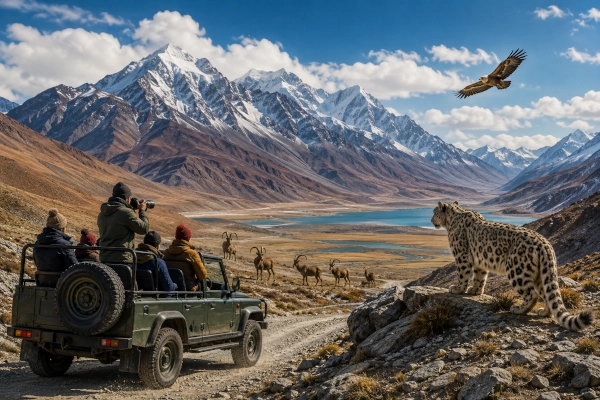
Ladakh is preparing to introduce what has been described as India’s first organised high-altitude wildlife safari, creating regulated routes through some of the country’s most sensitive mountain habitats.
Lieutenant Governor Vinai Kumar Saxena announced the initiative during the inaugural governing-body meeting of the Snow Leopard and High-Altitude Nature Conservation Society, commonly known as the SHAN Conservation Society. Saxena assumed office as the Lieutenant Governor of Ladakh in March 2026.
The proposed safari will offer guided journeys along designated wildlife and birdwatching routes using specially adapted vehicles operated by trained local drivers and nature guides.
Unlike conventional forest safaris in the plains, the Ladakh project will operate across a fragile cold-desert landscape shaped by high mountains, sparse vegetation, extreme temperatures and rare wildlife.
Its success will therefore depend less on the number of tourists accommodated and more on how carefully human movement is controlled.
Regulated Tourism to Replace Unchecked Off-Roading
One of the central objectives of the initiative is to reduce unregulated driving through wildlife-rich areas.
The growing popularity of Ladakh has encouraged visitors to travel beyond established roads in search of remote landscapes and photography locations. Uncontrolled off-roading can damage alpine vegetation, disturb nesting birds, fragment animal habitats and leave vehicle tracks that remain visible for years in the slowly recovering cold-desert ecosystem.
Under the proposed system, the Forest Department will identify authorised routes and determine where safari vehicles may operate.
Tourists will travel with trained drivers and guides rather than independently entering sensitive habitats. This approach is intended to concentrate vehicles on selected tracks, improve visitor supervision and reduce disturbance in breeding, feeding and resting areas.
The safari model is being developed along the lines of regulated vehicle tourism in major wildlife destinations such as Kaziranga and Ranthambore, although Ladakh’s terrain and ecological conditions will require a substantially different operating system.
Vehicle numbers, route timings, stopping points, seasonal closures and minimum viewing distances will need to be determined according to scientific assessments rather than tourism demand alone.
Snow Leopards at the Centre of the Initiative
The snow leopard is expected to become the principal symbol of the safari programme.
Ladakh supports India’s largest estimated population of the elusive high-altitude predator. The 2024 Snow Leopard Population Assessment in India estimated approximately 718 snow leopards nationally, including about 477 in Ladakh.
The Union Territory’s mountain ecosystem also supports bharal or blue sheep, Ladakh urial, ibex, Tibetan wolves, red foxes, Himalayan marmots, brown bears and several other species adapted to extreme elevations.
Ladakh’s major protected landscapes include Hemis High Altitude National Park, Changthang Wildlife Sanctuary and Karakoram Wildlife Sanctuary. The territorial administration identifies conservation, scientific monitoring, human-wildlife conflict mitigation and community-based ecotourism as important components of its wildlife policy.
Wildlife sightings, particularly of snow leopards, can never be guaranteed. The animals occupy enormous territories and are naturally difficult to observe.
The safari must therefore be promoted as an opportunity to understand a complete mountain ecosystem rather than as a race to surround or photograph an individual animal.
SHAN Society to Provide an Institutional Framework
The safari forms part of a broader conservation programme being developed through the SHAN Conservation Society.
The society was constituted as a specialised institutional mechanism for protecting snow leopards, associated wildlife, alpine vegetation, wetlands and Ladakh’s cold-desert habitats. It is also expected to support scientific research, ecological monitoring, conflict mitigation and nature-based livelihood programmes.
Creating a dedicated organisation could help bring government departments, scientists, conservation groups, tourism operators and village communities onto a common platform.
This coordination is particularly important in Ladakh because wildlife habitats frequently overlap with grazing grounds, village lands, military infrastructure, tourism routes and traditional pastoral landscapes.
Conservation cannot succeed through restrictions alone. Communities living alongside snow leopards and other predators must receive visible economic benefits from protecting wildlife.
The safari programme attempts to create that connection by directing tourism-related employment towards local residents.
Local Youth to Become Guides and Trackers
Twenty young residents are expected to receive training in bird identification, wildlife tracking and visitor management.
They will be provided with binoculars and practical instruction that can help them work as guides, spotters and interpreters.
Local knowledge is particularly valuable in Ladakh. Residents understand seasonal animal movements, mountain weather, traditional trails, water sources and subtle wildlife signs that may escape an unfamiliar observer.
Formal training can combine this inherited knowledge with scientific methods, ethical wildlife-viewing practices, first aid and responsible tourism standards.
Ten birdwatching hides are also planned in selected habitats. These structures can allow visitors to observe birds from concealed positions while reducing movement and noise.
Ladakh has become an important destination for birdwatchers because its wetlands, river valleys and mountain slopes support black-necked cranes, bar-headed geese, golden eagles, lammergeiers, Tibetan snowcocks and numerous migratory species.
Official tourism information already promotes wildlife viewing, birdwatching and responsible travel as important elements of the Ladakh experience.
Women Artisans to Participate in the Tourism Economy
The initiative also seeks to involve women artisans and community groups.
Safari routes and visitor centres could provide spaces for locally produced textiles, woollen products, handicrafts and traditional artwork. This would allow tourism earnings to extend beyond vehicle operators and accommodation providers.
Women’s collectives could also participate in hospitality, local cuisine, souvenir production, homestays and conservation-awareness campaigns.
A community-centred tourism model is more likely to gain local support because wildlife becomes an economic asset worth protecting rather than an external restriction imposed on grazing, construction or resource use.
Revenue-sharing mechanisms will be essential. A portion of safari fees could support village conservation funds, predator-proof livestock enclosures, waste management and compensation for animals lost to wildlife.
Without transparent local benefits, the project risks becoming another tourism product in which outside operators capture most of the income while villages bear the environmental costs.
Plastic-Free Villages and Waste Management
The wider programme includes plastic-reduction campaigns across around 40 villages and the installation of colour-coded waste bins.
Portable bins are also expected to be used by safari operators and visitors.
Waste management is one of Ladakh’s most serious tourism challenges. The region’s short tourist season produces large quantities of plastic bottles, food packaging and disposable materials, while remote villages possess limited collection and processing infrastructure.
Simply installing bins will not solve the problem unless waste is regularly collected, segregated, transported and recycled or scientifically disposed of.
Safari operators should therefore be required to follow a strict carry-in, carry-out system under which all waste generated during a tour is brought back to an authorised collection point.
Single-use plastics, feeding of wildlife and disposal of food waste in natural habitats should be prohibited.
Conservationists Call for Strict Limits
The proposal has considerable potential, but conservationists have cautioned that it must not become a pathway for mass tourism in vulnerable wildlife zones.
Open vehicles, repeated engine noise and large tourist groups can alter animal behaviour. Snow leopards may abandon resting areas, while ground-nesting birds can be displaced from breeding sites.
Winter tourism creates additional concerns because animals are already under stress from cold temperatures and limited food availability.
The administration will therefore need to establish ecological carrying capacities for every route. Daily permits should remain limited, and areas should be closed temporarily when wildlife is breeding, nesting or raising young.
Speed limits, noise restrictions and fixed observation distances must be enforced. Guides should prevent tourists from approaching animals on foot, blocking their movement or using drones near wildlife.
The project should also avoid publishing the precise locations of dens, nests and frequently used wildlife corridors.
Independent scientists and local conservation organisations should periodically review the effects of safari activity. Routes must be changed or closed if monitoring shows habitat damage or increased disturbance.
No Guarantee of a Snow Leopard Sighting
Responsible marketing will be crucial.
Snow leopard tourism can generate unrealistic expectations, encouraging drivers and visitors to chase animals or crowd a sighting. The new safari should avoid advertising guaranteed encounters.
Visitors should instead be introduced to tracks, scrapes, prey species, mountain ecology, traditional pastoral life and conservation work.
A tour without a snow leopard sighting can still offer significant value through birdwatching, landscape interpretation and an understanding of how local communities coexist with predators.
This broader approach can spread tourism across seasons and habitats without placing excessive pressure on a few known snow leopard locations.
A Possible Model for Himalayan Eco-Tourism
Ladakh’s proposed high-altitude wildlife safari represents an attempt to manage tourism before uncontrolled visitation causes irreversible ecological damage.
The programme combines designated routes, trained local guides, birdwatching facilities, waste-management campaigns and livelihood opportunities for village communities.
Its real achievement, however, will not be measured by the number of jeeps deployed or tickets sold.
Success will mean fewer vehicles leaving authorised tracks, reduced disturbance to wildlife, higher earnings for local families and stronger protection for Ladakh’s mountain habitats.
When carefully regulated, tourism can give communities an economic stake in conserving snow leopards and other rare species. When poorly managed, the same tourism can overwhelm the fragile landscapes visitors have travelled to experience.
Ladakh now has an opportunity to create a distinctly Himalayan model—one in which wildlife observation remains limited, scientific and community-led.
The proposed safari could become an important example for other mountain states, provided conservation remains its governing principle rather than an attractive label added to expanding tourism.
You may also like
-
Sindhu: The Indus Kingdom of Jayadratha in the Mahabharata
-
Kuninda or Kulinda: The Himalayan Realm of the Mahabharata in Uttarakhand and Himachal Pradesh
-
Durga versus Mahishasura: Weapons, Battlefield Tactics and the Triumph of Shakti
-
Kuluta: The Kullu Valley Kingdom of the Mahabharata
-
Trigarta: The Kangra–Jalandhar Kingdom of the Mahabharata
