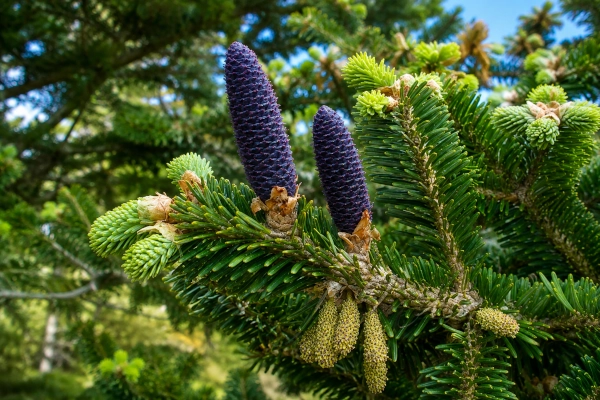
Talisa, more commonly called Talisapatra, is an aromatic Himalayan conifer valued in Ayurveda for its action on the respiratory and digestive systems. Its dried needle-like leaves are traditionally used in cough, breathlessness, hiccups, poor appetite, nausea and disorders associated with accumulated Kapha and impaired Agni.
The Ayurvedic Pharmacopoeia of India identifies the medicinal drug Talisa as the dried leaves of Abies webbiana Lindl., belonging to the Pinaceae family. Modern botanical databases, however, treat Abies webbiana as a synonym of the currently accepted name Abies spectabilis (D.Don) Mirb. Thus, both names may appear in Ayurvedic books, pharmacopoeias and herbal products.
Botanical Identity
Sanskrit names: Talisa, Talisapatra, Patradhya
English names: Himalayan silver fir, Himalayan fir
Hindi: Talispatra, Talish Patra
Malayalam: Talisapatra, Taleesapatri
Tamil: Talispatra, Taleesapatri
Telugu: Taleesapatri
Pharmacopoeial botanical name: Abies webbiana Lindl.
Currently accepted botanical name: Abies spectabilis (D.Don) Mirb.
Family: Pinaceae
Part used: Dried needle-like leaves
The species is a tall evergreen tree of the Himalayan temperate zone. Its native range extends from northern Afghanistan through the western Himalaya to Nepal. The tree bears spreading branches and flattened, aromatic leaves rather than the clustered needles seen in many pines.
Identification of Talisapatra
The medicinal leaves are generally flat, narrow and glossy, measuring approximately 1–5.5 centimetres in length and around 2 millimetres in width. The upper surface has a channelled midrib, while the lower surface carries two faint whitish bands on either side of the midrib.
The leaves have a short stalk, a greyish-brown or greenish-brown appearance after drying and a distinctive resinous or turpentine-like aroma. Their taste is characteristically aromatic and astringent. Two secretory cavities within the leaf contribute to its volatile and resinous character.
Correct identification is particularly important because Talisa has sometimes been confused with or substituted by leaves from other conifers.
Ayurvedic Properties of Talisa
The Ayurvedic Pharmacopoeia of India records the following pharmacodynamic profile:
Rasa—taste: Madhura, Katu and Tikta; sweet, pungent and bitter
Guna—qualities: Laghu and Tikshna; light and penetrating
Virya—potency: Ushna; heating
Vipaka—post-digestive effect: Katu; pungent
Dosha action: Principally alleviates Vata and Kapha
Important karmas: Dipana, Hridya, Vata-Kaphapaha and Shleshma-Pittajit
The combination of lightness, penetrating action, hot potency and pungent post-digestive effect explains its classical use where coldness, heaviness, mucus, impaired digestion and obstructed movement of Vata are prominent.
Talisa should not be viewed as an unrestricted heating herb. Its effects depend on dose, formulation, accompanying ingredients and the individual’s doshic condition.
Talisa as a Kapha-Reducing Herb
Kapha disorders often involve heaviness, excessive mucus, sluggish digestion and obstruction of the respiratory passages. Talisa’s Tikshna and Ushna properties help mobilise thick Kapha, while its Laghu quality prevents the formulation from becoming excessively heavy.
Its aromatic constituents also make it particularly suitable for powdered formulations intended for the throat and respiratory system. Talisa is traditionally selected when cough is accompanied by phlegm, poor appetite, a coated tongue or a sensation of heaviness in the chest.
This traditional use does not mean that the herb can replace medical treatment for pneumonia, asthma attacks, tuberculosis or other serious respiratory diseases.
Talisa for Cough
Kasa, or cough, is one of Talisa’s principal pharmacopoeial indications. The herb is traditionally incorporated into compound powders with ingredients such as Pippali, Maricha, Shunthi, cardamom and Vanshalochana.
Talisa is especially associated with cough involving:
- Thick or difficult-to-expel mucus
- Coldness and congestion
- Weak digestion accompanying respiratory illness
- Reduced appetite during prolonged cough
- Throat discomfort associated with Kapha accumulation
Its warming and aromatic nature assists the Ayurvedic process of liquefying and mobilising Kapha while supporting Agni. The Pharmacopoeia specifically includes Kasa among the therapeutic uses of the dried leaf.
A persistent cough, coughing blood, high fever, breathing difficulty, chest pain or falling oxygen levels requires prompt medical assessment.
Talisa for Breathlessness
Talisa is traditionally used in Shwasa, an Ayurvedic category that includes disturbed or difficult breathing. Its role is understood primarily through its Kapha-reducing, Vata-regulating and channel-clearing properties.
When thick Kapha blocks the respiratory channels, the movement of Vata becomes disturbed. Talisa is selected in compound formulations to reduce this obstruction and restore more normal movement.
This is a traditional Ayurvedic rationale rather than evidence that Talisa independently treats bronchial asthma, chronic obstructive pulmonary disease or acute respiratory distress. Prescribed inhalers and emergency medicines must never be stopped in favour of an herbal preparation.
Hiccup and Disturbed Vata
The Pharmacopoeia lists Hikka, or persistent hiccup, among Talisa’s traditional indications. Ayurveda interprets hiccup as an abnormal upward movement of Vata, often associated with irritation, Kapha obstruction or digestive disturbance.
Talisa may be included in formulations that warm the stomach, stimulate digestion and regulate the upward movement of Vata. Its use is usually combined with other ingredients rather than administered as a single drug.
Repeated or prolonged hiccups may sometimes be associated with gastrointestinal, neurological, metabolic or medicinal causes and should be medically evaluated.
Dipana: Kindling Digestive Fire
Talisa is classified as Dipana, meaning that it stimulates or supports digestive fire. Its pungent, bitter and warming qualities make it useful in:
- Agnimandya or reduced digestive capacity
- Aruchi or loss of appetite
- Ama-related heaviness
- Nausea associated with weak digestion
- Abdominal distension involving Kapha and Vata
- Poor taste perception during illness
The Pharmacopoeia lists Agnimandya, Amadosha, Aruchi, Chardi and Gulma among its traditional therapeutic applications.
In Ayurvedic practice, Talisa is usually combined with digestive spices and balancing substances so that its penetrating nature is directed appropriately.
Talisa in Nausea and Vomiting
Talisa is also mentioned in Chardi, or vomiting. This may initially appear unexpected because an Ushna and Tikshna herb can aggravate certain forms of Pitta-related nausea.
Its suitability depends upon the cause. It is more likely to be selected where vomiting is associated with Kapha, mucus, indigestion, heaviness or Ama rather than intense acidity, burning and excessive Pitta.
For this reason, Talisa should not be used indiscriminately for every form of nausea or vomiting. Persistent vomiting, blood in vomit, dehydration, severe abdominal pain or vomiting during pregnancy requires medical care.
Hridya: Pleasing and Supportive to the Heart
The Pharmacopoeia describes Talisa as Hridya. In Ayurvedic terminology, Hridya can indicate a substance that is agreeable, aromatic, palatable or supportive to the heart and chest region.
Talisa’s pleasant coniferous fragrance contributes to the sensory appeal of compound powders. By improving taste, appetite and respiratory comfort, it may create an overall feeling of openness and lightness in the chest.
Hridya should not be interpreted as proof that Talisa treats coronary artery disease, heart failure or abnormal heart rhythms.
Oral and Throat Conditions
Mukharoga, a broad category of oral disorders, is included among the pharmacopoeial uses of Talisa. Its aromatic, bitter and pungent qualities explain its presence in powders and pills intended for the mouth, throat and upper respiratory tract.
Talisa-containing formulations may traditionally be selected in conditions involving unpleasant taste, excessive oral secretions, throat congestion or Kapha accumulation. Direct application of unverified plant powder to ulcers, bleeding gums or infected oral lesions is not advisable.
Krimighna and Ama-Reducing Applications
The Pharmacopoeia lists Krimi, a broad Ayurvedic category associated with worms and harmful biological agents, among Talisa’s indications. Its Tikta, Katu, Ushna and Tikshna attributes are traditionally understood to create an unfavourable environment for excessive Kapha and Ama.
Modern laboratory observations should not be used to conclude that Talisa can replace clinically proven antiparasitic, antibacterial or antifungal treatment.
Important Ayurvedic Formulations Containing Talisa
Talisadi Churna
Talisadi Churna is the best-known formulation containing Talisapatra. Different authorised formularies may show minor variations, but the formulation commonly combines Talisa with warming and aromatic ingredients such as Maricha, Shunthi, Pippali, Vanshalochana, cardamom, cinnamon and sugar.
It is traditionally used for cough, respiratory congestion, weak digestion, poor appetite and Kapha-related throat conditions.
Drakshadi Churna
This compound powder combines digestive and respiratory herbs with nourishing ingredients such as Draksha. It is used according to the particular formulation and therapeutic context.
Bhaskara Lavana
Bhaskara Lavana is a classical digestive salt preparation traditionally used in abdominal distension, poor appetite, digestive weakness and Vata-Kapha disturbances.
Pranada Gutika
This is a classical pill preparation in which Talisa contributes aromatic, digestive and respiratory-supporting activity.
Jatiphaladi Churna
A compound powder containing aromatic spices and herbs, traditionally used in selected digestive and intestinal disorders.
Talisadi Modaka
A classical confection-like preparation carrying Talisa with other ingredients in a palatable base.
The Ayurvedic Pharmacopoeia of India lists Drakshadi Churna, Talisadi Churna, Bhaskara Lavana, Pranada Gutika, Jatiphaladi Churna, Puga Khanda and Talisadi Modaka among important formulations containing the drug.
Pharmacopoeial Dose
The Ayurvedic Pharmacopoeia of India records a dose of 2–3 grams of Talisa leaf powder. This is a pharmacopoeial medicinal range and should not be treated as a universal household dose.
The appropriate amount varies according to age, digestion, constitution, disease, accompanying ingredients and the exact formulation. Talisa is more commonly administered within a compound medicine than as an isolated leaf powder.
Modern Phytochemical Perspective
The Pharmacopoeia identifies essential oil and alkaloidal constituents in the dried leaves. Broader phytochemical research on Abies spectabilis has identified multiple groups of compounds, including triterpenoids, diterpenoids, sesquiterpenoids, flavonoids and lignans. One systematic investigation reported 72 constituents from the plant.
Research on material described as Abies webbiana has also reported monoterpenes, flavonoids, biflavonoid glycosides, phytosterols and diterpene-related compounds. The exact profile may vary according to plant part, location, extraction method and botanical identification.
These findings provide a chemical basis for continued investigation but do not establish the clinical effectiveness of Talisa for human diseases.
Experimental Pharmacological Research
Animal and laboratory studies involving Abies webbiana, Abies spectabilis and related Himalayan fir material have investigated antioxidant, anti-inflammatory, antimicrobial and neuropharmacological activity. One animal study of extracts from the aerial parts reported behavioural effects consistent with sedative, anxiolytic and antidepressant-like activity.
A phytochemical investigation of Abies spectabilis examined isolated compounds against several tumour cell lines, but the tested terpenoids did not show a positive cytotoxic effect at the reported concentrations. This illustrates why individual laboratory findings should not be converted into broad medicinal claims.
There is currently insufficient high-quality human clinical evidence to establish Talisa as an independent treatment for respiratory, digestive, neurological or infectious diseases.
Authentication and the Risk of Substitution
Talisapatra requires careful botanical authentication because needle-like leaves from different conifers may appear superficially similar. Ayurvedic literature on substitute drugs records the historical use of Taxus baccata leaves when genuine Abies webbiana was unavailable, and modern researchers have used chromatographic techniques to differentiate Talisa from yew material.
This distinction is medically important. Yew species contain taxine alkaloids that can cause severe cardiac conduction disturbances, dangerous arrhythmias, cardiogenic shock and death when ingested. Talisa should therefore be obtained only from a pharmacopoeially authenticated supplier and should never be collected by visually comparing an unknown conifer with online photographs.
Conservation Importance
The accepted species Abies spectabilis is currently listed as Near Threatened in the IUCN information incorporated by Kew’s Plants of the World Online. It is a high-altitude Himalayan tree whose medicinal leaves must be collected without damaging branches, reproductive structures or the long-term health of the tree.
Responsible cultivation, traceable sourcing and regulated harvesting are therefore preferable to uncontrolled collection from natural forests.
Safety and Precautions
Talisa is a potent aromatic medicinal leaf rather than an ordinary culinary herb.
Its Ushna and Tikshna qualities may be unsuitable in large quantities for people experiencing intense acidity, burning sensations, active gastritis, mouth ulcers or strongly aggravated Pitta. Concentrated essential oil should not be swallowed or used as a substitute for pharmacopoeial leaf preparations.
Extra caution is required during pregnancy, breastfeeding and childhood, and in elderly people or those with chronic liver, kidney, respiratory or cardiac disease. Possible interactions with sedatives and other medicines have not been adequately studied.
Only authenticated Ayurvedic medicines should be used. Unknown needle-like leaves, ornamental firs, pines and yews should never be consumed as Talisa.
Conclusion
Talisa is one of Ayurveda’s important aromatic respiratory and digestive medicines. Its dried leaves combine Madhura, Katu and Tikta tastes with Laghu and Tikshna qualities, Ushna Virya and Katu Vipaka. These characteristics make it especially suitable for Kapha-associated cough, mucus, breathlessness, hiccup, poor digestion, loss of appetite and Ama-related heaviness.
Its best-known role is within carefully balanced formulations such as Talisadi Churna, where warming spices, aromatic herbs and soothing ingredients work together. Modern phytochemical research confirms that Himalayan fir contains numerous terpenoids, flavonoids, lignans and volatile constituents, although robust human clinical evidence remains limited.
Correct botanical identification is essential because genuine Talisa and toxic yew leaves must never be confused. Used in an authenticated formulation under qualified supervision, Talisa remains one of Ayurveda’s most distinctive Himalayan medicines.
REFERENCES
1. Government of India, Ministry of AYUSH. The Ayurvedic Pharmacopoeia of India, Part I, Volume IV. Monograph: Talisa—Dried Leaf; Abies webbiana Lindl., Family Pinaceae.
2. Pharmacopoeia Commission for Indian Medicine & Homoeopathy. PCIM&H Monograph Details: Talisa / Talish Patra, Ayurvedic Pharmacopoeia of India.
3. Royal Botanic Gardens, Kew. Plants of the World Online. Abies spectabilis (D.Don) Mirb. Accepted name; Abies webbiana Lindl. listed as a synonym. Family: Pinaceae.
4. World Flora Online Consortium. Abies spectabilis (D.Don) Mirb. World Flora Online taxonomic record.
5. Wu L, Li YL, Li SM, Yang XW, Xia JH, Zhou L, Zhang WD. Systematic Phytochemical Investigation of Abies spectabilis. Chemical and Pharmaceutical Bulletin. 2010;58(12):1646–1649. DOI: 10.1248/cpb.58.1646.
6. Ghosh AK, Sen D, Bhattacharya S. A New Alkaloid Isolated from Abies webbiana Leaf. Pharmacognosy Research. 2010;2(4):186–189.
7. Kumar V, Singh RK, Jaiswal AK, et al. Screening of Methanol Extract and Ethyl Acetate Fraction of Abies webbiana Lindl. for Neuropharmacological Activities. Indian Journal of Pharmacology. 2015;47(5):536–541.
8. Vadivel V, et al. Chemical Fingerprints of an Indian Traditional Herbal Drug Talisapatra (Abies webbiana) and Comparison with English Yew (Taxus baccata). International Journal of Pharmacognosy and Phytochemical Research. 2018;10(2):84–91.
9. Poornima B. An Overview of the Causes of Current Practices in Pratinidhi Dravyas—Substitution of Drugs in Ayurveda—including Newer Techniques for Their Evaluation. AYU. 2013;34(1):7–12. DOI: 10.4103/0974-8520.115437.
10. Vardon Bounes F, et al. A Fatal Case of Taxus Poisoning. Journal of Medical Case Reports. 2015;9:130. DOI: 10.1186/s13256-015-0609-1.
11. Dahlqvist M, et al. Fatal Heart Block from Intentional Yew Tree—Taxus baccata—Ingestion: A Case Report. European Heart Journal – Case Reports. 2020;4(1):1–5.
12. IUCN Red List of Threatened Species. Abies spectabilis. Conservation category: Near Threatened.
13. IMPPAT: Indian Medicinal Plants, Phytochemistry and Therapeutics Database. Abies spectabilis—Hi
Ayurvedic health disclaimer: This article is provided for educational purposes and does not constitute medical advice, diagnosis or a prescription. Do not collect, identify or consume unknown conifer leaves, and do not self-medicate with Talisa powder or essential oil. Consult a qualified Ayurvedic physician before use, especially during pregnancy or breastfeeding, in children or older adults, or in the presence of chronic illness, allergies, liver or kidney disease, heart disease, bleeding disorders or regular medication. Do not stop prescribed respiratory medicines or other treatments. Severe breathing difficulty, chest pain, coughing blood, persistent fever, confusion or suspected plant poisoning requires immediate emergency care.
You may also like
-
Ayurveda on Cold Foods and Iced Drinks: Why Food Temperature Matters for Digestion
-
Serum Institute of India-Manufactured Ebola Vaccine Enters Clinical Trial in Uganda
-
Ayurveda and Hydration: How Much Water Should We Really Drink?
-
Warm Water in Ayurveda: When and Why It Is Recommended
-
Women Make Up 43% of India’s Ayush Workforce as Sector Supports 17.6 Lakh Livelihoods
:%20The%20Himalayan%20Silver%20Fir%20of%20Ayurveda)