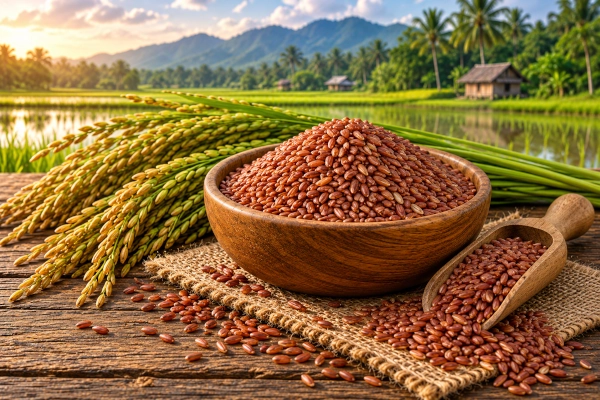
In the fertile river valleys and foothill landscapes of eastern Arunachal Pradesh grows Khaw Tai, an indigenous aromatic rice treasured for its strong fragrance, sweet taste and distinctive grain texture. Traditionally cultivated by the Tai Khamti community, this heritage grain represents an important part of the state’s agricultural biodiversity, food traditions and cultural identity.
Known officially as Arunachal Pradesh Khaw Tai (Khamti Rice), the variety is particularly associated with Namsai district and adjoining agricultural areas of Lohit and Changlang. Its short, bold grains develop a characteristic aroma and sticky texture when cooked, making the rice suitable for traditional steamed preparations, rice cakes and local delicacies.
Generations of Tai Khamti farmers have preserved Khaw Tai through traditional cultivation and seed selection. The variety remains closely connected with the community’s agricultural practices, which combine settled wet-rice farming with other forms of cultivation adapted to the region’s geographical conditions.
Khaw Tai received Geographical Indication (GI) registration on October 3, 2023, formally recognising its geographical association with Arunachal Pradesh. The recognition has strengthened the identity of a traditional rice variety that forms part of the state’s agricultural and culinary heritage.
GI Details at a Glance
- Geographical Indication: Arunachal Pradesh Khaw Tai (Khamti Rice)
- State: Arunachal Pradesh
- Product: Agricultural – Rice
- Class: 31
- Application Number: 803
- Date of Filing: 13 December 2021
- GI Journal: 175
- Journal Availability Date: 31 May 2023
- Certificate Number: 509
- GI Certificate Date: 3 October 2023
- Registered Proprietor: Namsai Organic Spices and Agricultural Producer Company Limited
- Registered Proprietor’s Address: Jaipur, District Namsai, Lohit – 792103, Arunachal Pradesh
- Geographical Area: Arunachal Pradesh
- Traditional Cultivation Region: Namsai, Lohit and Changlang districts
- Registration Valid Until: 12 December 2031
The Geographical Indications Registry confirms these details under Application Number 803. The registration identifies Arunachal Pradesh as the geographical area and recognises Khaw Tai as an agricultural product associated with the state’s traditional rice-growing communities.
Origins and History of Khaw Tai Rice
Khaw Tai belongs to the agricultural heritage of the Tai Khamti community, whose cultural traditions are closely connected with those of the wider Tai-speaking populations of Southeast Asia.
The Tai Khamti people have maintained a distinctive cultural identity in eastern Arunachal Pradesh, particularly around Namsai and adjoining areas. Their traditions include Theravada Buddhism, the Tai script, agricultural practices, specialised food preparations and a rich heritage of craftsmanship.
The precise date when Khaw Tai first entered cultivation in Arunachal Pradesh remains uncertain. However, the variety has been preserved through generations of Tai Khamti farming, reflecting the community’s longstanding dependence on rice as a staple food.
Traditional agricultural knowledge was transmitted through families and village communities. Farmers selected suitable seed material from successive harvests, helping maintain the characteristics associated with the variety.
Rice occupies an important place in Tai Khamti society because it is connected with everyday nourishment, hospitality, religious observances and community gatherings.
The preservation of Khaw Tai demonstrates how traditional agricultural crops can retain their identity through continuous cultivation and cultural use.
The Tai Khamti Community and Its Rice-Growing Traditions
The Tai Khamti are among the important indigenous communities of Arunachal Pradesh. Their settlements are concentrated in Namsai district, where agriculture remains an established component of rural livelihoods.
According to the Namsai district administration, the community traditionally practises both settled agriculture and shifting cultivation. Farmers cultivate rice, maize, millet, vegetables and other crops suited to local environmental conditions.
Rice has particular cultural importance because it forms the foundation of many traditional meals. The community maintains several methods of preparing rice, including steaming, wrapping cooked rice in leaves and combining rice with locally available ingredients.
The district administration describes fragrant rice as a fundamental component of Tai-style dining. Traditional preparations involve techniques developed and maintained within the community over generations.
Khaw Tai is closely associated with these food practices because of its fragrance and sticky cooking characteristics.
The relationship between the grain and the community extends beyond agriculture. Traditional food preparation contributes to the preservation of cultural knowledge, while continued cultivation helps maintain the seed material required for these dishes.
The Geography and Climate Behind Khaw Tai Rice
Khaw Tai is traditionally cultivated in the eastern part of Arunachal Pradesh, particularly within the agricultural landscapes of Namsai, Lohit and Changlang districts.
Namsai occupies a region of plains and foothills influenced by the wider Brahmaputra river system. Its agricultural environment includes fertile lowlands, seasonal streams and areas receiving substantial monsoon rainfall.
The district shares boundaries with Lohit, Changlang and Assam, creating an agricultural landscape that connects the eastern Himalayan foothills with the plains of northeastern India.
Rice cultivation benefits from seasonal rainfall and the availability of suitable agricultural land. Farmers manage water according to local field conditions, using both rain-fed and wet-rice cultivation practices.
The broader region contains different agricultural environments, including lowland paddy fields and hill slopes where traditional farming methods vary according to terrain.
Generations of cultivation have helped farmers identify suitable land, maintain local rice varieties and adapt crop-management practices to regional conditions.
The geographical identity of Khaw Tai reflects the relationship between inherited seed material, agricultural practices and the landscapes in which the variety has been preserved.
What Makes Khaw Tai Rice Unique?
Khaw Tai is distinguished by its strong natural aroma, short bold grains, white colour and pleasantly sweet taste.
The documentation supporting its Geographical Indication recognition describes it as an indigenous aromatic rice traditionally cultivated by Tai Khamti farmers.
Unlike long-grained aromatic rice varieties such as Basmati, Khaw Tai possesses comparatively short, broad grains. Its texture becomes sticky and chewy when cooked, making it suitable for several traditional preparations.
The variety’s strong fragrance is one of its most recognisable qualities. Agricultural documentation identifies this aroma as an important characteristic contributing to its reputation.
Khaw Tai is also valued for its sweetish flavour, which complements traditional dishes prepared with sesame, vegetables and other local ingredients.
A publication by the Confederation of Indian Industry on northeastern Geographical Indications describes Khaw Tai as possessing substantial genetic diversity and distinctive nutritional characteristics.
The publication also identifies comparatively high dietary fibre and lower phytate content among the qualities associated with the variety.
However, nutritional composition depends on the particular grain sample, cultivation conditions and processing method. Such characteristics should not be interpreted as proof that the rice can prevent or treat specific diseases.
Its combination of fragrance, taste, grain appearance and cooking texture distinguishes Khaw Tai within India’s indigenous aromatic rice heritage.
Traditional Cultivation and Indigenous Agricultural Knowledge
The cultivation of Khaw Tai reflects traditional agricultural practices maintained by Tai Khamti farmers.
The community uses agricultural methods suited to both lowland and upland conditions. Wet-rice cultivation is practised in suitable fields, while shifting cultivation has historically formed part of farming systems in hilly areas.
Traditional field preparation, seed selection and crop management rely on knowledge developed through long-term experience with the local environment.
The Namsai district administration documents the Tai Khamti community’s use of plough-based agriculture, traditionally employing draught animals to prepare fields.
Farmers preserve suitable seeds after harvesting and use them for subsequent agricultural seasons. This practice contributes to maintaining the grain characteristics associated with Khaw Tai.
Traditional cultivation may incorporate locally available organic materials and farm inputs. However, cultivation methods vary, and the use of traditional practices should not automatically be equated with certified organic production.
Seed purity remains important because mixing with unrelated rice varieties can gradually alter the characteristics valued by consumers.
The continued involvement of local farming communities remains essential for preserving Khaw Tai as a living agricultural resource.
Khaw Tai Rice in Traditional Tai Khamti Cuisine
Khaw Tai occupies an important place in Tai Khamti food traditions, where fragrant rice forms the foundation of everyday meals and special preparations.
The Namsai district administration describes Khao Hai, a traditional steamed rice preparation served either directly on a plate or wrapped in a leaf.
The sticky texture of Khaw Tai makes it suitable for preparations in which cooked rice must remain cohesive.
One of the community’s well-known dishes is Khawlam, a rice preparation associated with traditional cooking methods. Rice is commonly prepared in bamboo containers, producing a distinctive texture and flavour.
Another popular preparation is Khaupuk, made by combining sticky rice with sesame seeds. The dish is traditionally eaten as a snack or breakfast preparation.
The community also prepares Tongtep, a type of rice cake made using ground rice.
Other preparations include sticky rice shaped into rolls or balls and served with locally available ingredients.
These dishes demonstrate the versatility of Khaw Tai and the importance of traditional cooking methods in preserving the culinary identity of the Tai Khamti community.
The rice is also served with boiled vegetables, fish preparations and regional accompaniments, reflecting the close relationship between farming and local food resources.
The Importance of Rice in Tai Khamti Cultural Traditions
Rice plays a wider cultural role within Tai Khamti society.
The community follows Theravada Buddhism, and food offerings form part of religious observances and household practices. The Namsai district administration records the tradition of families maintaining prayer spaces and making regular offerings.
Traditional rice preparations also feature in community gatherings and occasions associated with hospitality.
The preparation and sharing of food help reinforce family and community relationships, while the continued use of indigenous ingredients preserves knowledge passed down through generations.
Khaw Tai’s importance therefore extends beyond its agricultural characteristics. The grain forms part of a culinary tradition connected with the community’s language, beliefs and social customs.
Its cultivation also helps sustain the agricultural knowledge required to prepare traditional dishes using authentic local ingredients.
This combination of farming and cultural significance contributes to Khaw Tai’s reputation as a distinctive heritage product of Arunachal Pradesh.
Geographical Indication Recognition in 2023
Arunachal Pradesh Khaw Tai received Geographical Indication registration under India’s Geographical Indications of Goods (Registration and Protection) Act, 1999.
The application was filed on December 13, 2021, by Namsai Organic Spices and Agricultural Producer Company Limited, representing the interests of producers associated with the traditional rice-growing region.
The Geographical Indications Registry published the application in Journal Number 175 on May 31, 2023. Following the registration process, Khaw Tai received GI Certificate Number 509 on October 3, 2023.
The registration acknowledges the rice’s geographical identity, distinctive characteristics and traditional reputation. It provides a legal framework for protecting the registered designation against unauthorised commercial use.
For farmers, GI recognition offers an opportunity to distinguish authentic Khaw Tai from other aromatic rice varieties. It can also support collective marketing and the development of speciality agricultural products associated with Arunachal Pradesh.
The registered geographical area is Arunachal Pradesh, while the crop’s traditional cultivation is most closely associated with the Tai Khamti settlements of Namsai and neighbouring districts.
Khaw Tai’s Nutritional Characteristics and Agricultural Value
Khaw Tai has attracted attention for its nutritional composition and qualities as an indigenous rice landrace.
The Confederation of Indian Industry’s publication on northeastern Geographical Indications describes Khaw Tai as containing approximately 80% carbohydrates, 7–8% protein, 5% fat and 3% dietary fibre in the reported composition.
The publication also identifies comparatively higher total dietary fibre and lower phytate content than certain high-yielding rice cultivars examined in the supporting documentation.
Phytate is a naturally occurring compound found in cereal grains and seeds. It can bind minerals such as iron and zinc, influencing their availability for absorption during digestion.
However, the nutritional composition of rice varies according to its variety, growing conditions, milling and cooking methods. The reported percentages should therefore be understood as characteristics of the samples described rather than fixed values for every commercial batch.
Khaw Tai also contains genetic diversity associated with traditional rice landraces. Preserving this diversity contributes to the wider conservation of agricultural resources that may prove valuable in future crop research and breeding programmes.
Its nutritional and agricultural characteristics add to its importance as a traditional food grain, although claims of specific medicinal benefits require appropriate scientific evidence.
Khaw Tai and the Conservation of Indigenous Rice Biodiversity
Indigenous rice varieties represent an important component of India’s agricultural genetic heritage.
Unlike modern commercial cultivars developed for relatively uniform agricultural performance, traditional landraces often contain variations shaped by generations of local seed selection.
These characteristics can include differences in plant structure, grain quality, maturity period and adaptation to environmental conditions.
Khaw Tai forms part of this diversity. Its continued cultivation helps preserve genetic material associated with the traditional rice-growing systems of eastern Arunachal Pradesh.
Research published in the Journal of Cereal Research identifies Khaw Tai among India’s GI-recognised rice varieties and highlights its strong fragrance, sweet flavour and characteristic grain appearance.
The conservation of such varieties is important because the expansion of commercially dominant rice cultivars can reduce the cultivation of traditional landraces.
Farmer-managed seed preservation, scientific documentation and suitable cultivation support can help maintain these agricultural resources.
For Khaw Tai, the continued participation of Tai Khamti farmers remains central to protecting its identity and preserving its distinctive characteristics.
Farmers and Producer Organisations Support Khaw Tai Cultivation
The GI registration of Khaw Tai reflects the role of organised agricultural producers in protecting traditional crops.
Namsai Organic Spices and Agricultural Producer Company Limited pursued the registration, helping establish formal recognition of the rice’s geographical identity.
Producer organisations can support farmers by coordinating seed selection, cultivation practices, harvesting, processing and marketing.
Such cooperation is particularly useful for speciality rice varieties, which require consistent grain quality and reliable identification to develop their reputation beyond local markets.
Farmers cultivating traditional rice also face challenges associated with production costs, variable yields and access to commercial buyers.
Collective marketing can help address some of these difficulties by aggregating produce and connecting farmers with processors, retailers and institutional buyers.
For geographically recognised products such as Khaw Tai, maintaining authentic seed material and appropriate quality standards remains essential for protecting consumer confidence.
APEDA Promotes Khaw Tai Rice for International Markets
Khaw Tai has been identified as one of Arunachal Pradesh’s agricultural products with potential for export promotion.
On April 12, 2025, the Ministry of Commerce and Industry announced that the Agricultural and Processed Food Products Export Development Authority (APEDA), in collaboration with the Government of Arunachal Pradesh, had organised an international buyer-seller meeting in Tawang.
The event brought together 11 buyers from three countries, 17 Indian exporters representing seven states and Union Territories, and more than 350 farmers.
Chief Minister Pema Khandu highlighted the potential for developing exports of GI-recognised agricultural products, including Khaw Tai Rice, mandarin oranges, kiwi, apples and yak cheese.
The state identified Southeast Asian and ASEAN markets as potential destinations for these products.
APEDA also encouraged the participation of farmer producer organisations in national and international trade fairs to strengthen market access.
These initiatives create opportunities to introduce Khaw Tai to consumers seeking distinctive regional rice varieties. However, export promotion should not be confused with confirmed commercial exports of the rice.
Sustained international sales require reliable production volumes, food-safety compliance, suitable packaging and effective distribution networks.
The Economic Potential of Khaw Tai Rice
Khaw Tai’s distinctive fragrance, cooking texture and regional identity provide a foundation for its development within India’s speciality rice market.
Unlike conventional rice varieties marketed primarily according to grain grade and price, Khaw Tai offers consumers a product connected with a particular agricultural tradition.
Its GI recognition can support differentiation from other aromatic rice varieties, particularly among consumers interested in regional foods and indigenous agricultural products.
The development of suitable processing and packaging facilities could help farmers reach markets beyond Namsai and adjoining districts.
Improved storage and transportation would also support product quality, particularly when rice must travel long distances from northeastern India to major consumer markets.
However, commercial development must remain connected with the communities responsible for preserving the variety. Appropriate producer participation and reliable pricing are essential for ensuring that increased market recognition contributes to rural livelihoods.
Preserving Khaw Tai Rice for Future Generations
The long-term preservation of Khaw Tai depends on maintaining both its seed material and the agricultural knowledge associated with its cultivation.
Traditional farming communities play a particularly important role because many indigenous varieties survive through regular cultivation rather than exclusively through institutional seed conservation.
Seed selection, crop management, harvesting and storage practices represent knowledge developed through generations of experience.
Agricultural research institutions can support farmers by documenting the variety’s characteristics and evaluating suitable methods for improving productivity.
Scientific characterisation can also help maintain varietal purity and distinguish authentic Khaw Tai from unrelated rice cultivars.
GI recognition provides an additional framework for protecting the rice’s geographical identity, while market development can encourage continued cultivation.
The combination of traditional knowledge, scientific support and organised marketing offers a foundation for preserving this agricultural resource.
Khaw Tai Rice: A Living Heritage of Arunachal Pradesh
Khaw Tai represents the enduring relationship between the Tai Khamti community, its agricultural traditions and the landscapes of eastern Arunachal Pradesh.
Its short, bold grains, strong natural fragrance and distinctive sticky texture have helped preserve its place in local cuisine across generations. Traditional preparations such as Khawlam, Khaupuk and Tongtep reflect the culinary knowledge associated with this heritage grain.
The GI recognition granted in October 2023 formally acknowledges its geographical identity and provides a framework for protecting its reputation.
Government initiatives to promote GI products, including APEDA’s agricultural export programmes, have created opportunities for broader market recognition.
Beyond its commercial potential, Khaw Tai remains an important component of India’s indigenous rice biodiversity. Its continued cultivation safeguards traditional seed systems, farming knowledge and the cultural identity of the Tai Khamti community.
With sustained farmer participation, agricultural research and improved market access, Khaw Tai can strengthen rural livelihoods while carrying the fragrant agricultural heritage of Arunachal Pradesh to wider markets.
References
- Geographical Indications Registry, Intellectual Property India — Arunachal Pradesh Khaw Tai (Khamti Rice), Application Number 803. Official GI registration, proprietor, journal publication, certificate and validity.
https://search.ipindia.gov.in/GIRPublicSearch/Application/Details/803 - Agricultural and Processed Food Products Export Development Authority (APEDA) — Geographical Indications of Arunachal Pradesh. Official listing of Khaw Tai Rice and its registered proprietor.
https://apeda.gov.in/Arunachal_Pradesh - District Administration, Namsai, Government of Arunachal Pradesh — Tai Khampti. Official information on the community’s history, agriculture, cultural practices and traditional cuisine.
https://namsai.nic.in/tai-khampti/ - Confederation of Indian Industry — A Booklet on Geographical Indications of Northeast States of India. Documentation of Khaw Tai’s characteristics, nutritional composition, cultivation traditions and GI recognition.
https://ciiipr.in/pdf/North-East-Booklet-%28without%20certificate%29.pdf - Ministry of Commerce and Industry — APEDA and Government of Arunachal Pradesh Host International Buyer-Seller Meet at Tawang, April 12, 2025. Official announcement concerning the promotion of GI-tagged Khaw Tai Rice and agricultural exports.
https://www.pib.gov.in/PressReleasePage.aspx?PRID=2121149 - Journal of Cereal Research — Geographical Indications: Agricultural Perspectives with Special Reference to Rice Genetic Resources in India. Scientific review identifying Khaw Tai among India’s GI-recognised traditional rice varieties.
https://epubs.icar.org.in/index.php/JWR/article/download/169734/63089/496621
You may also like
-
Indian Companies’ Overseas Investments Surge 41% to ₹16.71 Lakh Crore, UAE Emerges as Major Destination
-
India Plans World’s Highest Railway Station on ₹1.31 Lakh Crore Bilaspur–Leh Railway Corridor
-
India Crosses 65 Lakh Rooftop Solar Installations Under PM Surya Ghar Yojana
-
Indian Startup Aina Unveils AI Smart Ring with Context-Aware Controls
-
Russian BRICS Researchers Highlight India’s Responsible Business Roadmap and Employment Development Model
