Bhagavad Gita — Eternal Wisdom, Minus the Sleepiness
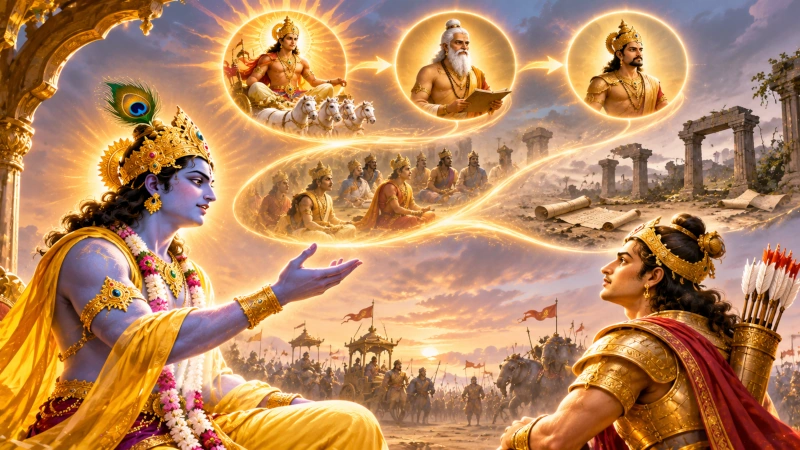
Human civilisation has accumulated extraordinary knowledge over countless generations, yet the preservation of wisdom has never been guaranteed. Kingdoms disappear, institutions decline, manuscripts are forgotten, and teachings that once guided entire societies gradually lose their original significance. In the fourth chapter of the Bhagavad Gita, Krishna reveals to Arjuna that the spiritual wisdom he is imparting is neither a new philosophy nor a teaching created specifically for the battlefield of Kurukṣetra.
Krishna explains that this imperishable knowledge was originally transmitted to Vivasvān, the Sun god, who imparted it to Manu, who subsequently taught it to Ikṣvāku. Through this succession, the knowledge became part of an ancient tradition maintained by royal sages. However, with the passage of time, the continuity of that tradition was broken, making it necessary for Krishna to reveal the teaching once again.
The Wisdom of the Bhagavad Gita
At the beginning of Chapter 4, traditionally known as Jñāna Karma Sannyāsa Yoga, Krishna introduces the ancient lineage through which the knowledge of Yoga was transmitted. His revelation establishes that the principles being communicated to Arjuna belong to a tradition extending far beyond the immediate circumstances of the Mahābhārata.
श्रीभगवानुवाच ।
इमं विवस्वते योगं प्रोक्तवानहमव्ययम् ।
विवस्वान्मनवे प्राह मनुरिक्ष्वाकवेऽब्रवीत् ॥
Śrī-bhagavān uvāca |
Imaṃ vivasvate yogaṃ proktavān aham avyayam |
Vivasvān manave prāha manur ikṣvākave ’bravīt ||
Bhagavad Gita — Chapter 4, Verse 1
Meaning: The Supreme Lord said: I imparted this imperishable Yoga to Vivasvān. Vivasvān communicated it to Manu, and Manu taught it to Ikṣvāku.
Krishna describes the teaching as Avyaya, meaning imperishable or inexhaustible. Although the fundamental wisdom remains unchanged, its transmission and understanding depend upon those entrusted with preserving it. This distinction between the permanence of wisdom and the vulnerability of its transmission forms the philosophical foundation of the passage.
Vivasvān, Manu and Ikṣvāku: The Ancient Guardians of Wisdom
Vivasvān occupies an important position in the Vedic and Purāṇic traditions as a solar deity associated with illumination, cosmic order and the sustenance of life. Within the narrative of the Bhagavad Gita, he becomes the original recipient of the imperishable Yoga revealed by Krishna. The association of spiritual knowledge with the Sun also carries a symbolic significance, as illumination represents the removal of ignorance.
Vivasvān transmitted the teaching to Manu, traditionally associated with humanity, social organisation and the establishment of righteous conduct. Manu subsequently communicated it to Ikṣvāku, the ancestral ruler associated with the Sūryavaṃśa, or Solar Dynasty. The lineage thus connects divine wisdom with human civilisation and the responsibilities of governance.
The transmission of knowledge through these figures illustrates the integration of spiritual principles with social and political responsibilities. The teaching was not intended exclusively for individuals who had withdrawn from worldly life. It was also preserved among rulers responsible for maintaining justice, public welfare and the broader moral order of society.
Paramparā: The Unbroken Transmission of Knowledge
Krishna continues by explaining how the teaching was preserved through an established succession of teachers and recipients. This method of transmission is known as Paramparā, a concept that occupies a central position in India’s philosophical, spiritual and intellectual traditions.
एवं परम्पराप्राप्तमिमं राजर्षयो विदुः ।
स कालेनेह महता योगो नष्टः परन्तप ॥
Evaṃ paramparā-prāptam imaṃ rājarṣayo viduḥ |
Sa kāleneha mahatā yogo naṣṭaḥ parantapa ||
Bhagavad Gita — Chapter 4, Verse 2
Meaning: This Yoga was thus received through succession, and the royal sages understood it. However, with the passage of a great length of time, that Yoga was lost to the world, O Arjuna.
Paramparā represents more than the mechanical transfer of information from one generation to another. It involves preserving the meaning, context, practical application and philosophical depth of a teaching. A tradition survives in its fullest sense when successive generations understand its principles rather than merely repeat its words.
Krishna’s reference to the loss of Yoga reveals the vulnerability of even the most profound knowledge when the continuity of understanding is interrupted. The imperishable nature of the teaching does not guarantee that every generation will recognise or practise it. Wisdom may remain fundamentally valid while disappearing from the consciousness and conduct of society.
The Rājarṣis: When Governance Was Guided by Wisdom
Krishna specifically identifies the Rājarṣis, or royal sages, as the individuals who understood this ancient teaching. The term combines Rājan, meaning king, with Ṛṣi, meaning sage or seer. It represents the ideal of leadership in which political authority is guided by philosophical understanding, ethical discipline and spiritual maturity.
The Rājarṣi tradition challenges the assumption that governance and spirituality occupy entirely separate domains. A ruler entrusted with considerable authority must possess the judgement necessary to exercise power responsibly. Spiritual wisdom, in this context, provides a foundation for self-restraint, impartiality and concern for the welfare of others.
The earlier example of King Janaka, mentioned in Chapter 3 of the Bhagavad Gita, complements this understanding. Janaka represents the possibility of attaining spiritual perfection while continuing to fulfil worldly responsibilities. Together, these passages establish that spiritual knowledge was regarded not merely as a means of personal liberation but also as a foundation for responsible leadership.
How Wisdom Disappears Without Being Destroyed
One of the most profound observations in Krishna’s revelation is that knowledge can be lost even when its underlying truth remains unchanged. The disappearance of wisdom does not necessarily require the destruction of manuscripts, institutions or places of learning. It can occur gradually when people cease to understand the significance of what they have inherited.
A philosophical teaching may initially be preserved through thoughtful study, discussion and practical application. Over successive generations, however, its deeper meaning may become obscured by repetition without reflection, selective interpretation or the abandonment of its underlying principles. Eventually, the external form of the tradition may survive while its intellectual and spiritual substance becomes increasingly unfamiliar.
This distinction remains relevant to contemporary society. Humanity possesses unprecedented access to libraries, digital archives, educational institutions and communication technologies. Yet access to information does not automatically produce understanding, and the preservation of documents does not necessarily ensure the preservation of wisdom.
Why Krishna Chose Arjuna to Restore the Teaching
Having explained that the ancient teaching was lost over time, Krishna reveals why he has chosen to communicate it once again to Arjuna. His explanation emphasises the importance of the relationship between the teacher, the recipient and the knowledge being transmitted.
स एवायं मया तेऽद्य योगः प्रोक्तः पुरातनः ।
भक्तोऽसि मे सखा चेति रहस्यं ह्येतदुत्तमम् ॥
Sa evāyaṃ mayā te ’dya yogaḥ proktaḥ purātanaḥ |
Bhakto ’si me sakhā ceti rahasyaṃ hy etad uttamam ||
Bhagavad Gita — Chapter 4, Verse 3
Meaning: That same ancient Yoga has today been imparted by Me to you because you are My devotee and friend, for this is the highest spiritual mystery.
Krishna identifies Arjuna as both his devotee and his friend. The relationship is therefore founded upon devotion, trust and the willingness to receive profound guidance. Arjuna’s openness to questioning Krishna and acknowledging his own uncertainty makes him a suitable recipient of the teaching.
The restoration of wisdom requires more than the existence of a knowledgeable teacher. It also requires a recipient who is willing to examine established assumptions, overcome intellectual arrogance and engage sincerely with unfamiliar ideas. Arjuna’s moral crisis creates the circumstances through which ancient spiritual knowledge is communicated anew.
Arjuna’s Question: Wisdom Does Not Require Blind Acceptance
Arjuna does not immediately accept Krishna’s account of having instructed Vivasvān in the distant past. Recognising the apparent chronological difficulty, he raises a direct question concerning Krishna’s earlier transmission of the teaching.
अर्जुन उवाच ।
अपरं भवतो जन्म परं जन्म विवस्वतः ।
कथमेतद्विजानीयां त्वमादौ प्रोक्तवानिति ॥
Arjuna uvāca |
Aparaṃ bhavato janma paraṃ janma vivasvataḥ |
Katham etad vijānīyāṃ tvam ādau proktavān iti ||
Bhagavad Gita — Chapter 4, Verse 4
Meaning: Arjuna said: Your birth is recent, whereas the birth of Vivasvān occurred long ago. How am I to understand that You imparted this teaching in the beginning?
Arjuna’s response reveals an important characteristic of the intellectual tradition represented by the Bhagavad Gita. He respects Krishna as his teacher while retaining the freedom to question a statement that appears inconsistent with his understanding. His enquiry becomes the foundation for Krishna’s subsequent explanation of divine manifestation, the continuity of existence and the distinction between ordinary birth and divine incarnation.
The episode demonstrates that sincere questioning need not represent disrespect towards a teacher or a spiritual tradition. On the contrary, thoughtful enquiry can deepen understanding and prevent philosophical teachings from deteriorating into unquestioned repetition. A living tradition requires individuals who are prepared to understand why a teaching is significant rather than merely accept that it is ancient.
Krishna’s Revelation: The Teacher Beyond Time
Krishna responds to Arjuna by explaining that both of them have experienced numerous births, although Arjuna does not remember them. Within the theological framework of the Bhagavad Gita, Krishna possesses knowledge of these previous manifestations and therefore speaks from a perspective extending beyond ordinary human memory.
श्रीभगवानुवाच ।
बहूनि मे व्यतीतानि जन्मानि तव चार्जुन ।
तान्यहं वेद सर्वाणि न त्वं वेत्थ परन्तप ॥
Śrī-bhagavān uvāca |
Bahūni me vyatītāni janmāni tava cārjuna |
Tāny ahaṃ veda sarvāṇi na tvaṃ vettha parantapa ||
Bhagavad Gita — Chapter 4, Verse 5
Meaning: The Supreme Lord said: Many births of Mine and yours have passed, O Arjuna. I know them all, but you do not know them, O conqueror of enemies.
The passage introduces the theological distinction between Krishna’s divine consciousness and the limited recollection of ordinary embodied existence. Krishna subsequently explains his manifestation through his own divine power, providing the context for the doctrine of Avatāra developed in the following verses.
The transmission of Yoga to Vivasvān therefore belongs to the sacred chronology and cosmological framework of the Bhagavad Gita. Its philosophical significance lies in the understanding that spiritual wisdom transcends individual lifetimes and can be revealed again when circumstances require its restoration.
Information Is Not the Same as Wisdom
Modern civilisation has achieved an extraordinary capacity to collect, reproduce and distribute information. Vast quantities of knowledge can be accessed within seconds, and digital storage systems can preserve material that would once have required entire libraries. Nevertheless, the abundance of information has not eliminated the distinction between knowing something and understanding it.
A person may memorise every verse of the Bhagavad Gita without necessarily applying its principles to everyday decisions. Similarly, an individual may accumulate thousands of electronic books without developing the understanding contained within them. Krishna’s explanation of the loss of Yoga reminds us that preservation requires intellectual engagement and practical application.
The irony of the modern age is that humanity can store centuries of philosophical wisdom on a device small enough to fit inside a pocket, yet may struggle to devote fifteen uninterrupted minutes to reading it. Information has become increasingly accessible, while sustained attention remains a challenge. The survival of wisdom ultimately depends on what people understand, practise and communicate rather than simply what they possess.
Cultural Memory and the Responsibility of Every Generation
The ancient lineage described by Krishna also offers a broader perspective on the preservation of civilisational knowledge. Languages, philosophical traditions, scientific observations, artistic practices and ethical frameworks survive because successive generations consider them worthy of understanding and transmission. When that continuity weakens, important aspects of cultural memory may gradually disappear.
India’s intellectual heritage has been preserved through oral traditions, manuscripts, commentaries, scholarly debates, educational institutions and community practices. These mechanisms have enabled philosophical ideas to remain accessible across changing historical circumstances. However, the preservation of such knowledge remains an ongoing responsibility rather than an achievement that can be permanently taken for granted.
Each generation must engage with inherited knowledge in ways that retain its essential meaning while making it accessible within contemporary circumstances. Translation, digitisation, research and education can contribute significantly to this process. Their greatest value emerges when they encourage genuine understanding rather than merely preserving the outward appearance of intellectual continuity.
Preserving Wisdom Without Turning Tradition into Stagnation
The restoration of ancient Yoga by Krishna demonstrates that preserving a tradition does not necessarily mean communicating it in precisely the same manner under every circumstance. Krishna presents eternal principles to Arjuna within the context of a specific moral crisis, using dialogue, examples and philosophical reasoning relevant to his disciple’s situation. The underlying wisdom remains ancient, while its presentation responds to contemporary needs.
This distinction is important for societies seeking to preserve their intellectual heritage. Traditions can remain intellectually alive when their fundamental principles are examined and communicated in ways that successive generations can understand. Preserving wisdom does not require abandoning enquiry, discouraging research or rejecting every development associated with changing circumstances.
The challenge lies in maintaining continuity without losing depth and encouraging adaptation without distorting essential principles. Krishna’s dialogue with Arjuna illustrates how an ancient teaching can become meaningful again through thoughtful explanation and sincere engagement. Its renewal represents the restoration of understanding rather than the invention of an entirely different philosophy.
The Ancient Lineage of the Gita in the Modern World
The responsibility of preserving wisdom extends beyond spiritual teachers and religious institutions. Parents, educators, researchers, administrators and individuals engaged in cultural activities all contribute to the transmission of knowledge. Their actions influence which ideas survive, how those ideas are understood and whether they remain relevant to future generations.
A scientist documenting research, a teacher explaining foundational principles, a scholar preserving manuscripts or a parent communicating ethical values participates in a broader process of intellectual continuity. Each contributes to ensuring that valuable knowledge does not disappear when its present custodians are no longer available. The transmission of wisdom becomes a responsibility shared across society.
Krishna’s explanation also encourages humility among those entrusted with knowledge. No individual or generation can claim exclusive ownership of wisdom accumulated through the efforts of countless predecessors. Knowledge is both an inheritance received from the past and a responsibility towards the future.
Moral: Wisdom Survives Only When Generations Understand and Preserve It
Krishna’s revelation of the ancient lineage of Yoga teaches that even imperishable wisdom can disappear from human understanding when successive generations neglect its preservation. Vivasvān, Manu and Ikṣvāku represent a sacred succession through which spiritual knowledge was transmitted, while Arjuna becomes the recipient through whom that ancient teaching is renewed. The narrative establishes that the continuity of wisdom depends upon sincere enquiry, responsible transmission and practical application.
The Bhagavad Gita therefore reminds us that preserving knowledge is not merely an exercise in collecting manuscripts, memorising verses or celebrating antiquity. It requires individuals who are willing to understand inherited teachings, examine their significance and communicate them meaningfully to others. Without such engagement, even the most profound intellectual traditions can become unfamiliar to the societies that once preserved them.
The responsibility of every generation is not simply to inherit wisdom but to ensure that it remains alive. Krishna’s dialogue with Arjuna demonstrates that ancient knowledge can continue to illuminate contemporary life when it is approached with humility, curiosity and dedication. The greatest tribute to inherited wisdom is not merely to admire its age but to understand its meaning, embody its principles and transmit it faithfully to those who follow.
Scriptural References
The principal foundation of this article is the Śrīmad Bhagavad Gita, Chapter 4, traditionally known as Jñāna Karma Sannyāsa Yoga. Verses 1–5 establish the ancient lineage of Yoga, its preservation through Paramparā, its eventual disappearance and its renewed transmission to Arjuna. Chapter 3, Verse 20, provides complementary context concerning the role of royal sages such as Janaka.
- Bhagavad Gita 4.1: The transmission of Yoga from Krishna to Vivasvān, Manu and Ikṣvāku.
- Bhagavad Gita 4.2: Paramparā, the royal sages and the loss of spiritual knowledge over time.
- Bhagavad Gita 4.3: Krishna’s renewed revelation of the ancient teaching to Arjuna.
- Bhagavad Gita 4.4: Arjuna’s enquiry concerning the chronological relationship between Krishna and Vivasvān.
- Bhagavad Gita 4.5–6: Krishna’s explanation of previous births and divine manifestation.
- Bhagavad Gita 3.20: King Janaka and the attainment of spiritual perfection through action.
You may also like
-
King Janaka: The Ruler Who Reached Perfection Through Action
-
The Self Cannot Be Killed: Krishna’s First Great Teaching to Arjuna
-
Aranmula Parthasarathy Temple: The Krishna Shrine Where Mahabharata, Pamba and Kerala’s Temple Culture Meet
-
Procrastination and the Bhagavad Gita: Why We Delay the Life We Are Meant to Live
-
Overcoming Depression Through the Wisdom of the Bhagavad Gita
