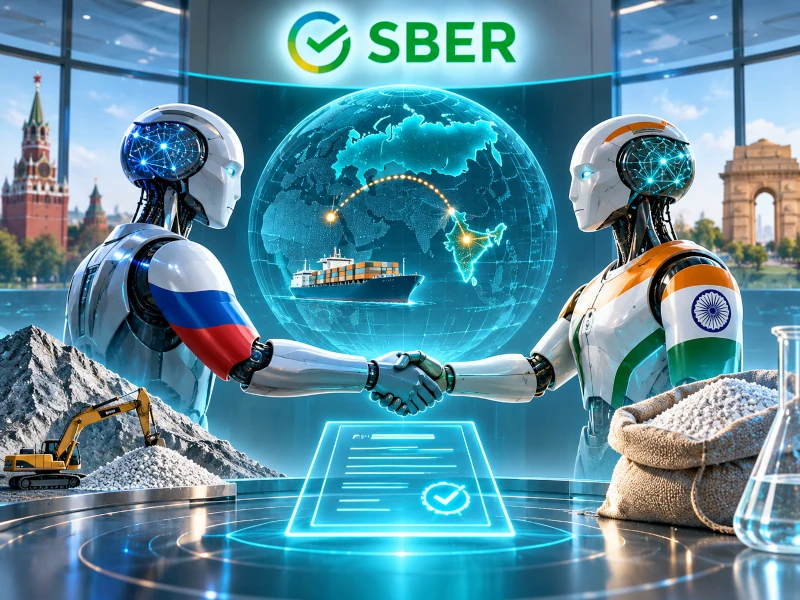
In a significant development in India–Russia technological and commercial cooperation, artificial intelligence agents representing companies from the two countries have conducted their first cross-border commercial transaction on SBER’s GigaNetwork platform. Russia’s PhosAgro, Europe’s largest producer of phosphorus-based mineral fertilisers, purchased 100 metric tonnes of an industrial chemical reagent from India’s Pharcos Speciality Limited in a transaction valued at more than ₹3 crore. The development was announced on 27 November 2026 at the international AI Journey conference in Moscow, demonstrating the practical application of agentic artificial intelligence in international commerce.
The transaction brought together Russian financial technology infrastructure and Indian-developed artificial intelligence capabilities, establishing a framework in which verified digital agents can negotiate commercial terms on behalf of businesses. The Indian side utilised an AI agent developed by CoRover.AI, whose platform incorporates BharatGPT alongside other large language models. The achievement represents an early step towards integrating artificial intelligence, banking infrastructure and international industrial supply chains within a trusted digital commercial environment.
Indian Industrial Exports Enter the Agentic AI Economy
The commercial transaction involved the procurement of a chemical reagent used in the processing of apatite-nepheline ore, an industrial activity associated with the production of phosphorus-based mineral fertilisers. PhosAgro placed an order for 100 metric tonnes of the reagent from Pharcos Speciality Limited, demonstrating the application of AI-assisted commercial negotiation in an industrial procurement environment rather than a simulated consumer transaction. The value and industrial nature of the order underline the potential relevance of agentic AI to business-to-business international trade.
The transaction also highlights the convergence of India’s manufacturing and artificial intelligence capabilities. While Pharcos Speciality Limited participated as the industrial supplier, CoRover.AI provided the technological platform through which the Indian commercial interests were represented. This combination illustrates how Indian AI developers could help domestic manufacturers and exporters participate in emerging digital trade ecosystems.
CoRover.AI and BharatGPT Demonstrate Cross-Border Commercial Capabilities
The Indian AI agent was developed by CoRover.AI, an Indian conversational and agent-based generative artificial intelligence platform designed for applications across business and public-sector environments. Its technological ecosystem incorporates BharatGPT alongside other large language models, enabling AI-driven interactions, commercial negotiations and multilingual communication. Its participation in the transaction demonstrates the application of Indian-developed agentic AI technology to international industrial procurement.
Unlike conventional conversational AI systems that primarily respond to queries or generate information, agentic AI systems are designed to undertake defined tasks, interact with other digital systems and execute workflows within authorised boundaries. In this instance, the Indian AI agent represented the supplier’s commercial interests while interacting with its Russian counterpart through SBER’s GigaNetwork infrastructure. The development illustrates the transition of artificial intelligence from an information-processing technology towards a tool capable of participating in structured commercial activities.
Ankush Sabharwal, Founder and Chief Executive Officer of CoRover.AI, described the transaction as evidence that artificial intelligence agents are progressing beyond answering questions and are becoming capable of facilitating commercial deals. He emphasised the importance of multilingual communication, regulatory compliance and verified commercial interactions in enabling Indian businesses to access international markets. According to Sabharwal, such technology could help enterprises of different sizes overcome communication barriers and simplify traditionally time-consuming commercial processes.
SBER’s GigaNetwork Establishes a Trusted Agent-to-Agent Commercial Environment
On the Russian side, PhosAgro’s commercial interests were represented by an artificial intelligence agent operating within GigaNetwork, a trusted digital environment developed by SBER for Agent-to-Agent (A2A) transactions. The platform is designed to enable AI agents representing separate organisations to communicate, negotiate and coordinate commercial activities within predefined institutional and financial frameworks. Its architecture combines artificial intelligence with identity verification, digital authentication and banking infrastructure.
Under the GigaNetwork commercial model, the buyer’s AI agent requests a quotation from the supplier’s agent before negotiating the price, quantity and other delivery conditions. Each participating agent is verified and operates within the authority granted by the company it represents. Bank-based identification and digital signatures provide mechanisms through which the negotiating parties can establish the identity of their counterparts and confirm the organisations on whose behalf commercial terms are being agreed.
This structure addresses an important requirement in the development of agentic commerce: establishing trust between digital representatives operating across organisational and national boundaries. By combining verified identities with defined commercial permissions, GigaNetwork seeks to create an environment in which businesses can utilise artificial intelligence without relinquishing institutional accountability. The approach is particularly relevant to industrial procurement, where contractual responsibilities and financial obligations can be substantial.
Integrating Artificial Intelligence with Banking and Financial Services
A distinctive feature of GigaNetwork is the incorporation of financial infrastructure directly into the AI-agent interaction environment. SBER’s platform is designed to integrate financial instruments at different stages of a commercial transaction, including escrow accounts, reservation of funds until contractual obligations are fulfilled, bank guarantees, insurance and deferred payments through credit arrangements. These mechanisms are intended to support the financial requirements associated with complex business transactions.
Under the proposed framework, a company’s AI agent could interact with a bank’s AI agent to identify financial products appropriate to the specific transaction and the client’s requirements. Such integration could reduce the need for businesses to coordinate separately with multiple financial service providers during procurement and contractual negotiations. The extent to which these services can be automated will depend on the permissions granted, applicable regulations and the continuing development of the platform.
The payment infrastructure incorporates predefined authorisations, financial limits and approved lists of counterparties established by the client. A draft payment transaction can be generated automatically when a specified event occurs within a smart contract, following which the client signs the payment through the SBERBusiness online banking system. This distinction is important because, under the workflow described by SBER, artificial intelligence facilitates commercial and financial processes while final payment authorisation remains under human control.
Blockchain and Smart Contracts Strengthen Commercial Traceability
GigaNetwork also incorporates blockchain technology to record key events occurring throughout the commercial transaction process. The platform enables buyers and suppliers to track the progress of transactions, including the fulfilment of contractual obligations and financial settlement. This creates a common digital record through which participating businesses can monitor the status of commercial activities.
The integration of smart contracts with banking infrastructure is intended to connect contractual milestones with subsequent financial processes. When predefined events occur, the system can initiate the preparation of relevant payment documentation within the limits of the authority granted to the participating AI agents. Such an approach could help improve coordination between procurement, contractual management and financial settlement while maintaining a verifiable record of important commercial events.
For international trade, where transactions may involve different jurisdictions, languages, financial institutions and regulatory requirements, traceability is an important component of commercial confidence. The combination of verified digital identities, predefined permissions and blockchain-based records offers a technological framework for addressing some of these challenges. However, the effectiveness of such systems will continue to depend on regulatory compliance, data integrity and appropriate institutional oversight.
Expanding India–Russia Commercial Cooperation Beyond Conventional Trade
The transaction represents an emerging dimension of India–Russia economic cooperation, extending bilateral engagement into artificial intelligence-enabled commercial infrastructure. While trade between the two countries has traditionally involved sectors such as energy, pharmaceuticals, fertilisers, engineering and industrial commodities, the introduction of agentic AI creates opportunities to explore new methods of connecting businesses and managing cross-border transactions. The participation of an Indian AI developer alongside an Indian industrial supplier illustrates how technological services and merchandise trade can reinforce one another.
Alexander Vedyakhin, First Deputy Chairman of the Executive Board of SBER bank, highlighted that India and Russia already possess infrastructure for settlements in their respective national currencies. He noted that identifying suitable commercial partners and agreeing on supply conditions remain essential processes before international payments can take place. Artificial intelligence agents, he explained, could simplify these preliminary commercial activities, particularly for small and medium-sized enterprises operating within BRICS economies.
The development should nevertheless be distinguished from the establishment of a new bilateral payment mechanism. SBER’s announcement confirms an AI-agent-facilitated commercial transaction valued in Indian rupees, but does not specify the currency in which the final payment was settled. Its principal significance lies in demonstrating how artificial intelligence can be integrated with existing commercial and financial infrastructure to support international business transactions.
SBER Plans AI-Powered Supplier Sourcing Services in India
Building on the experience gained through the transaction, SBER has announced plans to integrate its AI-agent interaction technology into the bank’s service for identifying suppliers in India. The proposed integration is intended to enable artificial intelligence agents to generate commercial proposals tailored to individual client requirements. Such a capability could help Russian businesses identify Indian suppliers whose products and commercial conditions correspond to specific procurement needs.
For Indian manufacturers and exporters, the proposed service could provide an additional digital channel through which they become accessible to international buyers. AI-assisted supplier identification and preliminary negotiation could be particularly useful in sectors characterised by specialised products, technical specifications and recurring industrial procurement requirements. However, SBER has described this integration as a forthcoming development rather than an already operational expansion of its Indian supplier sourcing service.
The initiative could eventually support a commercial environment in which buyers and suppliers use verified AI agents to identify opportunities, assess requirements and negotiate preliminary commercial conditions. As the technology develops, SBER expects AI agents to assume an increasing number of responsibilities, potentially including the independent conclusion of transactions within authorised limits. Such greater autonomy remains a future objective and should not be confused with the human-authorised payment workflow currently described by the bank.
Potential Opportunities for Indian MSMEs and BRICS Enterprises
The development of AI-assisted cross-border commerce could be particularly relevant to micro, small and medium enterprises seeking to enter international markets. Smaller businesses frequently encounter challenges associated with identifying overseas customers, communicating across languages, understanding procurement requirements and coordinating commercial documentation. Agentic AI could help reduce some of these barriers by assisting enterprises with preliminary negotiations and structured interactions with potential buyers.
Multilingual capabilities constitute another important aspect of the emerging agentic economy. CoRover.AI has emphasised the potential of its technology to enable Indian merchants to communicate with international customers in their preferred languages. When combined with verified commercial identities and appropriate financial infrastructure, such capabilities could expand the accessibility of international business opportunities to enterprises that lack extensive overseas commercial networks.
Denis Novikov, General Director of JSC Apatit, a PhosAgro Group company, highlighted the ability of artificial intelligence agents to interpret international trade requirements, identify potential commercial partners and help businesses streamline operational processes. He also expressed the company’s willingness to share its experience with partners across BRICS countries to encourage wider adoption of the technology. This reflects an emerging area of cooperation in which participating businesses could exchange practical experience in deploying artificial intelligence for commercial applications.
AI Journey Conference Showcases the Emerging Agentic Economy
The announcement was made at AI Journey, an annual international conference organised with the support of AI Alliance Russia that brings together artificial intelligence researchers, technology developers, industry representatives and other stakeholders. The conference focuses on emerging AI solutions and their implications for science, economic development and society, while also encouraging innovation among younger generations. Its international participation provides a platform for showcasing technological developments and exploring opportunities for collaboration.
The India–Russia commercial transaction adds a practical business dimension to discussions surrounding the future of artificial intelligence. Rather than limiting the application of AI to research demonstrations or conversational interfaces, the initiative illustrates how intelligent digital agents can participate in industrial procurement and interact with established banking infrastructure. It consequently provides an example of the emerging agentic economy, in which artificial intelligence increasingly supports economic activities through structured interactions between businesses, financial institutions and digital platforms.
Towards a Trusted AI-Enabled International Trading Ecosystem
The first cross-border transaction between Indian and Russian AI agents on SBER’s GigaNetwork platform represents an important milestone in the practical application of artificial intelligence to international commerce. By bringing together Indian-developed agentic AI technology, industrial manufacturing, Russian banking infrastructure, digital identity verification and blockchain-based transaction records, the initiative demonstrates how multiple technological capabilities can be integrated within a commercial environment. Its immediate achievement is the facilitation of a substantive industrial procurement transaction rather than the establishment of a fully autonomous international trading system.
For India, the participation of CoRover.AI and Pharcos Speciality Limited highlights the complementary strengths of domestic technology development and industrial manufacturing. As agentic AI platforms mature, Indian enterprises could find new opportunities to access international markets through increasingly sophisticated digital commercial infrastructure. The initiative offers a constructive foundation for deeper India–Russia technological cooperation and the gradual development of a trusted, accessible and accountable AI-enabled international trading ecosystem.
Source: SBER Press Office, Moscow — AI Agents from Russia and India Conduct Their First Cross-Border Transaction on SBER Platform, official press release dated 27 November 2026, issued in connection with the international AI Journey conference.
You may also like
-
ISRO Successfully Tests Indigenous Gas Generator for Next-Generation Methane Rocket Engine
-
Hetero Begins Exporting Generic HIV Prevention Medicine to Africa
-
Chariot AI Launches Indigenous Foundation Models Under IndiaAI Mission
-
Walchandnagar Industries Secures ₹18.46 Crore Universal Vertical Launcher Order
-
BPCL Inaugurates New Lubricant Blending Plant and Base Oil Terminal at Rasayani
