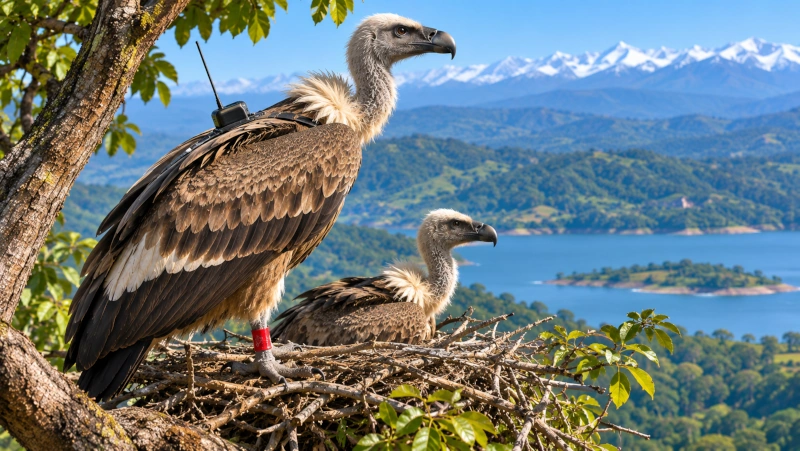
A satellite-tagged White-rumped Vulture (Gyps bengalensis), one of South Asia’s most critically endangered birds, has been recorded occupying a nest in Himachal Pradesh after travelling approximately 600 kilometres from Nepal. The remarkable movement, documented through satellite tracking and confirmed by field observations, provides valuable insights into the species’ long-distance dispersal, habitat selection and breeding behaviour across international boundaries.
The adult vulture was fitted with a satellite transmitter at Shuklaphanta National Park in western Nepal on March 16, 2026, as part of a conservation research programme. After travelling through Uttarakhand, the bird reached the Pong region of Himachal Pradesh, where it remained for several months. On November 4, vulture biologist Malyasri Bhattacharya observed the tagged bird occupying a nest in the Kangra forest near Pong, establishing an important connection between conservation habitats in Nepal and India.
Satellite Tracking Reveals Remarkable Journey Across the Himalayas
The vulture was captured and tagged through a collaborative initiative involving Nepal’s Department of National Parks and Wildlife Conservation, Bird Conservation Nepal and the Royal Society for the Protection of Birds. Researchers fitted the bird with a satellite transmitter using a backpack harness and attached a red identification ring marked J81 to its leg before releasing it into its natural habitat.
The tracking operation formed part of a wider research programme designed to understand vulture movements and assess the effectiveness of Nepal’s second Vulture Safe Zone in the country’s far-western region. Satellite transmitters allow researchers to follow individual birds over extended periods, generating information about their movement patterns, feeding areas, habitat preferences and responses to environmental conditions.
Following its release, the tagged vulture initially remained around Shuklaphanta National Park before moving westwards into India. It travelled through Uttarakhand and subsequently reached Himachal Pradesh in April 2026. Tracking records showed that the bird remained active within an area extending approximately 45 kilometres around the Pong region, an important nesting landscape for White-rumped Vultures.
The observation demonstrates that vultures can establish themselves in suitable habitats considerable distances from their original tagging locations. Such movements are particularly important for understanding how populations distributed across different geographical regions remain connected through individual dispersal.
Nesting Discovery in Himachal Pradesh
The latest development came on November 4, when vulture biologist Malyasri Bhattacharya, a member of the IUCN Species Survival Commission’s Vulture Specialist Group, located the satellite-tagged bird occupying a nest in the Pong area.
The identification was particularly significant because the bird had been continuously monitored since its release in Nepal. Researchers were therefore able to connect the observed nesting behaviour with a documented journey across international boundaries.
According to the conservation team, the vulture had paired with another bird and was occupying a nest when observed. The discovery provides evidence that an individual originating from a monitored population in Nepal can move into a distant Indian habitat and participate in nesting activity.
However, occupying a nest does not necessarily establish that eggs have been laid or that breeding has been successful. Continued field observations will help researchers document the progress of nesting activity and determine whether the pair produces surviving offspring.
The finding is nevertheless valuable because it demonstrates the potential importance of long-distance movements in maintaining connections between geographically separated populations of this critically endangered species.
Why the White-rumped Vulture Is Critically Endangered
The White-rumped Vulture was once among the most widespread vultures across the Indian subcontinent. Large populations occurred throughout India, Nepal and neighbouring countries, where the birds performed an essential ecological function by consuming animal carcasses.
During the 1990s and early 2000s, vulture populations across South Asia experienced catastrophic declines. Scientific investigations identified poisoning from the veterinary anti-inflammatory drug diclofenac as a principal cause of mortality among several species of Gyps vultures.
When vultures consumed carcasses of livestock recently treated with diclofenac, the drug could cause severe kidney damage and fatal visceral gout. The resulting mortality contributed to one of the most dramatic population collapses recorded among previously widespread bird species.
India subsequently prohibited veterinary diclofenac use, while Nepal and other countries introduced similar restrictions and conservation measures. These interventions were accompanied by efforts to establish safe feeding areas, monitor veterinary drugs, protect nesting habitats and strengthen conservation breeding programmes.
Despite these measures, the White-rumped Vulture remains classified as Critically Endangered on the IUCN Red List. Protecting surviving populations and understanding their ecological requirements therefore remain important priorities for wildlife conservation across South Asia.
Pong Region Emerges as an Important Vulture Conservation Landscape
The Pong region of Himachal Pradesh has become an important habitat for White-rumped Vultures and other large birds. The wider Kangra landscape contains forested areas, agricultural land and natural habitats that provide nesting opportunities and access to food.
Long-term conservation monitoring has documented encouraging improvements in vulture nesting activity in parts of Kangra district. Forest Department surveys have recorded a substantial increase in the number of monitored nests over the past two decades, reflecting the importance of sustained habitat protection, veterinary drug monitoring and conservation management.
The arrival and nesting activity of the Nepal-tagged bird adds another dimension to the region’s ecological importance. It demonstrates that the landscape can support not only locally established vultures but also individuals originating from populations hundreds of kilometres away.
Such connectivity is important for the long-term conservation of threatened wildlife. Movement between populations can facilitate the exchange of individuals, support recolonisation of suitable habitats and maintain ecological connections across large geographical areas.
The Pong observation also provides a practical example of how satellite tracking and field-based biological surveys can complement one another. Remote tracking establishes the movement history of individual birds, while direct observations provide information about their behaviour, nesting activity and habitat use.
India-Nepal Cooperation Strengthens Vulture Conservation
The discovery highlights the importance of cooperation between Indian and Nepalese conservation organisations in protecting species whose movements extend beyond national borders.
Previous satellite-tracking studies have demonstrated that White-rumped and Slender-billed Vultures regularly move through the transboundary Tarai landscape connecting Nepal and northern India. These movements reinforce the importance of managing conservation habitats as interconnected ecological systems rather than isolated protected areas.
Krishna Bhusal, Asia Regional Co-Chair of the IUCN SSC Vulture Specialist Group, highlighted the significance of maintaining coordination between conservation organisations in both countries. He emphasised the need to monitor veterinary drugs harmful to vultures, protect safe feeding habitats and continue exchanging scientific information.
Ankit Bilash Joshi, Vulture Conservation Programme Manager at Bird Conservation Nepal, also highlighted the importance of the bird’s long-distance movement and subsequent nesting activity. The observation demonstrates how vultures can use geographically separated habitats while remaining part of a wider ecological landscape.
The research illustrates the value of collaborative wildlife monitoring programmes involving government departments, conservation organisations and scientific institutions. Information collected in one country can contribute directly to conservation decisions in another, particularly when the species being studied regularly crosses international boundaries.
Satellite Technology Opens New Opportunities for Wildlife Research
Satellite telemetry has become an important tool for studying large birds whose movements are difficult to follow through conventional field observation. By recording the locations of tagged animals, researchers can identify migration routes, feeding territories, seasonal movements and important resting or nesting habitats.
For vultures, this information can be especially valuable because individuals may travel considerable distances in search of food. Tracking data can help scientists understand how birds respond to changes in food availability, habitat conditions and human activities across large landscapes.
The tagged White-rumped Vulture provides an example of how such technology can support long-term ecological research. Its movement from Shuklaphanta National Park to Himachal Pradesh was documented over several months, allowing researchers to identify its general route and the area in which it eventually established nesting activity.
The identification ring also allowed the bird to be recognised during field observations, connecting the satellite record with direct evidence of its behaviour. This combination strengthens the scientific value of the observation and provides researchers with additional information about the species’ dispersal and breeding ecology.
Continued monitoring of the bird and its nesting location can contribute to a better understanding of habitat requirements and help identify areas that are important for conservation across the India-Nepal landscape.
Protecting Vultures Across International Boundaries
The journey of the satellite-tagged White-rumped Vulture from Nepal to Himachal Pradesh illustrates the ecological connections linking wildlife habitats across South Asia. The bird’s movement through northern India and subsequent occupation of a nest in Kangra demonstrate how distant conservation landscapes can contribute to the survival of the same endangered species.
The finding also reinforces the importance of protecting safe feeding grounds, reducing exposure to harmful veterinary medicines and maintaining suitable nesting habitats. These measures benefit both resident vulture populations and individuals travelling between different regions.
For conservation researchers, the observation provides valuable information about long-distance movement and nesting behaviour in a critically endangered bird. For India and Nepal, it demonstrates the practical benefits of coordinated wildlife monitoring and sustained collaboration between scientific institutions and conservation authorities.
The successful identification of the tagged bird at its nesting site represents an important achievement for cross-border conservation research. It strengthens scientific understanding of White-rumped Vulture ecology while highlighting the interconnected habitats that remain essential to the species’ recovery across the Indian subcontinent.
References
1. The Rising Nepal — 6 November 2026
Nepal-tagged vulture travels 600 km to India
https://www.risingnepaldaily.com/news/88431
2. ABC Nepal — 6 November 2026
Nepal-Tagged Vulture Travels 600 km to Indian Forest
Nepal-Tagged Vulture Travels 600 km to Indian Forest
3. The Kathmandu Post — 28 June 2026
GPS-tagged vulture from Shuklaphanta flies 520 km to India’s Himachal Pradesh
https://kathmandupost.com/sudurpaschim-province/2026/06/28/gps-tagged-vulture-from-shuklaphanta-flies-520-km-to-india-s-himachal-pradesh
4. Scientific Research — Ibis, 20 July 2026
Continued population recovery and high annual survival rates of White-rumped Vultures in Nepal
https://doi.org/10.1111/ibi.70094
You may also like
-
Rare Migratory White Stork Recorded at Okhla Bird Sanctuary After Seven Years
-
Jammu and Kashmir Orders Mission-Mode Conservation of Endangered Hangul Deer
-
Wildlife Institute of India Researchers Record Gaur at 3,542 Metres in Sikkim Himalayas
-
Chhattisgarh Plans to Reintroduce 50 Blackbucks into Gomarda Wildlife Sanctuary After Five Decades
-
Zoological Survey of India Plays Major Role in Landmark Global Coral Reef Assessment
