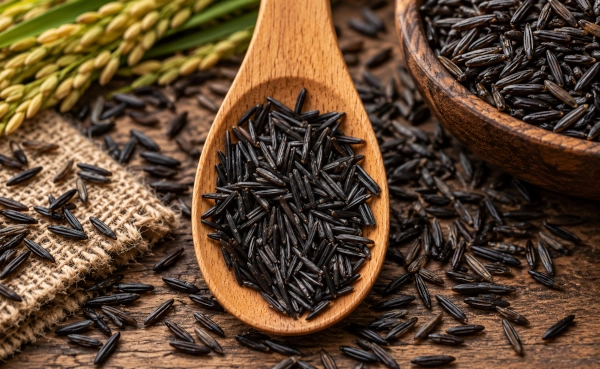
In the fertile Terai landscape of eastern Uttar Pradesh grows one of India’s most distinctive aromatic rice varieties. Known as Kalanamak, this traditional short-grained rice is recognised by its dark, almost black husk, powerful fragrance and soft texture after cooking. For generations, it has been associated particularly with Siddharthnagar and neighbouring districts close to the Nepal border, where farmers preserved the variety despite the spread of modern high-yielding rice.
Kalanamak belongs to the wider family of non-Basmati aromatic rices that demonstrate just how diverse India’s rice heritage once was. Unlike Basmati, whose reputation rests partly on very long grains and elongation during cooking, Kalanamak is a short aromatic landrace whose identity comes from fragrance, flavour, texture and its historical association with the eastern Uttar Pradesh Terai. ICAR describes it as a black-husked, short-grained aromatic rice with excellent grain and cooking quality and a very strong and pleasant aroma.
Why It Is Called Kalanamak
The name Kalanamak is generally associated with the appearance of the paddy. The husk surrounding the grain is dark, giving the harvested rice a distinctive blackish appearance before milling. Once the husk and bran layers are removed, however, the edible rice grain itself is much lighter.
This contrast between the dark paddy and fragrant white cooked rice helped make Kalanamak easily recognisable in traditional markets. Its appearance, combined with its intense aroma, distinguished it from ordinary rice varieties and gave it a reputation extending far beyond the villages where it was cultivated.
The grain is generally short rather than elongated, yet its fragrance can be remarkably pronounced. That aromatic character is one of the principal reasons Kalanamak survived even when farmers increasingly shifted towards varieties capable of producing much higher yields.
The Rice of Siddharthnagar
Kalanamak is most closely associated with Siddharthnagar district in eastern Uttar Pradesh, within the Himalayan Terai belt near the Nepal frontier. The region’s moist monsoon climate, fertile soils, low-lying fields and traditional rice culture created conditions in which Kalanamak developed and was maintained over generations.
Its identity also extends into surrounding parts of eastern Uttar Pradesh, where traditional cultivation has historically taken place. Government programmes today promote Kalanamak across Siddharthnagar and adjoining Terai districts, while Siddharthnagar itself has become the principal centre of branding, processing and promotion.
The Uttar Pradesh government has designated Kalanamak Rice as Siddharthnagar’s One District One Product, giving the variety an important place in the state’s effort to connect traditional agricultural products with modern processing and marketing.
A Rice With an Ancient Cultural Association
Few Indian rice varieties possess a cultural narrative as powerful as Kalanamak. Local tradition associates the grain with the landscape of ancient Kapilavastu and with the period of Gautama Buddha, whose life was closely connected with the region that today straddles the India-Nepal border.
The association is deeply embedded in regional memory, and Uttar Pradesh has increasingly marketed Kalanamak as “Buddha Rice” to connect the grain with the Buddhist heritage of Siddharthnagar and the wider Kapilavastu region. The Union Agriculture Ministry officially notes that this branding is being used to promote Kalanamak in high-value markets, particularly in Buddhist-majority and Buddhist-heritage countries such as Japan, Thailand, Vietnam, Singapore and Myanmar.
Historical claims linking the exact modern variety directly to the Buddha should be treated as traditional and cultural associations rather than as scientifically proven continuity across more than two millennia. What is clear, however, is that Kalanamak has become inseparable from the Buddhist heritage identity of the region, giving the rice a cultural significance far beyond its agricultural characteristics.
A Powerful Natural Aroma
The defining quality of Kalanamak is its fragrance. ICAR describes the traditional landrace as possessing a very strong and pleasant aroma, together with excellent grain and cooking quality. This makes it one of the most distinctive non-Basmati aromatic rices cultivated in northern India.
The fragrance becomes especially noticeable while the rice is cooking, when volatile aromatic compounds released by the grain spread through the surrounding area. In traditional households, this quality helped turn Kalanamak into a rice associated with hospitality, celebrations and special meals.
Its soft cooked texture further distinguishes it from many ordinary varieties. The combination of fragrance, tenderness and flavour means that comparatively simple dishes can showcase the grain effectively without requiring heavy seasoning.
Why Farmers Once Moved Away From It
Traditional Kalanamak possesses characteristics that make it desirable in the kitchen but challenging in the field. ICAR notes that the landrace is photoperiod sensitive, tall, prone to lodging and comparatively low yielding, all of which can reduce profitability compared with modern semi-dwarf rice varieties.
Tall rice plants are particularly vulnerable to lodging, in which stems bend or collapse before harvest because of wind, rain or the weight of mature grain. Lodging complicates harvesting and can reduce both yield and grain quality.
These disadvantages contributed to the decline of traditional Kalanamak cultivation during the decades when agricultural policy understandably prioritised food security and higher productivity. Farmers could often obtain substantially greater output from modern varieties, making continued cultivation of a low-yielding heritage rice increasingly difficult to justify.
The survival of Kalanamak therefore depended upon consumers continuing to value characteristics such as aroma and flavour strongly enough for farmers to retain the seed.
Science Steps In to Preserve the Aroma
Rather than abandoning the variety, Indian agricultural scientists began attempting to improve its productivity while retaining its aromatic and culinary qualities. ICAR-IARI has undertaken systematic breeding programmes aimed at developing shorter, higher-yielding Kalanamak lines capable of resisting lodging more effectively.
By 2026, six improved Kalanamak varieties had been released and notified: Kalanamak KN3, Bauna Kalanamak 101, Bauna Kalanamak 102, Kalanamak Kiran, Pusa Narendra Kalanamak 1 and Pusa CRD Kalanamak 2. The Union Agriculture Ministry reports that the latter two dwarf high-yielding varieties average around 4.5 tonnes per hectare, compared with roughly 2.5 tonnes per hectare for traditional Kalanamak.
This represents an important model for heritage-crop conservation. Instead of treating traditional varieties as museum pieces, plant breeders are attempting to preserve their defining traits while reducing the agronomic disadvantages that discouraged farmers from growing them.
BARC Joins the Improvement Programme
Kalanamak improvement has also moved beyond conventional plant breeding. The Bhabha Atomic Research Centre is working with Acharya Narendra Dev University of Agriculture and Technology on improving the landrace through radiation-induced mutation breeding.
The programme involves Krishi Vigyan Kendras in Siddharthnagar, Maharajganj, Basti, Gorakhpur and Balrampur, while multiple testing stations across Uttar Pradesh are evaluating improved Kalanamak material. The objective is to develop varieties that retain the traditional grain’s desirable characteristics while improving agronomic performance.
This combination of traditional farmer conservation, conventional breeding and advanced mutation breeding demonstrates how seriously India’s agricultural research system now treats the preservation and improvement of Kalanamak.
The GI Journey
The effort to secure geographical protection for Kalanamak Rice formally linked the grain with its recognised production region in Uttar Pradesh and provided legal protection to its name.
The current Intellectual Property India record gives the following details:
Geographical Indication: Kalanamak Rice
GI Application Number: 205
Category: Agricultural
Class: 30
State: Uttar Pradesh
Applicant/Registered Proprietor: Shohratgarh Environmental Society
Applicant Address: 09 Adarsh Colony, Shohratgarh, District Siddharthnagar, Uttar Pradesh
Date of Filing: 25 March 2010
GI Journal: No. 50
Journal Availability Date: 7 May 2013
Certificate Number: 194
Certificate Date: 9 September 2013
Current Registration Valid Until: 24 March 2030
The GI registration formally protected Kalanamak as an agricultural product associated with Uttar Pradesh and provided a legal framework through which genuine producers could distinguish their grain from rice grown or marketed outside the recognised system. Intellectual Property India currently records the registration as active and valid until March 2030.
Why the GI Tag Matters
The value of Kalanamak depends heavily on reputation. Once consumers are willing to pay more for the name, the temptation arises for traders to mix ordinary short-grain rice with genuine Kalanamak or market visually similar products under the same identity.
Such practices can damage both farmers and consumers. Genuine growers lose part of the premium created by their product, while buyers who receive inferior or adulterated rice may conclude that Kalanamak itself is inconsistent in quality.
GI protection establishes a legal connection between product, region and recognised producer community. When supported by traceability, quality testing and credible packaging, it can help ensure that the commercial value attached to the Kalanamak name remains connected with the farmers and processors maintaining the authentic grain.
A Remarkable Modern Revival
The most striking part of the Kalanamak story is that the variety is no longer merely surviving; it is undergoing a measurable revival. According to the Union Agriculture Ministry, production in Siddharthnagar increased to more than five times its 2018 level by 2025.
The number of farmers cultivating Kalanamak paddy increased from 2,915 in 2018 to around 23,000 in 2024. At the same time, the reported selling price of Kalanamak rice rose from approximately ₹40 per kilogram in 2018 to ₹150 per kilogram in 2026, substantially improving profitability compared with ordinary rice.
These figures illustrate an important principle in agricultural conservation. Farmers are far more likely to preserve a traditional variety when its uniqueness creates an economic advantage rather than an economic penalty.
Kalanamak’s revival therefore demonstrates how GI recognition, government promotion, research support and premium marketing can work together to turn conservation into a viable livelihood strategy.
Processing and Packaging Move Closer to Farmers
One difficulty facing many heritage crops is that the farmer often sells raw produce while much of the value is created later through processing, branding and retail. Government programmes surrounding Kalanamak are attempting to narrow this gap by building processing infrastructure closer to the production region.
A Common Facility Centre in Siddharthnagar has been established under the One District One Product programme to provide facilities for processing, packaging and export support. Farmers, micro-enterprises and Farmer Producer Organisations can also access assistance under schemes supporting food-processing units and milling infrastructure.
Such infrastructure can be particularly valuable for GI products because presentation and traceability matter almost as much as the raw crop itself. Premium rice sold in properly identified packaging can capture considerably more value than paddy sold anonymously into a bulk commodity chain.
From Siddharthnagar to Overseas Markets
Kalanamak is increasingly being positioned as a speciality export rice rather than merely a regional grain. APEDA has facilitated connections between Farmer Producer Organisations and international buyers, while shipments have already reached markets including Singapore and Nepal.
The wider strategy is to use the rice’s aroma, GI status and Buddhist cultural association to distinguish it from ordinary non-Basmati exports. Branding it as Buddha Rice is intended particularly to appeal to markets in East and Southeast Asia where the cultural connection with Buddhist heritage may increase consumer interest.
This represents a fundamentally different export model from bulk rice trade. Instead of competing primarily on price and volume, Kalanamak can compete through provenance, rarity, cultural identity and sensory quality.
Kalanamak and the Rise of Speciality Rice
India is one of the world’s largest exporters of non-Basmati rice, shipping more than 15 million tonnes during 2025–26. Within that enormous trade lies a much smaller but potentially higher-value category of speciality rice varieties distinguished by geography, aroma, colour, grain character or cultural history.
Kalanamak belongs naturally within this premium segment. Its black husk provides a distinctive visual identity, while its fragrance and history differentiate it from ordinary commodity rice.
The opportunity lies not in transforming every hectare of eastern Uttar Pradesh into Kalanamak fields, but in creating a protected premium market large enough to reward farmers who choose to maintain the crop.
Preserving a Landrace While Improving It
The modern Kalanamak programme also raises an important question facing agricultural conservation: how far can a traditional crop be improved before it ceases to represent the original landrace?
Improved varieties are necessary if farmers are expected to compete economically, particularly when traditional Kalanamak is tall, lodging-prone and low yielding. At the same time, the traits that created its reputation — especially aroma, taste, cooking quality and grain character — must not be sacrificed in pursuit of productivity.
This balance explains why continued conservation of original landraces remains important even as improved Kalanamak cultivars spread. Traditional genetic material acts as a reference and a reservoir from which future breeders can recover valuable traits.
Conservation and improvement therefore need not be contradictory. Properly managed, each can strengthen the other.
A Grain Connecting Agriculture With Buddhist Heritage
Kalanamak occupies an unusual position among Indian GI foods because its identity connects agricultural heritage with one of the world’s great cultural landscapes. Siddharthnagar lies within the wider region associated with ancient Kapilavastu and the early life of Gautama Buddha, giving the rice a cultural narrative capable of reaching audiences far beyond India.
The historical details surrounding the traditional Buddha story should be distinguished from archaeological certainty, but the cultural association itself has become an important part of the grain’s modern identity. Government promotion explicitly uses this heritage connection in branding Kalanamak as Buddha Rice for premium international markets.
This combination of place, story and flavour gives Kalanamak something most agricultural commodities do not possess: an identity that consumers can remember.
The Black-Husked Grain That Returned From Decline
Kalanamak could easily have followed many traditional rice varieties into obscurity. Its tall plants, low yields and susceptibility to lodging made it increasingly difficult to justify economically when modern varieties offered farmers greater productivity.
Instead, its powerful fragrance and cultural reputation kept the variety alive long enough for a different agricultural model to emerge. GI registration protected its identity, scientific breeding improved productivity, ODOP programmes created processing infrastructure and speciality marketing began rewarding farmers for qualities other than yield alone.
The results are now visible in the rapid growth of cultivation, farmer participation and market value recorded in eastern Uttar Pradesh.
Kalanamak therefore represents more than an aromatic rice. It shows how a traditional landrace can move from decline towards revival when farmer knowledge, scientific research, geographical protection, cultural identity and modern marketing begin working together.
From the black-husked paddy fields of Siddharthnagar to premium packs marketed as Buddha
You may also like
-
ICAR’s New Soybean Varieties NRC 268 and NRC 270 Show Potential to Nearly Double India’s Average Yield
-
GE Aerospace to Double India Supply Chain Spending to $400 Million by 2030, Strengthening Indigenous Manufacturing
-
India’s Startup Ecosystem Expands Beyond Bengaluru and Hyderabad as Tier-II Cities Gain Momentum
-
NABARD Report Highlights Growing Strength of Women-Led Farmer Producer Organisations in India
-
Indian Banks Expected to Record 25.4% Profit Growth in Q2 FY27 as Lending Expands and Margins Prepare for Recovery
