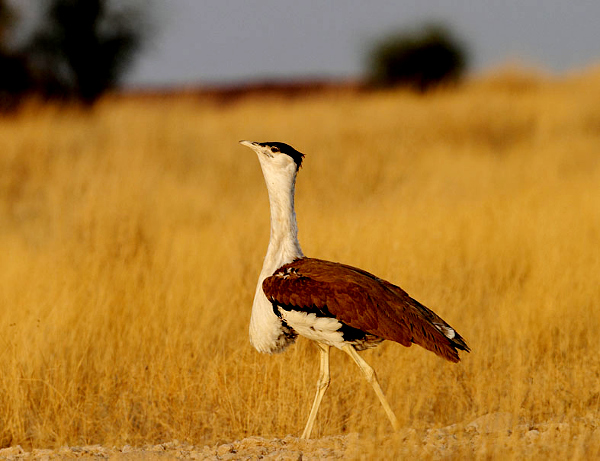
India’s effort to rescue the critically endangered Great Indian Bustard has achieved a major conservation milestone, with the captive-breeding programme reporting the production of 98 chicks at specialised conservation facilities in Sam and Ramdevra in Rajasthan’s Jaisalmer district.
The achievement was reviewed during the 91st meeting of the Standing Committee of the National Board for Wildlife in Coimbatore. The programme is now preparing for its next decisive stage: the carefully managed release of captive-bred birds into protected natural habitats.
A New Hope for the Godawan
Known locally as the Godawan, the Great Indian Bustard is Rajasthan’s state bird and one of the rarest large flying birds in the world. Once distributed across extensive grasslands in India, the species has suffered a steep decline because of habitat fragmentation, disturbance and collisions with overhead power lines.
The bird is currently classified as Critically Endangered. Rajasthan’s Thar landscape remains its principal surviving stronghold, making the success of the Jaisalmer breeding centres crucial to the species’ long-term recovery.
The latest milestone reflects years of cooperation among the Union Ministry of Environment, Forest and Climate Change, the Wildlife Institute of India and the forest departments of Rajasthan and Gujarat.
Scientific Breeding Expands the Captive Population
India’s conservation strategy combines several breeding methods to preserve genetic diversity and increase the number of healthy birds.
The programme uses natural breeding, artificial incubation, artificial insemination and the scientific collection of selected eggs from the wild. Specialists closely monitor incubation temperatures, chick nutrition, disease risks, behaviour and genetic lineage.
By 14 June 2026, the programme had recorded 26 hatchings during its fourth breeding season. Eighteen of these chicks were produced through artificial insemination, four through natural breeding and four from eggs collected from the wild. At that stage, the captive stock had reached 94 birds.
The subsequent increase to the reported 98-chick milestone demonstrates the growing effectiveness of the conservation-breeding system.
A chick hatched on 21 May 2026 also successfully crossed the critical first 40 days of survival, an important stage in the development of young bustards.
The Importance of Artificial Insemination
Artificial insemination has become an important part of the Great Indian Bustard recovery effort. The technique allows conservationists to increase breeding opportunities while managing valuable genetic material from a very small founder population.
It can also support the development of a genetic resource bank capable of preserving reproductive material for future conservation requirements.
The use of assisted reproduction is particularly valuable for a species that breeds slowly and produces relatively few eggs. Every successful hatch therefore contributes significantly to building a population large enough to support eventual reintroduction.
Preparing the Birds for Rewilding
The next phase will involve gradually preparing selected captive-bred bustards for life in the wild. This process will require more than simply releasing birds into open grassland.
Young bustards must develop the ability to find natural food, recognise predators, move across large landscapes and adapt to changing desert conditions. Conservationists will also need to select secure release sites with suitable vegetation, limited disturbance and reduced collision risks.
Infrastructure, monitoring systems and management protocols are being developed to improve survival after release. Birds may be monitored through satellite or radio-based tracking systems so scientists can study their movements, habitat choices and adaptation.
A gradual or “soft-release” approach can allow birds to become accustomed to natural conditions while remaining under observation before complete independence.
Jump-Start Intervention Supports Wild Breeding
The programme has also used a technique known as jump-starting. Under this method, vulnerable eggs are collected, incubated under controlled conditions and replaced through arrangements designed to protect breeding continuity and strengthen the founder population.
The Union Environment Ministry reported in June that three chicks had also hatched in the wild in Rajasthan through jump-start intervention. The approach is intended to reduce predation risks while improving genetic diversity within the conservation programme.
A second jump-start initiative at Naliya in Gujarat has also shown encouraging results, expanding conservation activity beyond Rajasthan.
Grassland Protection Remains Essential
Captive breeding provides a vital population reserve, while the ultimate recovery of the Great Indian Bustard depends on the protection of its natural grassland habitat.
The species requires large, open landscapes for feeding, courtship, nesting and movement. Fragmentation caused by infrastructure, agricultural conversion and human activity can reduce the availability of safe breeding areas.
Overhead electricity lines remain one of the most serious threats. Great Indian Bustards are heavy birds with limited frontal vision, making fast-moving individuals vulnerable to collisions with wires. Wildlife Institute of India studies have identified power lines as a leading source of mortality for bustards in the Thar region.
Measures such as marking hazardous lines, rerouting infrastructure from important habitats and strengthening protection around breeding zones will remain central to the recovery strategy.
Protecting an Entire Desert Ecosystem
The Great Indian Bustard is also an important flagship species for India’s grasslands. Protecting its habitat benefits many other animals that depend on the same ecosystem, including the chinkara, desert fox, spiny-tailed lizard and Lesser Florican.
The Wildlife Institute of India has emphasised that conservation measures undertaken for bustards can strengthen protection for a wider range of threatened grassland wildlife.
Healthy grasslands also support pastoral communities, soil conservation and the ecological balance of India’s arid regions.
A Major Step Towards Recovery
The production of 98 Great Indian Bustard chicks represents one of India’s most significant recent wildlife-conservation achievements. It demonstrates how scientific breeding, assisted reproduction, habitat management and cooperation between government institutions can create hope for a species facing extreme extinction risk.
The coming rewilding phase will determine how successfully captive-bred birds adapt to natural landscapes. Continued habitat protection, power-line mitigation, scientific monitoring and community participation will shape the programme’s long-term results.
For the Godawan, the milestone marks a transition from emergency conservation towards the gradual rebuilding of a self-sustaining wild population.
You may also like
-
IIT Hyderabad Develops Lung-Derived Bioink for 3D Bioprinting and Regenerative Medicine
-
Indian Scientists Discover Molecular Switch That Can Regulate Cellular Autophagy
-
Scientists Map Earliest Glow of Hydrogen, Opening A New Window to the Universe
-
Indian Researchers Study RAD51 DNA-Repair Gene Variant in Prostate Cancer
-
TDB Backs Multi Nano Sense With ₹37.51 Crore to Build Indigenous Multi-Gas Sensor Platform
