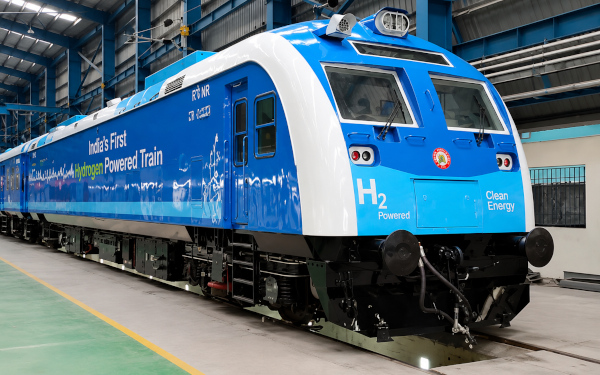
India’s first hydrogen fuel cell-powered passenger train has completed nearly 900 kilometres during its first five days of commercial operation on the Jind–Sonipat route, marking a major step towards cleaner railway transportation.
Inaugurated by Prime Minister Narendra Modi on July 17, 2026, the 10-coach train is powered by two 1,200-kilowatt hydrogen-electric propulsion systems. Its fuel cells combine hydrogen with oxygen to generate electricity, producing only water vapour and heat as direct by-products.
The train replaces conventional diesel propulsion while offering fares equivalent to ordinary Diesel Multiple Unit services, ranging from ₹10 to ₹25. Its operations are supported by an indigenously developed hydrogen storage and refuelling facility at Jind.
The successful service strengthens India’s position among countries adopting hydrogen-powered rail technology and supports the National Green Hydrogen Mission. Railway authorities view the Jind–Sonipat project as a potential model for expanding zero-emission passenger services across suitable non-electrified routes.
You may also like
-
India’s Renewable Energy Capacity Expands as Solar Power Reaches 175 GW and Wind Power Crosses 59 GW
-
India Advances ₹68,816 Crore Ultra-High-Voltage Transmission Corridor to Strengthen National Power Grid
-
EndureAir Completes Training of Indian Defence Personnel Following Delivery of Indigenous ALAKH Kamikaze UAV
-
Indian Army Prepares Pokhran Trials for Indigenous Jet-Powered Kamikaze Drones
-
India’s Exports Rise 16.66% to $568.84 Billion During April–October 2026–27
