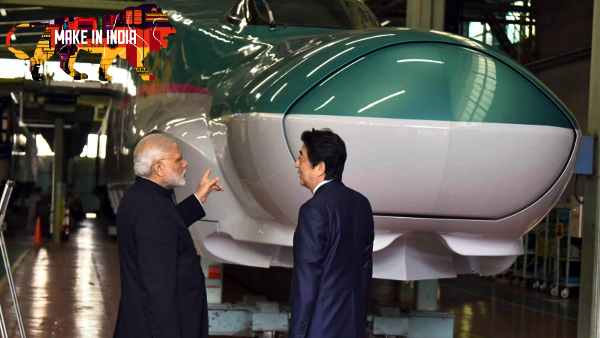
The country’s first high-speed rail project, spearheaded by the Railway Ministry’s special purpose vehicle – National High-Speed Rail Corporation (NHSRCL) will contribute in reducing India’s dependence on imports for crude oil, besides boosting infrastructure development.
The high-speed rail will be powered by indigenous electric power, unlike diesel, petrol, or aviation fuel. It is a proven environment-friendly transport option, according to the NHSRCL, responsible for developing and implementing the bullet train project.
Data from the National High-Speed Rail Corporation’s website shows, the carbon emission for a 600 km trip per passenger by the high-speed rail is 8.1 kg, compared to 67.4 kg for car travel and 93 kg for airplane travel, according to a study by the International Union of Railways.
This means that the carbon emission by the high-speed rail is far lesser than a car or an airplane. As the high-speed rail will be operated by electric power, it will contribute in reducing the country’s dependence on imports for crude oil.
Source: Energy Infra Post
You may also like
-
ONGC Explores Three Advanced Oilfield Technologies to Improve Mumbai High Well Operations
-
Kabra Extrusiontechnik’s GEON Commissions 20 MWh Battery Storage Project in Rajasthan
-
India’s Wind Energy Capacity Reaches 59.20 GW as Government Targets 100 GW by 2030
-
NTPC Subsidiary NVVN Targets 1,000 MWh Battery Storage Capacity by March 2027
-
DFCCIL Sets New Freight Operations Record with 946 Train Interchanges in a Single Day
