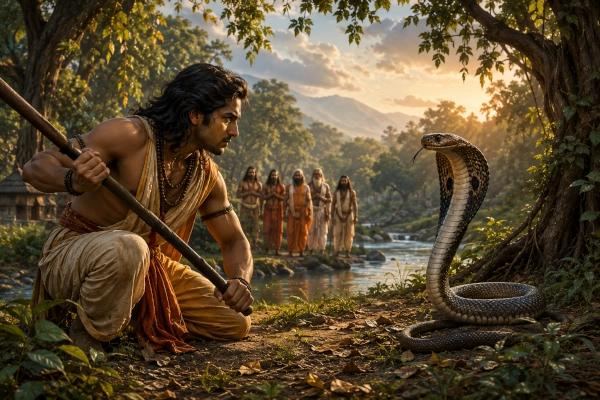
The Mahabharata repeatedly returns to a difficult question: when does the desire to punish wrongdoing become wrongdoing itself? Few episodes explore this more clearly than the story of Ruru and the harmless Dundubha serpent in the Adi Parva. What begins as the grief of a young man whose beloved is struck down by snakebite becomes a warning against anger, indiscriminate revenge and the temptation to condemn an entire group for the act of one dangerous member.
The story is especially significant because it does not pretend that all serpents are harmless. The Mahabharata knows poisonous snakes capable of killing human beings, and Takshaka himself later becomes responsible for the death of King Parikshit. Yet the epic simultaneously insists that poisonous aggressors must be distinguished from harmless creatures that merely share their appearance. Through Ruru, the Dundubha serpent, Janamejaya and Astika, the Mahabharata asks whether fear and grief can ever justify violence against those who have done no wrong.
Ruru and the Maiden Pramadvara
Ruru belonged to the celebrated lineage of the sage Bhrigu. His father was Pramati, while his ancestry connected him with Chyavana and other renowned sages. As a young man, Ruru encountered Pramadvara, a maiden of extraordinary beauty who had been raised in the hermitage of the compassionate sage Sthulakesa.
Pramadvara herself had an unusual origin. She was the daughter of the Gandharva Viswavasu and the celestial woman Menaka, but she had been abandoned near a river shortly after birth. Sthulakesa discovered the infant, took her into his hermitage and raised her with great affection until she grew into a graceful young woman.
Ruru fell deeply in love with her, and arrangements were made for their marriage. The future appeared settled, and the two families waited for the auspicious day when Ruru and Pramadvara would formally begin their life together. Then, only a short time before the wedding, an apparently insignificant event shattered everything.
The Snake Hidden in the Grass
Pramadvara was playing with her companions when she unknowingly stepped upon a serpent lying coiled upon the ground. Startled or threatened by the sudden contact, the snake struck her and drove its venomous fangs into her body.
The poison acted almost immediately. Pramadvara collapsed before her horrified companions, and the life seemed to leave her body. The young woman whose marriage was only days away now lay motionless upon the earth while sages and relatives gathered around her in grief.
Ruru could not bear the sight. He withdrew from the gathering and wandered away overwhelmed by sorrow, unable to accept that the woman with whom he had expected to share his life had been taken from him so suddenly. His love was genuine, but the grief produced by that love would soon turn into something much darker.
Ruru Gives Away Half His Life
Ruru’s despair was so great that divine intervention followed. A messenger of the gods appeared and told him that Pramadvara’s allotted life had ended, but there remained one extraordinary possibility. If Ruru willingly surrendered part of his own lifespan, that portion could be given to her.
Ruru did not hesitate. He agreed to give half of his remaining life so that Pramadvara might live again. Dharmaraja accepted the sacrifice, and the maiden awakened as though rising from deep sleep.
The joy of the families was immense. Ruru and Pramadvara were later married according to the proper rites, and the young sage received back the woman he had believed lost forever. Yet something inside him had changed during the hours when he believed she was dead.
Ruru had saved Pramadvara through an extraordinary act of love, but he had not overcome the anger created by the snakebite. Instead, his gratitude for her restoration became mixed with hatred for the entire serpent race.
Love Becomes Hatred
Ruru made a terrible vow. Because one serpent had nearly taken Pramadvara from him, he decided that every serpent he encountered deserved death.
From that time onward, whenever Ruru saw a snake, anger returned with full force. He remembered Pramadvara lying motionless on the ground, and rather than distinguishing the creature before him from the serpent that had actually bitten her, he treated every snake as though it shared the same guilt.
He began killing serpents whenever he found them. His weapon became an instrument not of defence against immediate danger but of retaliation against a category of creatures.
The distinction is important. Ruru was not simply protecting himself from venomous snakes that were attacking him. He had transformed a personal tragedy into a general sentence against every being that resembled the creature responsible for it.
The Old Serpent in the Forest
One day Ruru entered a large forest and saw an old serpent stretched upon the ground. The creature belonged to a type called a Dundubha, a snake-like being that was harmless and lacked the deadly venom of the serpents Ruru feared.
Ruru did not pause to examine it. The familiar form was enough to awaken his anger, and he raised his staff with the intention of killing the creature.
The frightened Dundubha did something Ruru did not expect. It spoke.
The serpent asked why Ruru intended to kill it when it had never harmed him. There had been no attack, no threatening movement and no danger to Pramadvara or anyone else. The only accusation against it was that it looked like the creature Ruru hated.
Ruru Explains His Hatred
Ruru did not conceal his motive. He told the serpent that his beloved wife had once been bitten by a snake and that he had therefore vowed to destroy every snake he encountered.
To Ruru, the reasoning seemed simple. A serpent had caused his suffering, and serpents would pay for it.
The Dundubha immediately challenged the logic of the vow. It explained that the snakes capable of biting and killing human beings were different from harmless Dundubhas. Although the harmless serpents shared the outward appearance of dangerous snakes, they did not possess the same nature and should not be condemned for crimes they could not commit.
The Dundubha was vulnerable to the same fears and dangers as other snakes but did not possess their venom. To kill such a creature merely because it belonged to the same broad category would therefore be an act of ignorance rather than justice.
The Staff Remains Raised
The moment is simple, but its moral importance is enormous. Ruru stands with a weapon in his hand and enough strength to kill the creature before him, while the serpent possesses no equivalent power to defend itself.
The question is no longer whether Ruru can kill it. He obviously can. The question is whether the fact that he has suffered gives him the right to kill a being that did not cause his suffering.
The frightened serpent forces Ruru to look at an individual rather than a category. Until that moment, the word “snake” had been enough for him. Now a living creature was asking him to explain what personal wrong justified its death.
Ruru hesitated. The anger that had driven his campaign against serpents encountered something it had previously avoided: the innocence of the intended victim.
Not Every Serpent Bears Venom
The Dundubha’s argument contains a principle that extends far beyond snakes. Outward similarity does not create shared guilt.
Some serpents possess dangerous venom and may attack. Others are harmless. To treat them all as identical because they share a general appearance is to abandon judgment precisely when judgment is most necessary.
The Mahabharata does not deny the reality of danger. Its serpent narratives contain creatures of terrifying power, and some deliberately attack human beings. What the Dundubha rejects is the claim that the existence of dangerous members makes every similar creature a legitimate target.
Fear may explain why distinctions are forgotten, but fear does not make the distinctions disappear.
The Serpent Reveals a Hidden Identity
Once Ruru lowered his weapon, his curiosity replaced his anger. The Dundubha’s speech was far too thoughtful to belong to an ordinary creature, and Ruru asked who he really was.
The serpent revealed that he had once been a sage named Sahasrapat. His snake form was the consequence of a curse.
Long before, Sahasrapat had been friendly with another ascetic named Khagama. One day, while Khagama was performing the sacred fire ritual, Sahasrapat decided to frighten him as a joke. He fashioned a false snake from blades of grass and suddenly presented it to his friend.
The prank worked far more strongly than he expected. Khagama became so frightened that he lost consciousness. When he recovered, embarrassment and fear turned rapidly into anger.
A Joke Produces a Curse
Khagama possessed great ascetic power, and his words could not be treated lightly. Furious that Sahasrapat had frightened him with a powerless imitation serpent, he pronounced a curse that fitted the act with almost poetic precision.
Because Sahasrapat had used a harmless false snake to create fear, he himself would become a harmless snake.
Sahasrapat immediately regretted the joke. He bowed before his friend and begged forgiveness, explaining that he had intended amusement rather than injury.
Khagama’s anger softened, but the power of the curse could not simply be erased. Instead, he added a condition for its ending. Sahasrapat would remain in the form of the harmless serpent until the day he encountered Ruru, son of Pramati.
That day had finally arrived.
Fear Had Already Created One Injustice
The history of Sahasrapat adds another layer to the story. His transformation into a serpent had itself begun with fear.
He frightened Khagama.
Khagama became angry.
Anger produced a curse.
The curse transformed Sahasrapat’s life.
Now, many years later, Ruru’s own fear and anger were about to produce another act of violence against the same victim.
The pattern was repeating itself. Fear became anger, anger demanded punishment, and punishment threatened to exceed the original offence.
Sahasrapat’s life had already demonstrated the danger of allowing an emotional reaction to become irreversible judgment. Ruru was being offered the opportunity not to repeat the same mistake.
Sahasrapat Returns to His Former Form
The encounter with Ruru fulfilled the condition of the ancient curse. Sahasrapat was freed from the harmless serpent form and regained his original appearance.
Before departing, however, he gave Ruru a teaching that directly challenged the young man’s campaign of revenge. He told him that sparing the lives of living beings was among the highest forms of virtue and that one should cultivate gentleness, truthfulness, forgiveness and benevolence rather than allow anger to govern conduct.
Sahasrapat also reminded Ruru that he was born into a Brahmana lineage. The violent enforcement of punishment belonged to the responsibilities of rulers when justice genuinely required it, while Ruru’s own path demanded restraint and spiritual discipline.
His message was not that wrongdoing should never be confronted. It was that violence must not become an uncontrolled extension of personal rage.
Ahimsa Does Not Mean Ignoring Danger
The lesson can easily be misunderstood if separated from the wider serpent stories of the Mahabharata. The epic does not teach that every snake is harmless or that a person should calmly accept an attack from a poisonous creature.
Indeed, the Astika narrative explicitly distinguishes between serpents that are vicious, highly poisonous and inclined to bite innocent beings and those that are harmless and virtuous. The important distinction is not between action and complete passivity but between justified protection and indiscriminate destruction.
A dangerous aggressor may require restraint or defensive action. A harmless creature does not become an aggressor merely because another member of its kind once caused harm.
The moral discipline lies in making that distinction while fear and anger are demanding something simpler.
Ruru’s Hatred Opens a Larger Story
Before Sahasrapat departed, he told Ruru that there was another story he needed to hear. It concerned King Janamejaya, who would attempt something far greater than Ruru’s individual campaign against snakes.
Ruru had vowed to kill every serpent he happened to encounter. Janamejaya would attempt to destroy the serpent race through an enormous sacrifice.
The transition between these stories is deliberate. The Mahabharata moves from one grieving man striking individual snakes with a staff to a king using the power of the state and ritual authority to bring an entire population into the fire.
The scale changes dramatically, but the moral danger remains recognisable.
The Death of King Parikshit
Janamejaya’s anger began with the death of his father, King Parikshit. During a hunting expedition, Parikshit became exhausted, hungry and thirsty. He encountered a sage who was observing silence and, angered that the ascetic did not respond to his questions, placed a dead snake around the sage’s shoulders as an insult.
The sage himself did not retaliate. His young son Sringin, however, learned what had happened and became enraged. In the intensity of that anger, he cursed Parikshit to die within seven days from the bite of Takshaka, the powerful king of serpents.
The curse was fulfilled. Takshaka eventually reached the king and killed him with his venom, bringing Parikshit’s reign to an abrupt end.
Once again the narrative contains a chain of escalating anger. Parikshit reacts badly to frustration, Sringin reacts excessively to the insult against his father, Takshaka becomes the instrument of the curse, and Janamejaya inherits the grief created by all of them.
Janamejaya Chooses Collective Revenge
When Janamejaya learned the circumstances of his father’s death, he became determined to punish Takshaka. Yet his revenge did not remain limited to the serpent who had killed Parikshit.
The king ordered the performance of the Sarpa Satra, the great snake sacrifice. Through powerful ritual formulas, serpents were drawn helplessly towards the sacrificial fire.
The sacrifice became a machinery of collective destruction. Snakes of different colours, sizes and conditions were pulled into the flames together. The ritual did not ask which serpent had killed Parikshit or which serpent had ever harmed a human being.
The target had expanded from Takshaka to serpent-kind.
Ruru’s error had become imperial.
The Fire Does Not Ask Who Is Guilty
The Mahabharata’s description of the sacrifice is deliberately disturbing. Serpents fall into the fire in enormous numbers, twisting around one another and crying out as the ritual power drags them towards destruction.
Some are described as highly poisonous and dangerous, but the sacrifice itself makes no individual distinction. The innocent and guilty face the same flames.
This is the danger of collective punishment. Once a category becomes the target, individual conduct stops mattering.
The angry person no longer asks, “What did this being do?” The only question becomes, “What kind of being is this?”
That was precisely the mistake Ruru almost made when he raised his staff over the harmless Dundubha.
Even the Mahabharata Distinguishes Among the Snakes
Within the Astika narrative, the distinction becomes explicit. When the serpents fear the destruction foretold for them, the divine explanation does not condemn every serpent equally.
The Mahabharata acknowledges that some serpents were vicious, dangerously venomous and inclined to bite creatures that had done them no harm. It simultaneously states that the harmless and virtuous serpents were not destined to share the same destruction.
This is a crucial qualification. Justice requires discrimination in the original sense of the word: the ability to distinguish one case from another.
The poisonous aggressor and the harmless serpent may look similar, but their conduct is different. Moral judgment must follow conduct rather than appearance alone.
Astika Enters the Sacrificial Ground
The destruction eventually approached its climax, and the fate of the serpent race depended upon a young sage named Astika. He was born through the union of the ascetic Jaratkaru and the serpent princess Jaratkaru, sister of the serpent king Vasuki.
Astika therefore stood between two worlds. Through his father he belonged to the human Brahmana lineage, while through his mother he was connected directly with the Nagas whose lives were being consumed in the sacrifice.
His birth had long been anticipated as the means through which the virtuous serpents would eventually be saved. When the sacrifice threatened his mother’s relatives, Astika went to Janamejaya’s court and used wisdom rather than force to stop the destruction.
Astika Does Not Defend Takshaka’s Act
The moral strength of Astika’s intervention comes from what he does not need to claim. He does not have to argue that Takshaka never killed Parikshit.
Takshaka did kill him.
Janamejaya’s grief therefore has a genuine cause.
The problem lies in what the king does with that grief. Punishing or confronting the being responsible is one question. Destroying thousands of others because they share Takshaka’s form or lineage is another.
Astika’s intervention restores the distinction that anger had erased.
Violence and the Loss of Proportion
The serpent stories repeatedly show that anger has a tendency to expand its target.
Ruru loses Pramadvara to one snake and vows to kill every snake.
Sringin hears that his father has been insulted and sentences Parikshit to death.
Janamejaya loses Parikshit to Takshaka and attempts to burn the serpent race.
In each case, a real injury becomes the starting point for a response whose scale threatens to exceed the original wrong.
The Mahabharata does not trivialise the injury. Pramadvara truly appears dead. The sage truly is insulted. Parikshit truly dies.
The warning is that suffering does not automatically make every response to suffering righteous.
Fear Is Not Proof of Guilt
The harmless Dundubha is frightening because he looks like something dangerous. That resemblance is enough to activate Ruru’s memory of Pramadvara’s poisoning.
Yet fear describes the condition of the observer, not necessarily the character of the observed.
Someone may genuinely be afraid and still misunderstand the danger before him. Ruru’s fear and anger are psychologically understandable, but neither proves that Sahasrapat deserves death.
The Mahabharata therefore separates two questions that human beings often combine. The first is whether fear is sincere, while the second is whether the feared individual is actually guilty.
The first can be true while the second is false.
Anger Prefers Categories
Individual judgment requires effort. It demands that a person stop, observe and investigate.
Anger prefers something easier.
It prefers categories.
Ruru does not need to learn anything about the old Dundubha if “snake” is already enough to pronounce the sentence. Janamejaya does not need to know which serpents are violent if every serpent can be drawn into the sacrificial fire.
Collective blame therefore offers emotional simplicity at the cost of justice.
The Mahabharata’s answer is to return repeatedly to individual conduct.
The Harmless Serpent as a Moral Test
The old Dundubha is physically weak compared with Ruru, yet morally he becomes the stronger figure in the encounter. He does not defeat Ruru in combat or escape through speed.
He asks a question.
Why should I die for something I did not do?
That question forces Ruru to confront the difference between vengeance and justice.
Had the Dundubha attacked him, the moral situation would have been different. Had Ruru been defending Pramadvara from an immediate threat, force might have been necessary.
But the serpent lies harmlessly on the ground.
The only thing threatening Ruru is his own memory.
Violence Can Begin Long Before the Blow
The story also suggests that violence does not begin only when the staff falls.
Ruru’s physical attacks arise from a judgment he has already made in his mind: all serpents are enemies.
Once that conclusion is accepted, killing an individual serpent becomes almost automatic.
The deeper moral intervention must therefore occur before the weapon is used. Ruru must correct the way he sees the creature before him.
Sahasrapat does exactly that by forcing him to replace the category with an individual.
The serpent is no longer merely “one of them.” He becomes a being with a history, a voice, vulnerability and innocence.
The Difference Between Justice and Revenge
Justice asks what happened, who caused it and what response is proportionate.
Revenge begins with pain and searches for something upon which to place that pain.
The two can sometimes resemble each other because both may involve punishment. Their direction, however, is different.
Justice attempts to restore order.
Revenge attempts to satisfy anger.
Ruru’s vow is clearly shaped by the second impulse. Killing a harmless Dundubha cannot undo Pramadvara’s suffering, cannot punish the snake that actually bit her and cannot make future poisonous snakes harmless.
It can only provide Ruru with another object for his rage.
Why the Mahabharata Links Ruru to Janamejaya
The placement of the Ruru story immediately before the great account of Astika and the snake sacrifice is deeply significant. After Sahasrapat teaches Ruru about restraint, he directs him towards the history of Janamejaya’s attempt to destroy the serpents.
The small personal story becomes the doorway into the larger political one.
Ruru represents the individual possessed by collective anger.
Janamejaya represents the ruler capable of turning that anger into organised destruction.
Sahasrapat interrupts the first.
Astika interrupts the second.
In both cases, wisdom enters at the moment when grief is trying to erase distinctions.
The Meaning of Ahimsa in the Story
The teaching given to Ruru is often associated with ahimsa, the principle of refraining from unnecessary harm. In this context, ahimsa is not presented as blindness towards real danger.
It requires something harder.
It requires control over violence even when violence feels emotionally satisfying.
A person frightened by a venomous snake may have good reason to protect himself. A ruler confronted by a genuine aggressor has a duty to protect his people. Neither situation justifies deliberately harming a harmless being merely because it resembles the aggressor.
Restraint therefore depends upon discernment.
Without discernment, even the language of protection can become a justification for revenge.
The Serpent Is Not Only a Symbol of Evil
The Mahabharata’s serpent world is complex because its Nagas and snakes are not represented as a single moral type. Some are destructive, some dangerous, some wise, some frightened, some virtuous and some harmless.
Vasuki worries about the survival of his people.
Astika is born partly from the serpent lineage and becomes a figure of wisdom.
Takshaka kills Parikshit.
The Dundubha harms nobody.
By presenting such different beings under the broad serpent category, the epic prevents the reader from turning appearance into moral destiny.
The serpent itself becomes a test of whether the observer can distinguish fear from judgment.
The Deeper Lesson of Ruru
Ruru begins the episode as a sympathetic figure. He loves deeply enough to surrender half his own lifespan for Pramadvara.
That makes his later transformation especially important.
The same capacity for intense attachment that produces sacrifice also produces hatred when grief enters it. Love by itself does not automatically produce wisdom.
Ruru must learn that devotion to one person cannot justify cruelty towards unrelated beings.
His encounter with the harmless serpent therefore completes a different kind of rescue. Earlier he saved Pramadvara from death by giving away part of his life. Now the Dundubha saves Ruru from becoming a man whose grief continually produces death.
The Deeper Lesson of Janamejaya
Janamejaya’s story enlarges the same teaching for rulers.
A private person consumed by anger can harm those around him. A king consumed by anger can transform personal grief into public policy.
The snake sacrifice becomes dangerous not merely because Janamejaya hates Takshaka but because royal power allows that hatred to operate on a massive scale.
The ruler must therefore possess greater self-control than the ordinary person, not less. His grief may be human, but his response affects beings who had no part in producing it.
Astika stops the sacrifice because someone must restore proportion after the king’s anger has lost it.
Fear, Anger and Collective Blame
Taken together, these serpent stories create one of the Mahabharata’s clearest examinations of collective blame.
Fear says that danger exists.
Anger says that someone must pay.
Collective blame says that identifying the actual wrongdoer is no longer necessary.
The Mahabharata refuses that final step.
The poisonous serpent that attacks without cause is not morally identical to the harmless Dundubha. Takshaka’s responsibility for Parikshit’s death cannot automatically become the responsibility of every serpent dragged towards Janamejaya’s fire.
The innocent do not become guilty through resemblance.
What the Harmless Snake Taught the Angry Man
Ruru entered the forest believing that he already understood serpents. One had nearly destroyed his happiness, and that experience seemed sufficient to define all of them.
The old Dundubha taught him that suffering had given him a reason to grieve, but not permission to stop thinking.
The creature lying before him was not the serpent that had bitten Pramadvara.
It was not poisonous.
It had not threatened him.
It had committed no offence deserving death.
Once Ruru understood this, the staff could no longer fall with the same certainty.
The Meaning of Violence
The Mahabharata does not treat all violence as morally identical. A warrior defending people from an aggressor, a ruler punishing genuine wrongdoing and an angry man striking an innocent creature may all use force, but the ethical character of those acts is not the same.
The decisive questions concern cause, intention, necessity and proportion.
Who actually caused the harm?
Is the present target responsible?
Is violence necessary to stop an immediate danger, or is it being used to satisfy anger?
Has punishment remained connected to the guilty, or has fear expanded guilt to everyone who looks similar?
Ruru fails these tests until the Dundubha forces him to reconsider.
Janamejaya nearly fails them on a far greater scale until Astika intervenes.
The Serpent Who Was Spared
The most important moment in Ruru’s story is not a battle. It is the moment when a weapon is not used.
Ruru possesses the power to kill the old serpent, and no one is physically capable of stopping him. Yet conversation creates a space between anger and action.
Inside that space, judgment returns.
The harmless serpent survives, Sahasrapat is released from his curse, and Ruru receives a teaching that leads directly into the Mahabharata’s great account of Astika and the salvation of the serpent race.
The story therefore ends with a form of victory very different from defeating an enemy.
Ruru wins by refusing to kill someone who is not his enemy.
Through the harmless Dundubha and the later intervention of Astika, the Mahabharata offers a demanding principle: real danger may justify protection, and genuine wrongdoing may require punishment, but neither fear nor grief makes collective hatred righteous. Violence becomes injustice when it no longer asks who actually caused the harm and instead condemns the innocent merely because they resemble the guilty.
You may also like
-
National Institute of Naturopathy Opens Admissions for BNYS Programme at Pune for 2026–27
-
Yudhishthira’s Counter-Diplomacy With Shalya: Working With an Ally Who Has Joined the Other Side
-
Gnani AI Launches Nationwide Challenge Offering Up to 100 Paid AI Internships
-
NMMSS Scholarship Application Deadline Extended to October 31, 2026
-
DGCA Introduces Training Framework for Gyroplane Pilots in India
